

What should I put in my GCSE Art sketchbook? The short answer is: evidence of how your project grows. Your sketchbook should show where your ideas came from, what you observed, which artists or designers helped you think differently, what you experimented with, what you changed and why your final response developed in the way it did.
It does not need to look perfect from the first page. In fact, a sketchbook containing thoughtful trials, useful mistakes and genuine changes of direction can reveal much more than a book filled with polished copies. The important thing is that a viewer can follow your creative journey and understand the decisions you made.
The GCSE Art sketchbook checklist
- Initial thoughts, questions and possible directions
- First-hand photographs, observational drawings and visual recording
- Relevant artist, photographer, designer or cultural research
- Your own visual studies made in response to that research
- Experiments with materials, techniques, processes and presentation
- Brief annotations that explain decisions rather than merely describe
- Alternative compositions, crops, viewpoints, layouts or colour ideas
- Refinements showing what you kept, rejected or improved
- A well-tested plan for the final response
- Photographs of larger, three-dimensional or digital work made outside the book
- A short evaluation of what succeeded and what you learned
This is a checklist, not a compulsory page order. Your teacher may organise the course differently, and Fine Art, Photography and Graphic Communication projects will not all look the same. Always follow your school’s instructions and use this guide to identify gaps rather than to force every project into an identical formula.
Your sketchbook is evidence, not decoration
A strong GCSE Art sketchbook answers a series of questions: What interested you? What did you look at closely? What did you learn from another creative practitioner? What happened when you tried a process? How did you use the result to make your next decision?
Presentation matters because clear pages help your work communicate. However, torn paper, coloured backgrounds, borders and attractive lettering do not earn marks simply because they look decorative. Use presentation to organise information, direct attention and support the mood of the project. For more detailed layout advice, see How to Present Your Art Sketchbook.
1. Begin with a purposeful starting point
Your opening pages should establish what you intend to investigate. Include the project title or brief, then move quickly beyond a decorative title page. Add a mind map, a small collection of your own photographs, visual observations, key words, questions and several possible directions.
Instead of writing “My theme is identity”, ask more useful questions: Which parts of identity interest me? Family, place, culture, memory, appearance, online identity or private identity? What could I photograph or draw myself? Which materials might suit the mood?
2. Add first-hand observation and your own source material
Primary sources make a project more personal. Draw from objects, people and places you can see directly. Take your own photographs rather than depending entirely on images found online. Record different angles, details, lighting conditions and arrangements. A page of small, purposeful studies can be more useful than one highly finished drawing that never influences the rest of the project.
- Fine Art: observational drawings, colour studies, texture rubbings, painted studies and photographs of your subject.
- Photography: contact sheets, selected images, camera-setting tests, crops, lighting experiments and edited outcomes.
- Graphic Communication: visual research, photographs, drawing, typography tests, audience research, layout thumbnails, colour palettes and mock-ups.
3. Include artist research that changes your work
Artist research should not become several pages of copied biography. Select practitioners whose ideas, subject matter, composition, materials or processes genuinely relate to your project. Include only enough contextual information to explain why the work matters, then analyse specific visual qualities and test something you have discovered.
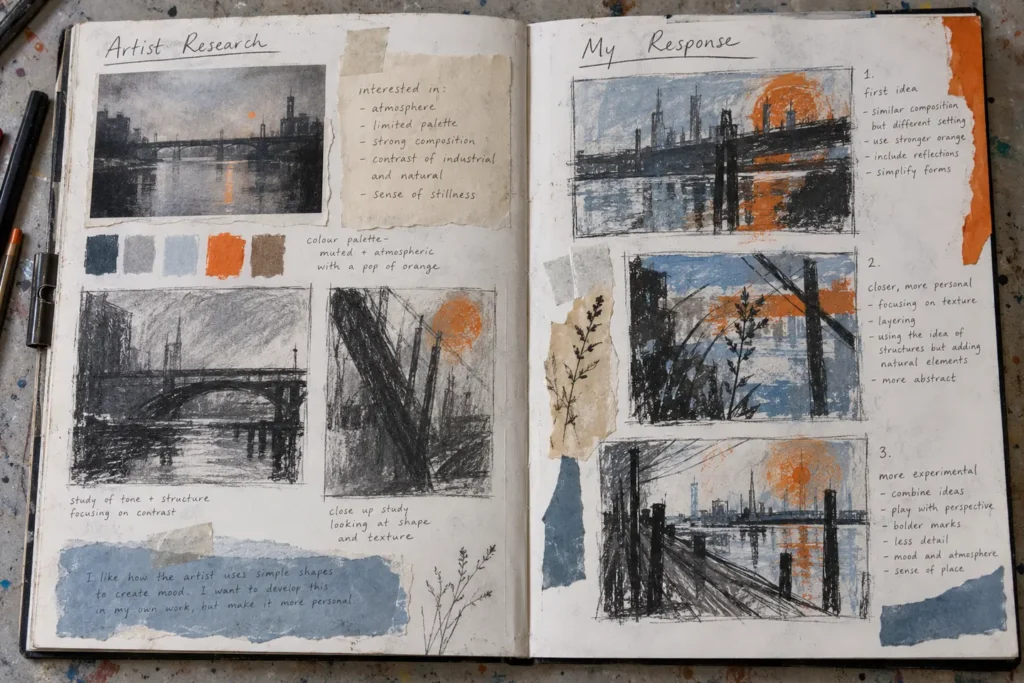
A useful research page might include a reproduction of a relevant work, visual analysis, your own copy of a small detail to understand technique, a colour or mark-making test and a sentence explaining what you will investigate next. Read How to Research Artists for GCSE Art and use the free Artist Analysis Worksheet if you need more structure.
4. Show purposeful experimentation
Experimentation is not just using five materials once. It means testing possibilities, comparing results and allowing what you discover to influence the next stage. Keep the subject or idea connected while changing one or two variables: scale, surface, process, colour, lighting, viewpoint, typography or composition.
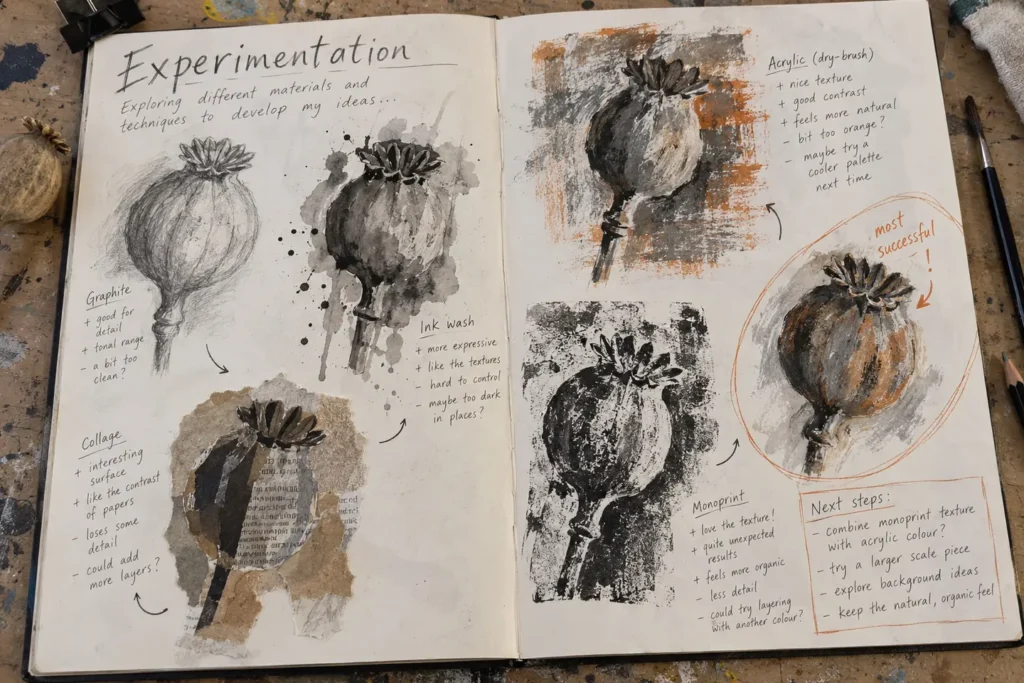
Beside each experiment, record what worked, what did not, what surprised you and what you will carry forward. “I used acrylic paint” only describes an action. “The dry-brush marks created the rough surface I wanted, but the orange dominated the form, so I will test a more limited palette next” demonstrates a decision. Explore further ideas in GCSE Art Experimentation Techniques That Build AO2.
5. Record ideas, not just finished work
Examiners need to see enough visual evidence to understand how you reached your outcome. Include rough thumbnails, rejected crops, alternative colour schemes and early attempts. A crossed-out idea can be useful if you explain briefly why it was rejected and what you tried next.
Photograph work that cannot be placed directly in the sketchbook: large paintings, sculpture, installations, textile samples, printmaking stages, screen-based animation, packaging mock-ups or a photography shoot. Select images that reveal process as well as the final result.
6. Develop ideas through visible choices
Development is the bridge between research and outcome. Avoid jumping from one initial idea to a final piece. Produce alternatives and compare them. Try a close crop and a wider view; portrait and landscape formats; muted and saturated colour; ordered and disrupted layouts; natural and artificial light; hand-made and digital processes.
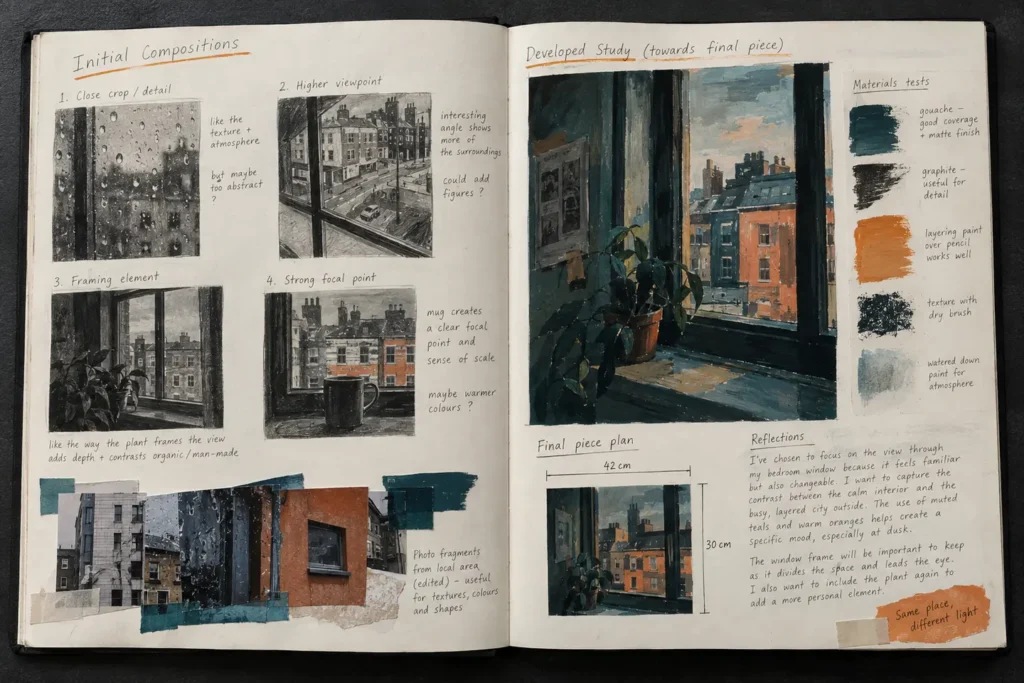
Then combine the strongest qualities rather than simply choosing your favourite thumbnail. Your final plan should show intended composition, format, scale, materials and focal point. It should also explain how the idea connects to earlier research and experiments. Use How to Plan a GCSE Art Final Piece: AO4 Step by Step when you reach this stage.
7. Annotate decisions in clear student language
You do not need to fill every empty space with writing. Short, specific annotation placed beside the relevant image is usually more effective than a large paragraph added at the end. Explain intention, influence, process, result and next step.
- Intention: “I wanted the close crop to make an ordinary object feel unfamiliar.”
- Influence: “I borrowed the repeated structure, but changed the subject and palette to connect it to my own photographs.”
- Result: “The reflected light created depth, although the background competes with the focal point.”
- Next step: “I will simplify the background and repeat the experiment at a larger scale.”
For more examples, see How to Annotate a GCSE Art Sketchbook Well.
How sketchbook evidence connects to AO1–AO4
| Assessment Objective | Useful sketchbook evidence |
|---|---|
| AO1: Develop | Relevant artist and contextual research, analysis, visual responses and ideas that become more personal. |
| AO2: Refine | Experiments with materials, techniques and processes; comparisons; improvements and informed choices. |
| AO3: Record | First-hand drawings, photographs, observations, contact sheets, notes, measurements and visual studies relevant to your intentions. |
| AO4: Present | Connections between research, experiments and intentions; composition studies, final plans and a personal, meaningful response. |
One page can support several objectives at once. A photograph you took records a primary source for AO3; editing it through several processes can demonstrate AO2; connecting those experiments to a photographer can support AO1; using the strongest result in a resolved response can contribute to AO4. Read the complete GCSE Art Assessment Objectives guide for a clearer overview.
A possible GCSE Art sketchbook order
If you are staring at a blank book and wondering what should come next, this flexible sequence can help:
- Introduce the theme, questions and initial possibilities.
- Collect your own photographs and make first-hand observational studies.
- Research a relevant practitioner and analyse selected work.
- Create your own visual response to specific qualities you identified.
- Test materials, techniques or digital processes and evaluate them.
- Develop two or more possible directions.
- Introduce further research where it helps solve a problem or extend an idea.
- Combine and refine the strongest discoveries.
- Test composition, scale, colour, layout and presentation.
- Plan, make and document the final response.
- Evaluate the outcome and identify what you learned.
Real projects often loop backwards. A material experiment may lead you to another artist; a photoshoot may reveal a new subject; a failed composition may send you back to observational drawing. That is development, not disorder, provided you show the connection.
What do examiners look for in an Art sketchbook?
Requirements vary between courses and examination boards, but GCSE Art and Design assessment focuses on the quality of evidence across the Assessment Objectives. Examiners are looking for relevant research, purposeful experimentation, skilful recording, development, informed decisions and a personal response—not a universal number of decorated pages.
You can check the official qualification information for your board through AQA, OCR, Pearson Edexcel or Eduqas. Your teacher remains the best source for deadlines, component requirements and the way your school organises evidence.
Common GCSE Art sketchbook mistakes
- Copying information: long biographies and internet text do not demonstrate your own understanding.
- Copying an artist’s final image: use selected qualities as a starting point, then transform them through your own subject and intentions.
- Producing unrelated experiments: connect tests to the project and explain what each one helps you discover.
- Hiding mistakes: show useful failures and explain the adjustment they prompted.
- Jumping to the final piece: include alternative compositions and a developed study first.
- Prioritising decoration: design pages around evidence rather than filling space with backgrounds and borders.
- Adding annotation afterwards: annotate while decisions are fresh so the writing genuinely informs the next stage.
- Leaving work undocumented: photograph larger, digital, three-dimensional or time-based work.
How can I improve my GCSE Art sketchbook quickly?
Do not try to disguise gaps with decoration. Spend one focused hour finding the weakest connection in your project:
- Lay out the project and identify where the visual journey becomes unclear.
- Add one missing piece of evidence: primary-source photographs, an observational study, an artist response, a material comparison or composition alternatives.
- Add short annotations explaining why that evidence matters.
- Finish with a clearly stated next step and then complete it.
If you are aiming for the highest band, compare your project with the guidance in What Makes GCSE Art Coursework Grade 9 Ready?. The aim is not to imitate an exemplar but to check whether your own project demonstrates sustained, connected and increasingly confident thinking.
Frequently asked questions
How many pages should a GCSE Art sketchbook have?
There is no single page total that applies to every school, board, project or sketchbook size. Follow your teacher’s guidance and concentrate on sufficient high-quality evidence. Twenty well-connected pages can communicate more than forty repetitive or decorative ones.
Do I have to fill every blank space?
No. Controlled empty space can improve clarity and emphasis. Fill gaps in your evidence, not every centimetre of paper.
Does my handwriting have to be perfect?
It needs to be readable. Typed annotation can be appropriate, particularly where accessibility is important, but keep the wording personal and specific. Check your school’s expectations.
Can I include mistakes?
Yes. A useful mistake followed by evaluation and improvement is evidence of creative thinking. Do not include endless accidental work without reflection; show what the mistake taught you.
Can I use digital work in a physical sketchbook?
Yes. Print selected stages, variations and outcomes at a useful size. Include screenshots or contact sheets that reveal development, then annotate the decisions and processes involved.
Does everything have to be in chronological order?
A broadly understandable sequence helps, but creative development is rarely perfectly linear. Use headings, arrows, captions and cross-references so a viewer can follow genuine changes of direction.
Can I copy an artist’s work?
A small analytical study can help you understand a technique, provided the source is credited and the purpose is explained. Your project should then move beyond imitation by applying selected ideas to your own subject matter, sources and intentions.
Make the sketchbook show your thinking
A successful GCSE Art sketchbook is not a scrapbook of finished pictures. It is a visible record of curiosity, observation, experimentation and decision-making. Keep asking: What have I discovered? How does this connect to my theme? What will I change or try next?
Explore more guidance through GCSE Art Help or read the broader guide to building a stronger GCSE and A Level Art sketchbook.
No responses yet