
GCSE Art AO4 Explained: Personal Response and Visual Language
GCSE Art AO4 is where the discoveries made throughout your project come together in a personal and meaningful response. It rewards your ability to realise an intention and communicate it through purposeful visual language.
Students often call AO4 “the final piece”, but that description is too narrow. A resolved outcome is important, yet the examiner also considers how convincingly the response grows from your research, experimentation, recording, reflection and refinement.
This guide explains the official wording, what “personal and meaningful” really means, how visual language communicates intentions and how AO4 evidence can differ across Fine Art, Photography and Graphic Communication.
The most important principle
AO4 is not an impressive object added to the end of an unrelated sketchbook. It is the convincing realisation of ideas, decisions and discoveries developed across the project.
What Is AO4 in GCSE Art?
For GCSE Art & Design qualifications in England, the official AO4 wording is:
Present a personal and meaningful response that realises intentions and demonstrates understanding of visual language.
Ofqual GCSE Art & Design assessment objective AO4
GCSE Art AO4 is worth 25% of the total marks. It applies to both the portfolio and the externally set assignment. Every phrase in the wording matters.
Present – GCSE Art AO4
Present means more than mounting one final outcome. Ofqual’s guidance makes clear that a body of work can collectively realise intentions. Your presentation should allow the examiner to understand the relationship between the journey and the response.
Personal
Personal does not mean that your work must reveal private information. It means that the response contains your own selection, interpretation and decision-making. Sources may influence you, but the outcome should not look like a copy of somebody else’s solution.
Meaningful
A meaningful response communicates something purposeful. It might express an atmosphere, investigate a visual idea, record an experience, solve a design problem, communicate with an audience or change how familiar subject matter is understood.
Realises intentions – GCSE Art AO4
To realise an intention is to turn it into a convincing visual form. Your original intention may develop as the project progresses. AO4 rewards how effectively the final direction is realised—not whether you followed your first plan without changing it.
Demonstrates understanding of visual language
Visual language is the way meaning is communicated through visual choices. Composition, viewpoint, scale, colour, tone, texture, shape, form, space, typography, sequence, material and presentation all affect what the viewer understands and feels.
Is AO4 Just the Final Piece?
No. The final response is usually the most visible AO4 evidence, but AO4 is not isolated from the rest of the project. A skilful final piece may be less convincing if it appears suddenly, copies an artist too closely or has little connection to the student’s recorded intentions.
Strong AO4 evidence may include:
- A resolved painting, drawing, print, sculpture, installation or mixed-media response
- A coherent photographic image or sequence
- A poster, publication, identity, packaging solution or digital communication
- A textile sample, garment, constructed surface or design collection
- A three-dimensional prototype, model or resolved product
- A film, animation, projection, performance record or time-based response
- A carefully selected group of related outcomes rather than one object
- Supporting refinements that make the relationship between intention and response clear
- Presentation decisions involving scale, order, spacing, format, surface, setting or audience
Useful test: If the final response were removed, could your project still explain what you intended to make? If the sketchbook were removed, could the response still communicate the intention visually? Strong AO4 needs both connections.
From Project Journey to AO4 Response
A convincing GCSE Art AO4 response usually grows through a connected sequence:
Investigate → Record → Experiment → Select → Refine → Realise → Present
- Investigate: identify sources and ideas that matter to the project.
- Record: gather first-hand observations, images, studies and insights.
- Experiment: test relevant media, processes, compositions or design solutions.
- Select: identify the discoveries that best support the intention.
- Refine: improve visual, technical and communicative effectiveness.
- Realise: bring selected ideas and processes together in a coherent response.
- Present: choose the form, order, scale and context that communicate it most clearly.
The process does not have to be perfectly linear. A problem discovered during realisation may lead back to another observation, experiment or refinement.

Weak and Strong AO4 Responses
| Weaker AO4 evidence | Stronger AO4 evidence |
|---|---|
| The outcome appears suddenly at the end | The response visibly grows from earlier discoveries and decisions |
| The style closely copies one artist | Influences are selected, combined and transformed personally |
| The piece is technically neat but says little | Visual and technical choices communicate a clear intention |
| Every experiment is included in the final response | Only the most relevant qualities are selected and synthesised |
| Scale and presentation are treated as decoration | Format, scale and presentation strengthen meaning or function |
| The outcome follows the first plan despite later discoveries | The realised direction responds intelligently to how the project developed |
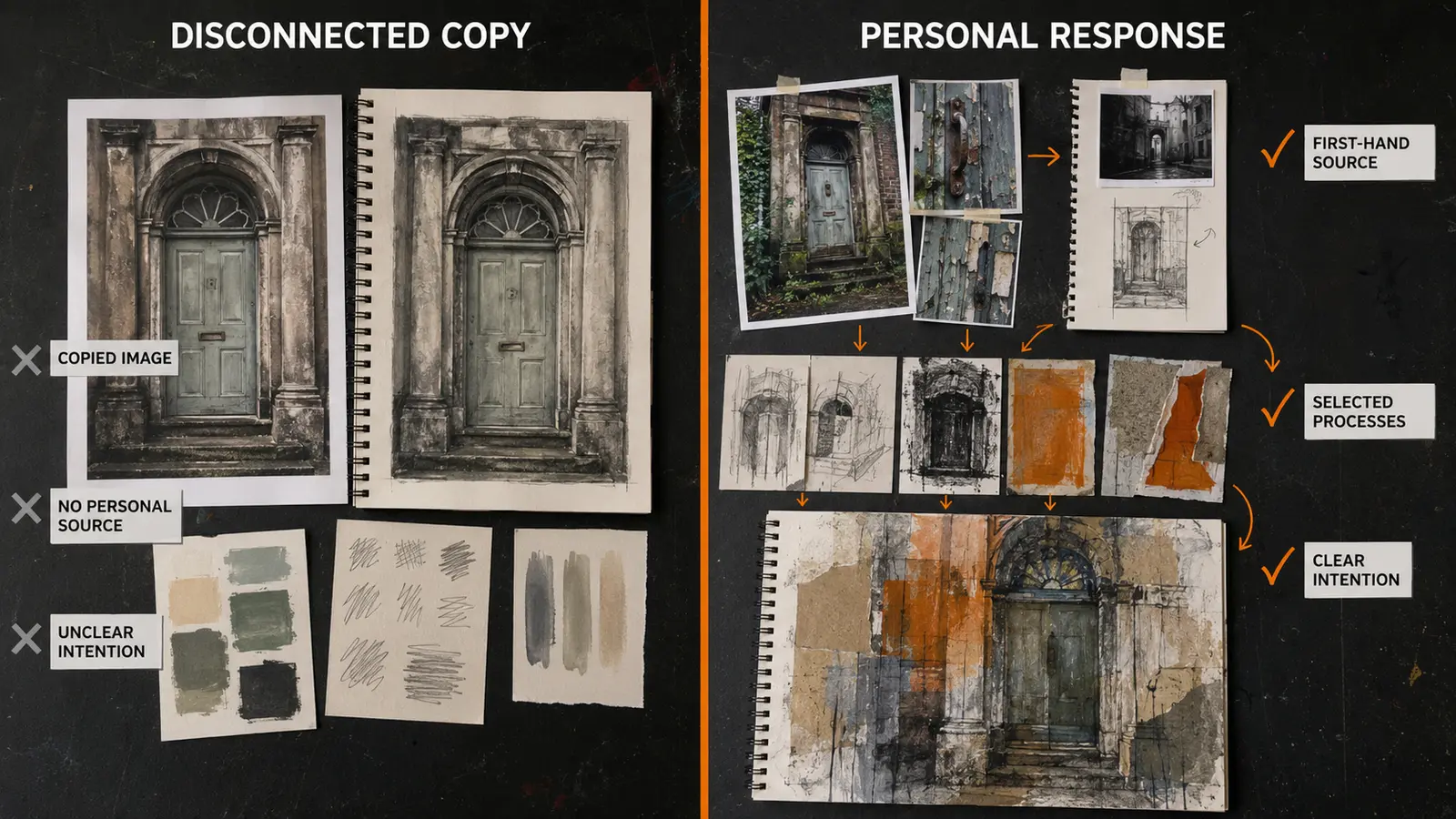
What Makes a Response Personal?
A personal response is shaped by your choices. Two students can begin with the same theme and produce completely different work because they select different sources, viewpoints, materials, details, meanings and presentation methods.
- Use first-hand photographs, drawings, observations or experiences as genuine starting material.
- Select aspects of contextual sources rather than copying an entire visual style.
- Combine influences with discoveries from your own experiments.
- Make independent choices about composition, format, material, colour and scale.
- Allow your response to change when the investigation reveals something more interesting.
- Explain the intention clearly, then let the visual response do most of the communicating.
Personal does not mean completely original in the sense of having no influences. Artists, designers and photographers always work in relation to things they have seen. The personal quality comes from how you interpret, transform and connect those influences.
What Makes a Response Meaningful?
Meaning does not require a dramatic political message or a painful personal story. A response becomes meaningful when its choices have a purpose and the viewer can sense what matters.
- A close crop may make an ordinary surface feel intense or unfamiliar.
- A restricted palette may communicate memory, distance or unease.
- Repeated photographs may express routine, change or isolation.
- Rough materials may reinforce an idea about damage, age or neglect.
- Clear hierarchy may help a poster communicate urgently to a young audience.
- A fragile structure may deliberately create tension between strength and vulnerability.
The meaning should be supported by the visual language rather than existing only in a paragraph beside the work.
How Visual Language Communicates
Visual language is not a list of formal elements inserted into annotation. It is the deliberate use of those elements to affect meaning, function and experience.
| Visual choice | Questions to ask |
|---|---|
| Composition and hierarchy | Where does the viewer look first, and does that support the intention? |
| Colour and tone | What mood, contrast, emphasis or unity do these choices create? |
| Line, shape and form | Do they feel controlled, energetic, fragile, stable, natural or mechanical? |
| Texture and material | Does the surface contribute meaning, or is it included only for effect? |
| Scale and format | How does size change impact, intimacy, function or audience experience? |
| Viewpoint, crop and space | What is emphasised, hidden, isolated or made dominant? |
| Sequence and repetition | Does order create a narrative, rhythm, comparison or change over time? |
| Typography and imagery | Do they communicate the message, purpose and audience consistently? |
AO4 in Different GCSE Art Specialisms
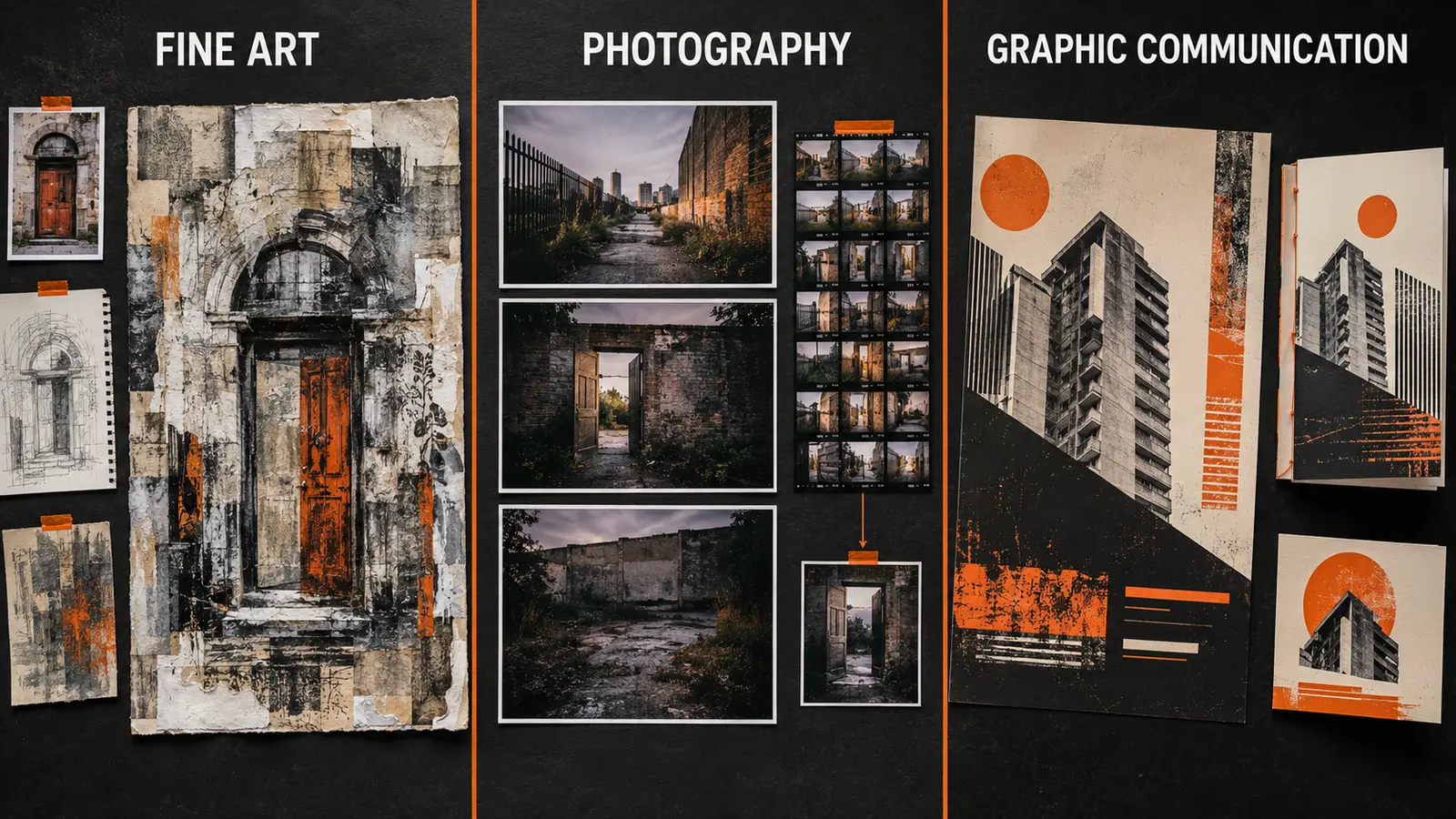
The AO4 wording remains the same, but a realised response can take very different forms.
| Specialism | Possible response | Visual language may include |
|---|---|---|
| Fine Art | Painting, drawing, print, sculpture, installation, mixed media or a related series | Composition, mark, colour, material, surface, scale, space and display |
| Photography | Single image, sequence, book, projection, installation, moving image or combined media | Viewpoint, framing, focus, exposure, light, colour, sequence, scale and print/display choices |
| Graphic Communication | Poster, publication, identity, packaging, campaign, interface or coordinated design system | Hierarchy, typography, grid, image, colour, format, legibility, audience and consistency |
| Textile Design | Constructed textile, surface design, garment, installation, sample collection or functional object | Pattern, repeat, colour, fibre, stitch, texture, construction, scale and function |
| Three-Dimensional Design | Product, model, prototype, architectural response, jewellery, ceramics or spatial design | Form, structure, material, scale, ergonomics, stability, function and environment |
A Practical Fine Art Example
Imagine that your project investigates weathered doors as evidence of time, use and repair.
- Your own photographs reveal repeated layers of paint, rust and repaired surfaces.
- Contextual research helps you notice how artists use fragments, repetition and worn materials.
- Graphite, image transfer, translucent paint and torn-paper tests reveal different qualities.
- You select the close crop, broken edges and layered surface because they support the idea of accumulated time.
- You refine the composition so the doorway remains recognisable without becoming a literal copy of the photograph.
- The resolved mixed-media response combines selected qualities and is presented at a scale that makes the damaged surface feel physically present.
The response is personal because it transforms first-hand sources through independent selection. It is meaningful because composition, material and scale all reinforce the intention.
A Practical Photography Example
Suppose your project explores isolation within busy urban architecture.
- Early shoots investigate elevated viewpoints, repeated structures and the scale of the figure.
- Contact-sheet reflection shows that low, directional light creates stronger separation and atmosphere.
- A targeted reshoot applies those discoveries with more controlled framing and exposure.
- You select three images that communicate distance without repeating exactly the same composition.
- The sequence moves from public space towards increasing enclosure.
- Consistent printing, scale and spacing help the images operate as one personal response rather than three unrelated best shots.
A Practical Graphic Communication Example
Imagine that you are designing publicity for a youth-theatre production about disappearance and uncertainty.
- The brief identifies a teenage audience, required information and several output formats.
- Original corridor photography and figure studies provide relevant imagery.
- Thumbnail testing shows that one isolated figure and a tightly cropped title create the clearest hierarchy.
- Type, colour and image tests establish a consistent tense atmosphere.
- Legibility checks lead to changes in spacing, contrast and subtitle size.
- The realised response is presented as a coordinated poster, social tile and ticket in which each format adapts the same visual system.
Presentation Is Part of the Meaning
Presentation should support the response rather than rescue weak work with decoration. Consider how the viewer will encounter the outcome and what each presentation choice communicates.
- Scale: should the response feel intimate, physical, monumental or functional?
- Format: would one image, a sequence, a book, an object or a coordinated set communicate best?
- Spacing and order: how should the viewer move through related elements?
- Surface and finish: does the material quality strengthen the idea?
- Location: does a wall, plinth, screen, room or real-world mock-up provide the correct context?
- Documentation: have temporary, large, three-dimensional or time-based outcomes been photographed clearly?
- Audience: is the outcome presented in a form suited to the people who should experience or use it?
Resolved Does Not Mean Perfect
A resolved response feels intentional and sufficiently developed. It does not need to remove every trace of risk, hand-making or uncertainty. An expressive surface can be resolved; a deliberately incomplete edge can be resolved; a restrained photographic sequence can be resolved.
Ask whether the response:
- Communicates the intended idea, feeling, function or message
- Applies the most relevant discoveries from the project
- Shows appropriate control of materials, processes and visual language
- Has been refined enough for important decisions to feel deliberate
- Is presented in a form that supports its purpose
Unfinished because time ran out is different from intentionally unresolved. Planning and rehearsal help prevent technical problems from obscuring your ideas.
Planning the Realisation
Before beginning a major response or supervised period, make practical decisions visible.
- Confirm the intention in one or two clear sentences.
- Select the composition, sequence or design system using evidence from earlier tests.
- Choose materials and processes you have practised successfully.
- Test scale, surface, file size, printing, construction or equipment before the final session.
- Prepare source images, templates, supports and materials in the form permitted by your centre.
- Divide the available time into stages and protect time for essential finishing and presentation.
- Identify one simpler alternative in case a technical problem occurs.
Follow your teacher’s instructions carefully about preparatory work, materials, equipment and the rules for supervised assessment.
What Separates Developing AO4 from High-Level AO4?
A GCSE grade reflects evidence across all four assessment objectives, so no final response can guarantee a grade by itself. However, stronger GCSE Art AO4 usually shows these qualities.
| Developing AO4 | High-level AO4 |
|---|---|
| The outcome responds generally to the theme | The response realises a clear and increasingly personal intention |
| Some earlier ideas and experiments are used | The strongest discoveries are selected, transformed and synthesised |
| Visual choices create an effect | Visual language communicates meaning, purpose or audience convincingly |
| Technical control is uneven or limits the idea | Materials and processes are handled effectively for the intended result |
| The relationship to sources may remain obvious | Influences are understood and transformed into an independent response |
| Presentation shows care | Format, scale, sequence and display actively strengthen the intention |
At the highest GCSE level, the response feels confident and coherent. It communicates more than technical competence because every major choice contributes to the intention.
How GCSE AO4 Differs from A Level AO4
The central principle is similar, but A Level students must realise intentions through a more sustained, independent and conceptually developed investigation.
| GCSE AO4 | A Level AO4 |
|---|---|
| A personal and meaningful response grows from a connected GCSE project | The response synthesises a longer, more focused and independently sustained enquiry |
| Intentions should be clear and increasingly personal | Intentions may be more complex, critically examined and conceptually ambitious |
| Visual language should communicate effectively | Visual language is expected to show greater sophistication, control and subtlety |
| Presentation supports meaning, function and audience | Presentation is more critically resolved in relation to context, scale and professional practice |
GCSE students are not expected to produce degree-level work. They are expected to realise an appropriate intention with purpose, personal decision-making and effective visual communication.
AO4 Does Not Work Alone
AO4 is the synthesis of the creative journey rather than a separate chapter.
- AO1 develops the ideas and critical understanding that give the response direction.
- AO2 explores, selects and refines the media, techniques and processes used to realise it.
- AO3 records the observations, insights and changing intentions that explain its development.
- AO4 brings those discoveries together and presents a personal, meaningful realisation.
Review the complete process through the GCSE Art Hub, the GCSE Art AO1 guide, the GCSE Art AO2 guide and the GCSE Art AO3 guide.
Common GCSE AO4 Mistakes
- Starting the final response without enough preparation. Resolve important composition and technical questions first.
- Producing a larger copy of one sketchbook study. Use the project’s discoveries to transform and develop it.
- Copying an artist’s style too closely. Select influences and combine them with first-hand sources and personal decisions.
- Trying to include every experiment. Synthesis requires selection, not accumulation.
- Changing materials at the last moment. Use processes that have been tested and refined.
- Assuming neatness equals resolution. Effectiveness, meaning and intention matter more than polish alone.
- Explaining meaning only through writing. Make visual language carry the intention.
- Ignoring presentation. Scale, format, order and display affect the response.
- Following the original plan despite better discoveries. Intentions can develop when the change is reasoned and visible.
- Treating AO4 as separate from AO1–AO3. The realised response should synthesise the journey.
GCSE Art AO4 Checklist
- ☐ My final intention is clear and connected to the project.
- ☐ My response grows visibly from relevant first-hand sources and investigations.
- ☐ I have selected the strongest discoveries rather than including everything.
- ☐ Contextual influences have been interpreted and transformed personally.
- ☐ My composition, colour, materials, imagery or typography support the intention.
- ☐ I have practised the important materials, processes or technical methods.
- ☐ The response communicates meaning, function or audience through visual language.
- ☐ Scale, format, sequence and presentation strengthen the work.
- ☐ The response is sufficiently resolved without losing purposeful risk or expression.
- ☐ My AO4 connects naturally with AO1, AO2 and AO3.
A final test
Place your realised response beside the most important sources, experiments and refinements. Can you identify what was selected, transformed and communicated? If those connections are visible and the response makes sense on its own, your AO4 is doing its job.
GCSE Art AO4 FAQs
Is GCSE Art AO4 just the final piece?
No. The outcome is important, but Ofqual’s guidance allows intentions to be realised across a body of work. Examiners consider how the response grows from and synthesises the creative journey.
Does the final response have to be large?
No. Scale should suit the intention, material, function and audience. A small intimate object, a carefully printed photographic series or a compact publication can be highly effective.
Can GCSE Art AO4 be a series rather than one outcome?
Yes. A sequence or coordinated group may realise the intention more effectively than one object. Make the relationship, order and presentation of the parts purposeful.
Can a digital outcome count?
Yes. Digital photography, illustration, animation, film, publication and design can provide strong AO4 evidence when the response is personal, meaningful, resolved and appropriately presented.
Can I change my intention near the end?
Yes, when the change grows logically from investigation, recording or experimentation. Make the reason visible so the final direction feels developed rather than accidental.
Does unfinished work receive no GCSE Art AO4 credit?
Assessment depends on the evidence presented. An incomplete realisation may weaken how convincingly intentions are achieved, but AO4 is not automatically reduced to one all-or-nothing judgement about a single object.
Does presentation affect GCSE Art AO4?
Yes. Presentation can strengthen meaning, function and audience experience. It should be purposeful and clear rather than decorative or unnecessarily elaborate.
Official Guidance
Check the current Ofqual GCSE Art & Design requirements and your exam board’s specification. Useful starting points include AQA GCSE Art & Design, Pearson Edexcel GCSE Art & Design, OCR GCSE Art & Design and Eduqas GCSE Art & Design.
AQA has confirmed that its qualification update for first assessment in 2027 does not change the four assessment objectives or their equal weighting. Always follow your teacher’s instructions about your centre’s specification, supervised assessment and presentation requirements.
Not Sure Whether Your AO4 Realises Your Intentions?
Independent feedback can identify weak connections, unresolved decisions and opportunities to make your personal response and visual language more convincing.