
A Level Art AO2 Explained: Exploration, Selection and Refinement
A Level Art AO2 assesses how intelligently you turn ideas into practical possibilities. It is not a reward for using the largest number of materials, filters, techniques or processes. It is about exploring purposefully, selecting with judgement and continually improving the relationship between your methods and your intentions.
At A Level, AO2 is not simply the GCSE requirement with more experiments added. The work should show greater independence, more informed selection, stronger technical control, more perceptive review and a sustained process of refinement. Each significant test should answer a question, reveal a possibility or identify a problem that affects what the student does next.
A Level Art AO2 explained – The most important difference
GCSE students refine work by exploring ideas and experimenting with appropriate media, materials, techniques and processes. A Level students must explore and select appropriate resources as well as media, materials, techniques and processes, while reviewing and refining ideas as the work develops.
In plain English: at A Level, it is not enough to demonstrate that you tried several things. You must show why those particular things were worth trying, what each test revealed, which qualities were selected, how the results were reviewed and how successive decisions produced a more convincing personal solution.
The official A Level AO2 wording
Explore and select appropriate resources, media, materials, techniques and processes, reviewing and refining ideas as work develops.
This wording is used across the main A Level Art and Design awarding organisations. AO2 is worth 25% of the qualification, just like AO1, AO3 and AO4. The objectives overlap: exploration should be informed by AO1, documented and evaluated through AO3, and used to strengthen the realisation of intentions in AO4.
A Level Art AO2 explained – What every part of the wording means
| AO2 wording | What it means in practice | What an examiner should be able to see |
|---|---|---|
| Explore | Investigate possibilities through purposeful practical activity. Change one or more relevant variables and observe the consequences. | A range of meaningful alternatives rather than repeated versions of the same unexamined idea. |
| Select | Make informed choices about what is most suitable for the student’s intentions. | Evidence of retaining, combining, adapting or rejecting possibilities for stated reasons. |
| Appropriate | Choose because something serves a visual, conceptual, technical, functional or communicative purpose. | A clear relationship between intention, method and outcome—not a technique included only to show variety. |
| Resources | Use the tools, equipment, technologies, facilities, formats, references and practical opportunities needed to develop the work. | Thoughtful use of cameras, software, printing methods, found materials, studio facilities, locations, scale or presentation systems where relevant. |
| Media and materials | Investigate the physical or digital substances through which the work is made and communicated. | Understanding of their properties, limitations, expressive qualities and suitability. |
| Techniques | Develop ways of handling tools and materials. | Increasing control, sensitivity and the ability to adapt a technique rather than merely reproduce a taught exercise. |
| Processes | Explore sequences of actions through which work is generated, transformed, edited, reproduced or presented. | Evidence that the working method itself has been considered, adjusted and exploited creatively. |
| Reviewing | Pause during development to judge what the work is communicating and what remains unresolved. | Specific evaluation of success, limitation, relevance and potential—not simply “I like this”. |
| Refining ideas | Improve, clarify, deepen, simplify, combine or redirect an idea using evidence from the work. | Visible changes in composition, process, scale, sequence, material, tone, symbolism, hierarchy, format or meaning. |
| As work develops | Review and refinement must happen repeatedly, not only in a final evaluation. | A connected chain in which one result leads logically to the next decision. |
GCSE AO2 and A Level Art AO2: the precise difference
| GCSE AO2 | A Level AO2 | What the A Level wording demands |
|---|---|---|
| Refine work by exploring ideas | Explore and select appropriate possibilities | Selection is foregrounded. Students must discriminate between alternatives rather than treating every experiment as equally valuable. |
| Selecting and experimenting with appropriate media, materials, techniques and processes | Selecting appropriate resources, media, materials, techniques and processes | The practical enquiry can include tools, technologies, facilities, scale, format, site, software and presentation resources as well as materials. |
| Refinement is the overall aim | Reviewing and refining ideas as work develops | Evaluation must operate throughout the project and visibly control the next stage. |
| Purposeful experimentation can reach an exceptional GCSE standard | Exploration is expected to be more independent, controlled, sustained and appropriate to increasingly complex intentions | The student must make more mature judgements about creative potential, limitation, risk and resolution. |
| Technical progress is important | Technical progress must be integrated with conceptual, visual or communicative development | A technically impressive test that does not advance the student’s intentions has limited developmental value. |
A Level AO2 requires more—but more of what?
- More purpose: every significant exploration should respond to an intention, question or problem.
- More independence: students increasingly decide what needs testing rather than completing identical teacher-directed samples.
- More selectivity: choices are made with discrimination rather than everything being carried forward.
- More technical understanding: students know how and why processes behave as they do.
- More control: techniques become increasingly fluent, sensitive and adaptable.
- More risk with judgement: students move beyond safe repetition but evaluate whether risk strengthens the work.
- More review: success and limitation are examined throughout development.
- More refinement: ideas are repeatedly clarified rather than cosmetically polished once.
- More connection: practical decisions respond to AO1 research and AO3 recording.
- More consequence: exploration must visibly affect the developing work and eventual response.
- More coherence: the selected methods, visual language and intentions increasingly belong together.
- More resolution: later work shows that earlier practical questions have been addressed rather than abandoned.
What A Level does not require more of
More advanced AO2 does not mean filling a sketchbook with unrelated material samples, filters, test strips or software effects. Examiners do not award marks because a student has used a particular number of media or completed the greatest volume of experiments.
- Not more materials used once and then abandoned.
- Not more filters applied to the same photograph without a purpose.
- Not more colour schemes that are never compared.
- Not more typefaces displayed without testing hierarchy or audience response.
- Not more artist-style copies labelled as experiments.
- Not more identical test strips with only minor changes.
- Not more annotation describing the steps of a process.
- Not more technical polish detached from meaning.
- Not more finished outcomes replacing genuine development.
The real increase is in purpose, discrimination, technical understanding, critical review and developmental impact.
How much exploration is enough?
In A Level Art AO2, there is no exam-board quota for the number of materials, techniques, contact sheets, layouts, colour tests or experiments. The right amount is the amount needed to investigate the important possibilities, make informed comparisons and refine the work convincingly.
A student does not need to test everything. In fact, unfocused abundance may weaken the project. A stronger A Level approach identifies the variables that matter and explores those with enough depth to make a decision. For example:
- A painter may compare surface, transparency and scale rather than trying every material in the cupboard.
- A photographer may test viewpoint, light and sequence because those decisions control the intended psychological effect.
- A graphic communicator may test hierarchy, image crop, grid and format because those decisions affect audience understanding.
The test is not “Have I made enough experiments?” It is:
- Have I explored the most important practical possibilities?
- Did I vary something meaningful rather than merely produce more versions?
- Can I explain what each test revealed?
- Have I compared alternatives against my intentions?
- Did I reject weak options rather than present everything as successful?
- Did I combine the most useful qualities where appropriate?
- Can an examiner see how review caused the next refinement?
- Has the work become more personal, coherent and convincing?
What is the role of research in AO2?
Research is most directly associated with AO1, but strong AO2 is rarely uninformed. A Level students need more detailed understanding of the resources, materials, techniques and processes they choose. This may include:
- Investigating how relevant practitioners handle a process
- Understanding the properties and limitations of materials
- Researching camera, lighting, printing or software possibilities
- Studying production methods, formats and presentation systems
- Testing safe and responsible working methods
- Examining how process affects meaning
- Considering sustainability, durability and suitability
- Investigating audience or user needs
- Comparing traditional and contemporary methods
- Learning enough technical vocabulary to review decisions precisely
However, technical research does not become strong AO2 evidence merely because it is written down. It must be applied, tested, selected and used to refine the student’s own work.
A Level Art AO2 explained – Media, materials, techniques, processes and resources
| Term | Simple meaning | Examples |
|---|---|---|
| Media | The broad means through which work is created or communicated | Painting, print, photography, moving image, collage, digital illustration, sculpture |
| Materials | The physical or digital substances used | Graphite, ink, acrylic, paper, fabric, clay, photographic files, type, sound |
| Techniques | Ways of handling tools and materials | Glazing, impasto, masking, long exposure, selective focus, image transfer, hand lettering |
| Processes | Sequences through which work is generated or transformed | Monoprinting, screen printing, darkroom printing, digital compositing, animation, prototyping |
| Resources | The practical means and conditions that enable the work | Cameras, lenses, software, presses, locations, models, studio lighting, scanners, printers, formats and display systems |
These categories overlap. Students do not need to label every decision according to a category. The important point is that selection is appropriate to the intention.
The AO2 exploration-and-refinement cycle
- State the intention or practical question. What needs to be communicated, discovered or improved?
- Choose an appropriate variable. Test material, process, viewpoint, scale, light, sequence, format, hierarchy or another relevant factor.
- Make a controlled exploration. Keep enough elements consistent for the effect of the change to be understood.
- Record what happened. Preserve visual evidence and relevant technical information.
- Review against intentions. Judge meaning, effect, control, limitation and potential.
- Select or reject. Decide what should be retained, altered, combined or abandoned.
- Refine purposefully. Use the judgement to create a more resolved variation.
- Test in context. Check whether the selected quality still works within the developing composition, sequence, format or outcome.
- Repeat where necessary. Continue until the important practical and conceptual questions have been convincingly addressed.
Refinement does not always mean making work neater. It may involve simplifying, enlarging, fragmenting, reducing colour, changing pace, removing detail, increasing ambiguity or deliberately retaining roughness because that better serves the intention.
How should an A Level student select?
Selection should be based on criteria rather than personal preference alone. Useful criteria include:
| Selection criterion | Question to ask |
|---|---|
| Intention | Does this choice communicate what I am trying to express? |
| Conceptual relevance | Does it deepen the meaning or merely create an attractive effect? |
| Visual effectiveness | How does it affect composition, atmosphere, hierarchy, rhythm, scale or focus? |
| Technical control | Can I use it confidently enough to realise the idea—or can greater control be developed? |
| Creative potential | Does it open a worthwhile direction that can be extended? |
| Personal ownership | Am I adapting the method to my own enquiry rather than imitating someone else? |
| Suitability | Is it appropriate for the scale, format, audience, site, time and available resources? |
| Safety and responsibility | Can it be used safely, legally, ethically and, where relevant, sustainably? |
A Level Fine Art AO2 example
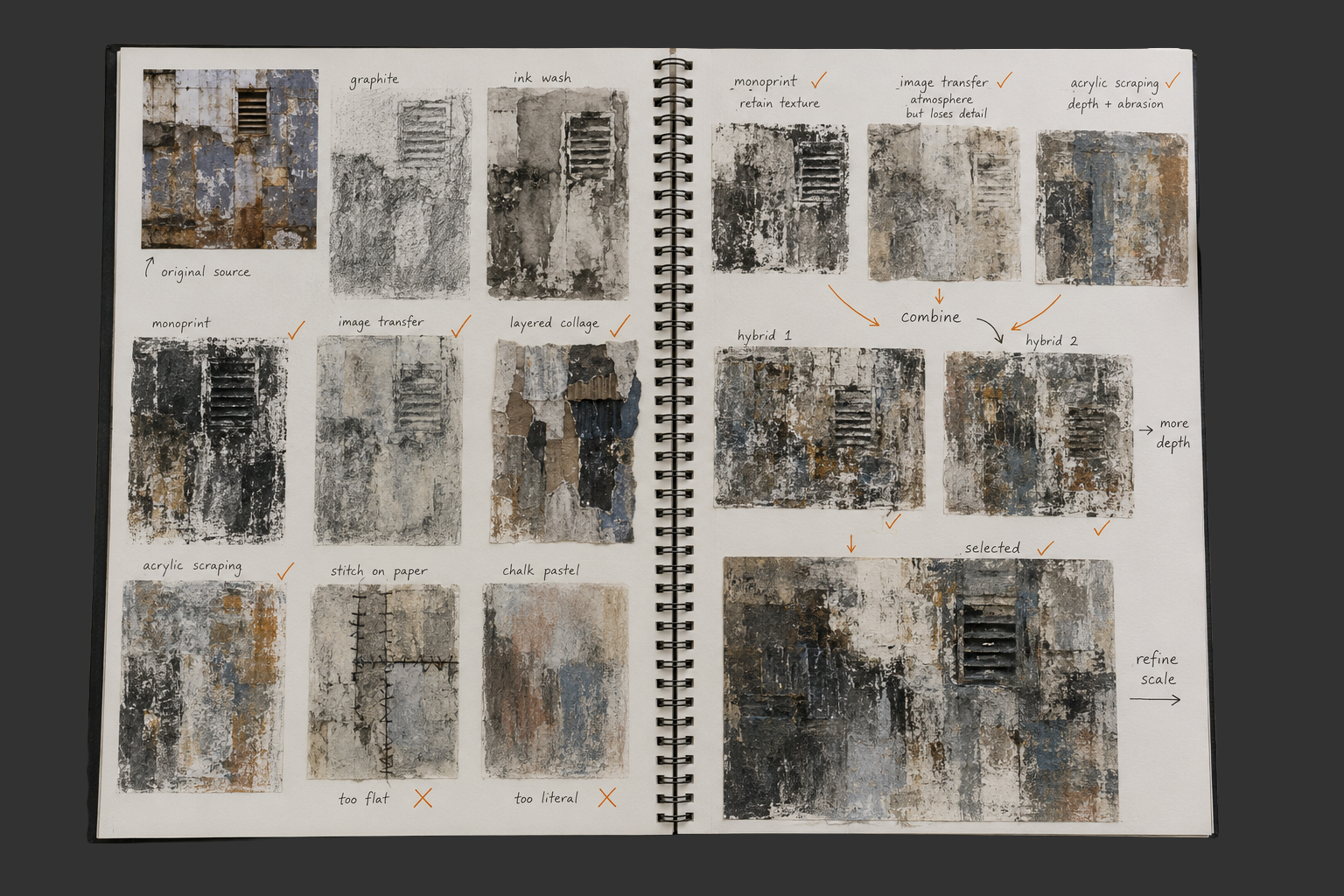
Imagine a student is continuing an investigation into weathered urban surfaces and memory. A GCSE response might explore several suitable materials and develop the strongest into a final composition. At A Level, the practical enquiry should become more selective and conceptually responsive.
- The student identifies the qualities that matter: erosion, layering, partial visibility and the tension between preservation and loss.
- Graphite, ink wash, monoprint, transfer, collage, acrylic scraping and stitched paper are tested because each may communicate one of those qualities.
- The student compares what each process contributes rather than judging only technical success.
- A neat graphite study may be rejected because it records the wall accurately but communicates little sense of erosion.
- Image transfer may retain atmosphere but lose too much structural detail.
- Monoprint and scraping are selected for texture and unpredictability; transfer is retained for partial visibility.
- Two hybrid versions combine those qualities in different proportions.
- The stronger hybrid is enlarged and refined, with scale, empty space and surface contrast adjusted to strengthen the idea of memory.
A Level Photography AO2 example
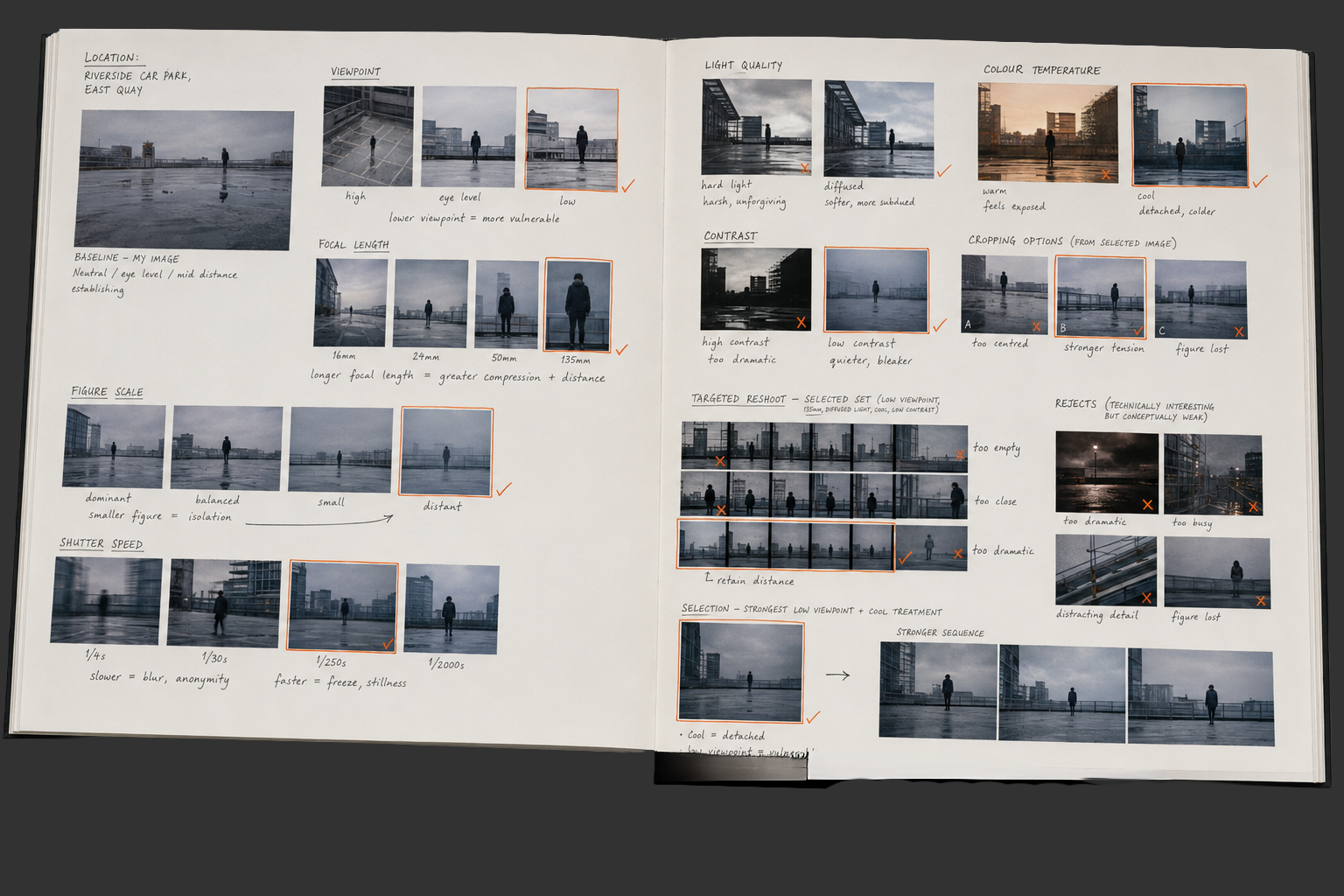
A Photography student exploring isolation in urban spaces should not treat AO2 as a catalogue of camera settings and editing filters. Technical choices should be judged by the meaning they create.
- The student begins with a baseline image and identifies the variables most likely to affect isolation: viewpoint, focal length, figure scale, shutter speed, light, contrast, colour treatment and crop.
- Tests are controlled well enough for differences to be understood.
- A dramatic high-contrast image may be rejected because it creates danger rather than emotional distance.
- A technically impressive blurred figure may be rejected because movement weakens the intended stillness.
- A lower viewpoint, smaller figure and cooler subdued treatment are selected because they increase vulnerability and detachment.
- A targeted reshoot applies those decisions rather than simply producing more photographs.
- Alternative crops are compared for tension, spatial balance and the relationship between figure and architecture.
- The final three-image sequence is refined for pace, consistency and progression.
A Level Graphic Communication AO2 example
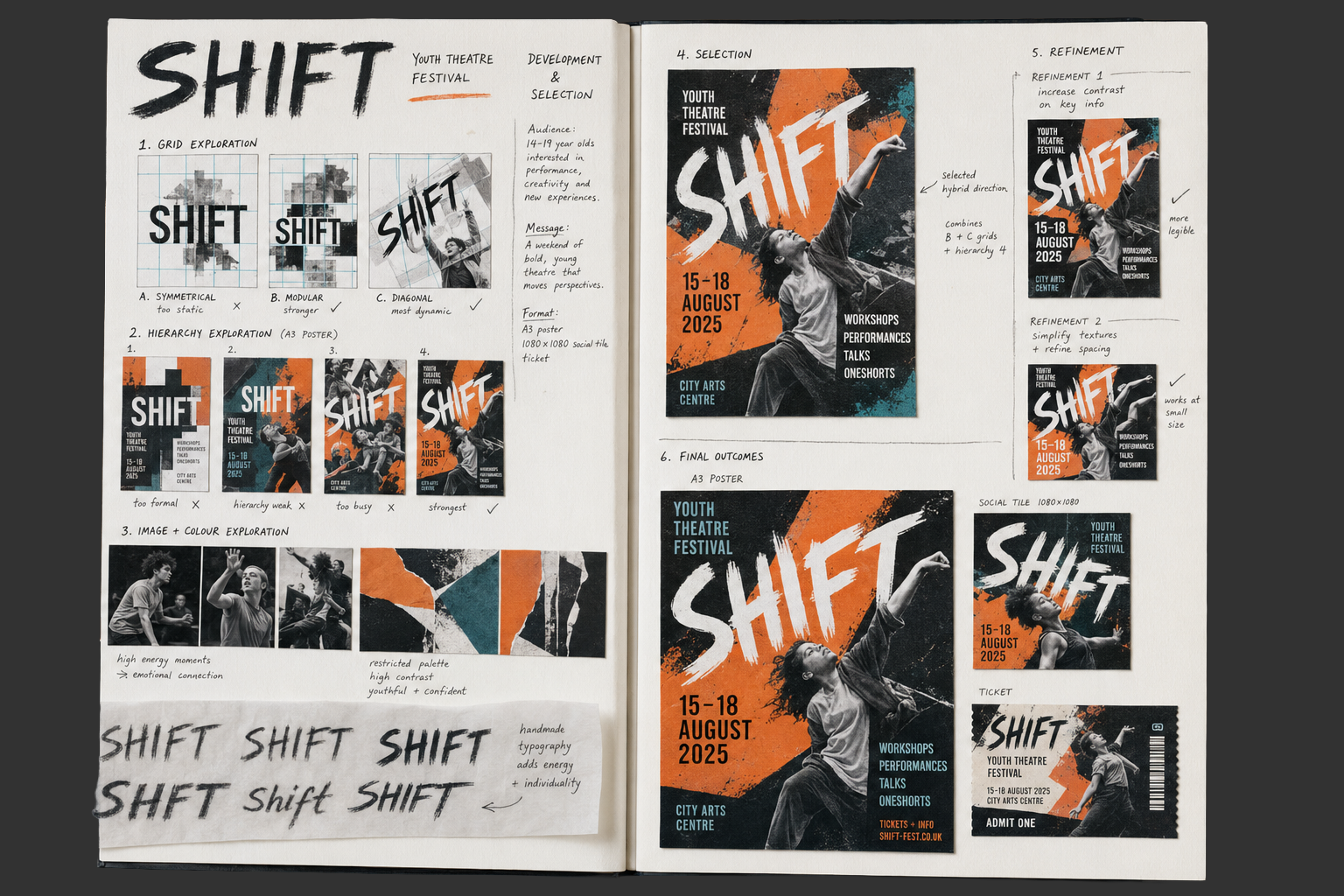
In Graphic Communication, AO2 should test how effectively visual choices communicate to a defined audience across relevant formats. A mood board followed by one finished poster does not demonstrate sustained selection and refinement.
- The student maintains the same youth-theatre brief, message and audience while testing meaningful variables.
- Hand-cut collage, original photography, ink texture, hand lettering and digital type are explored for their communicative qualities.
- Grid structures are compared for energy, order and adaptability.
- Hierarchy variations are judged for immediate understanding at poster distance.
- Restricted colour combinations are tested for contrast, tone and consistency.
- Options that are too formal, too busy or difficult to read are rejected.
- A hybrid direction combines the energy of hand lettering and collage with the control of a modular grid.
- Spacing, contrast and information grouping are refined.
- The selected visual system is tested at poster, social-tile and ticket sizes so that refinement responds to real format demands.
Description, review and refinement are not the same
| Level of annotation | Example | Why it matters |
|---|---|---|
| Description | “I used a low viewpoint and changed the image to blue.” | Records actions but does not judge their effect. |
| Technical observation | “The low viewpoint increases the amount of architecture above the figure, while the cooler colour reduces the warmth of the reflected light.” | Explains what the decisions changed. |
| Review against intention | “The architecture now feels more dominant and the cool treatment creates emotional distance, which supports my intention. However, the figure is too central and appears posed.” | Judges success and identifies a specific limitation. |
| Refinement decision | “I will retain the low viewpoint and cool palette, move the figure into the right third and increase empty space on the left so the isolation feels less staged.” | Creates a justified and testable next step. |
Useful A Level AO2 annotation prompts
- I am testing… because I need to discover whether…
- The variable I changed was… while I kept… consistent.
- This material or process produces…
- The most useful quality is… because it supports my intention to…
- When compared with…, this version is more/less effective because…
- The technical success is…, but the conceptual limitation is…
- I will retain… and reject… because…
- Combining… with… may allow me to…
- The result became too… and changed the meaning from… to…
- The next refinement will alter… while preserving…
- Testing the design at a different scale revealed…
- This refinement responds to my AO1 research into…
- The decision improves the relationship between… and…
- I now need to resolve… before developing the outcome.
Good annotation need not be long. A precise visual comparison and one clear refinement decision can be more useful than a paragraph describing the method.
Does AO2 have to be written?
No. AO2 evidence can be visible in the practical work itself: one image leading to another, alternatives compared, unsuccessful routes abandoned, selected qualities combined and later work becoming more controlled. Brief annotations can make the reasoning easier to follow, especially where a visual change could be misinterpreted.
The compulsory extended writing in the A Level Personal Investigation can also support AO2 where students critically consider relationships between working methods, practical decisions and outcomes. However, writing should not replace practical evidence. The examiner needs to see the exploration and refinement, not only read that it happened.
What greater A Level demand looks like across all four objectives
The step from GCSE to A Level affects every Assessment Objective. Students should not make AO2 more advanced while treating AO1, AO3 and AO4 exactly as they did at GCSE.
| Assessment Objective | GCSE emphasis | What A Level requires more of |
|---|---|---|
| AO1: Develop | Investigations and critical understanding of sources | Sustained and focused enquiry, contextual breadth, analytical depth, independent judgement and research that materially redirects ideas. |
| AO2: Explore, select and refine | Exploring ideas and selecting and experimenting with suitable media, materials, techniques and processes | Purposeful exploration, discriminating selection, wider consideration of resources, stronger technical control, continuous review and repeated refinement appropriate to increasingly complex intentions. |
| AO3: Record and reflect | Recording ideas, observations and insights relevant to intentions as work progresses | More searching first-hand recording, greater precision and selectivity, deeper insight and sustained critical reflection on work and progress. |
| AO4: Present and realise | A personal and meaningful response that realises intentions and demonstrates understanding of visual language | More ambitious personal resolution, stronger synthesis, greater coherence between intention and outcome and, where appropriate, convincing connections between visual, written and other elements. |
One practical decision can provide evidence for all four AOs
A student analyses how contextual sources use fragmented layers to suggest unstable memory (AO1), tests transfer, monoprint and scraping before selecting and combining their strongest qualities (AO2), records and critically evaluates the changing relationship between image and surface (AO3), and uses the refined hybrid process to realise a coherent personal response (AO4).
This is why the objectives should develop together. The strongest portfolios do not look like four separate chapters.
Weak AO2 compared with strong A Level AO2
| Weak or limited evidence | Stronger A Level evidence |
|---|---|
| A page of unrelated material samples | Selected materials tested against a clear visual or conceptual question |
| Many versions with no comparison | Meaningful variables controlled, compared and evaluated |
| Every experiment described as successful | Strengths, limitations and rejected routes identified honestly |
| Technique copied from a contextual source | A principle or process adapted to the student’s own subject and intentions |
| Technically accomplished work that leads nowhere | Technical learning visibly changes the developing composition, sequence, format or meaning |
| Filters or effects used because they look interesting | Editing choices selected for the specific response they create |
| A final piece suddenly becomes more polished | Repeated review and refinement can be traced throughout development |
| One selected idea enlarged without further testing | The selected direction is tested at relevant scale and in its intended context |
| Annotation lists materials and steps | Annotation compares effect, judges relevance and states the next refinement |
Common AO2 mistakes at A Level
- Confusing variety with exploration. Variety matters only when it helps answer a question.
- Producing repetitive test strips. Minor changes are useful only if they reveal something that affects the work.
- Selecting the neatest result automatically. Control is important, but an unresolved or unpredictable result may contain greater creative potential.
- Ignoring intention. A visually exciting experiment may communicate the wrong mood, message or meaning.
- Carrying every idea forward. Selection requires the confidence to reject weaker routes.
- Writing “I like this”. Preference needs to be replaced by evidence-based judgement.
- Experimenting after the outcome has already been decided. Tests should genuinely influence development.
- Stopping after selecting. A promising experiment still needs refinement, control and testing in context.
- Separating digital and hand-generated processes. Where appropriate, their strongest qualities can be combined rather than presented as unrelated exercises.
- Allowing technical exercises to dominate the enquiry. Skill should serve the idea, not replace it.
- Failing to connect experiments with the final response. Moderators need to see developmental consequence.
A practical AO2 project structure
This is a flexible model, not a compulsory order. Students should move between research, recording, practical exploration and review whenever the enquiry requires it.
- Clarify the intention: identify what the developing work needs to communicate or resolve.
- Audit existing evidence: use AO1 and AO3 to identify the most relevant practical questions.
- Choose purposeful variables: select materials, processes, resources or visual decisions worth investigating.
- Make controlled tests: vary enough to discover alternatives without losing the ability to compare them.
- Record relevant technical information: preserve settings, combinations or methods needed to understand and repeat results.
- Compare against criteria: judge meaning, visual effectiveness, control, suitability and potential.
- Reject and select: explain which qualities should move forward and why.
- Combine where appropriate: create hybrid approaches rather than choosing between useful qualities unnecessarily.
- Refine the selected direction: address specific limitations one at a time.
- Test at intended scale or format: check whether the method survives enlargement, reduction, sequencing, movement, installation or reproduction.
- Review the relationship with intentions: confirm that technical improvement has not weakened meaning.
- Carry learning into AO4: use the refined practical language to realise a personal and coherent response.
Top-level AO2 checklist for A Level students
- My practical exploration responds to clear intentions and questions.
- I have selected appropriate resources as well as suitable media, materials, techniques and processes.
- I understand the relevant properties, possibilities and limitations of my methods.
- I test meaningful variables rather than generating random variety.
- I use contextual and technical research to inform practical decisions.
- I compare alternatives visually and critically.
- I explain what each important test revealed.
- I identify technically successful work that does not support my intention.
- I reject weaker options with specific reasons.
- I combine useful qualities where this improves the work.
- My technical control develops as the project progresses.
- I take informed creative risks rather than repeating safe solutions.
- I review work throughout development, not only at the end.
- Each major refinement responds to an identified limitation or possibility.
- I test selected ideas at relevant scale, format or context.
- My exploration visibly affects the developing composition, sequence, message or meaning.
- My AO2 evidence connects with AO1, AO3 and AO4.
- The final response grows from the selected and refined practical language.
Frequently asked questions
A Level Art AO2 explained – How many experiments should an A Level student produce?
No awarding organisation sets a fixed number. Produce enough purposeful exploration to compare the important possibilities, make informed selections and refine the work convincingly. Five connected tests may provide stronger AO2 evidence than twenty unrelated samples.
Must I use lots of different materials?
No. A sustained investigation using a limited range of materials with increasing control, sensitivity and personal adaptation can be excellent. Variety should emerge from the needs of the enquiry.
Does an unsuccessful experiment earn marks?
It can provide valuable evidence when it was purposeful, its limitations are understood and the learning changes the next decision. An unexplained failure that leads nowhere is less useful than a critically reviewed failure that redirects the work.
Does refinement mean making work more realistic or polished? A Level Art AO2 explained.
No. Refinement means making the relationship between intention and visual response more convincing. It may involve greater control, but it can also mean simplifying, distorting, reducing, fragmenting, roughening or leaving selected ambiguity.
Can one experiment contribute to several Assessment Objectives?
Yes. A practical test may be informed by contextual understanding for AO1, demonstrate exploration and selection for AO2, record an insight for AO3 and contribute to the eventual realisation of intentions for AO4.
What is the clearest sign of strong AO2?
The examiner can see why the student made each important practical decision and how reviewing one stage caused a more purposeful next stage. The final working method has been discovered and developed—not chosen in advance and decorated with experiments afterwards.
The key message
A Level Art AO2 requires more purposeful exploration, more discriminating selection and more continuous refinement—not simply more experiments.
The strongest practical journey is a chain of informed decisions. Each test investigates a relevant possibility; each review identifies value or limitation; each selection narrows the direction; and each refinement brings the working method and the student’s intentions into closer alignment.
Would detailed feedback help?
If you are unsure whether your A Level experiments are sufficiently purposeful, whether your refinement is visible or how your evidence currently meets AO1–AO4, Portfolio to A Star can provide focused portfolio feedback and practical priorities for improvement.
Official specification sources
Assessment requirements can be updated. Students and teachers should always check the current specification and guidance for their awarding organisation.