
BTEC Component 1: Creative Practice in Art and Design
A student-friendly guide to investigating, experimenting, developing ideas and presenting a clear creative journey.
Component 1 is a practical portfolio project completed from a Pearson Set Assignment. Your centre assesses the work and Pearson moderates it. This page explains the creative process in accessible language; always follow the current assignment and your teacher’s assessment instructions.
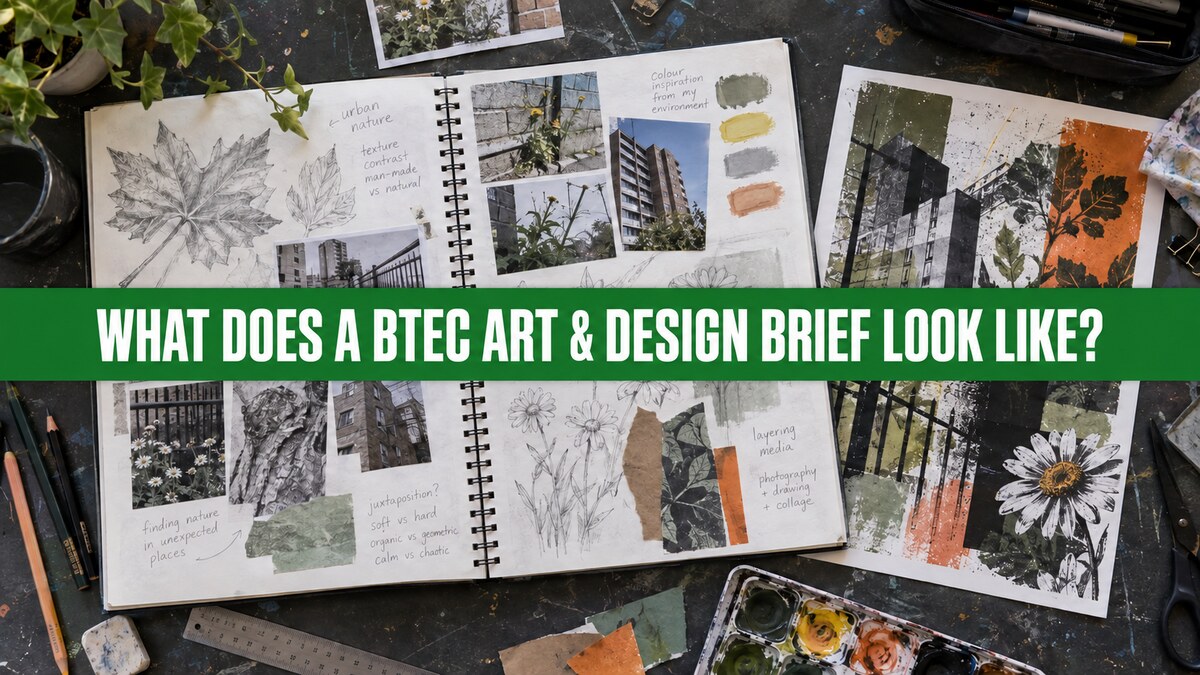
Component 1 at a glance
Pearson Set Assignment
Your work responds to the current assignment released for the assessment series.
Centre assessed
Your centre marks the evidence and Pearson checks the accuracy through moderation.
Portfolio evidence
Show decisions, experiments, reviews and development—not only a polished final outcome.
Independent work
During assessed sessions, work independently within the rules explained by your centre.
The four learning outcomes
These outcomes overlap. A strong portfolio makes the links between investigation, ideas, practical skill and communication easy to follow.
A
Investigate and experiment
Use relevant sources and test materials, techniques and processes to discover possibilities.
B
Generate and communicate ideas
Create several ideas and show how research, purpose and audience have influenced them.
C
Develop practical skills
Apply, review and refine practical skills as your work becomes more purposeful and resolved.
D
Record and communicate development
Present a readable creative journey using images, samples, notes, reviews and selected outcomes.
A practical route through Component 1
1. Understand the assignment
Identify the theme, purpose, audience, required evidence and practical opportunities.
2. Investigate
Gather useful primary and secondary sources. Select material that can genuinely influence your work.
3. Experiment
Test materials and processes, compare results and explain what each experiment teaches you.
4. Generate ideas
Produce alternatives rather than settling immediately. Connect ideas to research, audience and purpose.
5. Develop and refine
Take promising ideas forward, review decisions and make visible improvements through further testing.
6. Record and present
Organise the evidence so another person can understand what you tried, learned, changed and achieved.
Exemplar project: Hidden Nature
This illustrative project is pitched at Level 1/2 students. It is not assessed work and should not be copied. Use it to understand how evidence can show a connected creative journey.
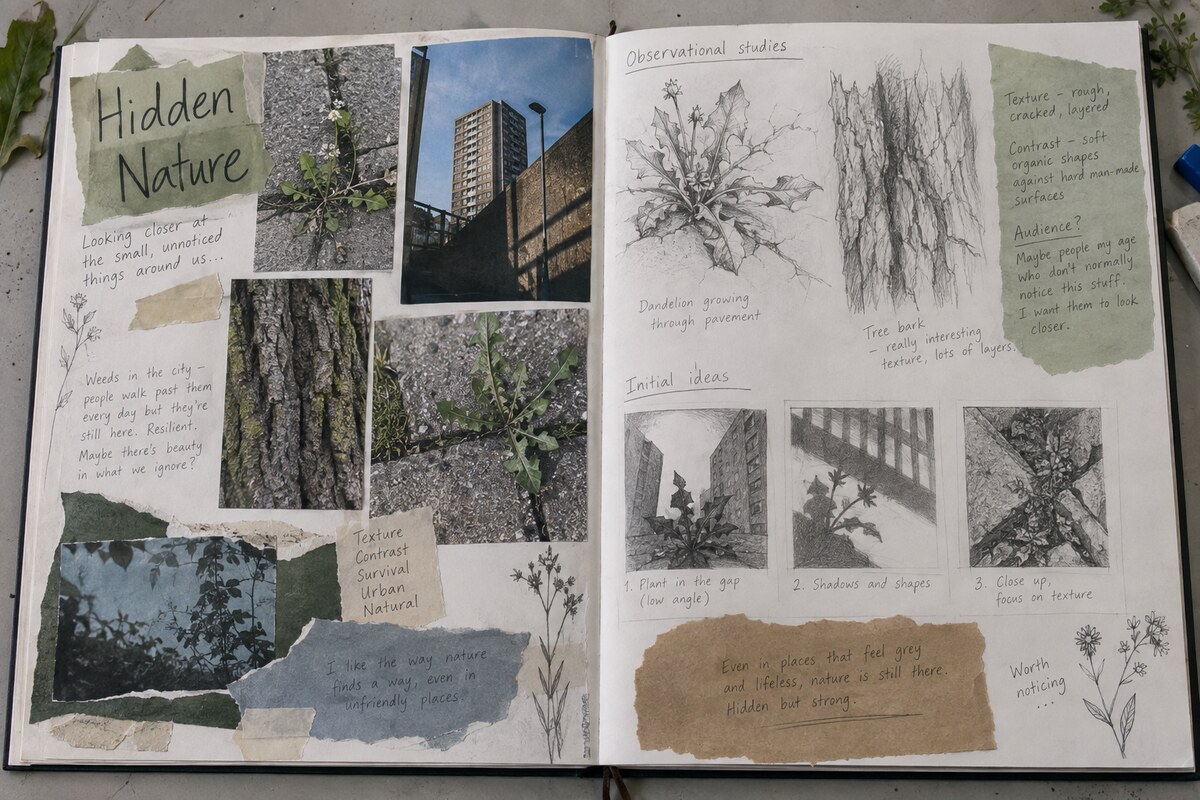
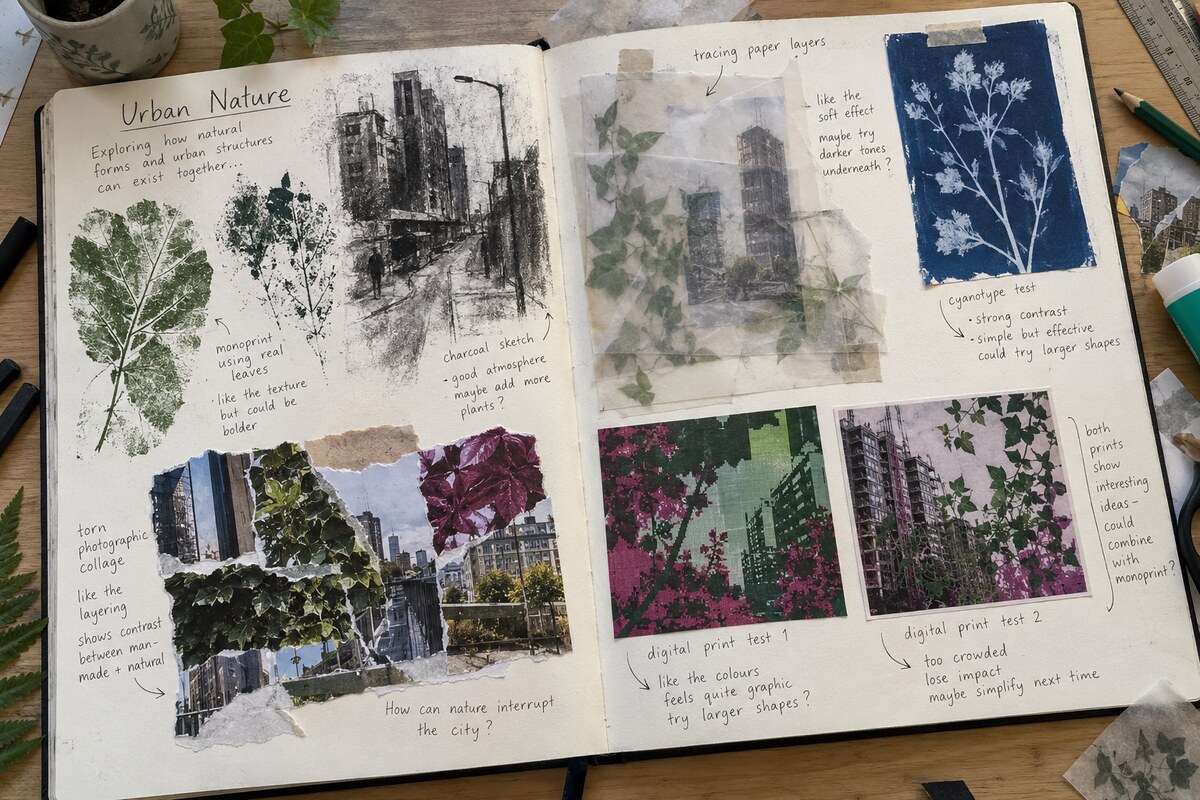
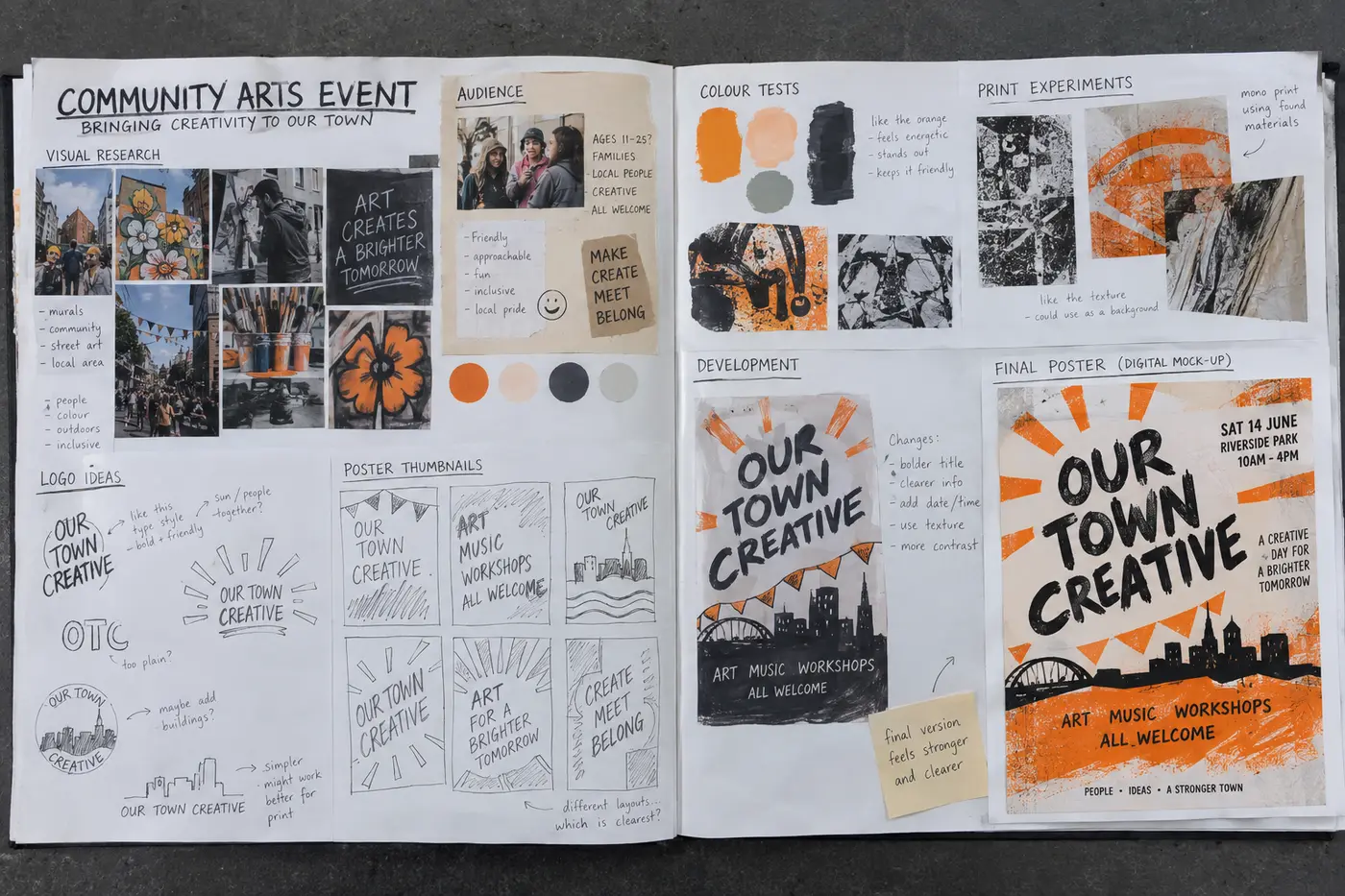
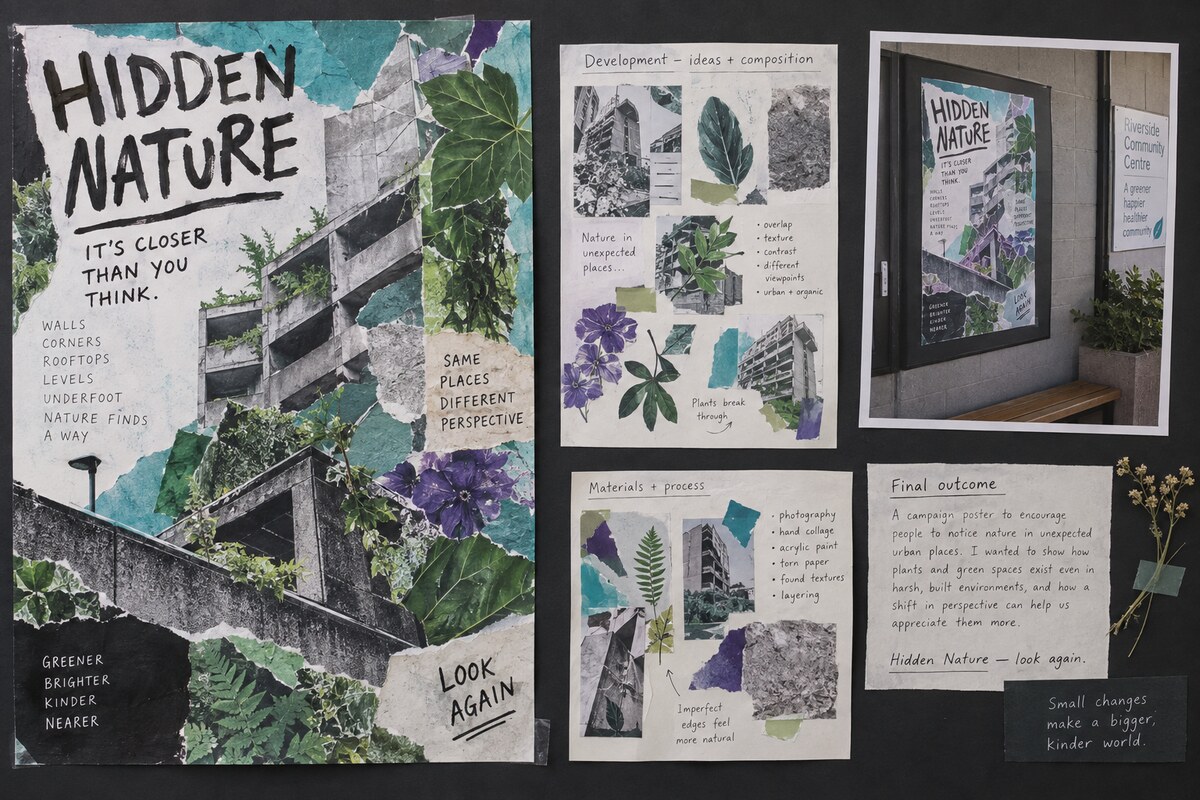
What stronger evidence tends to show
Relevant investigation
Sources are selected for a reason and lead to useful observations, questions or visual directions.
Purposeful experimentation
Tests explore genuine possibilities and their results influence what happens next.
Informed decisions
Ideas and material choices connect clearly to research, purpose and audience.
Visible development
The portfolio shows review, refinement and improvement rather than unexplained jumps.
Growing practical control
Skills become more confident and appropriate as the project progresses.
Considered presentation
Evidence is edited and organised so the creative journey is easy to understand.
Student-friendly annotation examples
“This print test created stronger contrast than my pencil study, so I will use it to make the hidden plant shapes easier to notice.”
“The repeated leaf shapes communicate growth, but the composition feels too regular. I will vary the scale and spacing in the next version.”
“I kept the photographic texture because it connects to the location, but simplified the colour palette so the poster reads more clearly from a distance.”
Useful annotation explains a decision, its effect and the next step. It does more than describe what you did.
Important assessment boundaries
For assessed work, follow your centre’s instructions, permitted-resource rules and supervision arrangements. Produce your own response and do not submit examples, wording or templates from this website as your work. Teachers may give general feedback within Pearson’s rules, but your creative decisions and evidence must remain your own.
Component 1 frequently asked questions
Is Component 1 an exam?
It is an internally assessed Pearson Set Assignment completed under your centre’s controlled conditions, rather than a traditional written examination.
Do I have to use a sketchbook?
Use the format required or permitted by your centre. Evidence might include sketchbooks, loose sheets, samples, photographs, digital slides or a combination, provided the journey is clear.
How much written work is needed?
There is no advantage in writing at length when a concise note will do. Use images and short annotations to explain sources, decisions, results, reviews and next steps.
Can I change direction during the project?
Yes, if the change comes from investigation, experimentation or review and still meets the assignment. Record why the new direction is more effective.
What makes evidence stronger?
Stronger evidence is relevant, purposeful and connected. It shows how research and experiments inform ideas, and how review leads to practical refinement.
Can I copy an exemplar layout?
No. Use exemplars to understand evidence and presentation principles, then make independent choices appropriate to your own assignment and creative work.
Return to BTEC Level 1/2
Check the official qualification
View Pearson’s current BTEC Tech Award information and assessment materials.