
Home › A Level Art Help › A Level Art AO1 Explained
What is AO1 in A Level Art?
AO1 is the Assessment Objective that judges how well you develop ideas through sustained, focused research. You must investigate relevant contextual and first-hand sources, analyse and evaluate what you learn, then show how that understanding changes the direction of your own work.
At A Level, AO1 is not the GCSE requirement with extra artist pages added. Your investigation must be more sustained, focused, independent and analytical. Strong evidence makes a clear chain visible: source → insight → practical test → evaluation → more personal idea. AO1 is worth 25% and should remain active throughout the project rather than ending when the research pages are finished.

The most important difference
GCSE students are expected to investigate sources and show critical understanding. A Level students must sustain and focus that investigation, use contextual and other sources, and demonstrate both analytical and critical understanding.
In plain English: an A Level student must do more than find relevant work and respond to it. They must investigate it in depth, understand why it matters, compare it with other evidence, decide what is useful, reject what is not useful and show exactly how those judgements change the direction of their own work.
What is the official A Level Art AO1 wording?
Develop ideas through sustained and focused investigations informed by contextual and other sources, demonstrating analytical and critical understanding.
This wording is used across the main A Level Art and Design awarding organisations. AO1 is worth 25% of the qualification, just like AO2, AO3 and AO4. The objectives are assessed together across the body of work rather than as four unrelated chapters.
What every part of the wording means
| AO1 wording | What it means in practice | What an examiner should be able to see |
|---|---|---|
| Develop ideas | Your thinking must change, grow, narrow, combine or become more ambitious as the project progresses. | A visible journey from an initial question to increasingly purposeful possibilities—not the same idea repeated in different materials. |
| Sustained | The investigation continues over time. Research is revisited and extended rather than completed on one isolated page. | Earlier discoveries influencing later photographs, drawings, experiments, compositions and decisions. |
| Focused | The investigation becomes more selective and relevant. You follow the lines of enquiry that matter and let weaker directions go. | A clear project question, purposeful source selection and evidence of prioritising the strongest direction. |
| Contextual sources | You investigate the circumstances, ideas and purposes surrounding creative work—not only its appearance. | Understanding of relevant cultural, historical, social, political, technological, environmental or personal contexts. |
| Other sources | Research can extend beyond artists, designers and photographers. | First-hand observation, locations, objects, archives, interviews, literature, film, music, science, architecture, data, materials, processes or audience research where relevant. |
| Analytical understanding | You break work down and explain how choices operate. | Discussion of composition, process, scale, sequence, material, light, colour, typography, symbolism, audience and visual language. |
| Critical understanding | You form supported judgements about meaning, effectiveness, relevance and limitation. | Comparison, interpretation, evaluation and clear decisions about what you will use, adapt, question or reject. |
What examiners expect from A Level Art AO1
Examiners assess the evidence in the portfolio, not the effort behind it. They should be able to follow how your investigation becomes deeper, more selective and more independent over time.
- A sustained line of enquiry: research returns throughout the project and answers questions raised by practical work.
- Relevant contextual understanding: you explain purpose, meaning, audience and circumstances where they genuinely illuminate the work.
- Analysis rather than description: you explain how visual and technical decisions create meaning or effect.
- Critical judgement: you compare, question, select and reject possibilities for stated reasons.
- Visible consequence: discoveries lead to new photographs, drawings, experiments, compositions, processes or decisions.
- Increasing independence: the project develops a position and visual language that are recognisably your own.
A polished artist page can still be weak AO1 if nothing changes afterwards. A less decorative page can be much stronger when it records a perceptive insight and produces a purposeful next step.
GCSE AO1 and A Level AO1: the precise difference
| GCSE AO1 | A Level AO1 | What the extra A Level language demands |
|---|---|---|
| Develop ideas through investigations | Develop ideas through sustained and focused investigations | Longer-term enquiry, greater continuity, stronger selection and a clearer line of development. |
| Demonstrating critical understanding | Demonstrating analytical and critical understanding | Close visual and conceptual analysis as well as supported judgement and evaluation. |
| Of sources | Informed by contextual and other sources | Broader types of evidence and deeper understanding of purposes, meanings and contexts. |
| No compulsory extended study in the national AO wording | The Personal Investigation includes a compulsory extended written element or related study | A more substantial, coherent and referenced argument connected to the practical investigation. |
| Teacher-framed starting points are common | Greater personal ownership and independence are expected | The student increasingly identifies the question, selects sources, makes connections and controls the direction. |
A Level requires more—but more of what?
- More continuity: research should remain active throughout the project.
- More selectivity: sources must be chosen for a reason, not merely collected.
- More contextual depth: consider purpose, meaning, time, place, audience and circumstances.
- More analysis: explain how visual, technical and conceptual choices operate.
- More critical judgement: compare, question, evaluate and reach supported conclusions.
- More independence: make your own connections rather than following a teacher-supplied route.
- More integration: research, writing, recording and practical exploration should inform one another.
- More consequence: discoveries must visibly alter what you make next.
- More reflection: identify limitations, unresolved questions and the next investigation required.
- More coherence: the project should become a connected enquiry rather than a folder of separate tasks.
What A Level does not require more of
More advanced study does not mean filling a sketchbook with additional biographies, copied images or decorative pages. Examiners do not award AO1 because a student has researched a particular number of artists or written the greatest number of words.
- Not more dates from an artist’s life unless those facts explain the work.
- Not more downloaded images with no interpretation.
- Not more copies made without explaining what was learned.
- Not more artist pages completed before practical work begins.
- Not more sources that all make the same point.
- Not more annotation that only describes what is visible.
- Not more presentation for its own sake.
The real increase is in depth, relevance, independence, connection and impact.
How much research is enough?
There is no exam-board quota for the number of artists, designers, photographers, pages or sources. The right amount is the amount needed to investigate the student’s question convincingly, compare different possibilities and support a sustained development of ideas.
As a practical guide—not a rule—a strong A Level project often contains two or three substantial core contextual investigations, supported by a wider group of more concise references. One source might shape subject or meaning, another might challenge the first, and another might help with process, structure, audience or presentation. A project may need more or fewer depending on its complexity.
The test is not “Have I researched enough people?” It is:
- Have I investigated more than one possible way of understanding my subject?
- Can I compare relevant approaches rather than discuss each source separately?
- Have I understood the contexts and purposes behind the work?
- Can I explain what each source contributed to my own enquiry?
- Can an examiner see the practical consequence of my research?
- Have I moved beyond my first idea?
What can count as an AO1 source?
A Level research should be broad enough to support the enquiry but focused enough to remain relevant. Depending on the discipline and theme, useful sources may include:
- Artists, designers, photographers and craftspeople
- Art movements, design histories and visual traditions
- Original photographs, drawings and direct observation
- Gallery, museum, exhibition and site visits
- Objects, artefacts, architecture and environments
- Archives, family records and oral histories
- Literature, poetry, film, theatre and music
- Social, cultural, political or environmental issues
- Scientific, psychological or philosophical ideas
- Processes, technologies and material traditions
- Audience, client, user or market research
- Interviews, questionnaires and first-hand testimony
A non-art source is valuable only when it helps the student understand, question or develop the project. A list of unrelated interests is not a focused investigation.
The AO1 research-and-development cycle
- Begin with a genuine question. What are you trying to discover, communicate, challenge or resolve?
- Gather first-hand evidence. Photograph, draw, visit, observe, interview, collect or document something directly connected to the enquiry.
- Choose a relevant contextual source. Select it because it can help answer a question—not because it is famous or easy to copy.
- Analyse and interpret. Investigate how the work operates, what shaped it, what it communicates and why its choices matter.
- Test an insight practically. Use the discovery to alter viewpoint, process, scale, sequence, material, composition, typography, lighting or meaning.
- Evaluate the result. Decide what became stronger, what remained unresolved and what should be retained, changed or rejected.
- Seek the next source or test. Research the gap revealed by the practical work.
- Refocus the enquiry. Narrow, combine or redirect the idea using accumulated evidence.
This cycle may repeat several times. That repetition—with each cycle becoming more selective and purposeful—is what makes an investigation sustained.
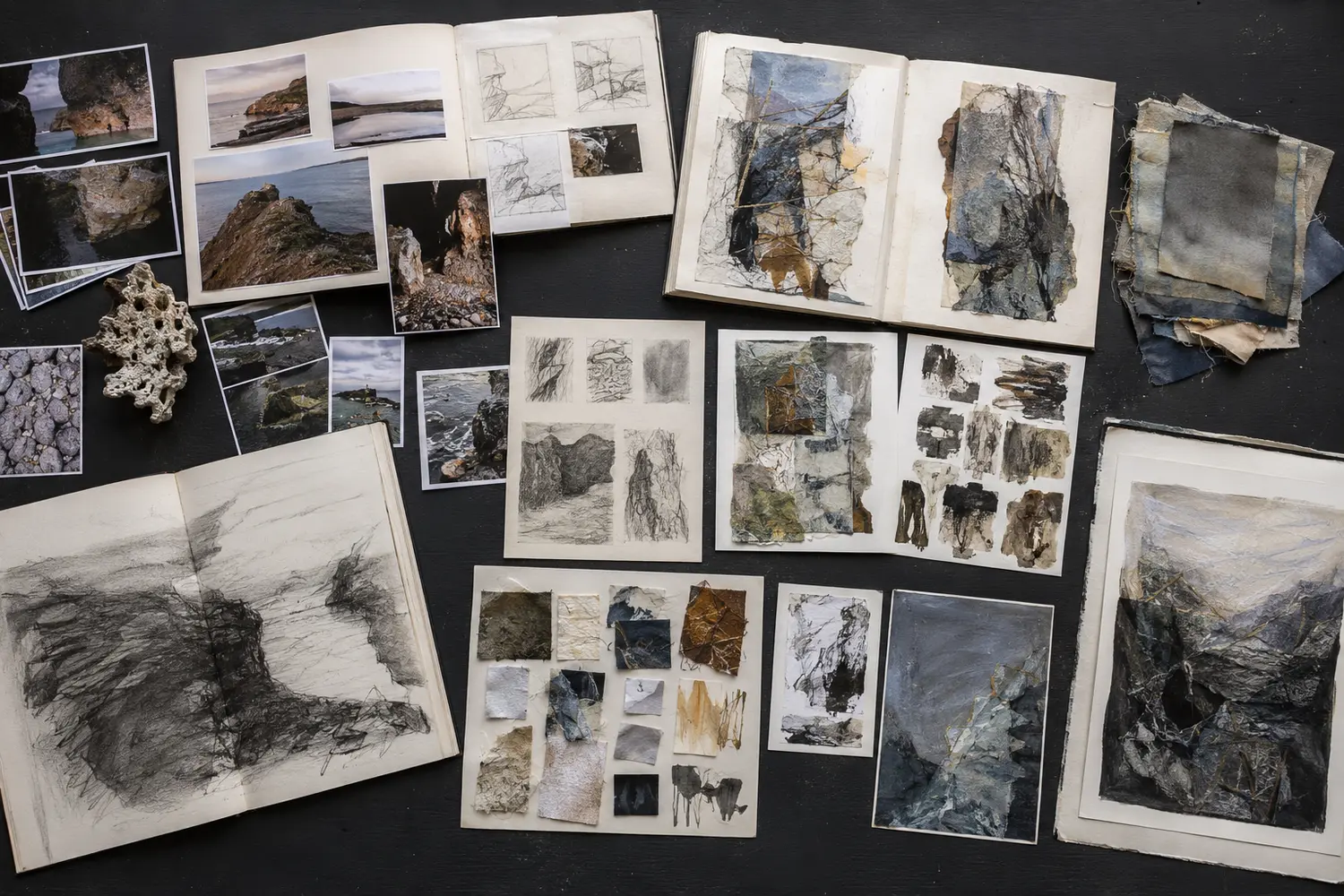
A Level Fine Art AO1 example
Imagine a student begins with photographs of damaged walls and weathered industrial surfaces. A GCSE response might investigate a relevant painter or printmaker, make a visual response and develop a composition. At A Level, the student should take the enquiry further.
- They examine their own relationship with the location and ask whether the subject is really decay, memory, erasure or regeneration.
- They compare contrasting approaches to surface, absence and place rather than researching several visually similar artists.
- They investigate the social or industrial history of the location where relevant.
- They analyse how scale, layering, fragmentation, removal and material damage create meaning.
- They test those ideas through drawing, transfer, print, collage, scraping, overpainting and selective destruction.
- They reject literal copies of the original wall and combine the most effective processes into a more personal visual language.
- They revisit contextual sources later to resolve scale, format and the relationship between fragment and whole.
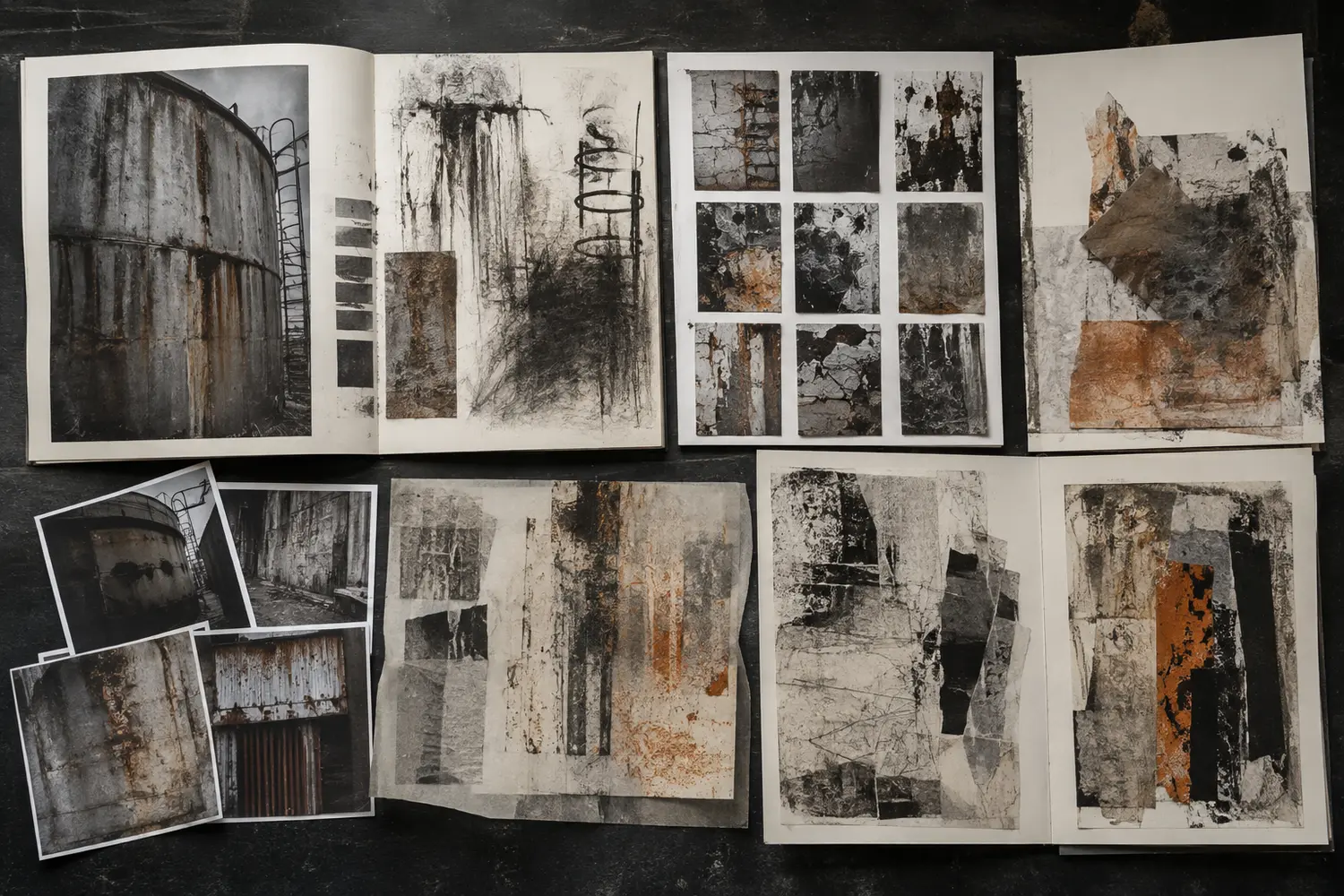
A Level Photography AO1 example
A Photography student investigating isolation in urban spaces should not treat AO1 as a sequence of photographer biographies followed by unrelated shoots. Research should change the way the student uses the camera and constructs meaning.
- The student analyses how different photographers use distance, scale, empty space, architecture, light and sequence.
- They compare a detached observational approach with a more atmospheric or psychologically charged approach.
- They identify which visual decisions support their own intention and which create the wrong meaning.
- The first contact sheet is evaluated for conceptual as well as technical success.
- Research triggers a purposeful reshoot: perhaps a lower viewpoint, smaller figure, cooler light, longer distance or emptier frame.
- Alternative crops and sequences are tested to control the viewer’s experience.
- The student reaches a personal photographic position rather than imitating one source.
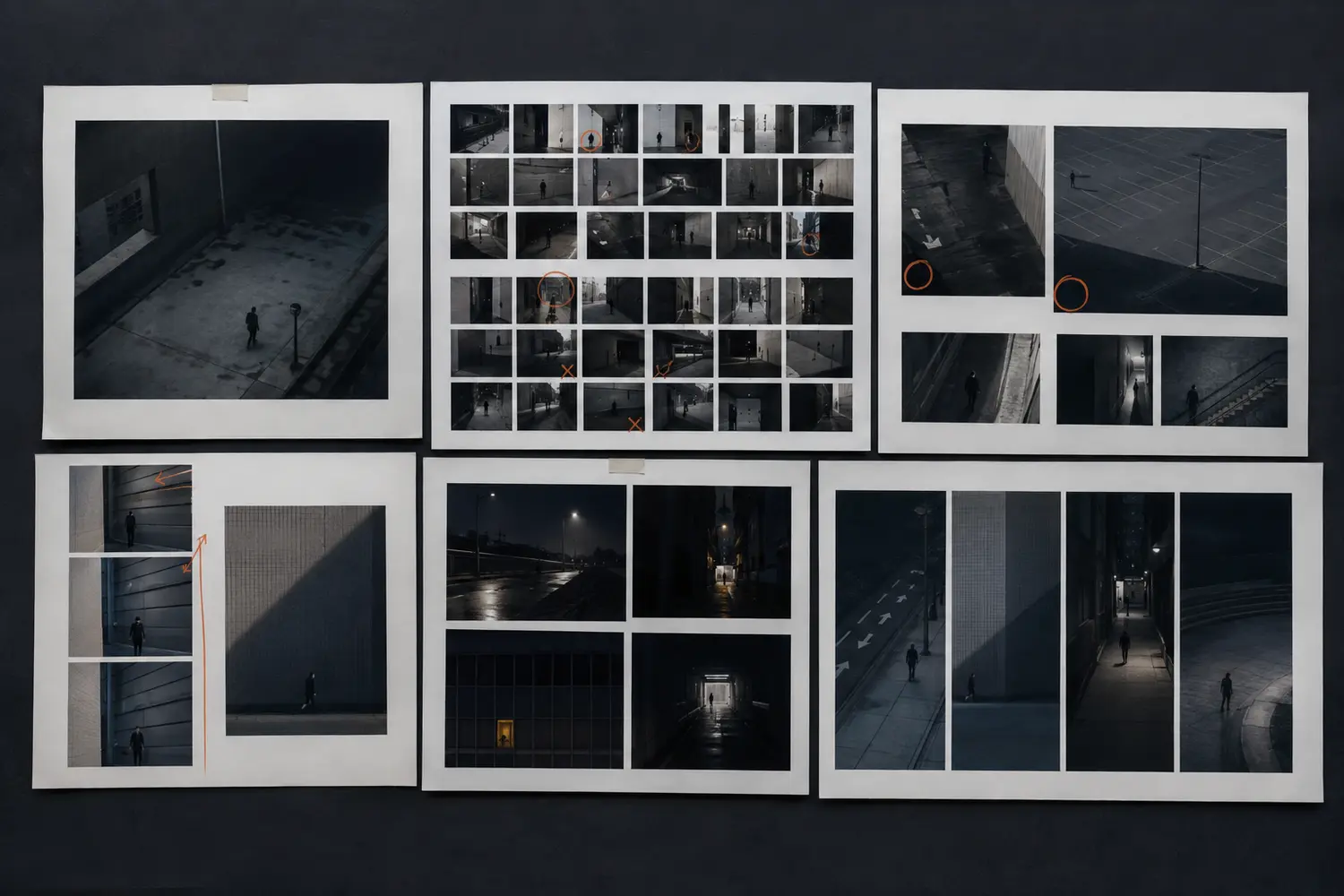
A Level Graphic Communication AO1 example
In Graphic Communication, AO1 includes understanding audience, message, context and the conventions of visual communication. Research should influence design decisions rather than become a decorative mood board.
- The student defines the audience, purpose, tone, format and communication problem.
- They investigate contrasting approaches to typography, image, hierarchy, grid, campaign structure and visual identity.
- They analyse why particular strategies succeed for particular audiences and contexts.
- They explore type and image relationships rather than reproducing an existing designer’s surface style.
- Thumbnail alternatives are compared for clarity, energy, tone and adaptability.
- Weaker options are rejected with reasons.
- The selected direction combines research insights into a coherent personal solution across more than one format.
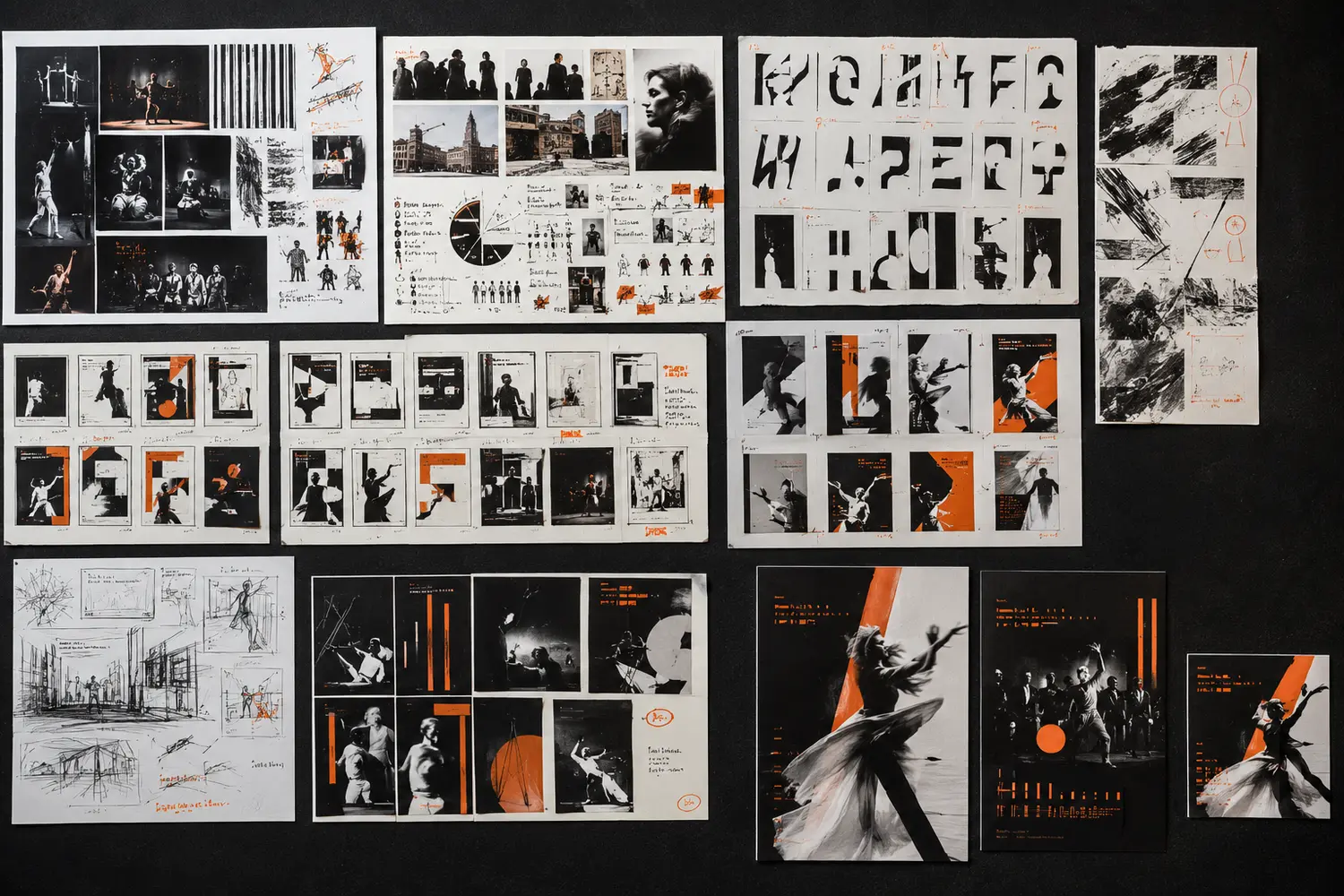
Description, analysis and critical understanding are not the same
| Level of writing | Example | Why it matters |
|---|---|---|
| Description | “The photograph shows one figure in a large empty space.” | Accurate, but it only states what can be seen. |
| Analysis | “Placing the small figure low in the frame allows the empty architecture to dominate, making the person appear vulnerable.” | Explains how a visual choice creates an effect. |
| Contextual understanding | “The image reflects a wider interest in alienation within modern urban environments, where architecture can appear impersonal and controlling.” | Connects the work to a relevant idea, purpose or context. |
| Critical judgement | “The distance is useful for my theme, but the image is so detached that it removes emotional tension. I will retain the scale contrast while using lower light and a less central figure.” | Evaluates relevance, identifies a limitation and creates a justified next step. |
Useful A Level AO1 annotation prompts
- The most relevant aspect of this source is… because…
- This work is shaped by its social, historical or cultural context because…
- The artist, designer or photographer controls the viewer’s response through…
- When compared with…, this approach is more/less effective because…
- This challenges my original assumption that…
- I am adapting the principle of… rather than copying the appearance of…
- My practical test revealed…
- The result supports my intention because…
- The limitation is…
- I will retain…, reject… and investigate… next.
- This decision redirects my project from… towards…
- The connection between my source and my own work is visible in…
Sentence starters are scaffolding, not a formula. The best writing is specific to the work and records genuine thought.
The compulsory A Level written study
The Personal Investigation includes extended contextual writing. This is one of the clearest formal differences between GCSE and A Level. Requirements vary slightly by awarding organisation, so students must follow their centre’s current specification.
| Awarding organisation | Current written requirement in Component 1 | Important AO1 implication |
|---|---|---|
| AQA | A coherent, logically structured extended response of 1,000–3,000 words of continuous prose, using specialist vocabulary and a bibliography. | The writing must support the practical work and demonstrate contextual, analytical and critical understanding. |
| Pearson Edexcel | A separate personal study of at least 1,000 words of continuous prose, linked to practical investigations and supported by contextual research. | Research, personal interpretation, conclusions and practical development must connect. |
| Cambridge OCR | A related study of at least 1,000 words using words and illustrations, demonstrating the context in which the practical portfolio exists. | The topic should allow breadth, comparison and meaningful contextualisation rather than isolated artist profiles. |
| Eduqas | An extended written element of at least 1,000 words integrated with the practical, critical and theoretical investigation; the specification gives additional guidance about extended-writing sections. | Visual and written elements are assessed holistically and should make clear, purposeful connections. |
The written study is not simply “the AO1 essay”. It can provide evidence across the objectives where appropriate. Its greatest value comes when it helps the student clarify the enquiry, analyse sources, evaluate practical decisions and reach personal conclusions.
What greater A Level demand looks like across all four objectives
The step from GCSE to A Level affects every Assessment Objective. Students should not make AO1 more advanced while treating AO2, AO3 and AO4 exactly as they did at GCSE.
| Assessment Objective | GCSE emphasis | What A Level requires more of |
|---|---|---|
| AO1: Develop | Investigations and critical understanding of sources. | Sustained, focused enquiry; contextual breadth; analytical depth; comparison; independent judgement; coherent extended writing; and research that visibly redirects ideas. |
| AO2: Explore, select and refine | Exploring ideas and selecting and experimenting with suitable media, materials, techniques and processes. | More purposeful exploration, increasingly discriminating selection, stronger technical control, critical review and repeated refinement driven by intentions rather than by a checklist of materials. |
| AO3: Record and reflect | Recording ideas, observations and insights relevant to intentions as work progresses. | More searching first-hand recording, greater range and precision where relevant, deeper insight, critical reflection on work and progress, and evidence selected because it advances the enquiry. |
| AO4: Present and realise | A personal and meaningful response that realises intentions and demonstrates understanding of visual language. | More ambitious personal resolution, greater coherence between intention and outcome, stronger synthesis of the whole investigation and, where appropriate, convincing connections between visual, written and other elements. |
One decision can provide evidence for all four AOs
A student analyses how a photographer uses a low viewpoint to make architecture dominate the figure (AO1), tests low and high viewpoints in a new shoot (AO2), records and evaluates which frames best communicate vulnerability (AO3), and uses the selected approach within a coherent final sequence (AO4).
This is why the objectives should develop together. The most convincing portfolios do not look like four separate sections.
Weak AO1 compared with strong A Level AO1
| Weak or limited evidence | Stronger A Level evidence |
|---|---|
| A biography and several downloaded images | A focused investigation of purposes, contexts, visual decisions and relevance to the student’s enquiry |
| One source followed by an imitation | Contrasting sources compared, interpreted and transformed through the student’s own practical tests |
| Research completed before making begins | Research revisited whenever practical work reveals a new problem or possibility |
| “I like the colours and will use them” | A precise explanation of how colour relationships control mood, symbolism, hierarchy or audience response |
| Many experiments with no direction | Experiments selected to test questions generated by contextual research |
| Every result described as successful | Limitations acknowledged and used to justify changes |
| Sources treated separately | Connections and differences used to form a personal position |
| A final idea appears suddenly | The outcome can be traced through research, recording, exploration, selection and refinement |
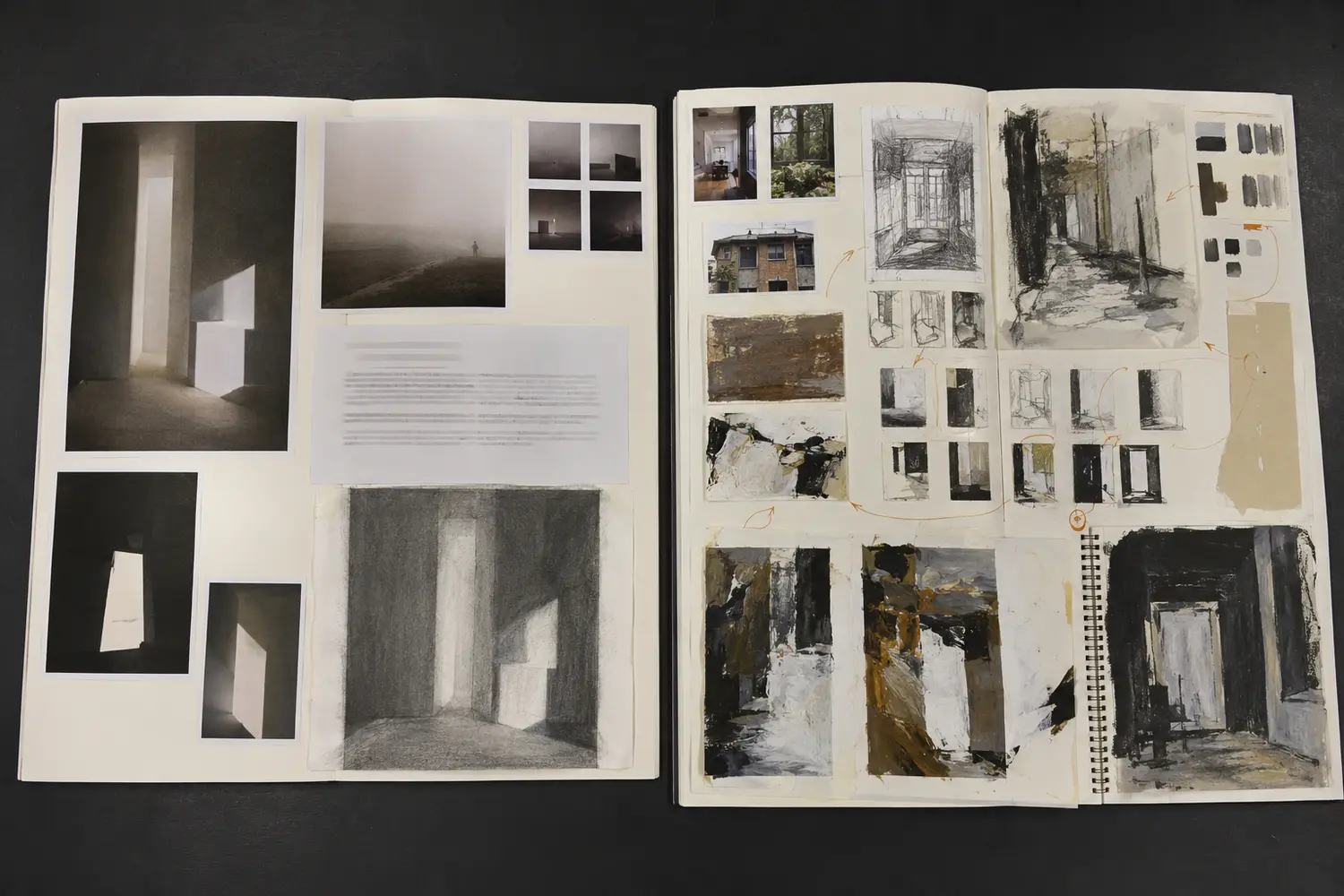
How to improve your A Level AO1 evidence
- Turn the theme into a question. Replace a broad subject such as “identity” with a focused problem you can investigate visually.
- Start from first-hand material. Original photographs, drawings, visits, objects or interviews give the enquiry personal substance.
- Choose sources for a purpose. State the question each artist, designer, photographer or non-art source can help you answer.
- Compare contrasting approaches. Explain how and why the sources differ, then decide what is most relevant to your intention.
- Finish analysis with a consequence. Write what you will test, retain, adapt, combine or reject next.
- Show the practical response beside the research. Make the connection easy for an examiner to follow.
- Return to research later. Use new sources when experiments reveal a problem with meaning, process, composition, audience or presentation.
- Edit ruthlessly. Remove repetition and strengthen the evidence that best demonstrates development, judgement and independence.
Common AO1 mistakes at A Level
- Researching a theme instead of investigating a question. “Portraits” is a subject; “how fragmented portraiture can communicate unreliable memory” is an enquiry.
- Choosing sources because they are easy to imitate. Relevance should be conceptual, contextual, visual or technical—not merely stylistic.
- Confusing biography with context. Context means the circumstances, ideas and purposes that help explain the work.
- Writing analysis with no practical consequence. Every important insight should suggest a test, decision or new question.
- Copying surface features. Adapt a principle, strategy or way of thinking rather than borrowing an appearance.
- Using too many similar sources. Contrast often produces stronger analysis and more independent decisions.
- Separating the written study from the portfolio. The practical and theoretical enquiries should illuminate one another.
- Leaving critical reflection until the end. Evaluation should steer the work while it can still change.
- Assuming more pages mean more marks. Relevance and development matter more than volume.
- Following a teacher-led sequence without personal ownership. A Level students must increasingly make and justify their own choices.
A practical AO1 project structure
This is a flexible model, not a compulsory order. Students should revisit stages whenever new evidence changes the enquiry.
- Define the enquiry: identify a personal starting point, question, intention or problem.
- Establish first-hand evidence: make original recordings and investigate the subject directly.
- Select a core contextual source: choose one that can deepen or challenge the initial idea.
- Analyse in context: investigate meaning, purpose, audience, visual language, process and circumstances.
- Respond practically: test a principle from the research through the student’s own subject matter.
- Evaluate and identify a gap: decide what the test clarified and what remains unresolved.
- Introduce a contrasting source: compare another relevant way of approaching the same question.
- Combine or choose: use comparison to form a more independent position.
- Develop the selected direction: sustain it through purposeful AO2 and AO3 activity.
- Revisit research during refinement: seek contextual evidence for problems of meaning, form, process or presentation.
- Conclude rather than merely stop: explain what the investigation established and how the outcome embodies that understanding.
Top-level AO1 checklist for A Level students
- My project is driven by a clear and worthwhile enquiry.
- My first-hand research gives the project personal substance.
- I have selected contextual sources because they answer or challenge specific questions.
- I understand relevant purposes, meanings and contexts—not only visual appearance.
- I analyse how choices create meaning and effect.
- I compare sources and make supported judgements.
- I use specialist vocabulary accurately and naturally.
- I acknowledge and reference sources appropriately.
- My research leads to visible practical experiments and decisions.
- I explain why I retained, adapted, combined or rejected particular possibilities.
- I revisit research as the project develops.
- My investigation becomes more focused over time.
- My decisions show increasing independence.
- My written study and practical portfolio clearly relate to one another.
- An examiner can trace how AO1 contributed to AO2, AO3 and AO4.
- The final direction could not have appeared without the investigation that preceded it.
Frequently asked questions
How many artists should an A Level student research?
No awarding organisation sets a fixed number. Use enough substantial and supporting sources to sustain the enquiry, make comparisons and develop an independent direction. Two or three deeply investigated core sources can be more valuable than ten superficial pages.
Does every source need a full research page?
No. Core sources may need extended visual and written investigation. A supporting source may be documented briefly if one image, idea, process or quotation has a specific role in the development.
Do I have to copy an artist’s work?
No. A practical response can help you understand a process or visual principle, but copying is not an automatic AO1 requirement. Evidence of understanding and the way learning informs your own development are more important.
Can my own photographs and drawings count towards AO1?
Yes, when they operate as investigations that help generate or develop ideas. They may also provide AO3 evidence. The objectives overlap because the same purposeful activity can demonstrate several kinds of understanding.
Is the written study assessed only as AO1?
Not necessarily. The written element is closely associated with contextual and critical understanding, but awarding organisations assess the Personal Investigation holistically and the writing can support evidence across the objectives where appropriate. Follow the exact guidance for your board.
What is the clearest sign of strong AO1?
The student’s own work would be substantially different—and weaker—without the investigation. Research has changed what they notice, think, test, select and finally communicate.
The key message
A Level AO1 requires more depth, more independence and more consequence—not simply more pages.
Research should form an active conversation between sources and the student’s own work. Each important discovery should sharpen the question, generate a practical possibility, support a judgement or redirect the project. When that process is sustained, focused and critically understood, AO1 becomes the engine that drives every other Assessment Objective.
About the author
This guide was written by Ian Bradbury, a retired Art, Graphics and Photography teacher with more than 40 years’ experience teaching students aged 11–18. It is grounded in current exam-board requirements and long classroom experience of helping students turn research into purposeful practical development.
Continue through A Level Art Help
- Return to A Level Art Help for course guides and practical advice.
- Move from research into experimentation with A Level Art AO2 explained.
- Strengthen observation and reflection with A Level Art AO3 explained.
- Plan a personal response with A Level Art AO4 explained.
- Read the discipline guides for A Level Fine Art, A Level Photography and A Level Graphic Communication.
- Use the artist research guide and A Level Art A* advice to review your evidence.
Would detailed feedback help?
If you are unsure whether your A Level investigation has enough depth, whether your research is influencing your own work or how your evidence currently meets AO1–AO4, Portfolio to A Star can provide focused portfolio feedback and practical priorities for improvement.
Official specification sources
Assessment requirements can be updated. Students and teachers should always check the current specification and guidance for their awarding organisation.