
A Level Art AO3 Explained: Recording, Insight and Critical Reflection
A Level Art AO3 explained – AO3 assesses how purposefully you record what you see, think, discover and understand—and how critically you reflect on your work and progress. It is not a reward for filling pages with drawings, photographs or long annotations. Strong A Level Art AO3 evidence is relevant to an intention and helps the creative enquiry move forward.
At A Level, AO3 is not simply the GCSE requirement with more drawings and more writing added. The work should show more searching first-hand observation, greater selectivity, more precise visual and technical recording, deeper insight and sustained critical reflection. Recording should capture information that matters; reflection should explain what has been learned and how that learning affects the next decision.
A Level Art AO3 explained – The most important difference
GCSE students record ideas, observations and insights relevant to intentions as work progresses. A Level students must do this while also reflecting critically on their work and progress.
In plain English: at A Level, it is not enough to collect or document information. You must examine what the evidence means, judge its relevance, recognise strengths and limitations, connect discoveries with your intentions and use reflection to guide development.
A Level Art AO3 explained – The official A Level AO3 wording
Record ideas, observations and insights relevant to intentions, reflecting critically on work and progress.
This wording is used across the main A Level Art and Design awarding organisations. AO3 is worth 25% of the qualification, just like AO1, AO2 and AO4. The objectives overlap: recording may begin within an AO1 investigation, document discoveries made through AO2 and help clarify the intentions eventually realised through AO4.
What every part of the wording means
| AO3 wording | What it means in practice | What an examiner should be able to see |
|---|---|---|
| Record | Capture, preserve, select and organise visual, written, technical, sensory or other relevant evidence. | Drawings, photographs, contact sheets, studies, diagrams, samples, notes or other records that have a clear purpose. |
| Ideas | Document possibilities, questions, connections, intentions and changes in thinking. | Thumbnails, plans, alternatives, mind maps, written propositions, visualisations and evidence that ideas evolve. |
| Observations | Look carefully and identify significant visual, physical, spatial, contextual or functional information. | First-hand recording that notices specific qualities rather than relying on assumptions or generic images. |
| Insights | Recognise something meaningful that is not merely a description of what is visible. | Evidence of discovery: relationships, patterns, tensions, meanings, possibilities or problems that affect the enquiry. |
| Relevant | Select information because it helps investigate, develop, test or realise an intention. | A focused body of evidence rather than everything the student happened to collect. |
| Intentions | The developing purpose, meaning, question, message, mood, function or visual direction of the work. | Recording choices that respond to what the student is trying to discover or communicate. |
| Reflecting | Look back at work in order to understand what happened and what has been learned. | Thoughtful comparison, evaluation, reconsideration and evidence that conclusions influence later work. |
| Critically | Question evidence, test assumptions and judge success, limitation, relevance and potential against appropriate criteria. | Specific, balanced and evidence-based judgement—not unsupported praise or negativity. |
| Work | Consider practical studies, experiments, research responses, designs, photographs, samples and developing outcomes. | Reflection attached to actual evidence rather than general statements detached from the portfolio. |
| Progress | Consider how the enquiry and the student’s understanding change over time. | A visible chain of discoveries, questions, decisions, redirections and increasingly informed intentions. |
GCSE AO3 and A Level AO3: the precise difference
| GCSE AO3 | A Level AO3 | What the A Level wording demands |
|---|---|---|
| Record ideas, observations and insights relevant to intentions as work progresses | Record ideas, observations and insights relevant to intentions, reflecting critically on work and progress | Critical reflection is explicit. Students must interpret and judge evidence, not merely document development. |
| Drawing, annotation, photography and other appropriate means can provide effective recording | Recording should become more searching, selective, perceptive and appropriate to a sustained personal enquiry | The student chooses the form, depth and precision of recording according to what the investigation needs. |
| Relevant first-hand recording can reach an exceptional GCSE standard | First-hand evidence should increasingly generate insight, challenge assumptions and clarify complex intentions | Observation becomes a form of investigation rather than a preliminary exercise. |
| Annotation can explain ideas and decisions as work progresses | Visual and written reflection should reveal deeper understanding of work, intention and progress | The record should capture reasoning, comparison, uncertainty, changed thinking and justified next steps. |
| Technical information may help document methods | Technical information is selected and interpreted according to its creative significance | Settings, measurements and processes matter when they explain a result or make purposeful development possible. |
A Level Art AO3 requires more—but more of what?
- More purpose: recording is undertaken to investigate a question, preserve important evidence or clarify an intention.
- More first-hand enquiry: students actively seek subjects, sites, people, objects, events or experiences that can reveal something valuable.
- More sustained observation: looking continues beyond the first obvious features to identify structure, variation, relationships and change.
- More selectivity: students decide what deserves close recording and what does not contribute enough.
- More precision: visual, technical and written information is accurate enough to support later decisions.
- More variety of appropriate means: drawing, photography, notation, sampling, mapping, audio, moving image or other methods are selected for a reason.
- More insight: records reveal discoveries, not merely appearances.
- More criticality: evidence and progress are questioned and judged against intentions.
- More independence: students identify what they need to record rather than completing identical teacher-directed exercises.
- More connection: recording responds to AO1 sources, captures AO2 discoveries and helps shape AO4.
- More reflection over time: conclusions are revisited as understanding and intentions change.
- More consequence: what is recorded and learned visibly changes the developing work.
What A Level does not require more of
More advanced AO3 does not mean filling every space with drawings, importing hundreds of photographs, copying large amounts of information or writing an essay beside every practical study. Volume is not the same as relevance, observation or insight.
- Not more photographs that repeat the same viewpoint without revealing anything new.
- Not more drawings completed only to prove that drawing took place.
- Not more secondary images collected from online searches.
- Not more annotations describing tools, materials and steps.
- Not more technical data recorded without explaining its significance.
- Not more decorative sketchbook writing that cannot be read.
- Not more praise such as “I like this” or “this went well”.
- Not more negative comments that do not diagnose a problem.
- Not more retrospective evaluation written after all decisions have been made.
- Not more presentation polish that hides uncertainty, revision or changed thinking.
The real increase is in purpose, first-hand enquiry, selectivity, precision, insight, critical judgement and developmental impact.
What counts as recording in A Level Art AO3?
Recording is much broader than realistic pencil drawing. The most appropriate method depends on what the student needs to notice, preserve, compare or understand.
| Form of recording | What it can capture | Examples |
|---|---|---|
| Drawing | Structure, proportion, spatial relationships, movement, tone, detail, memory or imagined possibility | Observational studies, thumbnails, diagrams, plans, continuous-line studies, tonal or colour notes |
| Photography | Appearance, moment, viewpoint, light, sequence, environment, evidence and change | First-hand shoots, contact sheets, details, comparative viewpoints, documentary sequences, test exposures |
| Material recording | Surface, weight, texture, flexibility, translucency, construction and physical behaviour | Samples, rubbings, casts, swatches, imprints, colour mixing, collected material and process notes |
| Written recording | Questions, intentions, sensory responses, interpretation, comparison, evaluation and changed thinking | Concise annotation, reflective notes, captions, keyword lists, technical logs, transcripts and evaluations |
| Spatial or technical recording | Scale, position, movement, dimensions, settings, sequence and conditions | Maps, measurements, plans, lighting diagrams, camera data, storyboards, timelines and installation sketches |
| Time-based or sensory recording | Sound, duration, rhythm, action, atmosphere and experiences not adequately held by a still image | Audio, video, frame sequences, written sensory notes, performance notation and sound maps |
These methods can overlap. An annotated photograph may record appearance, scale, light, atmosphere and a critical insight at the same time. The strongest method is not automatically the most difficult one; it is the method that captures the most relevant evidence.
First-hand and secondary recording
First-hand sources are encountered or created directly by the student: a person they photograph, an object they draw, a place they visit, a surface they touch, a performance they witness or an arrangement they construct. Secondary sources are mediated through someone else’s image, text, film, website or reproduction.
| First-hand recording can provide | Secondary material can provide |
|---|---|
| Original viewpoints and personal visual ownership | Access to distant, historical, inaccessible or vanished subjects |
| Direct experience of scale, light, texture, movement and atmosphere | Context, comparison, specialist knowledge and alternative perspectives |
| The ability to return, rearrange, reshoot or observe change | A starting point for identifying what needs first-hand investigation |
| Unexpected details and discoveries that a search cannot predict | Supporting evidence when its origin, purpose and limitations are understood |
| A clear connection between the student’s experience and personal intentions | Relevant information that should be transformed through the student’s own enquiry |
Strong A Level work usually gives first-hand recording a central role because it creates personal evidence and genuine opportunities for discovery. Secondary sources can still be valuable, but collecting them is not a substitute for looking, selecting, questioning and responding independently.
Drawing in its widest sense
Drawing is a way of thinking, investigating, planning, analysing and communicating—not only a test of realistic rendering. Depending on the discipline and intention, useful drawing may include:
- Slow observational studies
- Rapid gesture drawings
- Composition thumbnails
- Tonal and colour studies
- Diagrams and visual maps
- Measured or perspective drawings
- Storyboards and sequences
- Letterform and layout sketches
- Camera or lighting plans
- Construction and installation plans
- Drawing from memory or imagination
- Digital drawing and mark-making
A drawing can be unfinished yet highly valuable if it records the information needed. Conversely, a polished drawing may contribute little if it repeats what the student already knows and has no effect on the enquiry.
A Level Art AO3 explained – What does “reflecting critically” actually mean?
Critical reflection is not fault-finding and it is not a long description. It is the process of examining evidence, interpreting what it reveals, judging its significance and deciding what should happen because of it.
- Return to the intention. What was the work meant to investigate, communicate or achieve?
- Identify the evidence. What can actually be seen, compared, measured or supported?
- Interpret the effect. What does the visual, technical or contextual evidence suggest?
- Judge relevance. Which discoveries matter to the enquiry and which are distractions?
- Recognise strengths and limitations. What is convincing, unresolved, misleading or underdeveloped?
- Question assumptions. Has the work challenged what the student originally expected?
- Make connections. How does the evidence relate to contextual research, practical exploration or previous recording?
- State the consequence. What will be retained, rejected, revisited, recorded differently or developed next?
Critical reflection may be visible in annotation, but it can also be demonstrated visually: a new close-up study responds to a missed detail; a second shoot corrects an unhelpful viewpoint; a revised layout answers a legibility problem; or a sequence changes because comparison revealed a more convincing order.
The AO3 record–reflect–develop cycle
- Clarify the intention or question. Decide what needs to be discovered, preserved or understood.
- Select an appropriate source. Choose a subject, site, object, event, arrangement, model or body of evidence that can reveal something useful.
- Choose an appropriate recording method. Decide whether drawing, photography, sampling, notation, measurement, audio, video or a combination will capture the required information.
- Record first-hand evidence. Look closely and preserve relevant visual, technical, spatial, sensory or contextual information.
- Select significant details. Identify patterns, contrasts, relationships, variations, anomalies or possibilities.
- Reflect against intentions. Judge what the evidence means and why it matters.
- Identify what is unresolved. State what the current record cannot explain or what the developing work still lacks.
- Plan a consequential next step. Return, reshoot, redraw, enlarge, compare, measure, rearrange or investigate differently.
- Record again with greater focus. Use the earlier insight to make the next stage more precise and purposeful.
- Revisit conclusions. Allow new evidence to confirm, qualify or overturn earlier thinking.
A Level Fine Art AO3 example
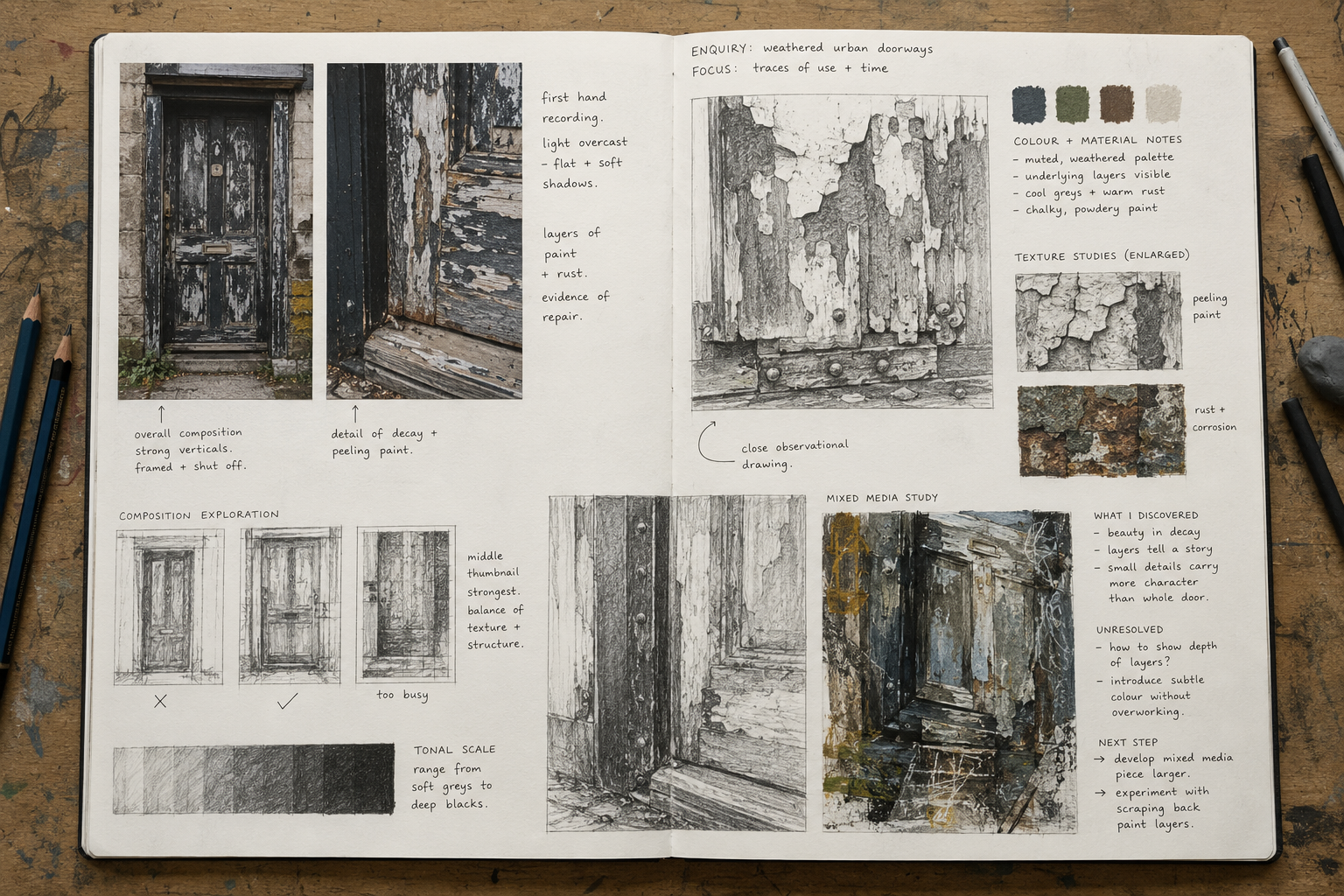
Imagine a Fine Art student investigating weathered urban doorways as evidence of use, repair and time. A weak response might copy one online photograph carefully. A stronger A Level Art AO3 enquiry begins with direct observation and uses recording to discover a personal visual direction.
- The student photographs one doorway from several distances and records the wider setting as well as overlooked details.
- A sustained graphite study identifies the dominant vertical structure, tonal depth and irregular edges.
- Enlarged studies investigate peeling paint, rust, repairs and accumulated layers.
- Colour notes record muted greys, warm rust and the difference between surface colour and underlying material.
- Composition thumbnails test whether the whole doorway or a cropped fragment better communicates traces of use.
- The student observes that small repaired areas reveal more history than the overall façade.
- A mixed-media study attempts to preserve that layering but becomes too uniformly dark.
- Critical reflection identifies the need for greater contrast between concealed and exposed areas.
- The next study retains the close crop, introduces quieter empty space and varies scraping so the layers remain distinct.
A Level Photography AO3 example
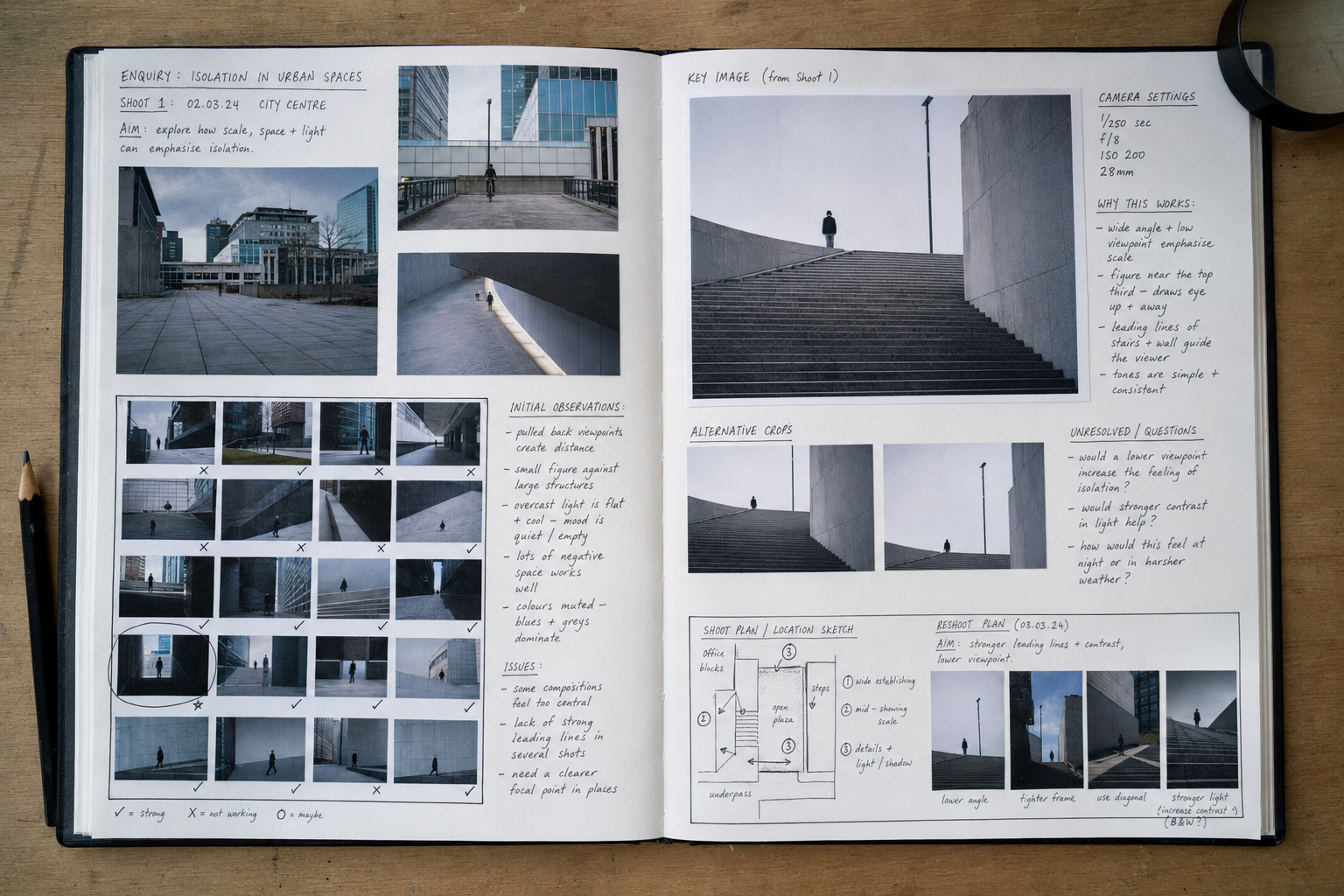
A Photography student exploring isolation in urban spaces needs more than a large contact sheet and a list of camera settings. AO3 should show what was observed, why particular frames matter and how reflection changes the next shoot.
- The student states an initial question about how figure scale, architecture, light and empty space can communicate isolation.
- An original location shoot records wide views, enclosed passages, different figure positions and changing light.
- The contact sheet is marked selectively, including images that are useful for different reasons and images that fail.
- Settings are recorded where they help explain sharpness, perspective, movement or light.
- The student notices that pulled-back viewpoints make the figure vulnerable, while several central compositions feel staged.
- One image is enlarged and annotated to identify leading lines, scale, tonal simplicity and the effect of the figure’s position.
- Alternative crops reveal that removing too much architecture weakens the sense of isolation.
- A simple location plan preserves useful positions and supports a targeted return.
- Critical reflection asks whether a lower viewpoint, stronger directional light or different weather would deepen the intended mood.
- The reshoot records those variables purposefully rather than producing more of the same images.
A Level Graphic Communication AO3 example
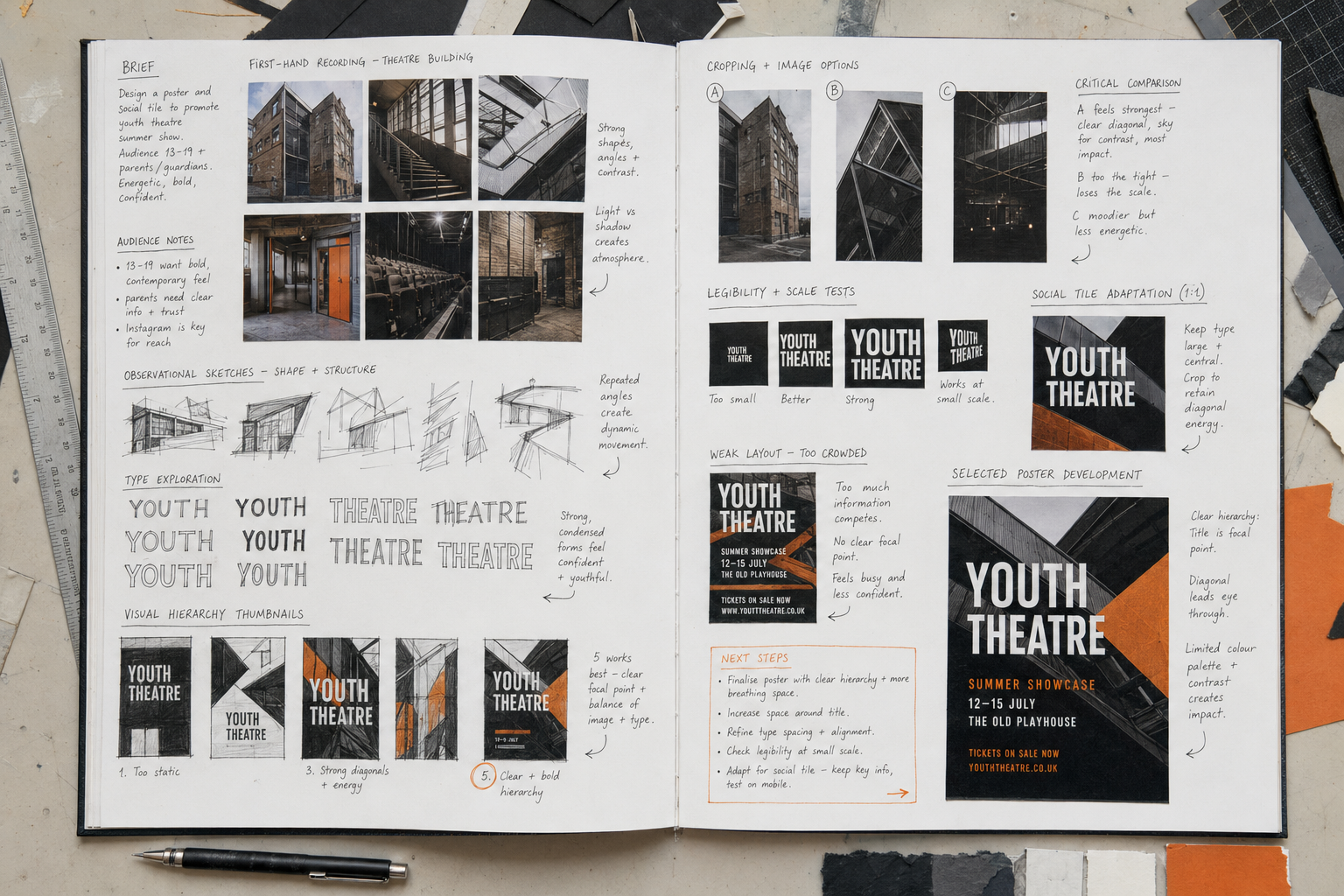
In Graphic Communication, recording should respond to a defined purpose, audience and format. A collection of unrelated posters is less useful than first-hand evidence and visual notes that help the student make communication decisions.
- The student records the youth-theatre brief, audience and required poster and social-tile formats.
- Original photographs of the theatre building capture architectural angles, shadows, textures and spaces associated with performance.
- Observational sketches extract repeated diagonals and structures rather than copying photographs decoratively.
- Hand-drawn letterform studies record variations in weight, width, energy and character.
- Hierarchy thumbnails test how quickly title, event and supporting information can be understood.
- Alternative crops are compared for atmosphere, scale and usable space for type.
- Small-scale tests reveal that one type treatment is visually interesting but loses legibility.
- A crowded layout is retained as evidence and criticised specifically rather than simply removed.
- The selected direction combines a strong diagonal crop, restrained orange accent and condensed title.
- Critical reflection identifies the next actions: increase breathing space, refine alignment, test mobile legibility and adapt the hierarchy rather than merely shrinking the poster into a square.
Description, observation, insight and critical reflection are not the same – A Level Art AO3 explained
| Level of recording | Photography example | Why it matters |
|---|---|---|
| Description | “This photograph shows a person standing at the top of some steps.” | Identifies subject matter but reveals little understanding. |
| Observation | “The small figure is surrounded by empty sky and heavy concrete forms. The steps create diagonal movement towards the figure.” | Records specific visual relationships. |
| Insight | “Although the lines lead towards the figure, the scale difference makes the architecture feel dominant; isolation is created by imbalance rather than physical distance alone.” | Interprets what the visual evidence suggests. |
| Critical reflection | “This supports my intention, but the central figure appears too controlled. I will repeat the low viewpoint with the figure entering from the right and preserve more empty space so the moment feels less staged.” | Judges relevance, identifies a limitation and creates a justified next step. |
Useful A Level AO3 annotation prompts
- I am recording… because I need to understand…
- This first-hand source is relevant to my intention because…
- Looking more closely revealed…
- The detail I initially overlooked was…
- The relationship between… and… suggests…
- This viewpoint records…, but conceals…
- Compared with…, this record gives more useful information about…
- The setting, measurement or material note matters because…
- This evidence challenges my earlier assumption that…
- The most significant discovery is… because…
- This record is technically successful, but it is less relevant because…
- My intention has changed from… to… because…
- The current work communicates…, although… remains unresolved.
- I need to return, reshoot, redraw, enlarge or compare… so that I can…
- My next decision will retain… and change… because…
Good annotation need not be long. One precise observation, one genuine insight and one justified next step can provide stronger evidence than a paragraph that narrates the making process.
Does AO3 have to be written?
AO3 is not exclusively a writing objective. Ideas, observations and insights can be recorded visually through drawings, photographs, diagrams, contact sheets, studies, maps, samples, plans and the progression of practical work. Critical reflection may also be visible when one piece of evidence causes a clear change in direction.
However, concise annotation is often valuable because it can make an insight, judgement or intended consequence unmistakable. The compulsory extended writing in the A Level Personal Investigation may contribute relevant reflective evidence, but it should not replace visual and practical recording. The portfolio must show that looking, thinking and making are connected.
What greater A Level demand looks like across all four objectives
The step from GCSE to A Level affects every Assessment Objective. Students should not make AO3 more advanced while treating AO1, AO2 and AO4 exactly as they did at GCSE.
| Assessment Objective | GCSE emphasis | What A Level requires more of |
|---|---|---|
| AO1: Develop | Investigations and critical understanding of sources | Sustained and focused enquiry, contextual breadth, analytical depth, independent judgement and research that materially redirects ideas. |
| AO2: Explore, select and refine | Exploring ideas and selecting and experimenting with suitable media, materials, techniques and processes | Purposeful exploration, discriminating selection, wider consideration of resources, stronger technical control, continuous review and repeated refinement appropriate to increasingly complex intentions. |
| AO3: Record and reflect | Recording ideas, observations and insights relevant to intentions as work progresses | More searching first-hand recording, greater precision and selectivity, deeper insight and sustained critical reflection on work and progress. |
| AO4: Present and realise | A personal and meaningful response that realises intentions and demonstrates understanding of visual language | More ambitious personal resolution, stronger synthesis, greater coherence between intention and outcome and, where appropriate, convincing connections between visual, written and other elements. |
One practical decision can provide evidence for all four AOs
A student investigates how relevant practitioners use scale and empty space to express isolation (AO1), tests viewpoint, figure position, light and crop before selecting the most effective qualities (AO2), records first-hand urban spaces and reflects critically on what each shoot reveals (AO3), then uses those connected decisions to realise a coherent personal sequence (AO4).
This is why the objectives should develop together. The strongest portfolios do not look like four separate chapters.
Weak AO3 compared with strong A Level Art AO3
| Weak or limited evidence | Stronger A Level evidence |
|---|---|
| Copied drawings from online photographs | Purposeful first-hand recording selected to investigate the student’s own intention |
| Many photographs from one position | Viewpoints, distances, conditions and details chosen to reveal different information |
| A contact sheet with favourite images circled | Selections compared against intention, with specific visual and technical reasons |
| Annotation describes materials and steps | Annotation records observations, interprets insights and judges consequences |
| Camera settings listed under every photograph | Relevant settings connected to the visual effect and future decisions |
| Every drawing is polished and complete | Different drawing methods and levels of finish selected according to investigative purpose |
| “I like this because it looks good” | Evidence-based judgement using intention, meaning, visual language, control or audience response |
| Problems are hidden or removed | Limitations are diagnosed and used to plan a more informed next stage |
| Reflection appears only at the end | Critical reflection operates throughout and visibly changes the enquiry |
| Earlier conclusions are treated as fixed | New evidence is allowed to deepen, qualify or overturn previous thinking |
Common AO3 mistakes at A Level
- Confusing recording with accumulation. More source material does not automatically provide more useful evidence.
- Relying heavily on secondary images. Online references rarely provide the same personal ownership or direct experience as first-hand enquiry.
- Drawing without a question. A technically competent study may contribute little if the student does not know what it is meant to investigate.
- Photographing without looking. Repeated snapshots often record less than a few deliberately observed viewpoints.
- Recording only whole subjects. Details, fragments, transitions and surroundings may reveal more significant information.
- Listing settings or materials. Technical information is useful only when its effect or future value is understood.
- Describing instead of interpreting. Saying what is present is not the same as explaining what it reveals.
- Using vague evaluation. “Successful”, “interesting” and “effective” need evidence and criteria.
- Writing reflection after the event. Retrospective commentary cannot replace evidence that reflection affected progress.
- Hiding failure and uncertainty. Honest, critical diagnosis can provide important developmental evidence.
- Treating annotation as decoration. Writing should be readable, precise and attached to relevant visual evidence.
- Failing to act on insights. A strong observation has limited value if it causes no further question, decision or development.
A practical AO3 project structure
This is a flexible model, not a compulsory order. Students should move between contextual investigation, first-hand recording, practical exploration and critical reflection whenever the enquiry requires it.
- Clarify the enquiry: identify the question, meaning, visual concern, audience need or practical problem being investigated.
- Plan first-hand opportunities: choose relevant subjects, locations, objects, people, events, arrangements or experiences.
- Select recording methods: match drawing, photography, sampling, notation or technical recording to the information required.
- Record breadth initially: gather enough contrasting evidence to reveal worthwhile directions.
- Review for significance: identify the details, relationships, anomalies and possibilities that deserve closer attention.
- Record in depth: return to selected evidence through closer observation, enlargement, comparison, measurement or changed conditions.
- Preserve relevant technical information: note settings, scale, location, sequence or method where this helps interpretation or repetition.
- State insights precisely: explain what has been discovered beyond simple description.
- Judge against intentions: identify what supports, complicates or contradicts the developing enquiry.
- Diagnose limitations: state what remains unclear, missing, unresolved or visually unconvincing.
- Plan and undertake a consequential next step: allow reflection to cause a new record, practical test, connection or change of direction.
- Revisit the evidence: show how later understanding has refined the original intention and contributed to AO4.
Top-level AO3 checklist for A Level students
- My recording responds to clear intentions, questions or practical needs.
- I have made first-hand recording central to my enquiry where appropriate.
- I choose sources because they can reveal relevant information.
- I use drawing in ways that help me observe, investigate, plan or communicate.
- I take my own photographs purposefully rather than using them as generic source material.
- I select recording methods according to the information I need.
- I record important visual, spatial, sensory and technical details accurately enough to use later.
- I look beyond obvious features and identify meaningful relationships or variations.
- I compare records rather than treating every example as equally valuable.
- I distinguish description from observation, insight and critical reflection.
- I explain why significant evidence is relevant to my intentions.
- I record uncertainty, failure and changed thinking honestly.
- I judge strengths and limitations using clear criteria.
- I state what remains unresolved rather than relying on vague comments.
- My annotation is concise, readable and attached to relevant evidence.
- I reflect throughout the project, not only in a final evaluation.
- My reflections cause specific and visible next steps.
- My AO3 evidence connects with AO1, AO2 and AO4.
- An examiner can trace how observation and reflection deepened my understanding.
Frequently asked questions
A Level Art AO3 explained – How many observational drawings should an A Level student produce?
No awarding organisation sets a fixed number. Produce enough purposeful recording to investigate the important visual information, compare possibilities and support development. Several connected drawings made for different investigative reasons may provide stronger AO3 evidence than many repeated studies.
Must every drawing be highly realistic?
No. The method should suit the intention. An accurate measured drawing, rapid gesture, tonal study, diagram, thumbnail or expressive record may each be appropriate. Technical control matters, but the value of a drawing also depends on what it observes, investigates or communicates.
Can photographs count as AO3?
Yes. Original photographs can record subjects, places, events, light, viewpoint, sequence, detail and atmosphere. They become stronger evidence when the purpose is clear, selections are thoughtful and critical reflection explains what the images reveal and how they affect progress.
Do contact sheets automatically provide strong AO3?
No. A contact sheet documents a shoot, but the quality of AO3 depends on the intention behind the shoot, the range and relevance of recording, the student’s selections, the insights gained and the consequence for later work.
Does all critical reflection need to be negative?
No. Critical reflection is balanced judgement. It can identify strengths, limitations, contradictions and possibilities. A positive conclusion is critical when it is supported by specific evidence and leads to an informed decision.
Can one piece of evidence contribute to several Assessment Objectives?
Yes. A first-hand study may be informed by AO1 research, record observations and insights for AO3, generate an AO2 experiment and contribute to the later realisation of intentions in AO4.
What is the clearest sign of strong A Level Art AO3?
The examiner can see that recording is selective and relevant, that observation produces genuine insight and that critical reflection changes what the student thinks or does next. The portfolio records an evolving enquiry—not merely a completed sequence of activities.
The key message
A Level Art AO3 requires more purposeful first-hand recording, more perceptive insight and more sustained critical reflection—not simply more drawings, photographs or annotation.
The strongest AO3 journey is a dialogue between looking and thinking. Each record captures evidence that matters; each observation identifies something specific; each insight deepens understanding; and each critical reflection creates a more informed question, decision or next step.
Would detailed feedback help?
If you are unsure whether your A Level recording is sufficiently purposeful, whether your reflection is genuinely critical or how your evidence currently meets AO1–AO4, Portfolio to A Star can provide focused portfolio feedback and practical priorities for improvement.
Official specification sources
Assessment requirements can be updated. Students and teachers should always check the current specification and guidance for their awarding organisation.