
BTEC Component 2: Responding to a Brief
A student-friendly guide to interpreting the brief, developing purposeful ideas and presenting a focused final response.
Component 2 is the externally assessed synoptic part of the BTEC Level 1/2 Tech Award in Art and Design Practice. Pearson sets and marks the task, and the work is completed under supervised conditions. It builds on the practical knowledge and skills developed in Component 1. Always follow the live task and your centre’s instructions.
Component 2 at a glance
External synoptic assessment
Pearson sets and marks the task. It brings together learning and practical skills from across the qualification.
48 guided learning hours
Teaching and preparation develop the knowledge and skills needed to interpret and answer a creative brief.
Up to 20 supervised hours
The assessed task is completed under the supervision arrangements and timetable specified by Pearson and your centre.
60 marks
Your development, final response and portfolio presentation are assessed together as one connected response.
The three assessment objectives
Component 2 is organised around three linked objectives. Your portfolio should make it easy to see how understanding the brief leads to development and then to a clear presentation.
AO1
Understand the brief
Identify its purpose, audience, requirements, creative opportunities and constraints. Use relevant research to inform your intentions.
AO2
Develop and produce
Generate alternatives, select appropriate materials and techniques, test ideas, review progress and produce a response that meets the brief.
AO3
Present the response
Organise the portfolio so it communicates intentions, changes, refinement and the final response clearly and appropriately.
How to decode a creative brief
What must be produced?
Underline the required outcome, format and any practical specifications. Separate essential requirements from optional possibilities.
Who is the audience?
Think beyond age. Consider the audience’s interests, expectations, location, access needs and how they will encounter the work.
What is the purpose?
Decide whether the response should inform, persuade, celebrate, challenge, guide, decorate or communicate in another way.
What are the constraints?
Note time, size, materials, resources, safety, function, style and presentation requirements. Constraints can generate ideas rather than simply limit them.
What evidence is needed?
Plan how to record research, initial ideas, tests, review, refinement, the final response and the decisions that connect them.
What is your intention?
Write a concise intention that links the brief, audience, purpose, chosen discipline and the effect you want the response to achieve.
A practical route through Component 2
1. Interpret the brief
Identify the required response, audience, purpose, constraints and creative opportunities before committing to an idea.
2. Research with purpose
Gather visual and contextual sources that answer questions raised by the brief and can influence practical decisions.
3. Generate alternatives
Produce several directions and compare how effectively each could communicate with the intended audience.
4. Test materials and techniques
Explore relevant processes, record results and select methods because they suit the purpose—not simply because they look attractive.
5. Develop the strongest direction
Combine useful discoveries, improve composition and technique, and keep checking the work against the brief.
6. Review and refine
Judge fitness for purpose, audience response, technical quality and clarity. Show how review leads to visible changes.
7. Produce the final response
Use appropriate control and finish while keeping the outcome connected to your evidence and original intentions.
8. Present the portfolio
Edit and organise the evidence so the development, decisions, refinement and final response can be followed without guesswork.
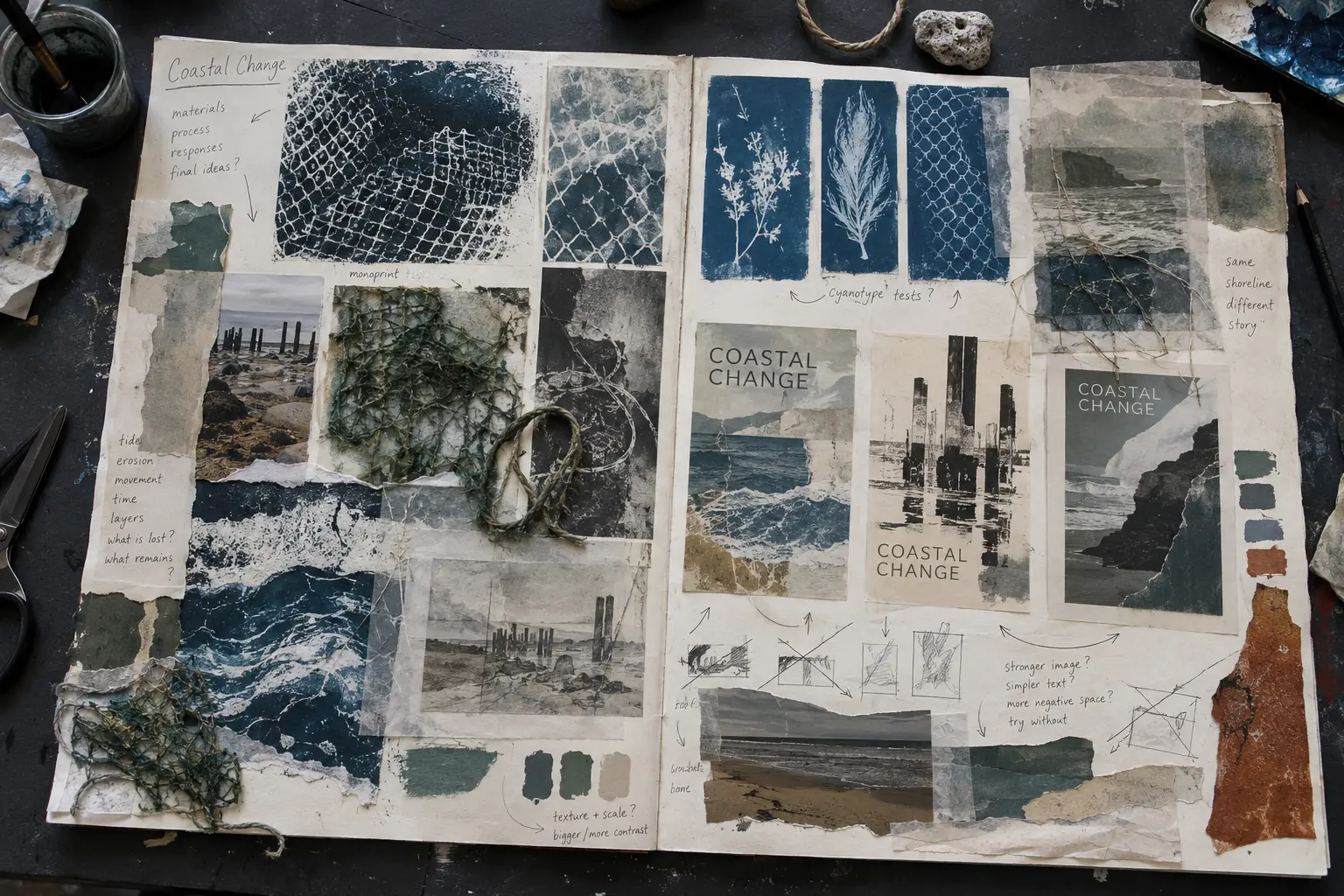
Exemplar project: Coastal Change
This illustrative project is pitched at Level 1/2 students. It is not assessed work and should not be copied. Use it to see how one idea can move from understanding a brief to a purposeful final response.


What stronger responses tend to show
A precise reading of the brief
Research and ideas respond directly to the audience, purpose and constraints rather than drifting into a general theme.
Relevant creative decisions
Materials, processes, imagery, scale and format are selected because they help the response work.
Visible alternatives
The portfolio shows more than one possible direction and explains why the stronger option was selected.
Review that changes the work
Evaluation leads to practical refinement instead of being added after decisions have already been made.
Fitness for purpose
The final response communicates clearly, suits its audience and works in the intended context or format.
A readable presentation
Images, samples and concise annotation are edited into a clear account of intentions, changes and achievement.
Useful annotation for Component 2
“The brief is aimed at local teenagers, so I selected familiar coastal photographs and tested a direct composition that can be understood quickly.”
“The net print created useful texture, but it reduced the clarity of the cliff image. In the next version I will keep it to one smaller area.”
“I changed the portrait layout to landscape because it shows the coastline more clearly and gives the image a stronger sense of distance.”
Effective annotation explains how a decision answers the brief, what the test revealed and what will change next.
Portfolio presentation checklist
- The brief, audience, purpose and constraints are clearly understood.
- Research is relevant and visibly informs the response.
- Several initial possibilities are shown.
- Material and technique tests have a clear purpose.
- Review leads to visible development and refinement.
- Changes in direction are explained and justified.
- The final response is shown clearly, including useful detail views where needed.
- The portfolio is organised so the creative journey is easy to follow.
Important assessment boundaries
Component 2 is an externally set and marked task completed under supervised conditions. Follow your centre’s instructions about permitted resources, preparatory work, supervision and what may be taken into each session. Produce your own response; do not submit exemplar images, wording or layouts from this website as your work. The live Pearson task and your centre’s instructions always take priority over general guidance.
Component 2 frequently asked questions
Is Component 2 an exam?
It is an externally assessed set task rather than a written examination. You develop and present practical art or design work under Pearson’s supervision arrangements.
How long is the supervised assessment?
The current specification allows a maximum of 20 supervised hours, arranged by the centre within Pearson’s timetabled assessment period.
Does Component 2 build on Component 1?
Yes. Component 2 is synoptic, so it brings together the research, idea-generation, practical development and presentation skills built through Component 1.
Can I work in any art and design discipline?
Your response may use an appropriate discipline and process permitted by the task and supported by your centre’s resources. The chosen approach must meet the brief.
What should the portfolio include?
Show the key stages: understanding and research, initial possibilities, tests, review, development, refinement and a clearly presented final response.
Can I change direction during the task?
Yes, when evidence shows why the change helps you answer the brief more effectively. Record the decision and keep checking the new direction against the audience, purpose and constraints.
Return to BTEC Level 1/2
Check the official qualification
View Pearson’s current qualification information and assessment materials.