
UNDERSTAND YOUR LEVEL 3 COURSE
The BTEC Level 3 in Art and Design gives you the freedom to be creative while developing the practical, technical and professional skills needed for higher education or a career in the creative industries.

LEVEL 3 ROUTES

PROJECT-BASED LEARNING
Work on real creative projects that allow you to develop your ideas, skills and your own creative style.

PORTFOLIO EVIDENCE
Learn how to document your creative journey and to produce high-quality portfolio evidence

PASS TO DISTINCTION*
Get practical advice, examples and support to help you achieve your best grade, from Pass to Distinction*
Choose the right qualification route
Art and Design (2016)
A broad, flexible course covering fine art, graphic design, photography, fasion, 3D design and more. Ideal if you want to explore different disciplines before specialising.
Art and Design Practice (2019)
A. more focussed course that allows you to specialise in a particular area of art and design practice. Designed for students who want to develop in depth, sector-specific skills.
What a strong Level 3 portfolio should show

Investigate
Research artists, contexts and ideas to inform your own work.

Experiment
Tru out materials, techniques and processes to explore possibilities.

Develop
Refine your ideas, make connections and take your work further.

Refine
Select and resolve your strongest ideas, showing critical judgement.

Present
Showcase your final work and supporting evidence in a clear, professional way.
Level 3 student work examples
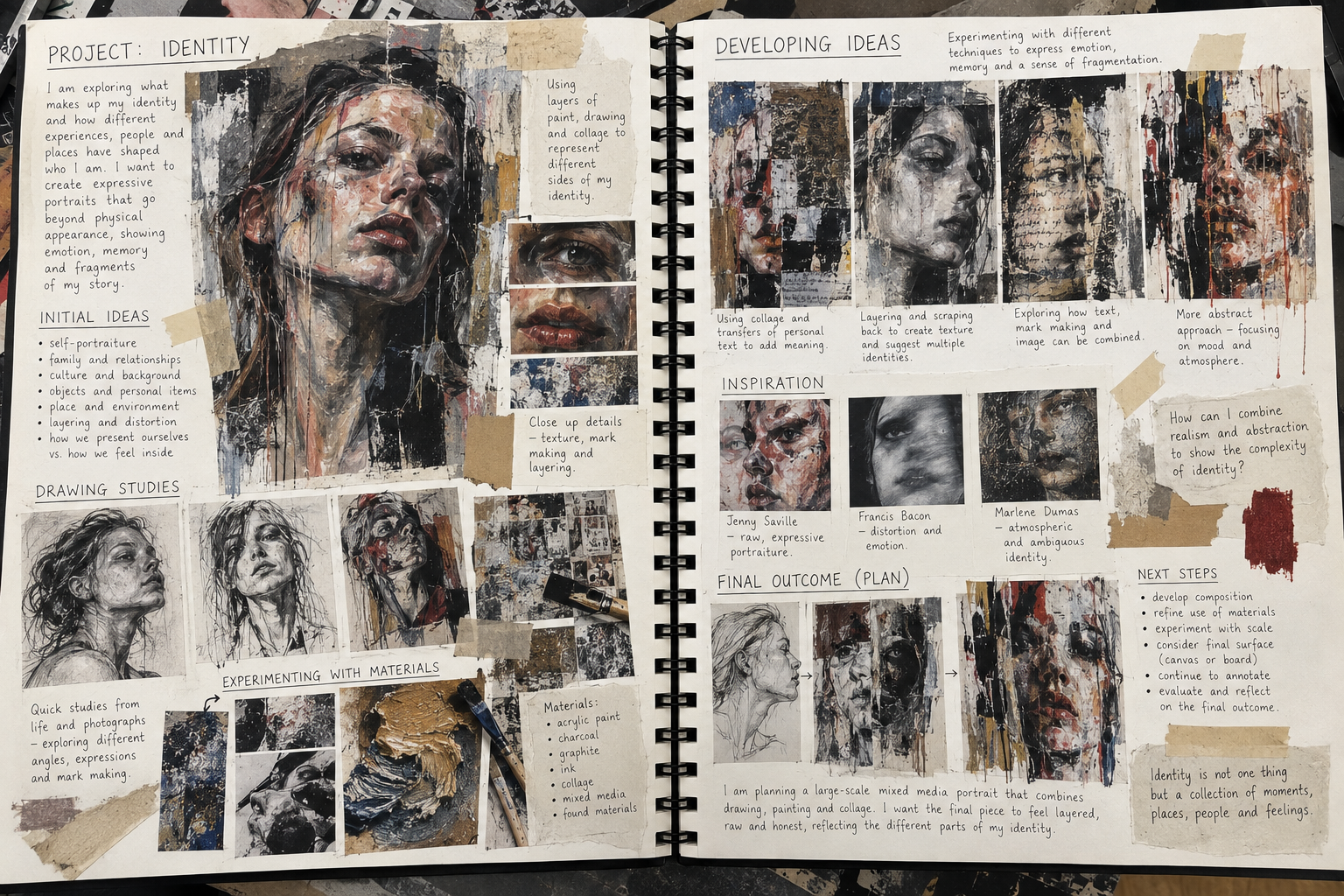
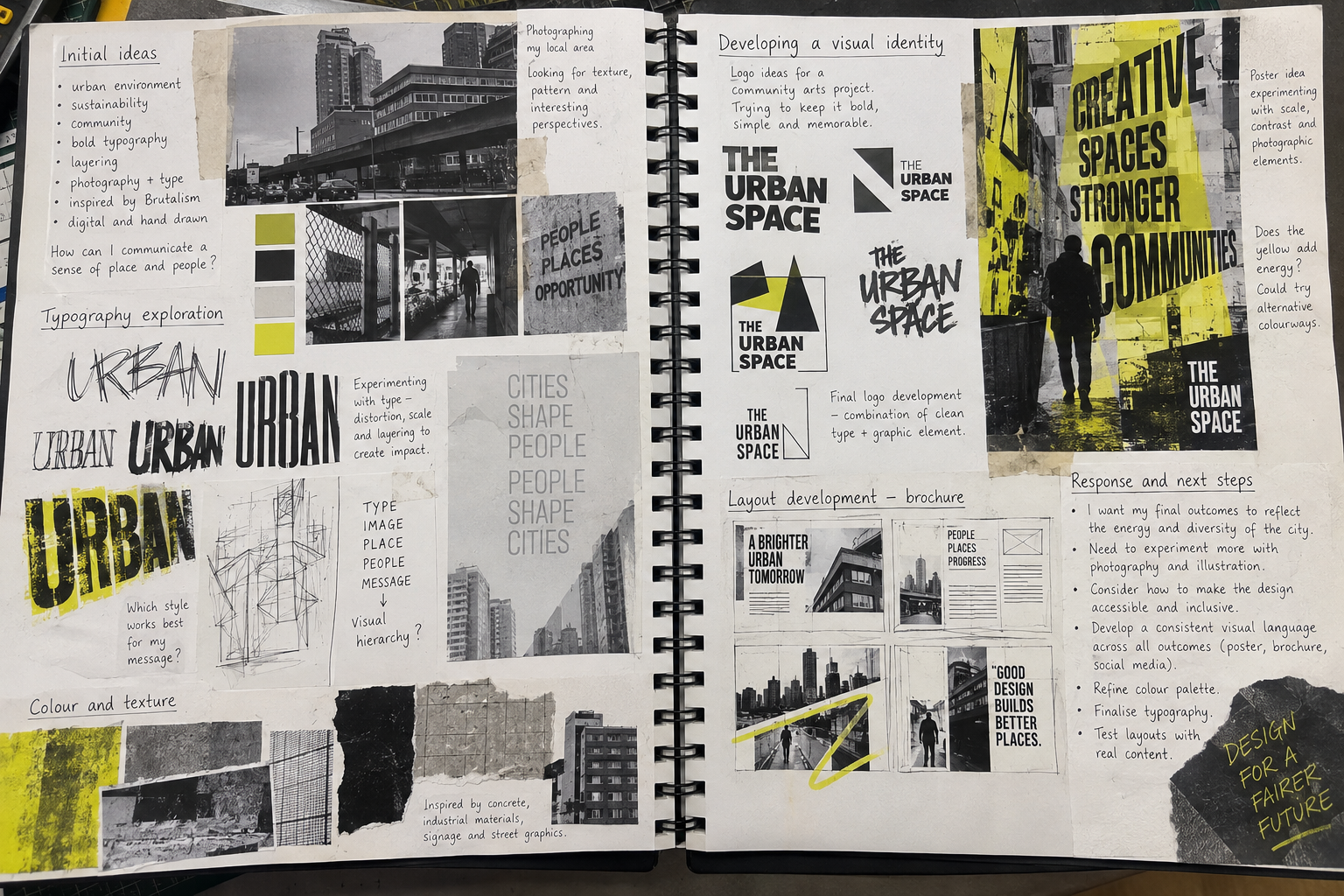
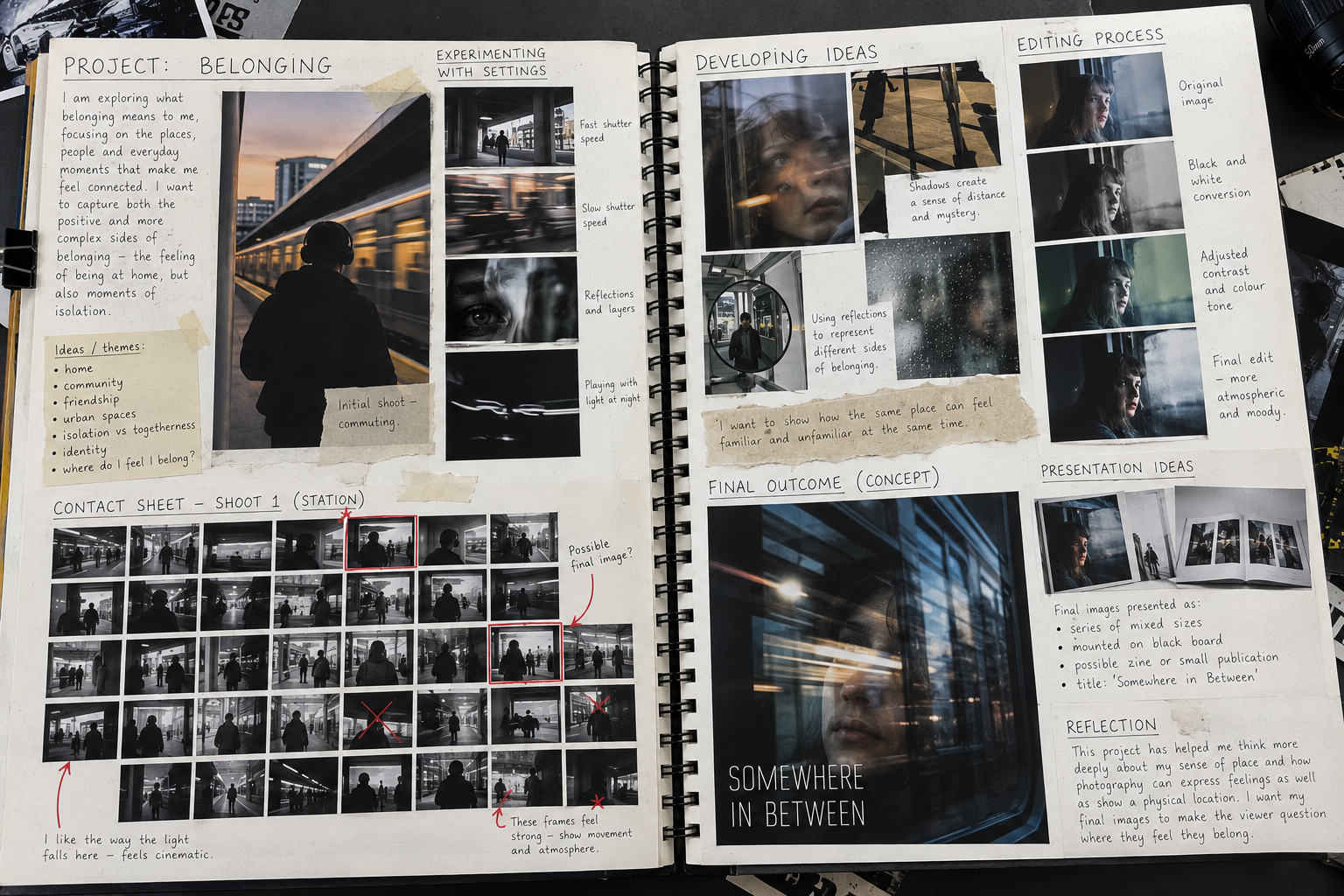
The BTEC Level 3 in Art and Design is a vocational qualification for students who want to develop practical and creative skills through project-based learning. Rather than relying mainly on written examinations, you build evidence through research, experimentation, development, practical work and finished outcomes.
Depending on the qualification and course offered by your school or college, you might explore Fine Art, Photography, Graphic Communication, 3D Design, Fashion or other creative disciplines. BTEC Level 3 qualifications can support progression to university, apprenticeships or employment in the creative industries.
This depends on which BTEC Level 3 specification you are studying. The 2016 BTEC Nationals in Art and Design use a combination of internally assessed assignments and externally set and assessed units. External tasks can include preparatory work, practical investigation and supervised assessment rather than simply a traditional written exam.
The 2019 BTEC Nationals in Art and Design Practice take a different approach. They are structured around practical assessment units and assessment criteria, with students developing evidence through creative projects and responding to vocationally relevant briefs. Grades are awarded from Pass through Merit and Distinction to Distinction*.
Yes. BTEC Level 3 Art and Design qualifications are designed to support progression to higher education as well as employment and further training. Pearson specifically identifies higher education as a progression route for its Level 3 Art and Design qualifications.
For creative degrees, universities may consider your qualification results alongside your portfolio, personal statement and, in some cases, an interview. Entry requirements vary considerably between universities and courses, so always check the requirements for the courses you are considering.
They are two different Pearson BTEC Level 3 qualifications, rather than simply old and new versions of exactly the same course.
The 2016 BTEC Nationals in Art and Design have a unit-based structure and include both internal and external assessment. They are available in several qualification sizes and include routes such as the Extended Certificate, Foundation Diploma, Diploma and Extended Diploma.
The 2019 BTEC Nationals in Art and Design Practice were designed around a more integrated creative-practice model. Students work through a creative process involving investigation, experimentation, development, refinement and production rather than treating skills as a series of largely separate units. Pearson describes the qualification as adaptable to both general and specialist creative practice.
Check with your school or college which specification you are studying, because the assessment structure and grading requirements are not identical.
Not necessarily. One of the strengths of BTEC Art and Design is the opportunity to explore different creative practices. You might work with drawing, painting, photography, digital media, graphic design, illustration, printmaking, textiles, 3D work or combinations of these.
Some courses are deliberately broad, while others are organised around a particular pathway. Pearson describes the 2019 Art and Design Practice qualification as suitable for a wide range of general or specialist practices, so exactly what you study will partly depend on the course your school or college offers.
There is written work, but BTEC Art and Design is not primarily an essay-based qualification. Most of your evidence is generated through the creative process.
You will normally need to document your research, explain your ideas, analyse relevant artists and designers, record experimentation, evaluate decisions and reflect on how your work develops. This might appear as sketchbook annotation, digital portfolio notes, evaluations, presentations or other forms of evidence rather than long essays.
The important thing is that your written evidence helps explain your thinking and creative decision-making — it should support the practical work rather than overwhelm it.
There isn’t one BTEC grade that guarantees university entry. Requirements vary according to the university, degree course and the particular BTEC qualification you are taking.
For Art and Design courses, your portfolio can also be an important part of the application, alongside your Level 3 results. You should therefore check the published entry requirements for each university course you are considering rather than assuming that a particular BTEC grade will automatically be enough.
For the 2019 Art and Design Practice qualification, Pearson’s grading runs from Pass to Distinction*; the Extended Diploma uses combinations such as PPP, MMM, DDM, DDD and D*D*D*.
Yes — depending on the size of the BTEC and the programme offered by your school or college. Some BTEC Level 3 qualifications are specifically designed to be studied alongside other Level 3 qualifications.
For example, Pearson describes the BTEC Level 3 National Extended Certificate in Art and Design as part of a programme of study that can include other BTECs or A Levels. Larger BTEC qualifications take up more curriculum time, so an Extended Diploma would normally form a much greater proportion of your study programme.
Pearson provides Sample Marked Learner Work, assessment materials and other teaching and assessment resources for BTEC Level 3 Art and Design. These can be useful for seeing how evidence is organised and how assessment criteria are applied. Some Pearson materials are restricted to teachers and centres, while others are publicly available.
You can also explore the BTEC Level 3 guides and exemplar projects here on Portfolio to A Star, where we show examples of sketchbook development, experimentation, annotation and progression towards final outcomes.
Yes, but it depends on the size of the BTEC qualification you are studying. BTEC Level 3 qualifications are at the same qualification level as A Levels, but different BTEC programmes represent different amounts of study.
For Pearson’s BTEC Level 3 Nationals in Art and Design, the Extended Certificate is equivalent in size to 1 A Level, the Diploma to 2 A Levels, and the Extended Diploma to 3 A Levels. The smaller Certificate is equivalent to half an A Level.
“Equivalent in size” does not mean that BTECs and A Levels are taught or assessed in the same way. BTEC Art and Design places considerable emphasis on practical projects, developing ideas, experimentation, creative processes and portfolio work, whereas A Level Art and Design follows a different assessment structure.
BTEC Level 3 qualifications can also carry UCAS Tariff points for university applications. For example, Pearson’s current tariff information shows that a D* in the Extended Certificate carries 56 points, the same tariff value as an A* at A Level. Universities set their own entry requirements, however, and students should always check the requirements for the particular degree they are considering.
Compare BTEC Level 3 with A Level
See the key differences to help you to choose the right pathway for your future
Visit the Official Pearson qualifications
Visit the Official qualification pages for a full course overview, entry requirements and updates.