
GCSE Art AO1 Explained: Research, Sources and Developing Ideas
AO1 is where your GCSE Art project begins to become more than a collection of attractive images. It shows that you can investigate a theme, learn from relevant sources and use what you discover to develop ideas of your own.
Students often call AO1 “artist research”, but that description is too narrow. Research is part of it; what matters is what the research helps you notice, question, test and change.
This guide explains the official wording, the evidence an examiner needs to see and the difference between a page that simply contains information and a project in which research genuinely drives the work forward.
The most important difference
At GCSE, AO1 asks you to investigate sources and demonstrate critical understanding. At A Level, that investigation must be more sustained and focused, with greater analytical depth. GCSE AO1 is less involved, but it is not superficial: your sources still need to make a visible difference to your ideas.
What Is AO1 in GCSE Art?
For GCSE Art & Design qualifications in England, the assessment objectives are set nationally. The official AO1 wording is:
Develop ideas through investigations, demonstrating critical understanding of sources.
Ofqual GCSE Art & Design assessment objective AO1
GCSE Art AO1 is worth 25% of the total marks. It applies to both your portfolio and the externally set assignment, although the way your school organises the work may vary.
The wording is short, but every part matters.
Develop ideas – GCSE Art AO1
Your project should change as it progresses. A source might influence your subject matter, composition, colour, materials, scale, viewpoint, lighting, typography, construction or meaning. Development means making purposeful decisions rather than repeating the first idea.
Through investigations
An investigation is active. You gather evidence, look carefully, ask questions, make visual responses and test possibilities. Reading a short biography and copying one artwork is not a complete investigation.
Demonstrating critical understanding
“Critical” does not mean being negative. It means selecting what is relevant, analysing how it works and forming a reasoned judgement. You should be able to explain what you learned, why it matters to your theme and how it will affect your next step.
Of sources
A source is anything relevant that helps you investigate and develop your project. Artists are important sources, but they are not the only ones.
What Counts as a Source?
Strong GCSE projects usually combine first-hand sources with carefully selected secondary sources.
First-hand sources
- Your own photographs
- Observational drawings
- Objects, people and places you can study directly
- Textures, natural forms and found materials
- Gallery, museum, site or studio visits
- Interviews, memories and personal experiences
Secondary sources
- Artists, designers, photographers and craftspeople
- Artwork seen in books, catalogues or reliable websites
- Architecture, historical objects and cultural material
- Films, literature, music or advertising when relevant
- Articles, documentaries and museum collection pages
Choose sources because they can help your project—not because they are famous or easy to find. A less obvious source that connects closely to your theme is often more useful than a predictable artist added at the end.
Source test: Can you identify one specific thing this source has helped you understand or change? If not, you may need to investigate it more carefully or choose a more relevant source.
AO1 Is Not About Filling Artist-Research Pages
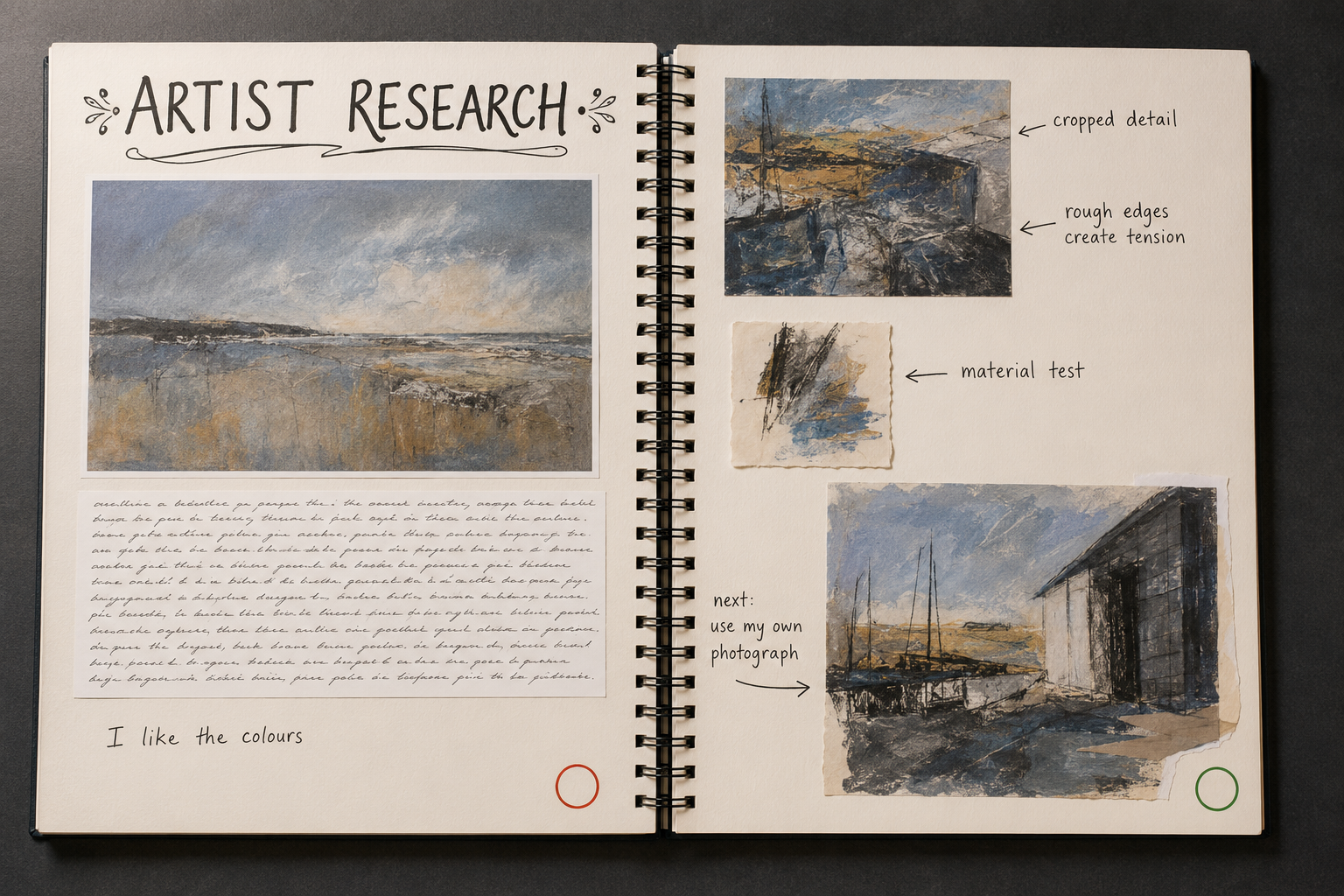
A page can look busy and still contain weak AO1. Long biographies, decorative headings, printed images and copied quotations may show that you found information, but they do not automatically show critical understanding.
| Weaker evidence | Stronger evidence |
|---|---|
| A general biography copied from a website | A short, relevant introduction written in your own words |
| Several artworks with no clear reason for their selection | One or two carefully selected works analysed closely |
| “I like the colours because they are bright” | An explanation of how colour creates mood, focus or meaning |
| A careful copy with no reflection | A practical study followed by a judgement about what was learned |
| The artist appears once and is never mentioned again | The source is revisited when compositions, materials or ideas are refined |
The aim is not to imitate another person’s finished work. It is to understand something useful about their choices and then apply that understanding to your own project.
What Strong AO1 Looks Like
Good AO1 normally follows a simple cycle. It does not have to appear in this exact order, and you may return to a source later in the project.
- Investigate: gather relevant first-hand and contextual sources.
- Observe: notice specific features, choices and meanings.
- Analyse: explain how and why those features work.
- Respond: make a drawing, photograph, study, sample or design informed by the source.
- Compare: judge what was successful and what could change.
- Decide: state the next step and show it in the following work.
This gives you a useful AO1 formula:
Source → Observe → Analyse → Respond → Compare → Decide → Develop
The final word is the most important. If your investigation does not lead to development, the chain is incomplete.
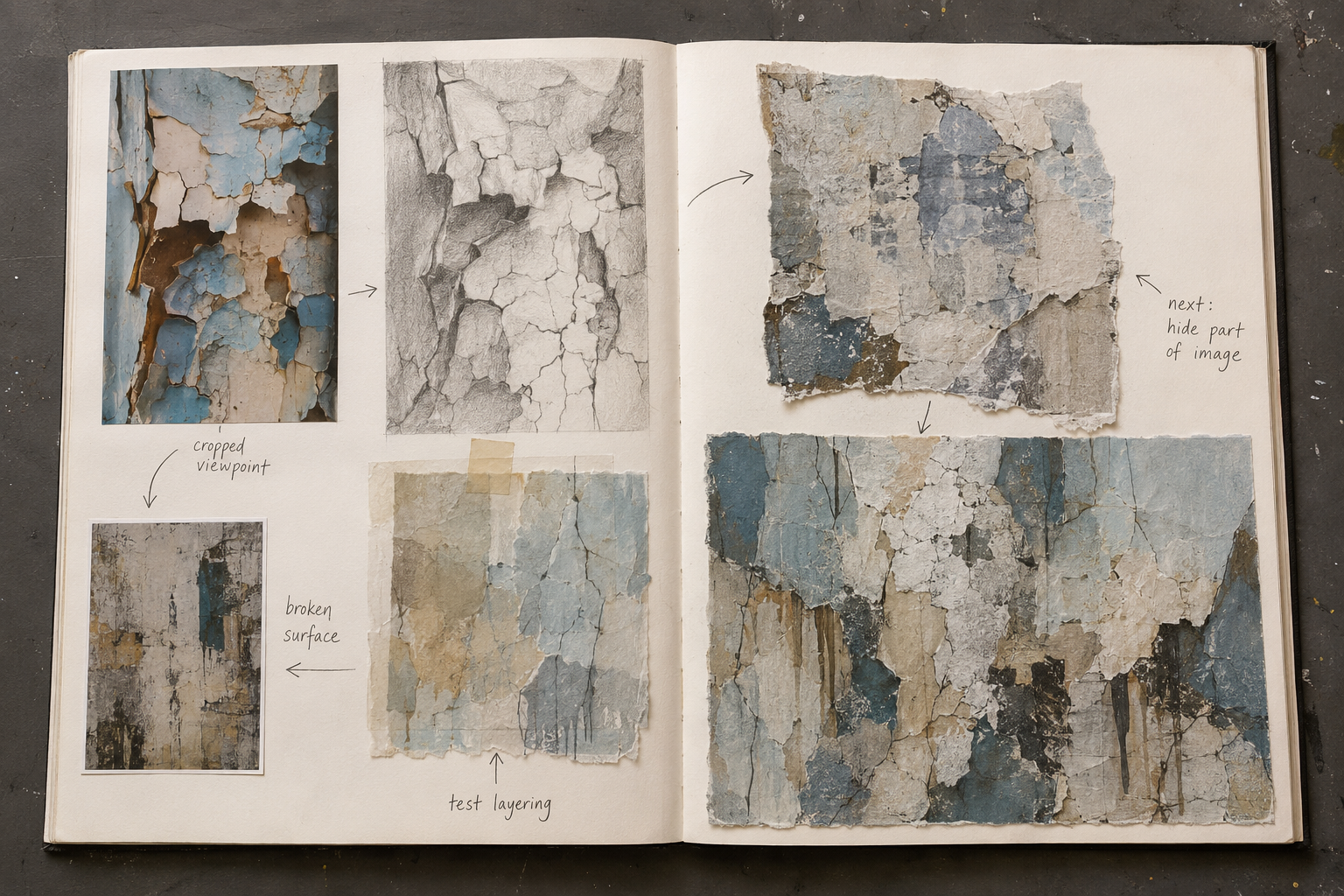
A Practical GCSE AO1 Example
Imagine that your theme is Layers and Decay.
- You photograph peeling paint, torn posters and weathered doors in your local area.
- You make close observational studies to understand edges, cracks and overlapping surfaces.
- You investigate an artist who uses distressed surfaces and analyse how texture, limited colour and fragments create a sense of history.
- You test paint, collage, sanding and image transfer using your own photographs.
- You compare the samples and decide that a cropped composition and partly hidden image communicate your theme most effectively.
- You use that decision to plan a more personal final piece.
The artist research is only one part of the AO1 evidence. Your photographs, observations, analysis, experiments and decisions work together to show a genuine investigation.
AO1 in Different GCSE Art Specialisms
The assessment objective is the same across specialisms, but the evidence can look different.
| Specialism | Possible investigation | Visible development |
|---|---|---|
| Fine Art | Own photographs of enclosed spaces, observational drawing and study of an artist’s use of viewpoint | Cropped compositions, changed scale and a more personal arrangement of forms |
| Photography | Initial street shoot and analysis of how a photographer uses light, sequence or distance | A targeted reshoot with more controlled framing, timing and visual narrative |
| Graphic Communication | Research into audience, purpose, type hierarchy and relevant poster designers | Thumbnail layouts that combine original imagery and clearer visual communication |
| Textile Design | Study of natural structures, surface patterns and a designer’s construction methods | Samples in which stitch, layering and material choice become increasingly purposeful |
| Three-Dimensional Design | Investigation of function, users, existing products, structures or architectural forms | Models and prototypes that respond to testing and improve form, scale or function |

How to Write Useful AO1 Annotation
Annotation should make your thinking visible. It does not need to be long, but it should be specific. Avoid describing only what the reader can already see.
A weak comment for GCSE Art AO1
I like this artist because the colours are interesting. I copied the picture in pencil.
A stronger comment for GCSE Art AO1
I selected this work because the tightly cropped viewpoint makes an ordinary surface feel unfamiliar. In my pencil study, the strongest area is where sharp lines meet broken tonal marks. I will photograph my own subject at closer range and test a similar contrast without copying the artist’s composition.
Useful sentence starters include:
- I selected this source because…
- The most relevant feature is…
- The artist, designer or photographer creates this effect by…
- This connects to my theme because…
- In my response, I tested…
- The strongest part is… because…
- This did not work as well because…
- As a result, I will next…
Specific visual language helps: composition, viewpoint, scale, contrast, line, tone, colour, texture, pattern, form, space, materials, process, function, audience and meaning.
How Much Research Do You Need?
There is no useful fixed number of artists or research pages. One source investigated thoroughly and used repeatedly can be more valuable than five shallow pages. However, a strong project usually draws from a relevant range of sources rather than depending entirely on one artist.
Ask these questions instead:
- Have I gathered enough first-hand material to make the project personal?
- Have I selected contextual sources for a clear reason?
- Have I analysed particular works rather than written only biographies?
- Have I made practical responses that test what I learned?
- Can an examiner see how the investigation changed my ideas?
What Separates Developing AO1 from High-Level AO1?
GCSE grades are awarded from the evidence across all four assessment objectives, so no single research page can guarantee a grade. However, the qualities below show the direction of progress.
| Developing AO1 | High-level AO1 |
|---|---|
| Sources are relevant but choices may be teacher-led or predictable. | Sources are relevant, increasingly independent and sometimes unexpected. |
| Comments identify some visual features. | Analysis explains how choices create effects, ideas or meanings. |
| Practical responses show influence from a source. | Responses apply understanding selectively and avoid simple imitation. |
| Ideas develop in a mostly logical way. | Ideas develop convincingly through comparison, reflection and purposeful decisions. |
| First-hand research is present. | First-hand research gives the project a clear personal direction. |
At the highest GCSE level, the investigation feels independent and convincing. You can see that the student understands their sources and has used that understanding to make increasingly personal choices.
AO1 Does Not Work Alone
The four assessment objectives are connected. A useful source might begin in AO1, lead to material experiments in AO2, encourage more recording in AO3 and influence the final response in AO4.
- AO1: investigate sources and develop ideas.
- AO2: refine ideas by experimenting with materials and processes.
- AO3: record observations, insights and intentions.
- AO4: present a personal and meaningful response.
This is why AO1 should not look like a sealed “artist research section” at the front of the sketchbook. Good sources can appear at the beginning, return during experiments and help resolve the final work.
For more support with the complete course, visit the GCSE Art Hub.
Common GCSE ART AO1 Mistakes
- Choosing a source after making the work. The connection then feels forced rather than investigative.
- Writing too much biography. Dates and life stories rarely explain how the work could inform your own ideas.
- Using only internet images. Your own photographs, observations and experiences give the project individuality.
- Copying without purpose. A copy only becomes useful evidence when you explain what it helped you understand.
- Making vague comments. “I like it” is an opinion, not critical understanding.
- Forgetting the next step. Analysis should lead to a decision that appears in later work.
- Using the same source in the same way repeatedly. Select, adapt and combine ideas rather than producing pastiche.
- Presenting polished pages but little thinking. Clear connections matter more than decoration.
GCSE AO1 Checklist
Before you finish a project, check whether your work shows the following:
- ☐ A clear starting point, theme, question or intention
- ☐ Relevant first-hand sources, including your own recording
- ☐ Carefully selected artists, designers or other contextual sources
- ☐ Analysis of specific works and visual choices
- ☐ Practical responses that explore what you learned
- ☐ Comparisons and honest judgements
- ☐ Written or visual evidence of your next decisions
- ☐ Ideas that become more personal as the project develops
- ☐ Links between AO1 and your experiments, recording and final response
- ☐ Sources acknowledged clearly enough for someone else to identify them
A final test
Cover the artist’s name and look only at your own work. Can you still see what you discovered, what you tested and how your idea changed? If the answer is yes, your AO1 is doing its job.
GCSE Art AO1 FAQs
Does GCSE Art AO1 just mean artist research?
No. Artist research is one form of contextual investigation. AO1 also includes relevant first-hand research, visual analysis, practical responses and the development of your own ideas.
How many artists should I research for GCSE Art AO1?
There is no universal number. Choose a manageable range of relevant sources and use them purposefully. Follow any project-specific guidance from your teacher.
Do artist copies count towards AO1?
They can contribute when the study has a clear investigative purpose and you explain what it taught you. A copy on its own does not demonstrate critical understanding or idea development.
Can my own photographs count as sources?
Yes. Original photographs are valuable first-hand sources, especially when you select, crop, compare and use them to develop work rather than treating them as simple documentation.
Does AO1 annotation need to be long?
No. Short, specific comments can be stronger than a page of general description. Explain what you noticed, why it matters, what you tested and what you will do next.
Can I introduce a new source later in the project?
Yes. The assessment objectives do not have to appear in a fixed sequence. A new question, experiment or problem may lead you to a relevant source later, provided the connection is genuine and visible.
Official Guidance
Assessment requirements can be checked through the Ofqual assessment objectives and your own exam board’s current specification. Useful starting points include AQA GCSE Art & Design, Pearson Edexcel GCSE Art & Design, OCR GCSE Art & Design and Eduqas GCSE Art & Design.
Your teacher will know how your centre applies the assessment criteria, so use their instructions alongside this guide.
Not Sure Whether Your AO1 Is Strong Enough?
Independent feedback can help you see whether your research is genuinely developing your ideas, where connections are unclear and what to improve before submission.