
GCSE Art & Design (Graphic Communication) Explained: Course, Assessment and How to Succeed
The GCSE Graphic Communication course is not just about making attractive posters or using design software. It rewards the complete design journey: understanding a brief, investigating useful designers and sources, recording first-hand information, generating alternatives, testing visual communication, refining ideas and presenting a personal response that is fit for its intended audience and purpose.
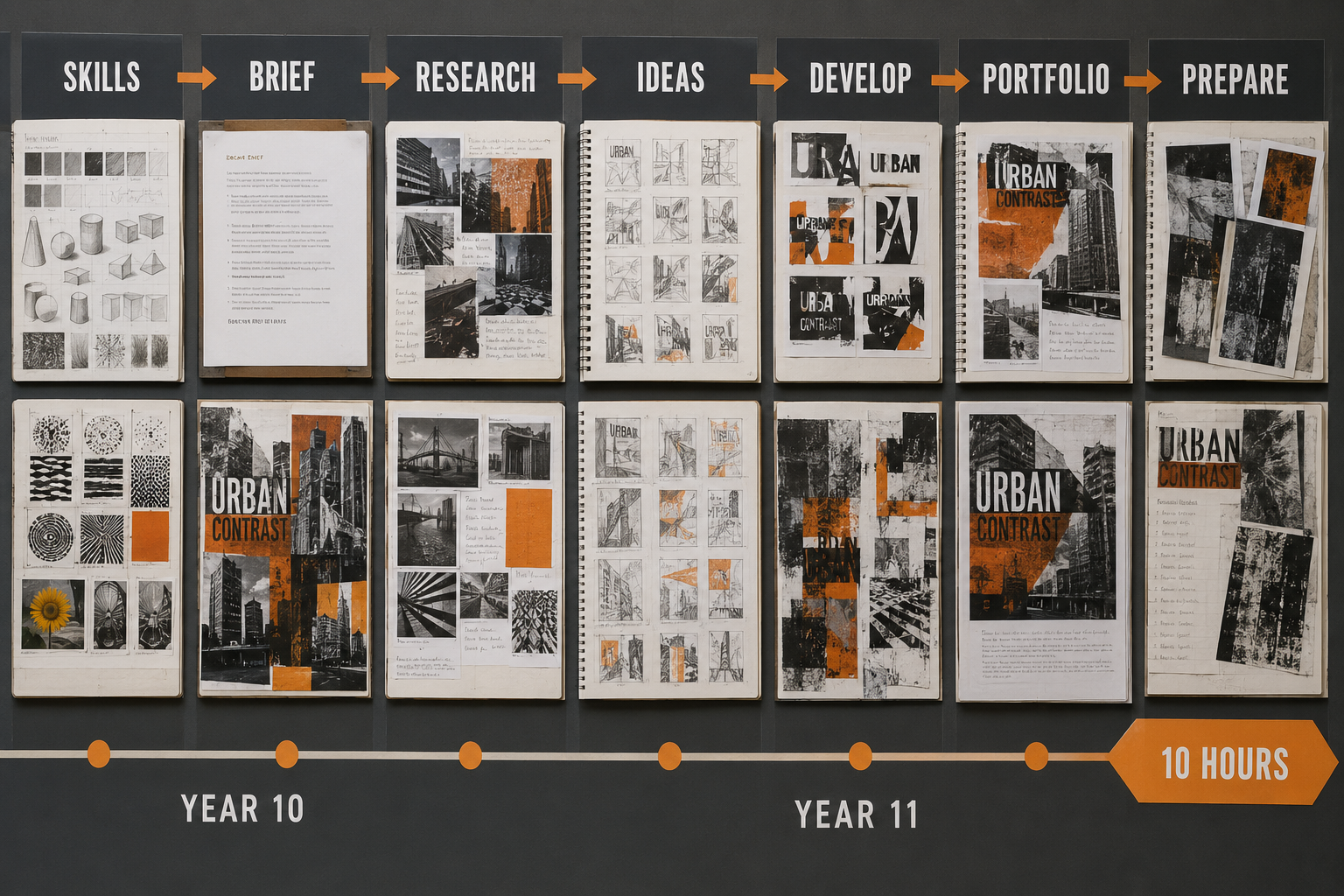
Most students complete the GCSE Graphic Communication course during Years 10 and 11. Your school will organise the course in its own way, but the main exam boards in England use the same four Assessment Objectives and the same overall balance between the portfolio and externally set assignment.
The GCSE Graphic Communication course in one sentence
You investigate a communication problem, learn from designers and other sources, record original information, generate and test visual ideas, refine the strongest direction and present a personal response—while showing clear evidence of AO1, AO2, AO3 and AO4 throughout.
What is the GCSE Graphic Communication course?
The GCSE Graphic Communication course is one of the available GCSE Art & Design titles. It is the process of designing mainly visual material to communicate information, ideas, meaning and emotions in response to a given or self-defined brief. It combines creative image-making with purposeful decisions about audience, message, typography, hierarchy, layout, format and context.
Depending on your school’s facilities and the direction of your project, you might explore:
- Communication graphics
- Design for print
- Advertising and branding
- Illustration
- Package design
- Typography
- Interactive web, app or game design
- Multimedia
- Motion graphics
- Signage and wayfinding
- Exhibition graphics
- Combinations of digital and handmade processes
Professional software does not automatically produce strong coursework. A clear hand-rendered poster, paper prototype or carefully constructed package can be more successful than a polished digital design that ignores the audience or brief. Use the processes available to you and make the reasoning behind your choices visible.
Drawing remains important, but it should suit the design context. It may include observational recording, thumbnails, storyboards, logo sketches, letterform studies, layouts, diagrams, grids, paper prototypes or quick visualisations. The purpose is to investigate, generate and communicate possibilities—not to decorate pages with unrelated drawings.
How long does the GCSE Graphic Communication course take?
The GCSE Graphic Communication course normally takes two years. It is a linear qualification, which means the completed portfolio and externally set assignment are assessed together at the end of the course.
A common two-year pattern
- Early Year 10: short workshops in drawing, original photography, image-making, typography, colour, composition, print, digital tools and presentation.
- Later Year 10: one or more design projects in which research, audience, brief, idea generation, experiments and refinement become more connected.
- Year 11 portfolio period: development, proofing, completion and careful selection of coursework.
- Year 11 externally set assignment: preparation from an exam-board starting point followed by 10 hours of supervised work.
This is a typical pattern, not a compulsory national timetable. Always follow the briefs, deadlines, file requirements and submission instructions given by your own teacher.
The two assessed parts of the GCSE Graphic Communication course
| Component | What it usually contains | Weighting |
|---|---|---|
| Component 1: Portfolio | A selection of coursework showing a sustained project or projects, supporting studies, contextual investigation, first-hand recording, design ideas, development, prototypes and personal response or responses. | 60% |
| Component 2: Externally Set Assignment | Preparatory work based on a starting point issued by the exam board, followed by 10 hours of supervised sustained focus. | 40% |
Both components of the GCSE Graphic Communication course are normally marked by your school and then checked through external moderation. Exact mark totals and administrative arrangements differ between boards, but AQA, Pearson Edexcel, OCR and Eduqas all use the same overall 60% portfolio and 40% externally set assignment balance.
How a successful project develops
A successful project should feel like a connected design process rather than a folder of unrelated logos, posters or software exercises. A broad starting point should become a specific communication problem with a clear audience, purpose and intended response.
- Understand the starting point or brief. Identify what must be communicated, to whom, for what purpose, in which context and through which format.
- Collect primary research. Photograph, draw, observe, interview, survey, measure or gather information relevant to the audience and subject.
- Investigate relevant designers. Analyse how selected practitioners solve related problems through imagery, typography, hierarchy, colour, layout, materials and tone of voice.
- Generate several ideas. Produce quick thumbnails, word-image combinations, alternative compositions, roughs, storyboards or prototypes before committing to one direction.
- Experiment with purpose. Test original imagery, illustration, lettering, type choices, colour systems, grids, print processes, formats or interactive behaviour.
- Compare and select. Judge alternatives against the brief, audience, clarity, visual impact, practicality and intended meaning.
- Refine and proof. Improve hierarchy, spacing, alignment, legibility, consistency, production quality and presentation; test the design at its intended size and context.
- Present a personal response. Realise an outcome or related set of outcomes that communicates effectively and clearly grows from the investigation.
The four Assessment Objectives
Every portfolio and externally set assignment in the GCSE Graphic Communication course is assessed through four Assessment Objectives. AO1, AO2, AO3 and AO4 are equally important: each contributes 25% of the overall qualification.
| Assessment Objective | In student-friendly language | Useful Graphic Communication evidence |
|---|---|---|
| AO1: Develop ideas | Investigate relevant designers and sources, understand the communication problem and use research to move your ideas forward. | Focused designer research, audience and contextual investigation, visual analysis, practical responses and visible changes in direction. |
| AO2: Explore and refine | Try appropriate media, processes and visual systems; compare results; select what works and improve it. | Typography, image, colour, composition, material and production tests; alternatives, selection, rejection, prototypes and refinement. |
| AO3: Record | Record relevant ideas, observations, information and insights as the design develops. | Original photographs, drawings, audience findings, notes, thumbnails, grids, storyboards, diagrams, roughs and evaluative annotations. |
| AO4: Present a personal response | Bring your strongest ideas together and present a personal, meaningful and effective response. | A resolved design or related outcomes that realise intentions and visibly connect to the brief, audience, sources and development. |
For more detail, read the Portfolio to A Star guides to GCSE Art AO1, GCSE Art AO2, GCSE Art AO3 and GCSE Art AO4.
Why the Assessment Objectives matter throughout the course
The Assessment Objectives should not be treated as four separate chapters. One purposeful design activity can provide evidence for several AOs at the same time.
| One connected design investigation | AO evidence it may provide |
|---|---|
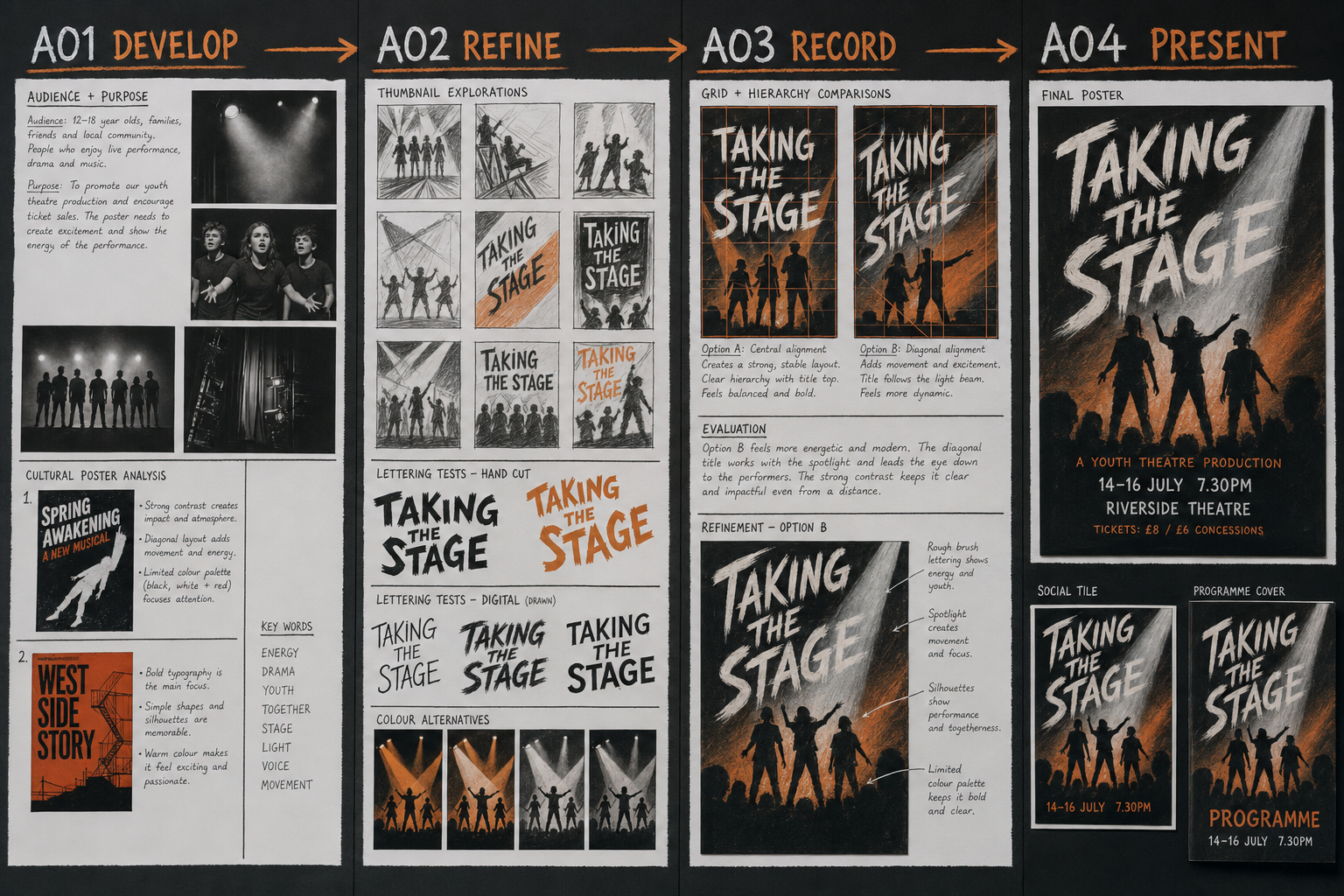
| You photograph the theatre, props and performers for a local youth-production poster brief. | AO3: relevant first-hand recording and original imagery. |
| You analyse how two designers use cropping, expressive typography and visual hierarchy in cultural posters. | AO1: investigation and critical understanding. |
| You test hand-cut lettering, photographic crops, limited colour palettes and alternative grid structures. | AO2: purposeful exploration of media, techniques and processes. |
| You compare thumbnail layouts, test legibility at small size and improve the strongest combination. | AO2 and AO3: selection, recording, evaluation and refinement. |
| You present a coherent poster, social tile and programme cover using the selected visual system. | AO4: a personal response that realises the developed intention. |
This is why adding designer research, thumbnails or annotations after the final design is risky. Research should affect ideas, first-hand recording should supply authentic content, testing should improve communication and evaluation should direct refinement.
What AO1 looks like in GCSE Graphic Communication
AO1 is about developing ideas through investigation. Researching designers matters, but copied biographies and collections of attractive posters are not enough. You need to analyse how specific designs work and show how that investigation affects your response to the brief.
- Define the intended audience, purpose, message, context, format and important constraints.
- Select designers, illustrators, typographers or studios because they help you solve a relevant communication problem.
- Analyse particular designs rather than writing everything you can find about the practitioner.
- Discuss hierarchy, composition, grid, typography, imagery, colour, scale, materials, tone and function where relevant.
- Create practical responses that test a useful visual principle rather than closely copying an existing design.
- Show how research changes your next thumbnail, type choice, image, layout or production decision.
What AO2 looks like in GCSE Graphic Communication
AO2 is about exploring, selecting and refining. A page containing many random fonts, filters or colour schemes is not automatically strong evidence. Better experiments compare controlled alternatives and help you decide what communicates most effectively.
- Explore handmade and digital image-making where appropriate: drawing, collage, photography, printmaking, cut paper, lettering and vector work.
- Test typeface, weight, size, spacing, alignment and hierarchy with the actual wording rather than meaningless placeholder text.
- Compare colour systems, grids, compositions, crops, materials and formats against the same brief.
- Identify strengths and limitations in relation to audience, legibility, mood, meaning and practicality.
- Combine the most successful discoveries rather than continuing to produce unrelated alternatives.
- Proof important details at actual size and refine alignment, spacing, contrast, consistency and production quality before final presentation.
What AO3 looks like in GCSE Graphic Communication
AO3 is about purposeful recording. Graphic Communication recording includes more than polished computer screenshots. It may involve original photography and drawing, audience or location research, notes from observation, mind maps, thumbnails, storyboards, grids, paper prototypes, roughs and annotations that direct the next design decision.
- Collect first-hand information and create original imagery wherever possible.
- Record the requirements of the brief accurately, including exact wording, sizes, formats and constraints.
- Use fast thumbnails to record many possibilities before refining a small selection.
- Document important stages in handmade, digital, printed or interactive development.
- Annotate decisions rather than merely listing software tools: explain what communicates clearly, what fails and what should happen next.
- Keep recording relevant to the audience, purpose and developing intention.
What AO4 looks like in GCSE Graphic Communication
AO4 is about presenting a personal and meaningful response. It is not simply a reward for clean computer production. The outcome should communicate effectively, realise the intention and bring together the strongest ideas, original content and visual decisions from the project.
- The outcome should answer the brief and be appropriate for its audience, purpose and context.
- Typography, imagery, colour, composition, format and materials should work as one coherent visual system.
- Information must be accurate, readable and organised through deliberate hierarchy.
- The response should show your decisions even when influenced by professional designers.
- One outcome or a related family—such as a poster, social tile, programme and ticket—may be valid when the format suits the intention.
- Final presentation should demonstrate how the design would function, without allowing decorative mock-ups to replace the actual design evidence.
The final-design myth
Your final poster, package or screen design is not automatically worth 25% on its own. AO4 contributes 25%, but the response is judged in relation to your intentions and the journey that produced it. A polished but generic final design cannot replace weak investigation, recording and development.
How are marks awarded?
Teachers do not normally give a fixed number of marks for every sketchbook page, thumbnail sheet or finished item. They judge the quality of the evidence for each Assessment Objective across the completed component and use the exam board’s assessment grid.
- Visible evidence matters. A design decision cannot be rewarded if the moderator cannot see how it developed.
- Quality matters more than quantity. A focused set of alternatives that are tested and refined may be stronger than dozens of unexplained layouts.
- Relevance matters. Every research page, experiment and annotation should help answer the brief.
- Connections matter. Strong work makes it easy to see how audience, sources, recording, ideas, tests and outcomes relate.
- Consistency matters. One polished mock-up cannot carry a whole project.
- Personal decisions matter. Your teacher can guide you, but the work should increasingly show your own judgement.
What do the GCSE grades mean?
GCSEs in England are graded from 9 to 1, with 9 as the highest grade. Grade 4 is described as a standard pass and grade 5 as a strong pass. There is no permanent percentage that guarantees a particular grade because grade boundaries can change from one examination series to another.
You do not usually need to achieve a separate pass in every AO. Your final grade is based on the combined total. However, leaving one Assessment Objective weak or missing removes a quarter of the available evidence, so a balanced project is safer than relying on strong software skills or polished outcomes alone.
What is the difference between basic and high-level work?
| Basic or lower-mark Graphic Communication evidence | Stronger, higher-mark Graphic Communication evidence |
|---|---|
| The brief is vague and the audience is described as “everyone”. | The communication problem, audience, purpose, context and constraints are specific. |
| Designer pages mainly contain biography and downloaded images. | Selected designs are analysed and visibly influence later decisions. |
| Most imagery is downloaded or copied. | Original photography, drawing, lettering or printmaking creates relevant personal content. |
| One first idea is moved straight onto a computer. | Many quick thumbnails lead to several genuinely different directions. |
| Experiments are random fonts, filters or colour swatches. | Controlled tests compare hierarchy, legibility, tone, imagery and visual impact. |
| Annotation lists software operations. | Evaluation judges communication against the brief and identifies the next change. |
| The final design closely imitates one designer or template. | Influences are combined with original research, content and personal decisions. |
| The outcome is shown only in decorative mock-ups. | Actual designs are proofed, refined and then shown accurately in relevant contexts. |

What happens in the externally set assignment?
The exam board provides a paper containing themes, visual material, questions or starting points. You choose one starting point and develop preparatory work during the period set by your school. You then complete 10 hours of supervised sustained focus, often divided into several sessions.
The preparation is assessed as well as the work produced during the supervised period. Before the 10 hours begin, you should already have:
- interpreted the starting point as a specific communication problem;
- identified a plausible audience, purpose, context and format;
- collected relevant first-hand research and original imagery;
- investigated useful designers and other sources;
- generated and compared more than one possible direction;
- tested the exact typography, imagery, colours, processes and production methods you intend to use;
- selected, proofed and refined the strongest design;
- planned a response that can be completed successfully in the available time.
The 10 hours are not the time to invent everything
Use the supervised period to realise a well-prepared response. Major decisions about format, grid, imagery, typography, colour, production and presentation should have been tested beforehand. Follow your board and centre instructions exactly: internet access is restricted during supervised time, and preparatory work cannot normally be changed after that period begins.
How much work should you do outside lessons?
Your school will set its own homework expectations, so follow those first. The GCSE Graphic Communication course requires regular research, idea generation, making, digital development and proofing. Steady weekly progress is more effective than attempting to finish a whole design project just before the deadline.
| Useful weekly habit | What it prevents |
|---|---|
| Check the brief and choose one clear communication problem to solve next. | Polishing an easy detail while an important gap remains. |
| Make a page of quick thumbnails before opening design software. | Developing only the first predictable idea. |
| Use school time for specialist printing, photography, software and teacher guidance. | Wasting access to processes or equipment unavailable at home. |
| Print or view the design at its intended size and write one next-step note. | Missing problems with scale, hierarchy, legibility or contrast. |
| Save versions and back up original assets, fonts, linked images and working files. | Missing links, overwritten development or unusable final exports. |
A simple way to organise your portfolio
- Keep the brief visible. Record audience, purpose, message, format, wording, dimensions and constraints accurately.
- Date important stages. This helps the design journey make sense.
- Label original content. Make clear which photographs, drawings, lettering and research are your own.
- Record sources and licences. Acknowledge designers, images, fonts and other material that is not your own.
- Save numbered versions. Use meaningful filenames rather than repeatedly overwriting “final”.
- Use clear folders. Separate 01_BRIEF_RESEARCH, 02_ORIGINAL_ASSETS, 03_IDEAS, 04_DEVELOPMENT, 05_PROOFS and 06_FINAL.
- Package linked assets where required. Keep working files, linked images and permitted fonts together.
- Back up your project. Keep a second copy in a secure location approved by your school.
- Export carefully. Keep editable originals and create separate high-resolution print, screen or submission files.
- Edit before submission. Remove unnecessary repetition and present the strongest evidence in a clear order.

Common mistakes to avoid
- Ignoring audience and purpose. A design can look attractive but still fail to communicate.
- Using downloaded imagery as the main content. Original recording makes the response more personal and authentic.
- Copying long designer biographies. Focus on selected work and what it teaches you.
- Beginning on the computer too soon. Generate genuinely different thumbnails before refining one route.
- Treating font changes as idea development. Explore different concepts, images, structures and messages—not just typefaces.
- Using effects without purpose. Every visual choice should strengthen hierarchy, tone, meaning or audience appeal.
- Writing software instructions as annotation. Explain the communication effect, judgement and next decision instead.
- Failing to proof. Check spelling, wording, contrast, margins, image quality, alignment and legibility at actual size.
- Relying on mock-ups. A mock-up presents a design; it does not prove that the design itself is resolved.
- Overwriting working files. Save versions so development and earlier decisions remain visible.
- Treating the AOs as separate sections. Strong projects connect investigation, recording, experimentation, evaluation and presentation from the beginning.
GCSE Graphic Communication self-checklist
- My project has a clear brief, audience, purpose, message and intended context.
- I have collected relevant first-hand research and created original visual content.
- I have investigated designers and sources that genuinely help solve the communication problem.
- My research affects my own imagery, typography, hierarchy, layout or production choices.
- I have generated several genuinely different ideas before selecting a direction.
- My experiments compare purposeful alternatives rather than random effects.
- I explain why ideas, typefaces, images, colours, layouts or materials were selected or rejected.
- I refine the strongest direction rather than simply making more versions.
- My notes explain communication, visual impact, decisions and next steps.
- I can show clear evidence of AO1, AO2, AO3 and AO4 throughout the project.
- My response grows from the brief, research, original recording and experiments.
- My hierarchy, typography, imagery, colour and format work together coherently.
- I have proofed wording, spelling, legibility, image quality, margins and production details.
- Sources, images and fonts that are not my own are clearly acknowledged.
- My original assets, versions, working files and exports are organised and backed up.
- The final portfolio is edited and easy for a moderator to follow.
Frequently asked questions
Do I need expensive design software for the GCSE Graphic Communication course?
No. Schools often provide appropriate software, and strong Graphic Communication can include drawing, collage, photography, printmaking, handmade lettering, paper prototypes and accessible digital tools. The assessment rewards purposeful investigation, original recording, experimentation, refinement and communication—not the software price.
Do I have to draw in the GCSE Graphic Communication course?
Yes, drawing should support development in an appropriate form, but it does not always mean a highly finished observational study. Thumbnails, layouts, storyboards, letterform experiments, diagrams, visualisations and prototypes can all be relevant drawing activity.
How many sketchbook pages or design ideas do I need?
Exam boards do not award the GCSE by counting pages or thumbnails. Your school may set targets to help you keep pace, but marks depend on the quality, relevance, variety, evaluation, refinement and connection of the evidence.
How many designers should I study?
There is no magic number. A small group of relevant designers analysed carefully and used to develop your work is better than many disconnected profiles. Follow your teacher’s project requirements.
Can one page count towards more than one AO?
Yes. A thumbnail sheet informed by designer research, using original imagery, comparing alternative layouts and annotated with a clear refinement decision may provide evidence across all four AOs.
Does every project need one final poster?
No. A resolved response may be a poster, publication, identity system, package, illustration, sign, animation, interface, exhibition graphic or related family of outcomes. The format should suit your intention and your centre’s requirements.
Can I use templates, stock images or AI?
Third-party templates and stock assets can hide the personal authorship being assessed, so ask your teacher before using them and acknowledge every permitted source. Generative AI must follow your school, exam-board and JCQ rules, be declared clearly and must not replace your own research, image-making, idea generation or design decisions.
What should I do if I am falling behind?
Ask your teacher which missing or weak evidence will have the greatest effect. Clarify the brief, prioritise original research or a necessary idea-generation stage, compare the strongest existing alternatives and refine one promising direction instead of beginning another unrelated design.
The key message
The best GCSE Graphic Communication projects make the design journey purposeful, personal and easy to follow.
Begin with a real communication problem. Understand the audience and purpose. Learn from relevant designers, collect original material and generate several possibilities. Test ideas against the brief, refine hierarchy and details, and proof the final response carefully. Keep AO1–AO4 connected, and the outcome will feel like the natural result of informed design thinking.
Explore more GCSE Art guidance
Visit the GCSE Art Hub for more help with research, experimentation, recording, sketchbooks, annotation and personal responses.
Would detailed feedback help?
If you are unsure whether your Graphic Communication portfolio shows enough evidence across AO1–AO4, Portfolio to A Star can identify your strengths, gaps and the most useful next steps.
Official specification sources
Requirements and administrative guidance can be updated. Students should always follow the current specification and instructions for their own exam board and school.
- AQA GCSE Art & Design (Graphic Communication): specification at a glance
- AQA GCSE Graphic Communication: subject content
- Pearson Edexcel GCSE Art & Design specification
- OCR GCSE Art & Design: specification at a glance
- Eduqas GCSE Art & Design specification
- GOV.UK: GCSE 9 to 1 grade scale explained
- Ofqual: GCSE grading and changing grade boundaries