
GCSE Art & Design (Fine Art) Explained: Course, Assessment and How to Succeed
The GCSE Fine Art course is not just about producing attractive final pieces. It rewards the whole creative journey: investigating useful sources, recording from first-hand experience, experimenting with materials, improving ideas and creating personal responses. Some schools and students refer to the qualification as Fine Art GCSE; throughout this guide, we use the more natural term GCSE Fine Art.
Most students complete the GCSE Fine Art course during Years 10 and 11. Your school will organise the course in its own way, but the main exam boards in England use the same four Assessment Objectives and a similar balance between coursework and an externally set assignment.
The GCSE Fine Art course in one sentence
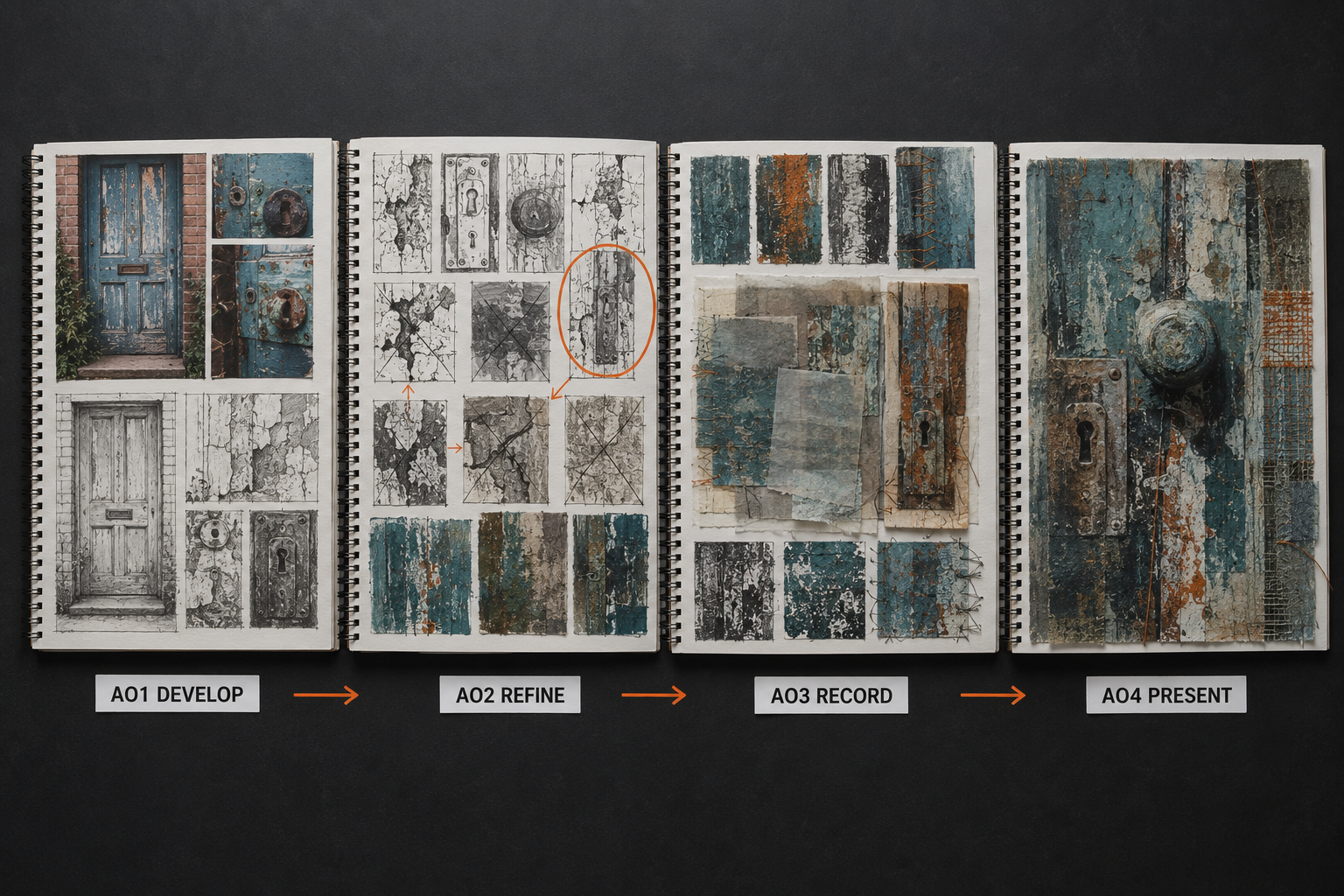
You explore a theme, learn from artists and other sources, record your own observations, test and improve ideas, and then create a personal response—while showing clear evidence of AO1, AO2, AO3 and AO4 throughout the project.
What is GCSE Fine Art?
Fine Art is one of the available GCSE Art & Design titles. It is mainly concerned with using visual language to explore ideas, experiences, themes and issues. It is broader than realistic drawing and painting, and it does not require every student to work in the same style.
Depending on your school’s facilities and the direction of your project, you might work with:
- Drawing and painting
- Printmaking
- Collage and mixed media
- Sculpture and construction
- Ceramics
- Photography within a Fine Art project
- Digital image-making
- Installation
- Textile or stitched processes
- Combinations of traditional and new media
Using more materials does not automatically earn more marks. A small, carefully observed drawing or a thoughtful series of prints can be stronger than a large painting made without research, testing or reflection. The important question is whether your choices help you communicate your idea.
How long does the course take?
The GCSE Fine Art course normally takes two years. It is a linear qualification, which means the completed portfolio and externally set assignment are assessed together at the end of the course.
A common two-year pattern
- Early Year 10: short workshops, observational drawing, photography, artist research and experiments with unfamiliar materials.
- Later Year 10: one or more projects in which you begin to make more independent decisions and connect the four Assessment Objectives.
- Year 11 portfolio period: development, refinement, completion and careful selection of coursework.
- Year 11 externally set assignment: preparation from an exam-board starting point followed by 10 hours of supervised work.
This is a typical pattern, not a compulsory national timetable. Always follow the project dates and submission instructions given by your own teacher.
The two assessed parts of GCSE Fine Art
| Component | What it usually contains | Weighting |
|---|---|---|
| Component 1: Portfolio | A selection of coursework showing a sustained project or projects, supporting studies, practical development and personal response or responses. | 60% |
| Component 2: Externally Set Assignment | Preparatory work based on a starting point issued by the exam board, followed by 10 hours of supervised sustained focus. | 40% |
Both components are normally marked by your school and then checked through external moderation. Exact mark totals and administrative arrangements differ between boards, but AQA, Pearson Edexcel, OCR and Eduqas all use the same overall 60% portfolio and 40% externally set assignment balance.

How a successful project develops
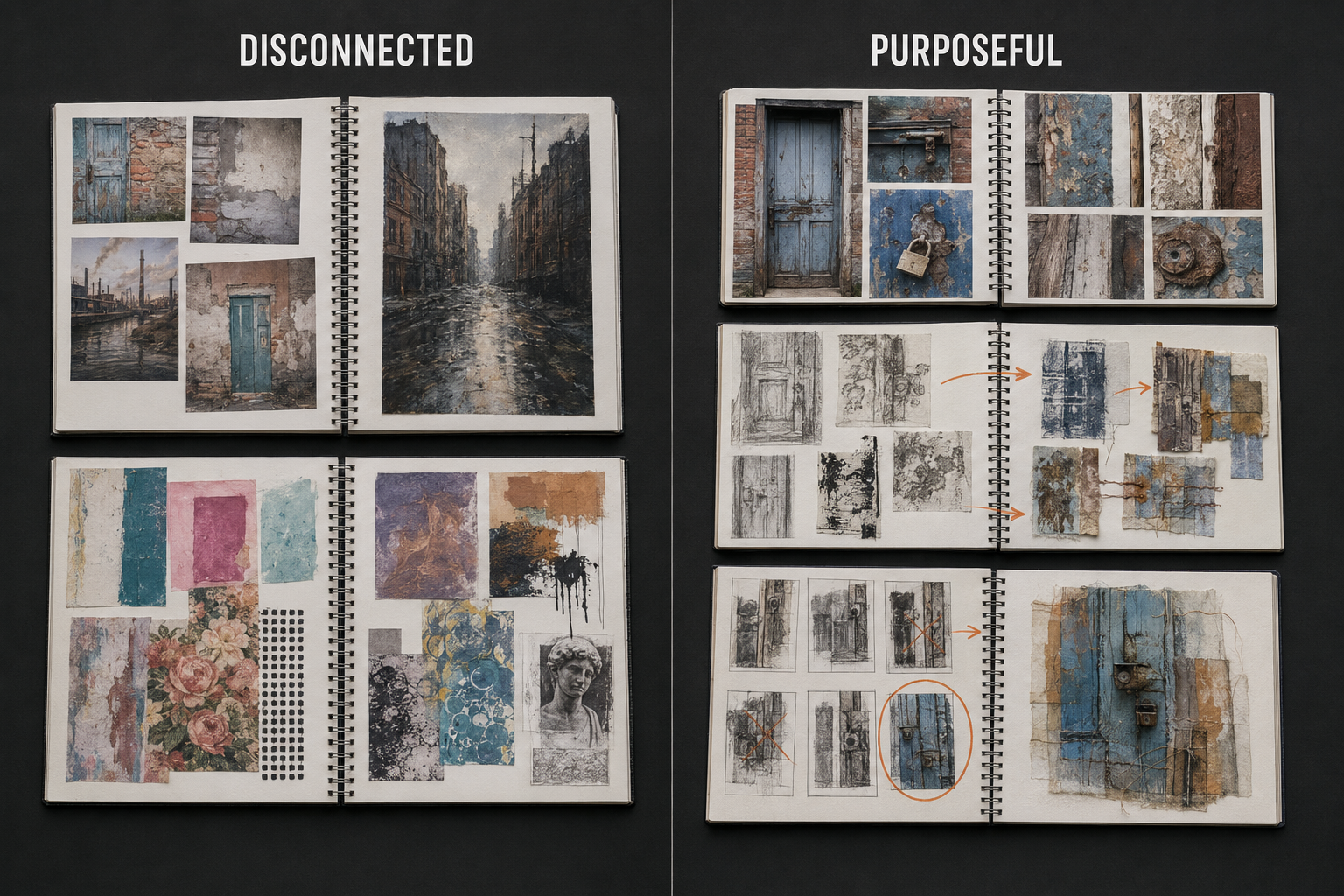
A project should feel like a connected journey rather than a folder of separate tasks. You may begin with a broad theme, but your focus should become more specific as you investigate and make discoveries.
- Explore the starting point. Make a mind map, ask questions and identify subjects you can investigate first-hand.
- Collect your own sources. Take photographs, draw from observation, visit a place, study objects or record an experience.
- Investigate relevant artists. Look closely at how selected artists use subject matter, composition, colour, materials, process and meaning.
- Respond practically. Use what you notice to try something new in your own work rather than simply copying an artwork.
- Experiment with purpose. Change a material, viewpoint, scale, surface, crop, technique or combination because you want to answer a question.
- Compare and select. Decide which results communicate your intention most effectively and explain why.
- Refine the strongest direction. Repeat important processes with greater control and solve weaknesses before the final response.
- Realise a personal response. Create an outcome or group of outcomes that clearly grows from the investigation.
The four Assessment Objectives
Every portfolio and externally set assignment in the GCSE Fine Art course is assessed through four Assessment Objectives. AO1, AO2, AO3 and AO4 are equally important: each contributes 25% of the overall qualification.
| Assessment Objective | In student-friendly language | Useful evidence |
|---|---|---|
| AO1: Develop ideas | Investigate relevant artists and other sources, understand what you see and use it to move your own ideas forward. | Focused artist research, visual analysis, source comparisons, practical responses and clear changes in direction. |
| AO2: Explore and refine | Try suitable materials, techniques and processes; compare the results; select what works and improve it. | Purposeful experiments, technical notes, alternatives, selection, rejection, combinations and refined studies. |
| AO3: Record | Record ideas, observations and discoveries that are relevant to your intentions as the work develops. | First-hand photographs, observational drawings, colour studies, notes, plans, annotations and reflections that lead to a next step. |
| AO4: Present a personal response | Bring your strongest ideas together and create a personal, meaningful and well-resolved response. | Final or resolved work that connects with your sources, experiments, recordings, intentions and chosen visual language. |
For more detail, read the Portfolio to A Star guides to GCSE Art AO1, GCSE Art AO2, GCSE Art AO3 and GCSE Art AO4.
Why the Assessment Objectives matter throughout the course
The Assessment Objectives should not be treated as four separate chapters. A strong activity can provide evidence for several AOs at the same time.
| One connected activity | AO evidence it may provide |
|---|---|
| You photograph weathered doors in your local area. | AO3: relevant first-hand recording. |
| You study how two artists use damaged surfaces and layered marks. | AO1: investigation and critical understanding. |
| You test ink, paint, collage, monoprint and stitched paper using details from your photographs. | AO2: purposeful exploration of media and processes. |
| You compare the results, select the strongest combination and improve the composition. | AO2 and AO3: refinement, recording and reflection. |
| You create a resolved mixed-media response based on the strongest discoveries. | AO4: a personal response that realises the developed intention. |
This is why leaving artist research, annotation or experiments until the end is risky. The AOs describe parts of one creative process. Each part should influence what happens next.
What AO1 looks like in GCSE Fine Art
AO1 is about developing ideas through investigation. Artist research matters, but copying a biography is not enough. You need to look closely, make your own observations and show how a source has affected your practical work.
- Select artists because they can help you investigate your theme, visual problem or chosen process.
- Analyse particular artworks rather than writing everything you can find about the artist’s life.
- Discuss visible features such as composition, viewpoint, scale, colour, mark-making, materials, mood and meaning.
- Create practical responses that test an idea or method you have noticed.
- Show how the research changes your next photograph, drawing, experiment, design or composition.
What AO2 looks like in GCSE Fine Art
AO2 is about exploring, selecting and refining. Random material samples do not become strong AO2 simply because there are lots of them. Your experiments should relate to your sources and intentions.
- Test a manageable range of appropriate materials and processes.
- Keep the subject or question connected so results can be compared fairly.
- Record useful technical details, such as tools, surfaces, colour mixtures, exposure, drying time or printing method.
- Identify both strengths and limitations.
- Repeat the strongest ideas with greater control instead of constantly starting something new.
- Test important decisions about scale, composition and presentation before making the final response.
What AO3 looks like in GCSE Fine Art
AO3 is about purposeful recording. Drawing is important, but recording can also include original photography, colour studies, diagrams, written observations, plans, measurements, contact sheets and photographs of work in progress.
- Use first-hand sources wherever possible rather than relying only on images found online.
- Record features that matter to your project: shape, texture, light, form, space, structure, colour or atmosphere.
- Annotate decisions, not just actions. Explain what you discovered and what should happen next.
- Photograph temporary experiments, three-dimensional work and important stages before they are changed.
- Make sure your recording remains relevant to your developing intention.
What AO4 looks like in GCSE Fine Art
AO4 is about presenting a personal and meaningful response. It is not simply a reward for technical neatness. The response should bring together the most useful ideas, observations and experiments from the project.
- The subject and idea should connect clearly with the investigation.
- The chosen materials should suit the intended meaning and visual effect.
- Composition, scale, format and presentation should be tested rather than guessed.
- The response should show your decisions, even when it has been influenced by other artists.
- One final piece, a series, an installation or a group of connected outcomes can all be valid when appropriate to the project.
The final-piece myth
Your final piece is not automatically worth 25% on its own. AO4 contributes 25%, but the response is judged in relation to your intentions and the journey that produced it. A polished but disconnected final piece cannot replace weak research, recording and development.
How are marks awarded?
Teachers do not normally give a fixed number of marks for every sketchbook page. They judge the quality of the evidence for each Assessment Objective across the completed component and use the exam board’s assessment grid.
- Visible evidence matters. An idea cannot be rewarded if the examiner cannot see it in your submitted work.
- Quality matters more than quantity. Four well-chosen experiments that are compared and developed may be more valuable than twenty repeated samples.
- Relevance matters. Every page should help the project move forward.
- Connections matter. Strong work makes it easy to see how sources, experiments, observations and responses relate to one another.
- Consistency matters. One excellent page cannot carry a whole project.
- Personal decisions matter. Your teacher can guide you, but the work should increasingly show your own choices.
What do the GCSE grades mean?
GCSEs in England are graded from 9 to 1, with 9 as the highest grade. Grade 4 is described as a standard pass and grade 5 as a strong pass. There is no permanent percentage that guarantees a particular grade because grade boundaries can change from one examination series to another.
You do not usually need to achieve a separate pass in every AO. Your final grade is based on the combined total. However, leaving one Assessment Objective weak or missing removes a quarter of the available evidence, so a balanced project is much safer than relying on one strength.
What is the difference between basic and high-level work?
| Basic or lower-mark evidence | Stronger, higher-mark evidence |
|---|---|
| A broad theme is repeated without becoming more focused. | The theme develops into a clear, personal direction. |
| Artist pages mainly contain biography and copied images. | Selected artworks are analysed and visibly influence practical decisions. |
| Experiments are disconnected samples labelled only with material names. | Experiments answer questions, are compared and lead to refinement. |
| Most source images come from the internet. | First-hand photographs and observations give the project originality and relevance. |
| Annotation describes what was done. | Reflection explains what was learned, what should change and why. |
| The first idea is enlarged into a final piece. | Several possibilities are tested before the strongest direction is selected. |
| The final response imitates one artist closely. | Influences are combined with personal sources, choices and intentions. |
| Presentation is rushed or confusing. | Work is edited, ordered, photographed and presented so the journey is easy to follow. |
What happens in the externally set assignment?
The exam board provides a paper containing themes, visual material, questions or starting points. You choose one starting point and develop preparatory work during the period set by your school. You then complete 10 hours of supervised sustained focus, often divided into several sessions.
The preparation is assessed as well as the work produced during the supervised period. Before the 10 hours begin, you should already have:
- interpreted the starting point in a personal way;
- collected relevant first-hand sources;
- investigated useful artists and other sources;
- explored more than one possible direction;
- tested the exact materials and techniques you intend to use;
- selected and refined your strongest ideas;
- planned a response that can be completed successfully in the available time.
The 10 hours are not the time to invent everything
Use the supervised period to realise a well-prepared response. You can still make sensible adjustments as the work develops, but composition, scale, materials and major technical problems should have been tested beforehand.
How much work should you do outside lessons?
Your school will set its own homework expectations, so follow those first. The GCSE Fine Art course is practical and often takes longer than a short written task, but steady weekly progress is far more effective than a large amount of rushed work just before a deadline.
| Useful weekly habit | What it prevents |
|---|---|
| Check the next deadline and choose one clear priority. | Spending time on an easy task while an important gap remains. |
| Complete one focused practical session at home when suitable. | Leaving every experiment or drawing until the final week. |
| Use school time for specialist materials and equipment. | Wasting access to printing, clay, large surfaces, cameras or teacher help. |
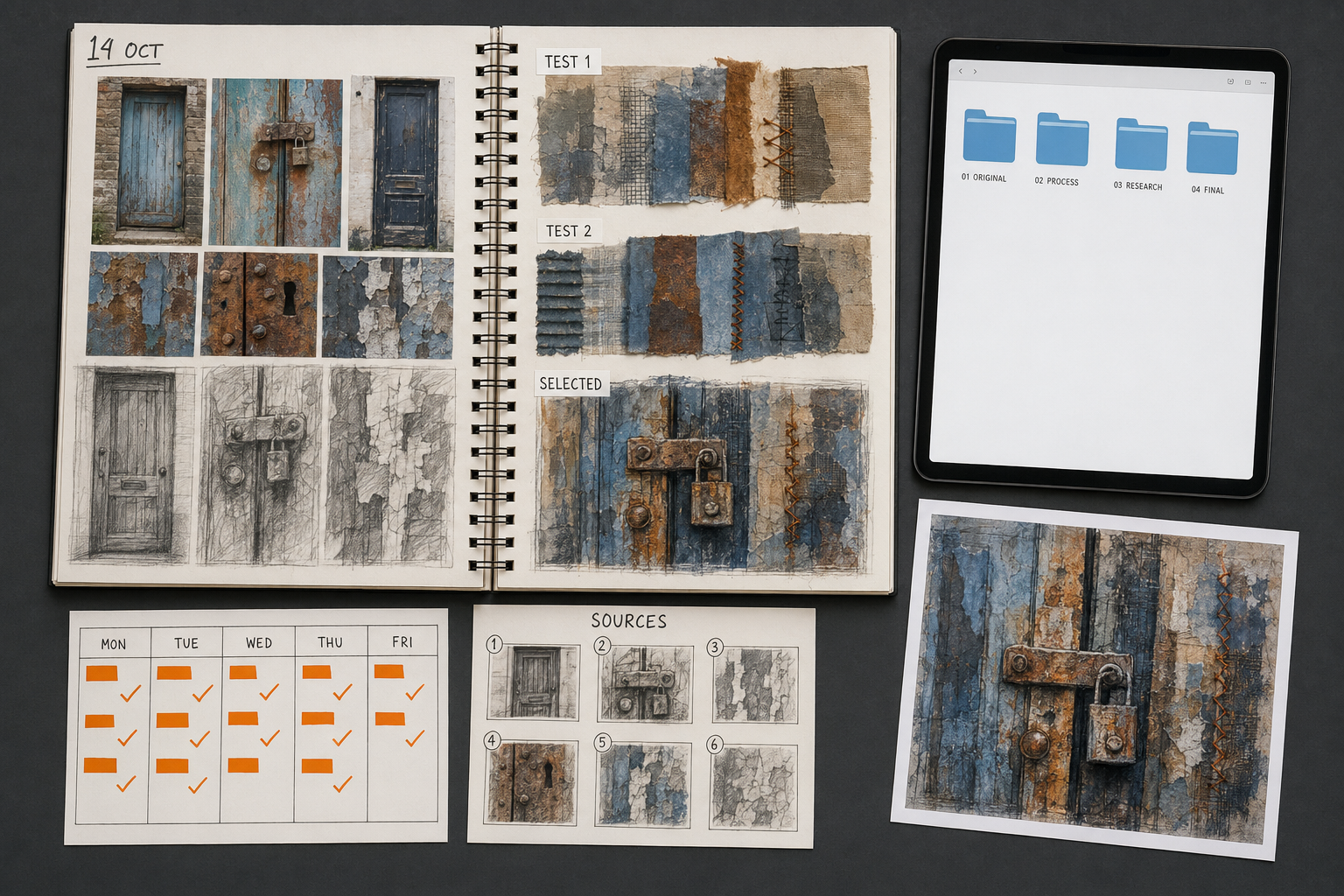
| Photograph work and write a short next-step note. | Forgetting decisions and losing evidence of temporary stages. |
| Update digital folders and back up original photographs. | Missing, duplicated or low-quality evidence at submission. |
A simple way to organise your portfolio
- Date important work. This helps the project sequence make sense.
- Label your own photographs. Make it clear which images and observations are first-hand.
- Record artist and website sources. Acknowledge material that is not your own.
- Keep experiments. Include relevant failures when they led to a useful decision.
- Photograph work in progress. This is especially important for temporary, large or three-dimensional work.
- Use clear digital folders. Separate original photographs, edited images, process photographs, research and final exports.
- Back up your files. Keep a second copy in a secure location approved by your school.
- Edit before submission. Remove unnecessary repetition and present the strongest evidence in a clear order.
Common mistakes to avoid
- Measuring progress only by page count. Full pages are not automatically useful pages.
- Copying long artist biographies. Focus on selected artworks and what you can learn from them.
- Depending on internet images. First-hand sources make your work more personal and convincing.
- Trying materials without a purpose. Link experiments to a visual question or intention.
- Starting a completely new idea whenever something goes wrong. Improvement usually comes from refining a promising direction.
- Writing vague comments. “I like it” does not explain what works or what should happen next.
- Hiding unsuccessful work. A relevant mistake can be valuable when you explain what it taught you and act on it.
- Making the final piece too ambitious. A smaller, resolved response is stronger than a huge unfinished one.
- Leaving presentation until the final day. Poor photographs, missing labels and a confusing order can hide good evidence.
- Treating the AOs as separate sections. The strongest projects connect investigation, experimentation, recording and response from the beginning.
GCSE Fine Art self-checklist
- My project has a clear theme that becomes more personal and focused.
- I have collected relevant first-hand photographs, drawings or observations.
- I have investigated artists and other sources that genuinely help my project.
- My research affects my own practical work.
- I have explored more than one possible idea or composition.
- My experiments are connected and purposeful.
- I compare results and explain what I have selected or rejected.
- I refine the strongest direction instead of repeating the same test.
- My notes explain discoveries, decisions and next steps.
- I can show clear evidence of AO1, AO2, AO3 and AO4 throughout the project.
- My response grows from my research, observations and experiments.
- My choice of materials, scale, format and presentation suits my intention.
- Sources that are not my own are clearly acknowledged.
- My photographs and digital files are organised and backed up.
- The final portfolio is edited and easy for a moderator to follow.
Frequently asked questions
Do I have to be brilliant at realistic drawing?
No. Drawing is an important way to observe, investigate, think and plan, but Fine Art includes many different approaches. Your recording and technical choices need to suit your intentions; there is no single approved style.
How many sketchbook pages do I need?
Exam boards do not award the GCSE by counting pages. Your school may set page targets to help you keep pace, but marks depend on the quality, relevance and connection of the evidence.
How many artists should I study?
There is no magic number. A small group of relevant artists studied carefully and used to develop your work is better than many disconnected profiles. Follow your teacher’s project requirements.
Can one page count towards more than one AO?
Yes. For example, an observational drawing informed by an artist, tested through several materials, compared and developed into a new composition may provide evidence for all four AOs.
Does every project need one large final piece?
No. A resolved response might be one artwork, a series, a group of objects, an installation or another suitable format. The form should be appropriate to your intention and the requirements set by your centre.
Can I use digital tools or AI?
Digital tools can be part of Fine Art when they support your own creative process. Any use of AI must follow your school and exam board rules, be acknowledged clearly and must not replace the personal authorship, practical evidence and decision-making being assessed. Ask your teacher before using it.
What should I do if I am falling behind?
Ask your teacher which missing or weak evidence will have the greatest effect. Choose one or two clear actions, remove decorative or repeated tasks and improve the strongest existing direction instead of beginning another unrelated project.
The key message
The best GCSE Fine Art projects make the creative journey purposeful, personal and easy to follow.
Start with first-hand curiosity. Learn from relevant artists. Experiment to answer questions. Record what you notice. Compare and refine your strongest ideas. Keep AO1–AO4 connected from the beginning, and your final response will feel like the natural result of your own investigation rather than something added at the end.
Explore more GCSE Art guidance
Visit the GCSE Art Help area for more help with research, experimentation, recording, sketchbooks, annotation and personal responses.
Would detailed feedback help?
If you are unsure whether your portfolio shows enough evidence across AO1–AO4, Portfolio to A Star can identify your strengths, gaps and the most useful next steps.
Official specification sources
Requirements and administrative guidance can be updated. Students should always follow the current specification and instructions for their own exam board and school.
- AQA GCSE Art & Design (Fine Art): specification at a glance
- AQA GCSE Fine Art: subject content
- Pearson Edexcel GCSE Art & Design specification
- OCR GCSE Art & Design: specification at a glance
- Eduqas GCSE Art & Design specification
- GOV.UK: GCSE 9 to 1 grade scale explained
- Ofqual: GCSE grading and changing grade boundaries