
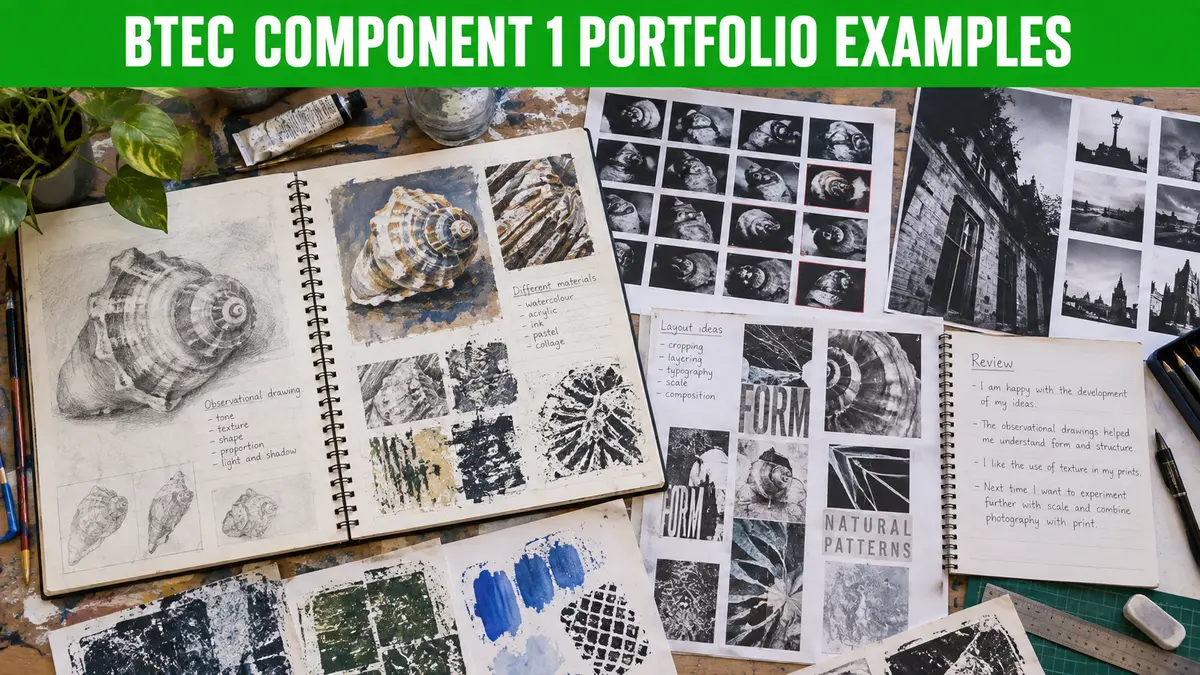
What could a strong BTEC Component 1 portfolio look like? The examples on this page show how a Level 1/2 student might present research, material experiments, developing ideas and reflective review. They are illustrative examples created for guidance—not official Pearson learner work—and they should not be copied.
Your own portfolio should record what you investigated, tried, learned and changed. The most convincing work is personal, practical and easy to follow. It lets the assessor see how your creative practice became more confident over time.
Component 1 at a glance
- Official title: Creative Practice in Art and Design
- Guided learning: 72 hours
- Assessment: non-exam internal assessment, marked by your centre and externally moderated
- Supervised assignment: approximately 20 hours
- Available marks: 84
Always follow the assignment and instructions issued by your school or college. Qualification information can change, so check the current Pearson specification.
What must Component 1 demonstrate?
Pearson organises Component 1 around four learning outcomes. In student language, your evidence should show that you can:
A. Investigate and experiment
Research practitioners and sources, record first-hand information and explore materials, techniques, processes and visual elements.
B. Generate and communicate ideas
Create different possibilities, use research to inform them and communicate your intentions through thumbnails, studies, models or prototypes.
C. Apply and review practical skills
Practise processes, make work, judge results and use what you learn to improve control, purpose and communication.
D. Record and communicate development
Organise evidence so the viewer can understand what you did, what developed and what your work demonstrates about your skills.
Example 1: research that leads somewhere
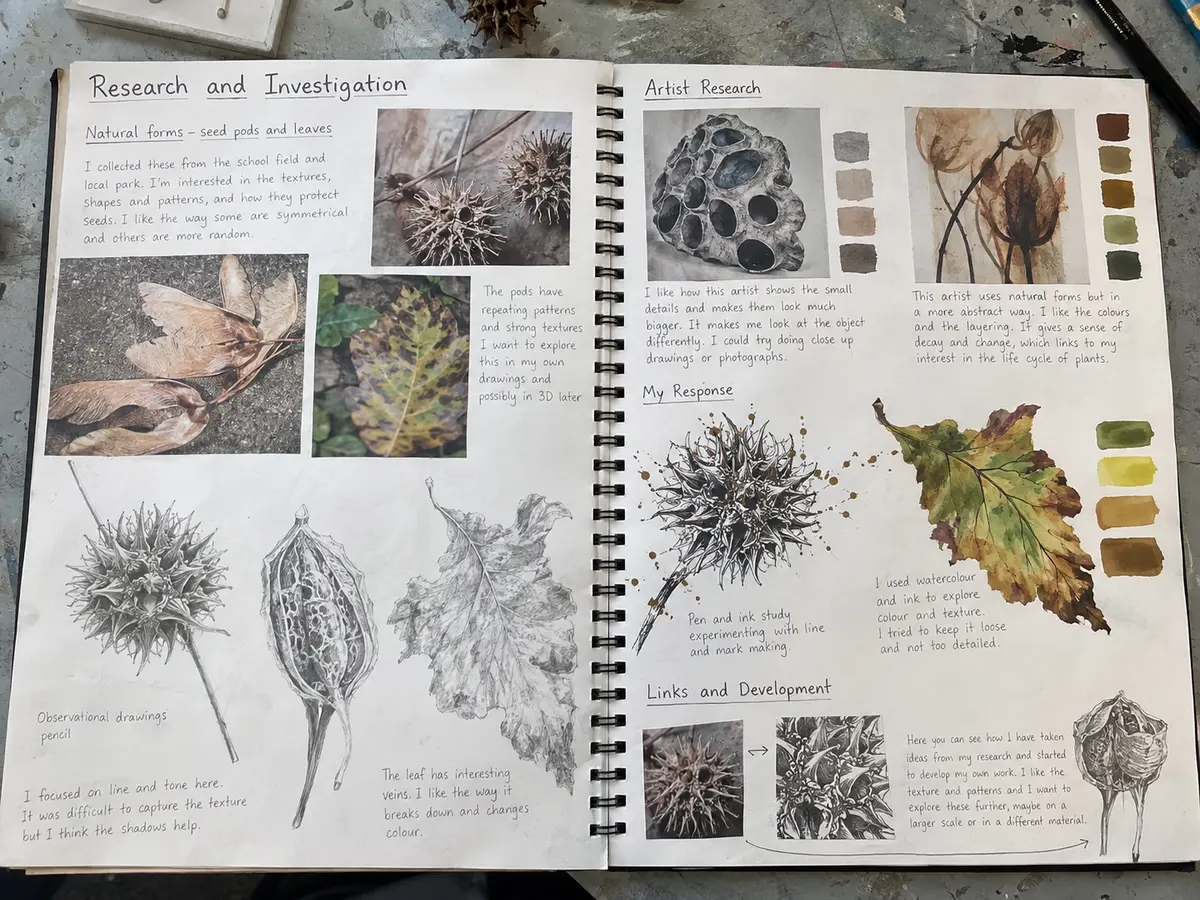
Useful evidence
- Your own photographs, drawings, collections or observations
- Relevant historic or contemporary practitioners
- Notes about materials, processes, purpose and audience
- Practical responses that test what you discovered
Why this is stronger
The research is not a detached biography. The student selects visual features—structure, texture, layering and colour—and then explores them through their own drawings and material responses.
Example 2: purposeful skills experiments
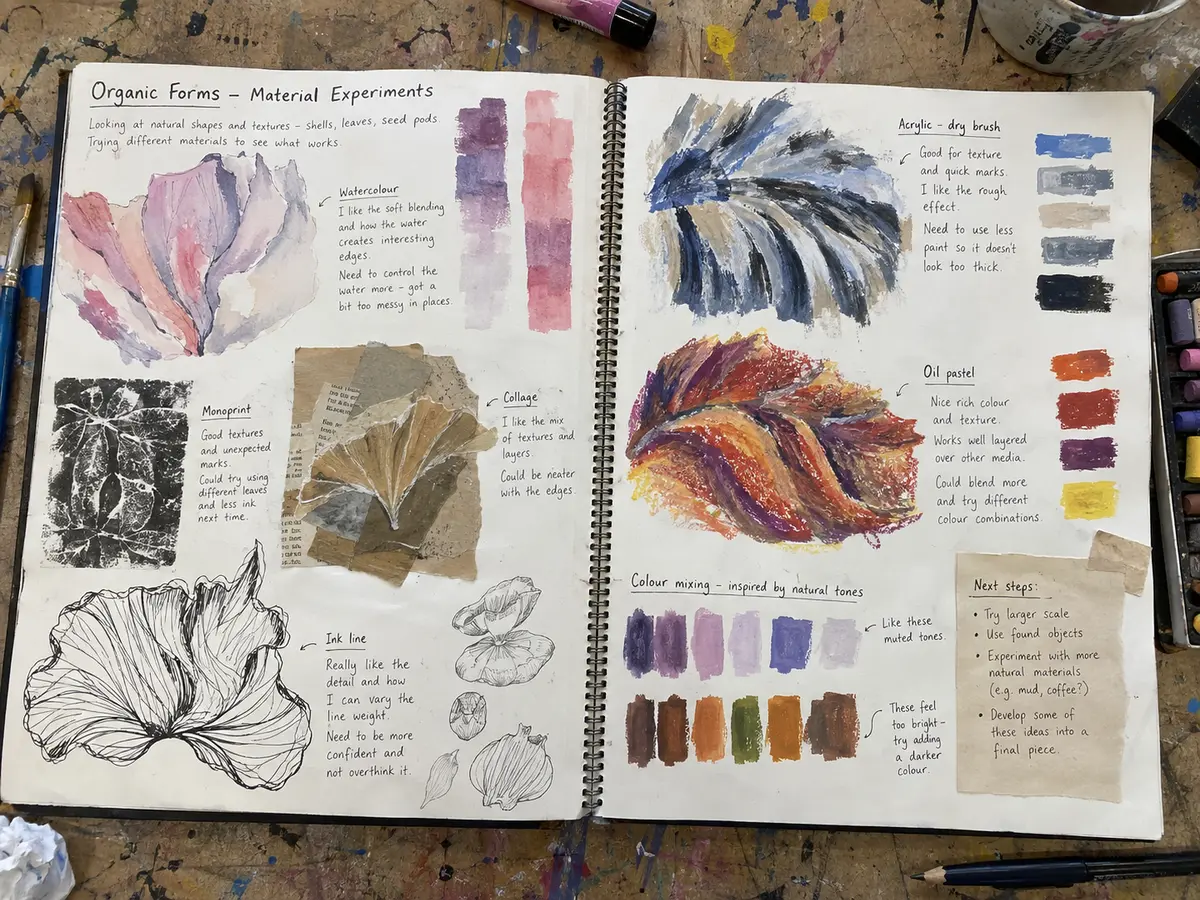
A strong experiment is not simply a neat sample. It helps you discover something. Record the material and method, then explain what happened, what was effective, what was difficult and where you could take it next.
A useful review sentence
The dry-brush acrylic created the rough texture I wanted, but the thick paint hid some of the finer shapes. Next I will use less paint and combine it with sharper ink lines.
Example 3: generating and developing ideas
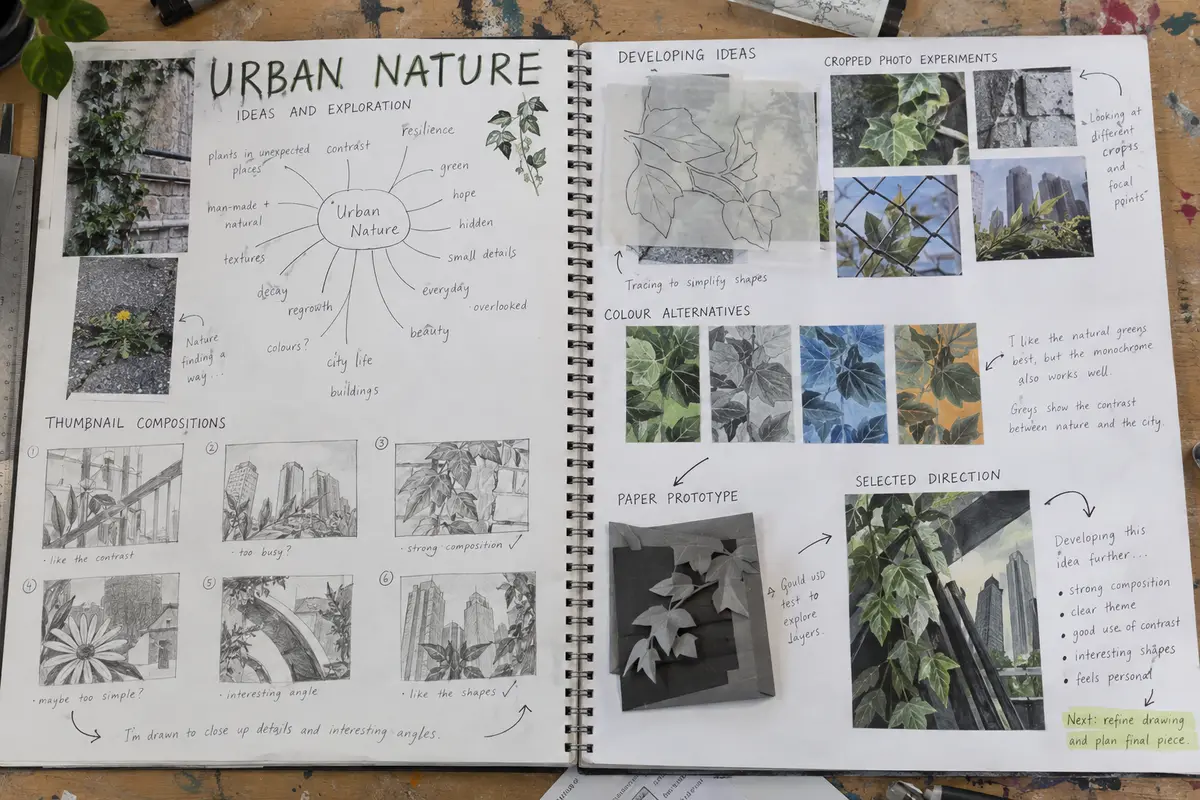
Development means making choices and changing the work—not drawing the same idea repeatedly. This example shows a theme being explored through photographs, thumbnails, tracing, alternative colour schemes and a simple paper prototype.
- Generate more than one possible response.
- Compare compositions, crops, colours, materials or formats.
- Identify which possibility communicates the idea most effectively.
- Explain what you will retain, change, combine or reject.
- Test the selected direction again at a larger scale or in a more resolved form.
Example 4: reviewing and communicating progress
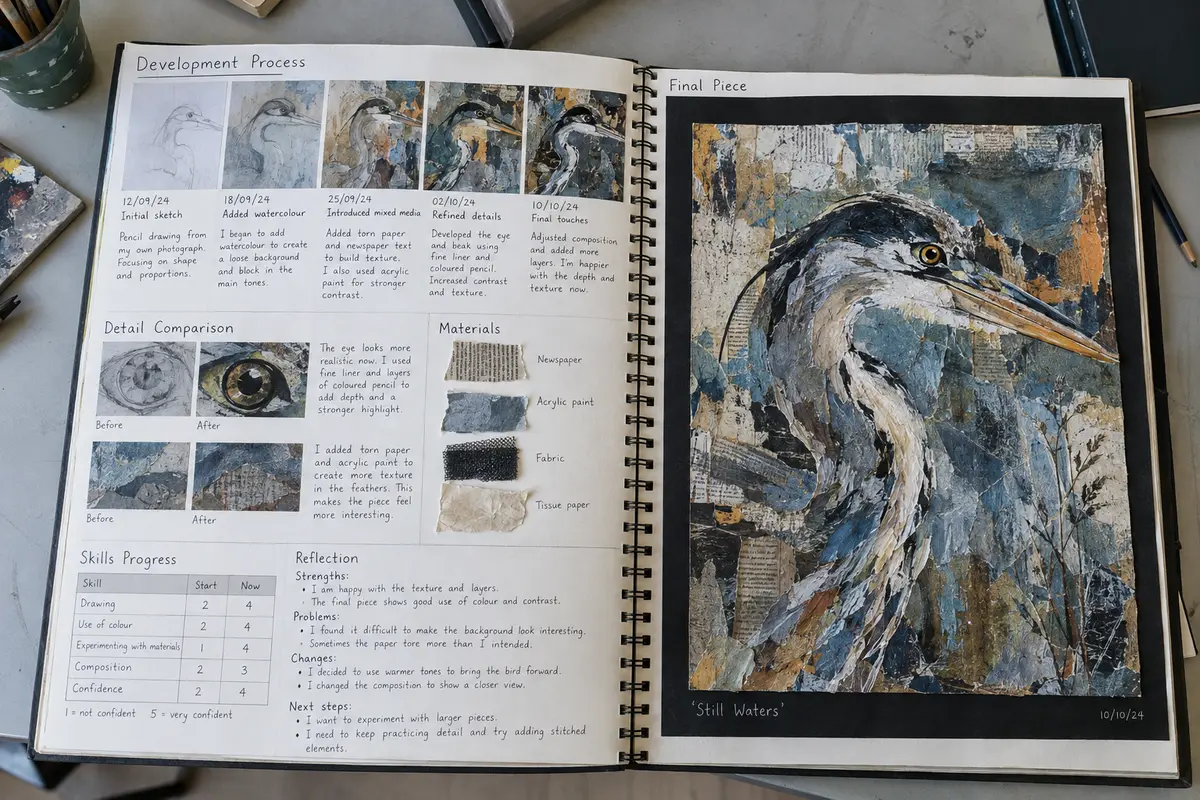
Review should be visible throughout the work rather than added as one paragraph at the end. Photographs of stages, before-and-after details, short evaluations and clearly stated next steps help the assessor understand how your control and decision-making developed.
Record
- Photographs of work in progress
- Dates or a clear sequence
- Material and process details
- Problems and unexpected results
Review
- Specific strengths
- What did not work and why
- Changes you made
- What you would try next
Component 1 portfolio checklist
- I have used relevant primary and secondary sources.
- I have investigated how practitioners use materials, techniques, processes and visual language.
- I have responded practically rather than only writing about research.
- I have explored different materials, techniques or processes.
- I have generated several ideas or possible solutions.
- I have shown how research and experiments informed my ideas.
- I have practised and improved practical skills.
- I have reviewed experiments and made purposeful changes.
- I have recorded work in progress, not only finished pieces.
- My portfolio is organised so another person can follow my development.
- My annotations are brief, specific and connected to visible evidence.
- The work remains personal and clearly reflects my own decisions.
Do not copy the examples
These images show ways of organising evidence, not a layout you must reproduce. Copied imagery, annotations or decisions cannot demonstrate your own creative practice. Use the examples to ask better questions about your work, then present your own investigations and development.
Common Component 1 weaknesses
- Research without a response: information about an artist is included, but it does not affect any practical work.
- Random experiments: many materials are tried, but there is no explanation of what was learned.
- One idea presented as development: the same composition is repeated without meaningful change.
- Decoration replacing evidence: pages look attractive, but important stages are missing.
- Vague annotation: comments such as “I like this” do not explain why something succeeded or what should happen next.
- Only showing finished work: the assessor cannot see how skills, control and decisions developed.
Frequently asked questions
Click or tap a green question bar below to reveal the answer. Select it again to close the answer.
Does Component 1 need to be completed in a sketchbook?
Your centre decides how evidence is organised. It could include a physical sketchbook, worksheets, mounted sheets, digital slides, photographs, prototypes or a combination. Whatever format you use, the creative journey must remain clear.
How much writing should I include?
Use enough writing to explain sources, intentions, decisions, results and next steps. Short, specific notes placed beside the relevant evidence are usually more useful than long descriptive paragraphs.
Do I need to use lots of different materials?
No. A smaller number of purposeful experiments can be stronger than many unrelated techniques. The important issue is what you learn, how you review the results and how the experiments influence later work.
Can Component 1 include photography or graphic design?
Yes. Component 1 can draw on different areas of art and design practice. Your evidence might involve Fine Art, Photography, Graphic Design, three-dimensional work or a combination, depending on your centre’s programme and resources.
Are these official Pearson portfolio examples?
No. They are original illustrative examples created by Portfolio to A Star to explain useful types of evidence. Pearson publishes its own specification, sample assignments and exemplar materials, which should be used for authoritative assessment information.
Continue with BTEC Art and Design
Official source: Pearson BTEC Level 1/Level 2 Tech Award in Art and Design Practice. Always use the current specification and instructions supplied by your centre.