
Home › A Level Art › Assessment Objectives › AO4 Explained
How to create a personal and meaningful A Level Art response
AO4 is where your investigation becomes a convincing response. It asks you to bring together the ideas, contextual understanding, practical discoveries, observations and critical decisions developed throughout your project—and realise them in a form that is genuinely personal and meaningful.
Your response should not appear suddenly at the end of the project. It should grow visibly from your artist and contextual research, first-hand recording, practical experiments, evaluation and refinement.
What is AO4 in A Level Art?
AO4 assesses how effectively you present a personal and meaningful response, realise your intentions and, where appropriate, connect visual and other elements. It is worth 25% of the assessment, but it should not be treated as an isolated final piece worth completing only at the end. Strong AO4 grows visibly from AO1 research, AO2 exploration and refinement, and AO3 recording and critical reflection.
“Present a personal and meaningful response that realises intentions and, where appropriate, makes connections between visual and other elements.”
A Level Art and Design AO4 wording
A Level Art AO4 explained word by word
| AO4 wording | What it means in practice | What should be visible |
|---|---|---|
| Present | Select, organise and communicate the response in the form best suited to the intention. | Purposeful decisions about format, scale, sequence, surface, context, audience or display. |
| Personal | The response reflects your own enquiry, evidence, judgements and way of combining influences. | First-hand sources, independent choices, transformation rather than imitation, and ownership of meaning. |
| Meaningful | The outcome communicates something that matters within the project. | A clear relationship between subject, intention, visual decisions and the viewer’s experience. |
| Realises intentions | The response fulfils, extends or intelligently revises the aims developed during the investigation. | A traceable connection between planning, testing, reflection, refinement and resolution. |
| Connections | Visual work may connect with writing, sound, movement, sequence, space, audience or other appropriate elements. | Connections that strengthen meaning—not extras included merely to satisfy a checklist. |
What examiners expect from AO4
Examiners are not simply asking whether the final piece looks impressive. They are judging whether the response is a convincing realisation of the investigation that produced it. A highly resolved outcome cannot repair a disconnected project, while an ambitious and thoughtful response does not need to be flawless to demonstrate strong AO4.
- Coherence: the outcome belongs to the project and can be traced through its development.
- Personal ownership: the response is shaped by your sources and decisions rather than reproducing another person’s work.
- Realisation: the selected media, process, scale, format and presentation fulfil the intention convincingly.
- Meaning: the visual decisions communicate an idea, experience, question, message or atmosphere.
- Selection: you recognise the strongest possibilities and leave weaker or irrelevant material behind.
- Connection: research, making, recording, reflection and presentation work together rather than appearing as separate tasks.
AO4 is more than the final piece
AO4 is often described as the “final outcome objective”, but this can be misleading. The outcome matters, yet the examiner also needs evidence that it is personal, meaningful and connected to intentions. Your sketchbook or portfolio should make those relationships easy to follow.
| Stage | Useful AO4 evidence |
|---|---|
| Early intention | A question, purpose, audience, experience or visual problem worth resolving. |
| Source selection | First-hand material and contextual sources chosen because they can develop the intention. |
| Practical development | Tests that change composition, process, sequence, scale, imagery or meaning. |
| Critical decisions | Clear reasons for retaining, adapting, combining or rejecting particular possibilities. |
| Refinement | Repeated improvement of the aspects that most affect communication and resolution. |
| Presentation | A final form that supports the work’s meaning, context and intended viewer experience. |
A Level Art AO4 examples
A Level Art AO4 explained – Fine Art AO4 example
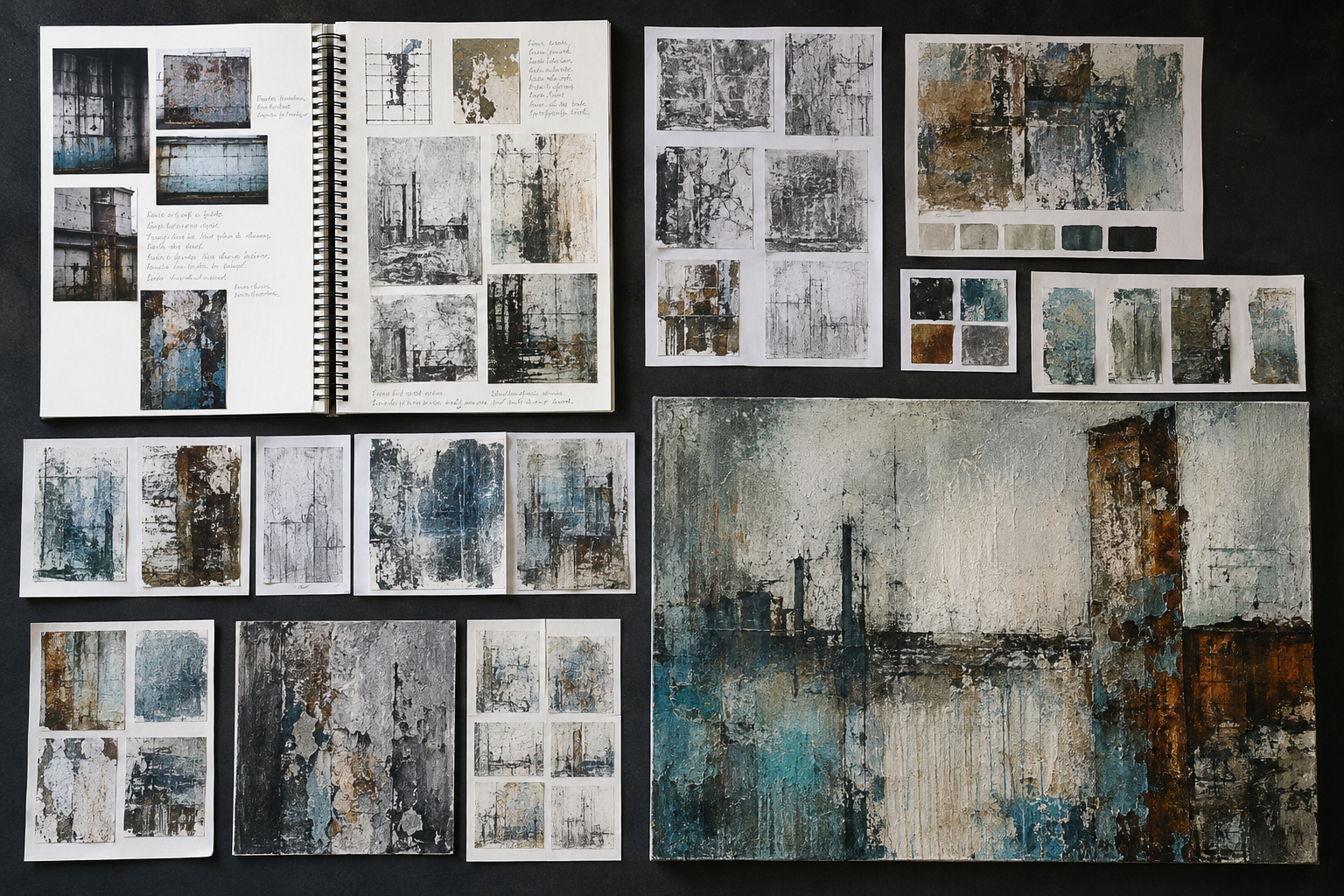
A Fine Art student photographs weathered industrial surfaces and begins by exploring physical decay. Through contextual research, drawing, transfer, print, scraping and layering, the enquiry shifts towards memory and regeneration. The student rejects literal copies of walls, selects the most expressive surface processes and develops a large mixed-media response in which damaged and rebuilt areas carry meaning.
A Level Art AO4 explained – Photography AO4 example
A Photography student investigates isolation in urban spaces. The first shoot establishes the subject but feels too descriptive. Analysis of distance, empty space, artificial light and sequencing leads to a planned reshoot. The student changes viewpoint and time of day, refines tonal relationships, compares alternative crops and constructs a final sequence in which each image contributes to a sustained psychological experience.

A Level Art AO4 explained – Graphic Communication AO4 example
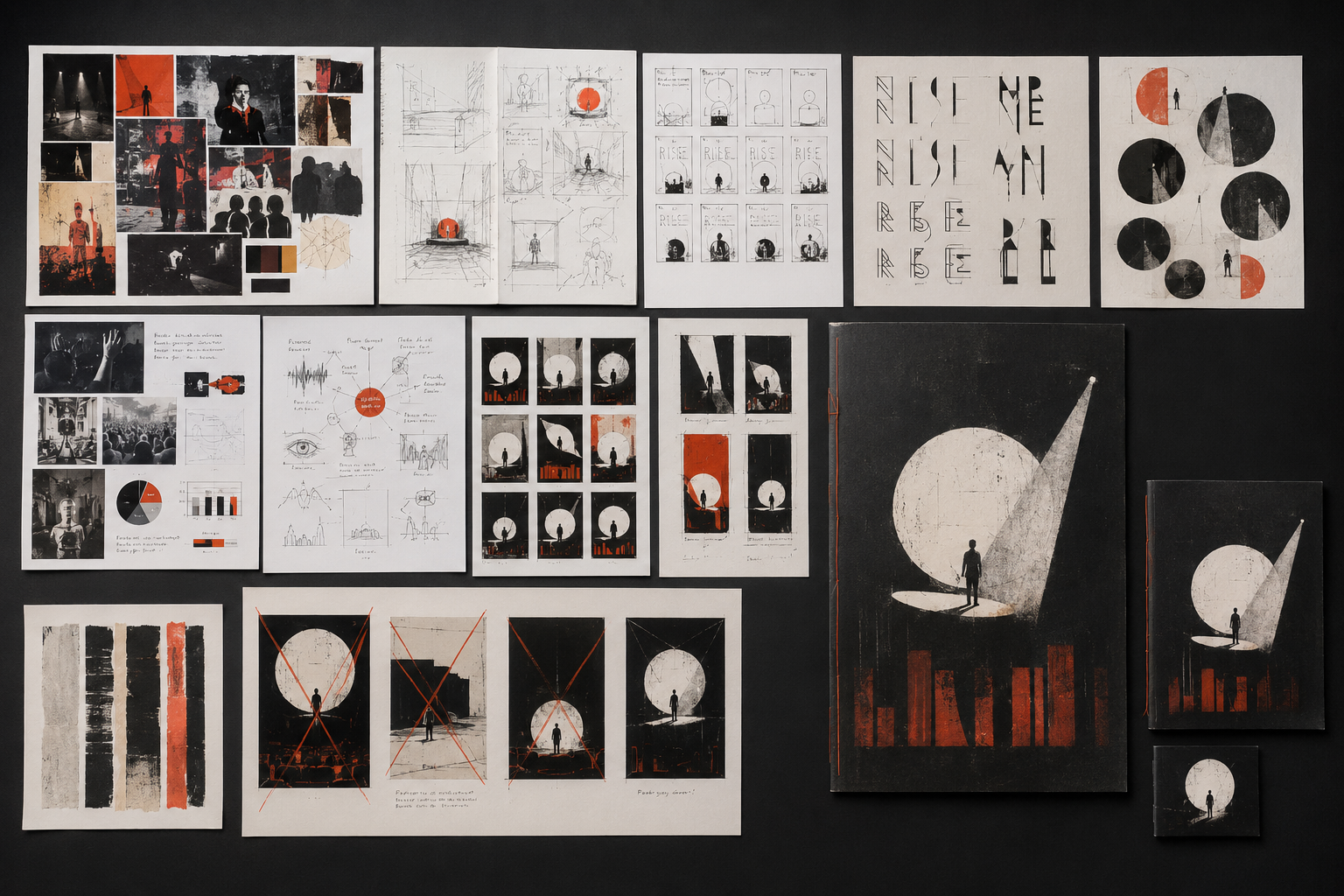
A Graphic Communication student develops a campaign for a fictional youth-theatre production. Audience research and original theatre imagery establish the message and tone. Thumbnail layouts test competing hierarchies; type, colour and image experiments reveal which approach communicates most clearly. The final poster, programme cover and social tile form one coherent visual system while responding appropriately to different formats.
How to improve your AO4 evidence
- Restate the intention precisely. Replace a broad theme with a question, purpose or experience that the outcome must communicate.
- Identify what changed during the project. Strong AO4 reflects discoveries made through research, experimentation and recording.
- Compare more than one possible response. Test alternatives in composition, scale, sequence, format, process or presentation.
- Explain selection and rejection. Record why one possibility serves the intention more effectively than another.
- Make research visible in your decisions. Adapt principles and insights rather than copying another person’s appearance.
- Resolve the weakest relationship. Ask what remains unclear between intention, imagery, process, format and viewer experience.
- Test presentation before committing. Use small mock-ups, proofs, sequencing trials or display photographs.
- Document the finished response properly. Use clear, evenly lit images that show the whole work and relevant details without distracting surroundings.
Weak and strong AO4 compared
| Weak or limited evidence | Stronger A Level AO4 evidence |
|---|---|
| A final piece appears suddenly. | The response can be traced through sources, tests, decisions and refinements. |
| The outcome imitates one contextual source. | Influences are understood, combined, questioned and transformed. |
| The student follows the first plan regardless of discoveries. | The intention becomes more focused as the investigation reveals stronger possibilities. |
| Experiments are included without selection. | Successful and unsuccessful tests are compared and used to justify the final direction. |
| Presentation is decorative or excessively elaborate. | Format and display support meaning, audience and viewer experience. |
| The annotation says only that the outcome was successful. | Evaluation identifies precisely how the response realises the intention and what remains unresolved. |
Common AO4 mistakes
- Assuming AO4 is awarded only for technical finish.
- Producing an outcome that does not follow from the investigation.
- Copying the style or composition of a contextual source too closely.
- Beginning the final response before the strongest direction has been tested.
- Changing scale, format or material without considering how the change affects meaning.
- Including several unrelated outcomes instead of resolving a coherent response.
- Mounting every sheet elaborately without a presentational reason.
- Failing to photograph temporary, three-dimensional, installed or time-based work properly.
- Writing a retrospective explanation that claims connections not supported by the visual evidence.
- Treating the externally set assignment as a separate final piece rather than a complete investigation assessed across all four objectives.
A Level AO4 checklist
- My response answers a clear intention, question or communication problem.
- The final direction can be traced through the portfolio.
- My first-hand sources give the response personal substance.
- Contextual research has influenced decisions without being copied.
- I have tested credible alternatives rather than accepting my first idea.
- I can explain what I retained, changed, combined and rejected.
- My selected media and processes suit the intention.
- Scale, format, sequence or duration have been tested where relevant.
- Visual elements work together to communicate meaning.
- Written, spoken, spatial, sound or time-based elements are included only where they strengthen the response.
- The outcome demonstrates appropriate control and resolution.
- Presentation supports the work rather than decorating it.
- Any series or group of outcomes feels coherent.
- The completed response has been documented clearly.
- An examiner can understand why this response could only have grown from this investigation.
Frequently asked questions about A Level Art AO4
Does AO4 only mean the final piece?
No. Your final outcome is important, but AO4 assesses whether you have presented a personal and meaningful response that realises your intentions. The examiner should be able to trace the response back through your research, first-hand recording, experiments, critical decision and refinement. A polished final piece that appears suddenly and has little connection with the investigation will provide limited AO4 evidence.
Does an A Level Art outcome have to be one object or image?
No. Your response could be a painting, sculpture, photograph, series of images, publication, animation, film, installation, digital outcome, performance or combination of formats. The most appropriate form depends on your intentions. A group or series of outcomes should work together coherently rather than appearing to be several unrelated final pieces.
Must the outcome match the original plan exactly?
No. Strong A Level work often changes as the investigation develops. Research, experimentation and first-hand observation may reveal possibilities that were not apparent at the beginning. What matters is that you can explain why your intentions changed and show how your decisions led to a more personal, meaningful and convincing response.
What makes an AO4 response personal?
A personal response grows from your own investigation, first-hand sources, experiences, questions and decisions. It does not have to reveal private information or be a self-portrait. It becomes personal when you select, combine and transform influences independently instead of copying an artist’s style or following a teacher-directed formula.Lorem ipsum dolor sit amet, at mei dolore tritani repudiandae. In his nemore temporibus consequuntur, vim ad prima vivendum consetetur. Viderer feugiat at pro, mea aperiam
Do presentation and mounting receive marks by themselves?
No. Elaborate mounting does not automatically earn AO4 marks. Presentation matters when choices about scale, format, sequence, spacing, surface, location or display help communicate your intentions. Presentation should strengthen the viewer’s experience of the work rather than decorate it or disguise weaknesses.
Is AO4 assessed separately from AO1, AO2 and AO3?
AO4 receives its own assessment, but the strongest evidence grows from the other objectives. AO1 provides contextual understanding and developing ideas; AO2 provides experimentation, selection and refinement; AO3 provides first-hand recording and critical reflection. AO4 brings this evidence together in a personal and meaningful response. Each assessment objective contributes 25% of the assessment.
The key message
Strong AO4 is not an impressive final piece attached to a project. It is the convincing realisation of the project. The response should make visible what you investigated, discovered, questioned, selected and refined. When the outcome feels personal, meaningful and inevitable—but not predictable—the four Assessment Objectives are working together.
Would detailed feedback help?
If you are unsure whether your outcome follows convincingly from your investigation—or what you should refine before completing it—Portfolio to a Star can identify the strongest evidence, the gaps and the next practical priorities across AO1–AO4.
Would you like an independent view of your work? Explore our online Art portfolio feedback service for practical, personalised guidance across AO1–AO4.
Continue through the A Level Assessment Objectives
- A Level Art AO1 explained: research and developing ideas
- A Level Art AO2 explained: exploration and refinement
- A Level Art AO3 explained: recording and critical reflection
- A Level Fine Art course explained
- A Level Photography course explained
- A Level Graphic Communication course explained
Official specification sources
Assessment requirements and administrative arrangements can change. Always use your centre’s current specification and guidance.