
Home › A Level Art › Graphic Communication Course Explained
A Level Graphic Communication Course Explained
A Level Graphic Communication—often described informally as A Level Graphic Design—is an Art and Design course about communicating ideas, information, meaning and emotion through words, images, typography, colour, layout, sequence, movement and format. Students do much more than produce polished posters: they investigate, record, generate alternatives, experiment, test, refine and justify a personal response for an understood purpose or audience.
What is A Level Graphic Communication?
A Level Graphic Communication is the study and creation of primarily visual material designed to communicate to an audience. Projects may involve advertising, branding, illustration, publications, packaging, typography, information design, interactive media, motion graphics, signage or design for film and performance. The course rewards the quality of the investigation and decision-making—not the cost of the software or the number of finished products.
The A Level Graphic Communication course at a glance
| Course feature | What students should know |
|---|---|
| Typical duration | The full A Level is normally taught over two academic years. |
| Component 1 | Personal Investigation: a sustained practical enquiry with supporting work, one or more personal responses and a related extended written element. Normally 60%. |
| Component 2 | Externally Set Assignment: preparatory investigation followed by 15 hours of supervised work. Normally 40%. |
| Assessment | AO1, AO2, AO3 and AO4 are equally weighted. The whole investigation is assessed, not merely the final design. |
| Course title | Awarding organisations generally use “Graphic Communication”; schools and students may also call it Graphic Design. |
| Exact requirements | Written-study format, raw marks, paper release and administration differ slightly by awarding organisation and centre. |
What can students study and make?
The course can be commercial, cultural, social, educational, experimental or personally driven. Students normally work in one or more related areas and may combine physical and digital processes where this suits the enquiry.
- Advertising and campaigns
- Brand identity and visual systems
- Editorial, book and magazine design
- Illustration and narrative imagery
- Typography and experimental lettering
- Poster and publication design
- Packaging and prototypes
- Information and wayfinding design
- Web, app and game concepts
- Motion graphics and animation
- Design for film, television or theatre
- Mixed-media visual communication
What work goes into an A Level Graphic Communication portfolio?
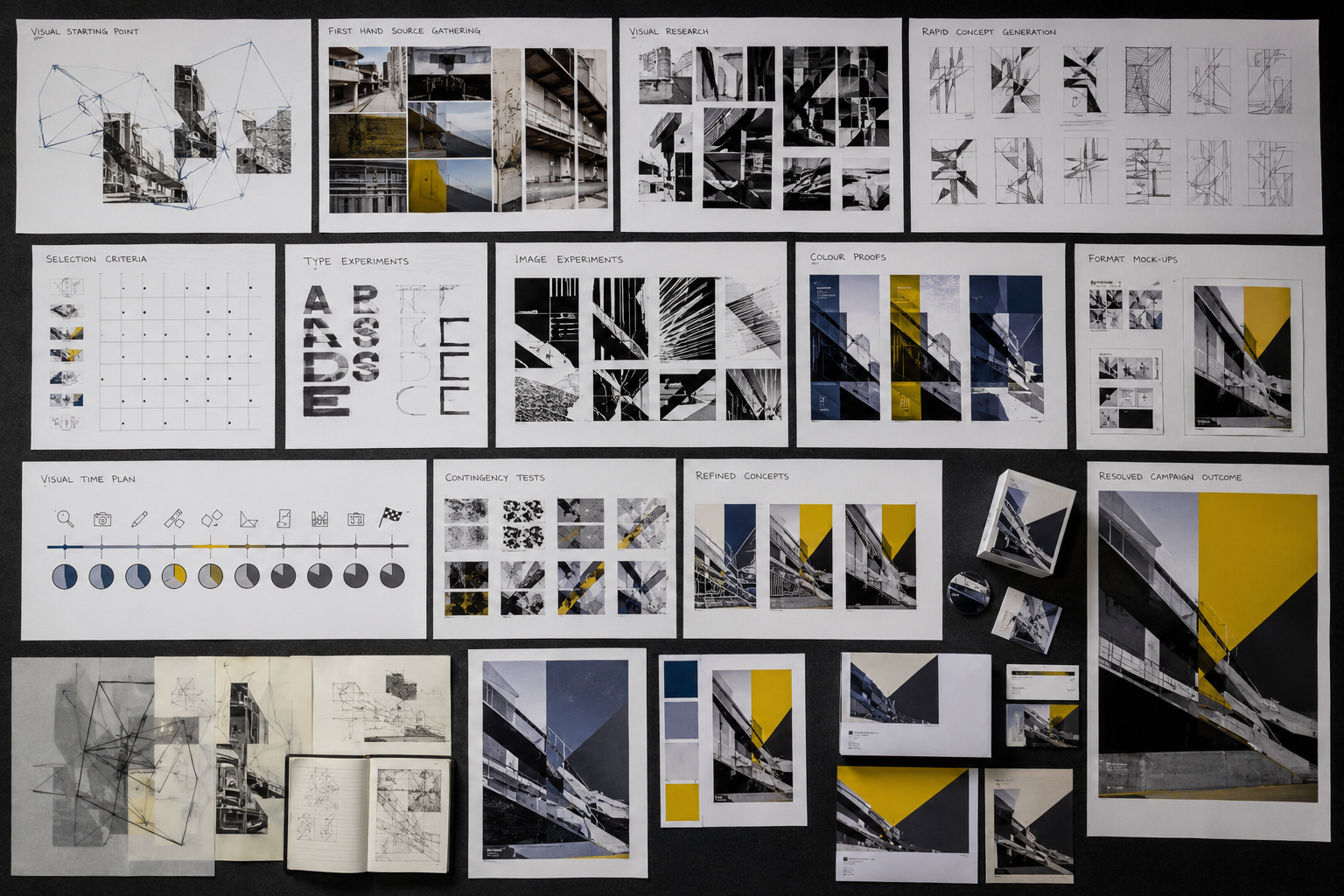
A strong portfolio shows an organised chain of judgement. It should allow the examiner to see what the student investigated, what was learned, which alternatives were considered, what was rejected and how the final communication grew from the enquiry.
- A clear enquiry or brief: message, purpose, audience, context and a worthwhile communication problem.
- First-hand sources: original drawing, photography, observation, collected type, objects, places, interviews, surveys or audience evidence.
- Contextual investigation: relevant designers, illustrators, typographers, studios, campaigns, movements and communication contexts.
- Distinct concepts: thumbnails and roughs that explore genuinely different ideas rather than rearranging the same layout.
- Image and typography development: alternative relationships, hierarchy, tone, legibility, grid, colour, scale and sequence.
- Practical testing: print proofs, prototypes, folding dummies, material trials, accessibility checks, screen sequences or motion tests.
- Critical reflection: concise evaluation that identifies what communicates, what fails and what should happen next.
- Selection and refinement: visible reasons for retaining, combining, adapting or rejecting ideas.
- Resolved communication: one outcome or a coherent family of outcomes that realises the intention.
- Source acknowledgement: accurate identification of quotations, images, data, typefaces and ideas that are not the student’s own.
What is the Personal Investigation?
The Personal Investigation is the larger component. It is a sustained practical and contextual enquiry developed from a focus that can support real depth. It should not become a collection of unrelated logos, posters and packages. Audience, purpose, first-hand material, contextual understanding, experimentation, critical selection, writing and outcomes should form one connected investigation.
The related written element should investigate a focused question and connect directly with practice. It is not an extended biography of a famous designer. Students can analyse and compare particular visual strategies, purposes, audiences and contexts, then show how those discoveries influenced their own decisions. Exact word-count and presentation rules vary, so students must use their current specification and centre guidance.
What happens in the externally set assignment?
Students select or respond to a starting point supplied by their awarding organisation and develop preparatory work over the period allowed by the centre. At A Level, this is followed by 15 hours of supervised work. The preparation and the work produced during supervised time are assessed together across AO1–AO4.
The supervised period should be used to realise a well-tested direction—not to discover that a typeface is missing, a printer changes the colour, a package cannot be assembled or an animation will not export. Before the timed sessions, students should have investigated the starting point, collected original sources, researched relevant contexts, generated alternatives, refined a viable concept and tested the permitted production process.

What do strong AO1–AO4 submissions contain?
| Assessment Objective | Strong Graphic Communication evidence |
|---|---|
| AO1: Develop | Sustained contextual, audience and purpose investigation; perceptive analysis; comparisons; and visible evidence that sources changed the student’s ideas. |
| AO2: Explore and refine | Genuinely different concepts, purposeful image and type experiments, material and process tests, selection, rejection and repeated refinement. |
| AO3: Record and reflect | Original drawing and photography, visual notes, thumbnails, storyboards, diagrams, audience evidence and critical reflection that directs the next decision. |
| AO4: Present and realise | A coherent, personal and meaningful response whose message, imagery, typography, hierarchy, format and presentation realise the developed intention. |
The objectives should not look like four isolated chapters. One well-documented prototype can show contextual understanding, original recording, exploration, audience testing, reflection, refinement and movement towards a resolved response.
How is A Level Graphic Communication different from GCSE?
| GCSE Graphic Communication | A Level Graphic Communication |
|---|---|
| Projects may begin with a teacher-framed brief or theme. | The student should demonstrate greater ownership of the enquiry and increasingly independent decisions. |
| Relevant practitioners are investigated and used to develop ideas. | Contextual research should be sustained, analytical, critical and visibly consequential. |
| Students generate and refine ideas using suitable processes. | Alternatives should be more conceptually distinct, selection more discriminating and refinement more sustained. |
| Audience and purpose are identified. | Audience, context, accessibility and intended response should influence the whole visual system. |
| Annotation records decisions and progress. | Reflection should evaluate effectiveness, recognise limitations and direct precise next actions. |
| The portfolio and externally set assignment are assessed. | The Personal Investigation includes a substantial related written element and the externally set component includes 15 hours of supervised work. |
What materials, software and processes can students use?
There is no single compulsory software package or production method. Students should select processes because they help investigate or communicate the intention. Traditional and digital methods can be combined.
| Area | Possible processes | What they can investigate |
|---|---|---|
| Drawing and ideation | Sketchbooks, layout pads, tracing paper, pens, markers, collage and tablets | Observation, thumbnails, storyboards, visual thinking and alternative concepts |
| Original imagery | Photography, scanning, photocopying, printmaking, montage and found textures | Authenticity, viewpoint, sequence, texture, symbolism and image transformation |
| Typography | Hand lettering, type specimens, digital type, experimental printing and calligraphy | Voice, hierarchy, rhythm, readability and expressive letterform |
| Layout and production | Grids, page-layout software, print proofs, dummies, packaging nets and prototypes | Scale, structure, sequence, material, usability and production feasibility |
| Digital and time-based work | Image editing, vector drawing, interface prototypes, animation, video and motion graphics | Interaction, duration, movement, responsive systems and screen-based communication |
Common mistakes to avoid
- Using a broad theme without defining a communication question, audience or purpose.
- Filling research pages with biographies while failing to analyse how design choices communicate.
- Depending on internet or stock images instead of gathering meaningful first-hand sources.
- Polishing the first idea before genuinely different concepts have been explored.
- Changing fonts, colours and filters without testing a specific communication problem.
- Presenting many products that repeat one weak visual idea rather than a coherent, developed system.
- Describing actions in annotations without explaining why a decision succeeded or failed.
- Allowing technical effects or software to replace personal enquiry and critical judgement.
- Leaving print, construction, animation or export testing until the supervised period.
- Failing to cite images, data, quotations, typefaces or generated material accurately.
A strong-portfolio checklist
- The enquiry can be expressed as a focused communication question.
- Audience, purpose and context influence visual decisions.
- First-hand sources are substantial, purposeful and clearly identified.
- Relevant designers and contexts are analysed rather than merely described.
- Research visibly changes the student’s own work.
- Several genuinely different conceptual routes are explored.
- Typography, image, colour, hierarchy, format and process are tested for a reason.
- Selection, rejection and refinement are recorded clearly.
- Annotations identify a precise next action.
- The written study and practical investigation illuminate one another.
- The resolved response grows convincingly from the preceding evidence.
- Physical, digital, moving or temporary work is documented clearly.
- Sources, files and versions are organised so authorship is unmistakable.
- AO1–AO4 are connected throughout the project.
Frequently asked questions
Is A Level Graphic Communication the same as Graphic Design?
Do I need expensive design software?
Do I have to be excellent at realistic drawing?
How many designers should I research?
How many final products are required?
Can students use generative AI?
The key message
A Level Graphic Communication rewards a connected and visible chain of judgement. A worthwhile communication problem leads to relevant research and first-hand recording; these generate distinct ideas that are tested, selected and refined; the learning is then realised through a coherent personal response for an understood purpose or audience.
Would detailed feedback help?
If you are unsure whether your Graphic Communication portfolio shows enough development, personal ownership or evidence across AO1–AO4, Portfolio to a Star can identify the strongest work, the missing connections and the most useful next practical priorities.
Continue exploring A Level Art
- A Level Art Help and course guidance
- A Level Art AO1 explained: research and developing ideas
- A Level Art AO2 explained: experimentation and refinement
- A Level Art AO3 explained: recording and critical reflection
- A Level Art AO4 explained: personal response and outcome
- A Level Fine Art course explained
- A Level Photography course explained
Official specification sources
Course requirements, written-study arrangements and administrative rules can change. Students should always use the current specification and instructions supplied by their school or college.