
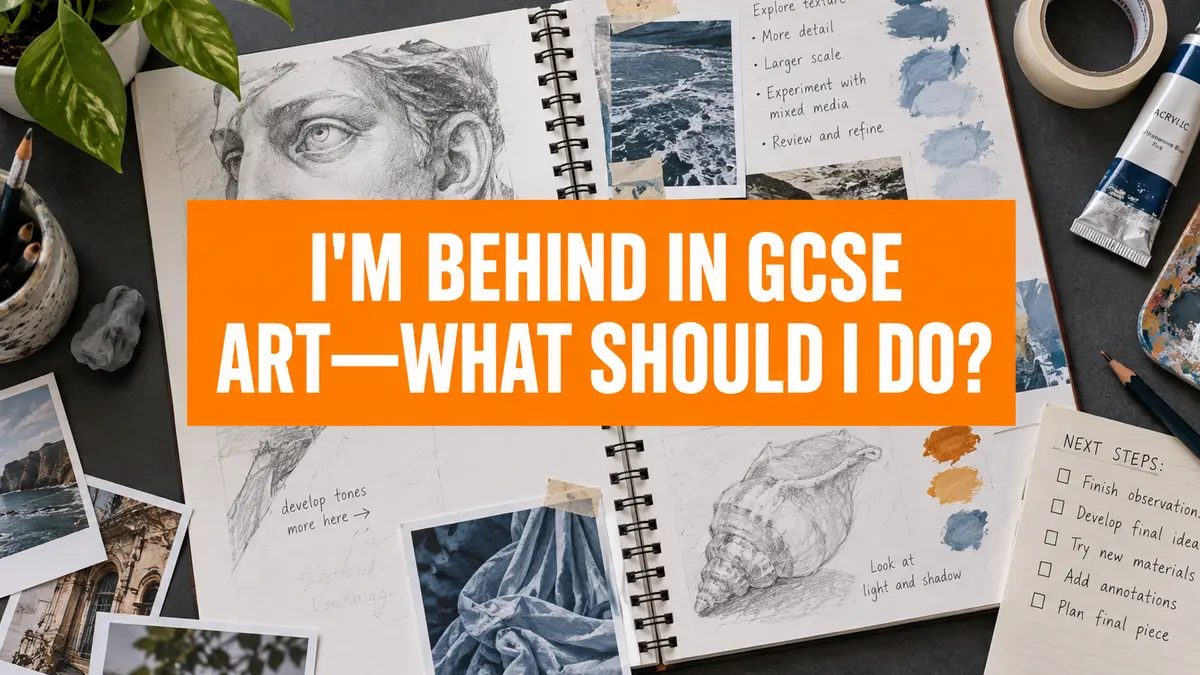
If you’re behind in GCSE Art, tell your teacher and make a realistic recovery plan before trying to produce more work. Do not begin by decorating unfinished pages, copying large sections of artist research or staying awake all night. First establish exactly what is missing, which deadline matters and which tasks will provide the strongest evidence for your project.
Falling behind can feel embarrassing, but avoiding the problem usually makes it harder. You do not need a perfect excuse or a finished solution before asking for help. A short, honest conversation can clarify priorities, reveal work your teacher already considers sufficient and prevent you spending hours on the wrong task.
What to do first
- Tell your Art teacher you are behind.
- Confirm the real deadline and what must be submitted.
- Lay out or photograph everything you have completed.
- Identify missing evidence rather than counting empty pages.
- Choose three priorities: do first, do next and only if there is time.
- Complete one connected task before starting another.
Step 1: Speak to your teacher today
Your teacher knows the course requirements, school deadlines and work you have already produced. Ask for a brief conversation and be specific:
“I know I’m behind and I want to make a sensible catch-up plan. Could you help me identify the three most important pieces of work I should complete first?”
If illness, caring responsibilities, additional needs, difficulties at home or your mental health have affected your work, tell an appropriate adult. You do not have to explain personal details to everyone. Your teacher, form tutor, pastoral lead, SENCO or another trusted member of staff can explain what support may be available. Do not assume that an extension is possible; ask rather than guessing.
Step 2: Find out how far behind you really are
Students often say “I have ten blank pages” when the real problem is not page quantity. Perhaps the project already contains useful drawings and experiments but lacks annotation. Perhaps there is plenty of research but no personal response. Your audit should focus on evidence and connections.
| Check | Ask yourself | Possible missing evidence |
|---|---|---|
| AO1: Develop | Have I learned from relevant artists and used that learning to move my own ideas forward? | Focused research, visual analysis, an original response or a connection to later work. |
| AO2: Refine | Have I tested, compared and improved materials, techniques or processes? | Purposeful experiments, evaluations, combinations and refinements. |
| AO3: Record | Have I collected and recorded relevant first-hand information? | Your own photographs, drawings, contact sheets, observations or notes. |
| AO4: Present | Does my outcome grow convincingly from my research, recording and experiments? | Composition alternatives, developed study, final plan, outcome documentation or evaluation. |
Use GCSE Art Assessment Objectives Explained Clearly if you are unsure what AO1–AO4 mean. If the sketchbook itself feels confusing, check What Should I Put in My GCSE Art Sketchbook?.
Step 3: Divide tasks into three priorities
Write every possible task on scrap paper, then sort the list. This prevents easy but low-value jobs from taking over.
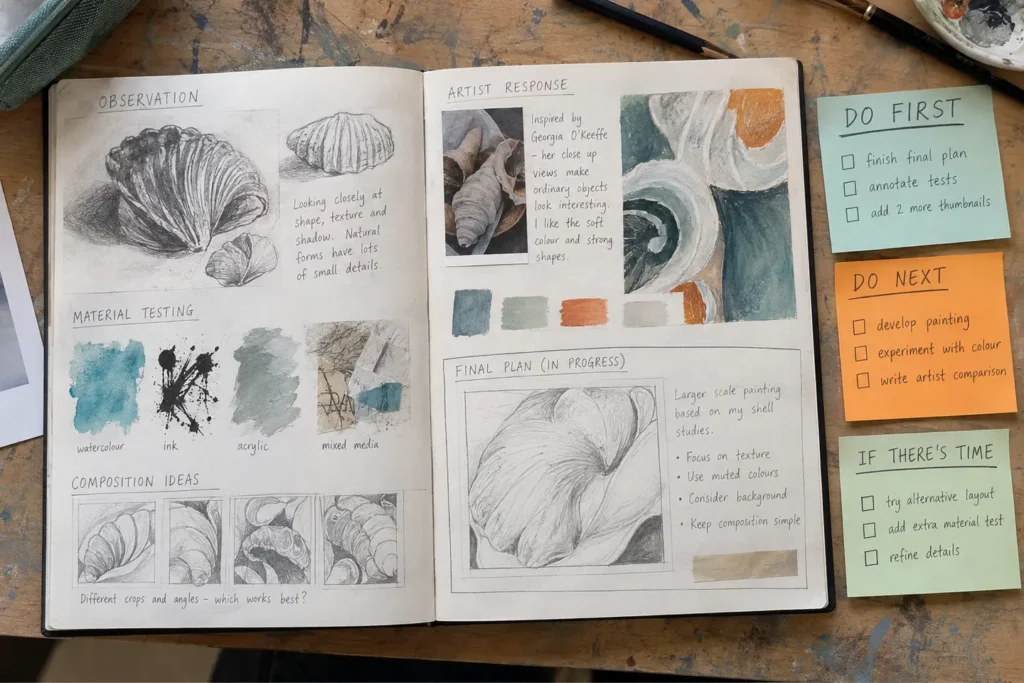
Do first
Essential evidence that is absent or a task your teacher has specifically requested. Examples might include your own source photographs, an artist response, material testing, composition ideas or a final plan.
Do next
Work that strengthens or connects existing evidence: concise annotation, a refined version of a promising experiment, a second photoshoot or a better mock-up.
Only if there’s time
Optional page decoration, elaborate headings, repeating an experiment that already proves the same point, or remaking acceptable work simply because it is not your favourite.
Step 4: Repair the weakest connection
A rushed project becomes stronger when the stages connect. Imagine that you already have photographs of weathered buildings and a pencil observation, but your material experiments and final idea feel unrelated. One useful mixed-media texture test derived from the photograph, followed by three composition thumbnails using its strongest qualities, can repair that journey more effectively than five unrelated finished pictures.

Look for the point where a viewer would ask, “How did you get from this to that?” Add the missing visual step and a short explanation. The guide How to Plan Coursework Sequence for Higher Grades will help you identify these gaps.
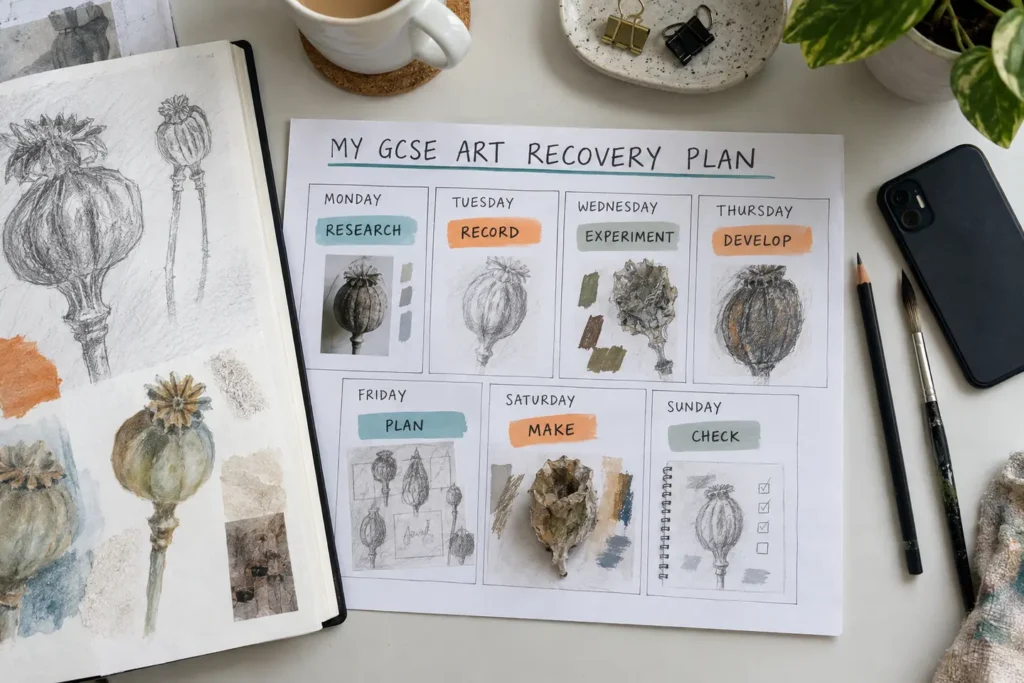
Step 5: Use a realistic GCSE Art catch-up plan
A plan should name actual outcomes, not vague activities such as “do Art”. Break work into tasks that can be finished in one session: select six photographs, complete two crop studies, compare three paint tests, annotate yesterday’s experiment or produce four composition thumbnails.
| Time available | Sensible focus |
|---|---|
| One session | Audit the project, document existing work and complete the single missing task your teacher considers most important. |
| Three days | Repair one weak AO connection, add concise annotation and produce a realistic final plan. |
| One week | Complete a short connected cycle: research or recording, experiment, evaluate, develop, plan, make and check. |
| Two weeks or more | Schedule several focused cycles, including time for teacher feedback, refinement and photographing outcomes. |
Adapt this to the deadline and priorities agreed with your teacher. Do not attempt to complete an imaginary full course in seven days. A recovery plan should improve the evidence you can realistically produce without damaging your health or your other subjects.
Step 6: Work in focused blocks
Choose one task, gather the materials before starting and remove obvious distractions. Work for a manageable block—perhaps 25 to 45 minutes—then pause briefly and decide the next concrete action. Your ideal working time may be different; the important part is giving one outcome your full attention.
- Start with a small action: print the photographs, mix the palette or draw four thumbnail boxes.
- Keep your phone away unless it is needed for photography, reference or timing.
- Finish, photograph and label one task before opening another.
- At the end, write one sentence beginning “Next I will…”
What should I prioritise in Fine Art?
Prioritise first-hand observation, relevant artist connections, visible testing of materials and composition development. A small set of connected studies in drawing, paint, print or mixed media is more useful than many unrelated techniques. If time is short, test a selected subject consistently across different processes, evaluate the results and refine the strongest one. See GCSE Art Experimentation Techniques That Build AO2.
What should I prioritise in GCSE Photography?
Do not hide hundreds of photographs on a device. Present selected contact sheets, identify successful and unsuccessful images, explain camera or lighting decisions and show how one shoot leads to another. A focused second shoot that responds to your evaluation can demonstrate more development than several disconnected shoots. Include editing stages and compare alternatives rather than presenting only the final image. The guide to developing GCSE Photography contact sheets can help.
What should I prioritise in Graphic Communication?
Keep the brief, audience and purpose visible. Prioritise relevant research, typography, imagery, colour decisions, layout thumbnails and development through mock-ups. Show alternatives before the final design. A rough package mock-up or poster test photographed in context can reveal practical decisions that a flat digital file cannot. Use Graphic Communication Coursework That Earns Marks for more specific guidance.
What not to do when you are behind
- Do not start a completely new theme unless your teacher specifically advises it.
- Do not write pages of copied biography. Use concise research that leads to your own visual response.
- Do not decorate pages before adding evidence. Presentation comes after purpose.
- Do not repeat the same test. Refine it or change a meaningful variable.
- Do not jump straight to a huge final piece. Test composition, scale and materials first.
- Do not copy another student’s work or submit AI-generated material as your own. Ask for help with planning while keeping the creative decisions and submitted evidence genuinely yours.
- Do not rely on an all-nighter. Exhaustion reduces concentration, decision-making and practical control.
If the deadline is extremely close
Contact your teacher immediately and ask what can still be accepted. Photograph and organise the work that already exists. Complete essential connections and short evaluations before optional decoration. Submit what you have by the agreed deadline unless your school tells you otherwise; an incomplete but authentic project is better than no submission or work that is not your own.
If your final outcome is still ahead, use How to Plan a GCSE Art Final Piece: AO4 Step by Step. Scale the plan to the time and materials genuinely available.
Look after yourself while catching up
Being behind in one subject does not make you lazy, incapable or a failure. Eat normally, sleep, take short breaks and ask for support. If worry is becoming difficult to manage, speak to a trusted adult. Childline offers support for managing stress and anxiety, while the NHS Every Mind Matters anxiety guidance includes practical self-care information. These resources do not replace support from your school, GP or another qualified professional when you need it.
Frequently asked questions
Will I fail GCSE Art if I am behind?
Being behind does not automatically determine your final result. Your outcome depends on the evidence submitted and how it meets the assessment criteria. Ask your teacher for an honest review of what is already present and what should be prioritised.
Should I submit an unfinished sketchbook?
Follow your school’s submission instructions. Do not withhold all your work simply because it is incomplete. Organise and submit the authentic evidence you have by the agreed deadline unless your teacher tells you differently.
Can I ask for an extension?
You can ask your teacher what arrangements are possible, especially if illness or serious circumstances affected your work. Extensions and formal considerations are governed by school and awarding-body procedures, so they cannot be assumed or promised.
What is the quickest useful work I can add?
The answer depends on the weakest part of your project. Often, a set of your own source photographs, several composition thumbnails, a comparison of connected experiments or concise decision-based annotation can clarify existing work quickly. Ask your teacher which gap matters most.
Should I stay up all night to finish GCSE Art?
No. Work completed while exhausted is often slower and less controlled, and an all-nighter can affect school and wellbeing the following day. Agree realistic priorities, work in focused blocks and protect time for sleep.
Should I finish old pages or move forward?
Repair an old page when it contains an important gap, such as missing analysis or evaluation. Otherwise, producing the next connected piece of visual evidence may be more valuable than making every earlier page look finished.
Can someone else help me complete the work?
A teacher, parent or adviser can help you organise time, understand instructions and reflect on your progress. The artwork, ideas, decisions and submitted evidence must remain your own. Ask your teacher if you are uncertain about permitted support.
You do not need to fix everything at once
The most useful next step is rarely “finish the whole sketchbook”. Speak to your teacher, identify one missing connection and complete one achievable task. Then review the result and choose the next one. Calm, connected progress will help more than panic-driven quantity.
Explore more practical guidance through GCSE Art Help. If you need to understand the strongest and weakest parts of an existing project, read How to Get an Independent View of Your Portfolio.
No responses yet