
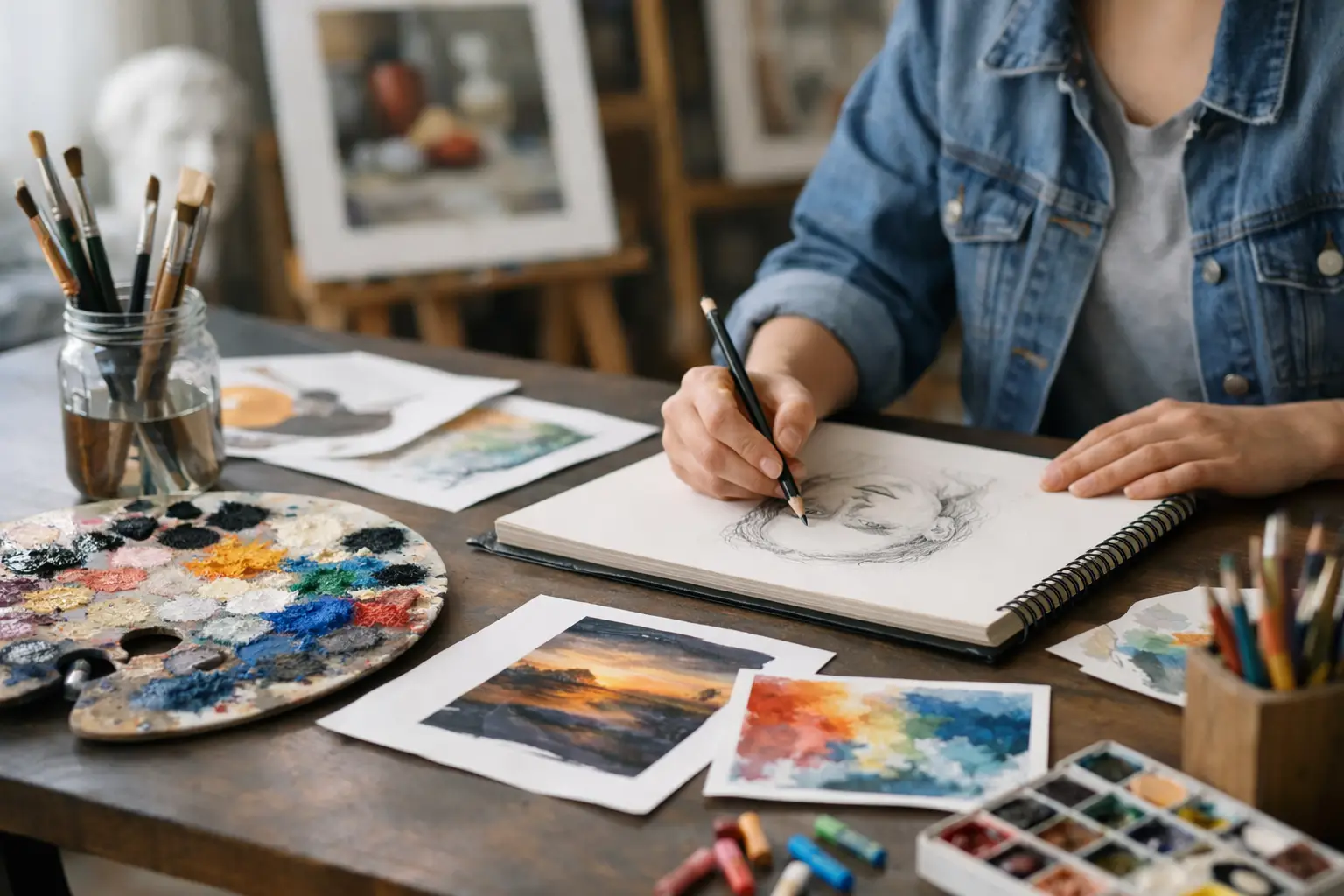
A beautiful final piece can make a strong first impression, but it cannot carry a GCSE portfolio on its own. GCSE art assessment objectives are the framework examiners use to see the thinking, investigation, decisions and skill behind your work. When your sketchbook shows that journey clearly, your ideas become easier to assess and your final response has far more authority.
The four objectives – AO1, AO2, AO3 and AO4 – are not four separate tasks to complete at the end. They should connect across your project from the first page to the final outcome. Think of them as four questions your portfolio needs to answer: Where did your idea come from? What did you try? What did you observe? What did you make from it all?
What are the GCSE art assessment objectives?
Most GCSE Art and Design courses assess work through four Assessment Objectives. They are normally equally important, although you should always check your own exam board specification and your teacher’s guidance. The wording can feel formal, but each objective is practical.
AO1 is about developing ideas through relevant research and informed links to artists, photographers, designers or other sources. AO2 is about experimenting, refining and selecting materials, processes and techniques. AO3 is about recording ideas, observations and insights. AO4 is about presenting a personal and meaningful final response.
High marks come from quality, not simply quantity. Ten rushed artist pages will not automatically beat two well-chosen investigations that genuinely influence your own work. Equally, a sketchbook packed with attractive drawings may still be limited if it does not explain how those drawings moved your project forward.
AO1: Develop ideas through meaningful research
AO1 asks you to investigate sources and make connections with your own intentions. An artist study is not a biography page, and it is not a copied image with a paragraph taken from the internet. Examiners want to see that you understand why a source matters to your project.
Start by choosing artists, photographers, craftspeople or designers whose work has a real relationship with your theme. If your project concerns identity, for example, you might investigate an artist’s use of portraiture, distortion, symbols or layered imagery. Be precise about the visual features that interest you: composition, colour palette, subject matter, materials, mood, viewpoint or message.
Then respond practically. Create studies of selected details, test a technique inspired by the source, or use a compositional approach as a starting point for your own photographs. Your annotation should make the connection visible: explain what you noticed, what you tested and what you may take forward. It is completely acceptable to decide that an approach does not suit your intentions. That is still useful development when you explain your reasoning.
Strong AO1 annotation sounds purposeful
Instead of writing, “I like this artist because it is colourful,” identify the decision you are making. For example: “The limited blue and orange palette creates a tense contrast. I will test this colour relationship in my own night-time street photographs to make the figures stand out.”
This is stronger because it turns appreciation into an action. Your research has a consequence for the next stage of the project.
AO2: Experiment, refine and make decisions
AO2 is where your creative confidence becomes visible. It rewards experimentation with materials and techniques, but random trials are not enough. Every test should help you learn something about your idea.
A Fine Art student might compare charcoal, ink wash and collage to decide which medium best communicates movement. A Photography student might test shutter speed, lighting direction, editing choices and cropping. In Graphic Communication, this could mean developing typography, layout, print processes, digital illustration or image combinations.
Show early experiments, but do not stop there. The most valuable AO2 evidence often appears when you revisit a technique and improve it. Perhaps your first mono-print is too faint, your first digital edit loses detail, or your initial collage becomes overcrowded. Record the problem, make a considered adjustment and show the improved version. That sequence proves refinement.
Selection matters too. A strong portfolio does not claim that every experiment succeeded. It identifies the most effective outcomes and explains why they deserve to be developed. This may mean leaving out a process you enjoyed because it distracts from your message. Assessment rewards thoughtful judgement, not attachment to every page.
Avoid the experimentation trap
Students sometimes produce a page of unrelated materials because they have heard that experimentation earns marks. It only becomes convincing AO2 when the trials are connected to a clear line of enquiry. If you are exploring memories of the seaside, for instance, you could test translucent layers, faded photographs, textured paint and handwritten text because each may suggest fragmentation or nostalgia. The connection gives the page purpose.
AO3: Record from observation and document your thinking
AO3 is often misunderstood as “include lots of drawings”. Drawing can be important, but recording also includes original photography, written observations, contact sheets, visual research, measurements, studies from objects, compositional plans and annotations that capture your decisions.
The key word is relevant. Your recordings should provide material you can use, adapt and develop. If your theme is natural forms, take your own close-up photographs and draw directly from shells, leaves, flowers or seed heads. Notice structure, texture, light, scale and unusual viewpoints. These observations will be more useful than relying only on downloaded reference images.
For Photography, a contact sheet can become excellent AO3 evidence when it reveals deliberate choices. Annotate which images have the strongest lighting, expression, framing or narrative potential. For Graphic Communication, record visual research into packaging, signage, logos or letterforms, then identify the features that could inform your design direction.
Your annotation does not need to be long. It needs to be specific. Name what you can see and explain what it tells you. “The side lighting exaggerates the folds in the fabric, creating a more dramatic result than the front-lit image” is far more useful than “This photo worked well.”
AO3 also supports every other objective. Original photographs can inspire artist comparisons in AO1, provide starting points for material tests in AO2 and feed directly into your final outcome for AO4. This is why a connected sketchbook is much stronger than a collection of isolated tasks.
AO4: Present a personal and informed final response
AO4 is the outcome, but it is also the proof that your development led somewhere. Your final piece, series, design or photographic outcome should draw together the strongest ideas, observations and techniques explored earlier in the project.
Personal does not mean that no artist has ever used a similar medium or subject. It means your response shows your own choices. Your viewpoint, source material, composition, editing, scale, combination of techniques and message should feel considered rather than copied.
Before beginning the final outcome, make a plan. Decide which source images you will use, what format and scale are most appropriate, which materials you have selected and why, and what visual effect you want to achieve. Small compositional thumbnails, colour tests or digital mock-ups can prevent avoidable problems later.
A final piece does not need to be complicated to score highly. A carefully resolved drawing can be more successful than an ambitious installation that has not been tested. Choose an outcome that gives you enough control to demonstrate your strengths while still challenging you appropriately. If your project is about fragile family memories, a layered mixed-media piece may be justified. If the strength of your photography lies in restrained portraiture, a coherent final series may communicate more than excessive editing.
How to make AO1 to AO4 work together
The strongest GCSE portfolios create a visible chain of decisions. You research a photographer’s dramatic shadows for AO1. You take your own portraits using side lighting for AO3. You test ink, digital contrast and collage over those images for AO2. You select the most effective combination and produce a final portrait based on those discoveries for AO4.
When reviewing a page, ask yourself what it leads to next. If there is no answer, add annotation, a practical response or a clear link to the following development. This does not mean forcing every page into a neat formula. Creative projects can change direction. But when they do, explain what you discovered and why the new direction is stronger.
A practical check before submission
Lay out your sketchbook or portfolio in order and look for gaps. Can someone who does not know your project understand your starting point, your research, your original recording, your experiments and your final decisions? Are there pages where annotation describes a result but does not explain its purpose? Is your final response clearly related to the work before it?
If you need to improve quickly, prioritise clarity over decoration. Add concise annotations that identify decisions, develop one or two promising experiments rather than starting several new ones, and make the visual links to your final outcome unmistakable. A focused improvement can be more valuable than filling empty space.
Your GCSE Art portfolio is not meant to show that every attempt was perfect. It should show that you can look closely, think independently, take creative risks and make better decisions as your project develops. Present that process with confidence, and the assessment objectives become a structure that helps your best work stand out.
No responses yet