
GCSE & A Level Art Sketchbooks: How to Build a Stronger Portfolio
A strong Art sketchbook is not a scrapbook of finished-looking pages. It is the visible record of how your ideas grow: what you noticed, what you researched, what you tested, what you changed and why. Whether you are studying GCSE or A Level Art, Fine Art, Photography or Graphic Communication, your sketchbook should make your creative thinking easy to follow.
Choose a Sketchbook That Supports Your Ideas
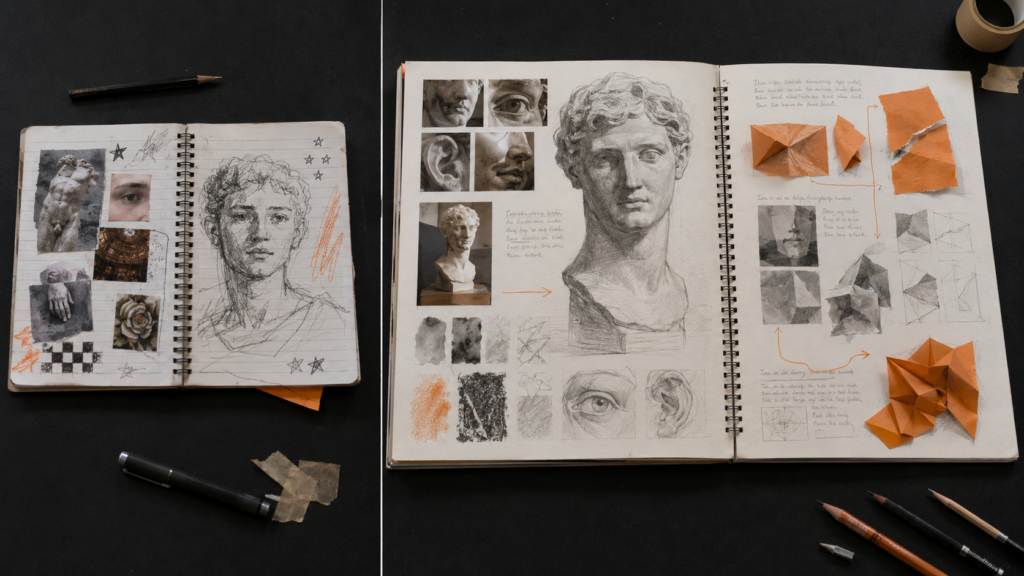
The best sketchbook is the one that gives your work room to develop. Before choosing, think about the scale of your drawing, photography, design layouts, annotations and experiments. A book that is too small can make work feel cramped; a book that is so large that you avoid using it can become equally limiting.
- A4 works well for regular drawing, annotation, photography contact sheets and a manageable weekly routine.
- A3 gives more space for sustained drawing, larger experiments, composition planning and ambitious presentation.
- Ring-bound books are useful when you need pages to lie flat or wish to add folded inserts.
- Good-quality cartridge paper is flexible for drawing, collage, light paint and mixed-media tests. Use separate sheets or boards for processes that would damage the book.
There is no single “correct” size. Choose deliberately, then use it with confidence. Consistency matters more than buying an expensive book.

What Needs to Go Into an Art Sketchbook?
A successful sketchbook does not need every page to contain every Assessment Objective. Across a project, however, it needs to show a clear relationship between investigation, experimentation, recording, reflection and a personal outcome.
A purposeful project normally includes:
- First-hand sources: your own photographs, drawings, observations, objects, visits, interviews or visual research.
- Preparatory ideas and sketches: quick thumbnails, mind maps, compositional alternatives, visual notes and plans.
- Artist, photographer or designer research: selected examples, visual analysis and practical responses that influence a next step.
- Experiments: materials, media, camera settings, editing, typography, layout, scale, colour and process tests.
- Selection and refinement: evidence that you compared options, kept what worked and improved what did not.
- Annotation and reflection: concise notes explaining observations, decisions, intentions and the next practical action.
- Development towards a response: a visible route from starting point to an increasingly personal and resolved idea.
Keep It Regular: Your Sketchbook Is a Working Space
Do not wait until a deadline to “make pages”. Work in your sketchbook little and often. Date work where useful, keep source material together, photograph practical experiments before they are lost, and leave enough space to return with reflection. A consistent working habit produces more thoughtful decisions and reduces last-minute presentation pressure.
- Spend time looking before drawing, photographing or designing.
- Write notes that explain what you noticed, not just what you like.
- After each test, record what worked, what did not and the next step.
- Keep original contact sheets, rough sketches and rejected ideas when they help show decision-making.
- Review the book every few weeks: is your project becoming more personal, selective and connected?
Make Your Sketchbook Memorable — But Keep the Focus on the Work
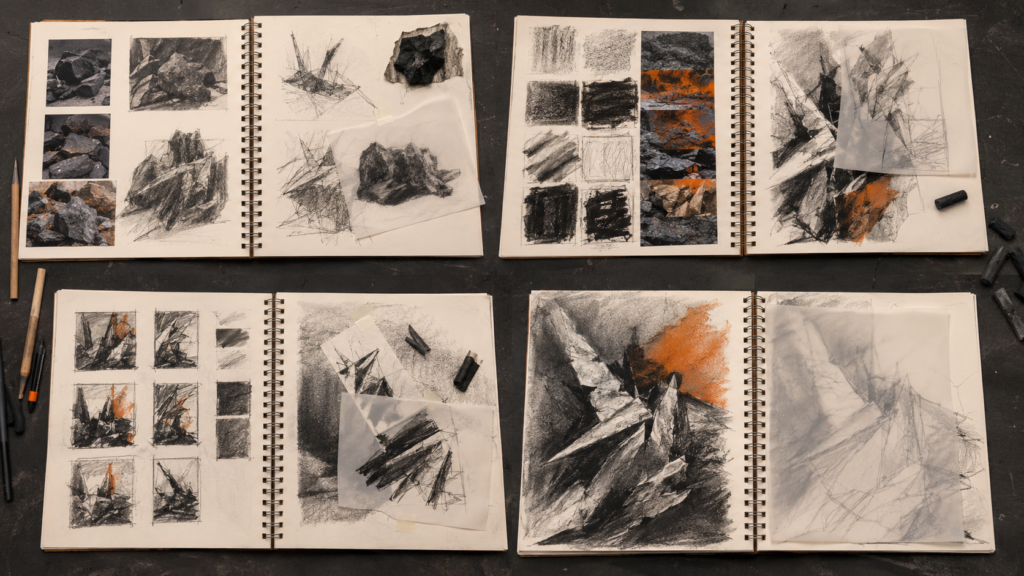
Torn edges, fold-outs, tracing-paper overlays, stitched inserts, collage, dry-brush marks and light coffee staining can make pages tactile and distinctive. Used thoughtfully, these choices can reinforce an idea: a fold-out may reveal a sequence of development; a torn edge may echo an architectural surface; an overlay may compare photographs, drawings or design alternatives.
However, presentation devices are never a substitute for strong evidence. Avoid using coffee staining, decorative tape or torn paper simply to fill an empty page. The important question is always: does this help the viewer understand my investigation, experiment or decision? If the answer is no, keep the page simpler.
Useful ways to add personality and depth
- Use a fold-out for a large drawing, a sequence of photographs or alternative compositions.
- Add tracing-paper overlays to test cropping, tonal changes, composition or type placement.
- Use torn or cut edges to frame a selected visual detail or create a purposeful collage transition.
- Include small material samples, printed proofs, test strips or contact sheets beside the response they informed.
- Vary scale: mix quick detail studies with larger sustained observations.
- Let some pages breathe. Negative space can make a selected drawing, photograph or experiment more powerful.
GCSE and A Level: What Is the Difference?
The same four Assessment Objectives apply, but A Level expects a more sustained, independent and critically informed journey. GCSE students should build confidence in connected research, practical work and reflection. A Level students should push this further through wider contextual investigation, more ambitious testing, clearer selection and a more individual line of enquiry.
| At GCSE | At A Level |
|---|---|
| Show clear original sources, relevant artist research, practical experiments and personal development. | Show a sustained, independent enquiry with deeper contextual understanding and more assured critical choices. |
| Use annotation to explain observations, experiments and sensible next steps. | Use reflection to evaluate, compare and justify decisions with increasing precision. |
| Build a coherent project journey towards a personal response. | Develop a more ambitious, selective and individual body of work, sustained over time. |
| Focus on purposeful evidence rather than trying to make every page perfect. | Demonstrate breadth, depth, intellectual curiosity and consistent ownership of the direction. |
A Quick Sketchbook Check Before You Move On
- Is my work based on enough original recording?
- Have I chosen artists, photographers or designers because they are genuinely relevant?
- Do my experiments test a specific idea rather than simply show that I used a material?
- Does my annotation explain a decision and identify a practical next step?
- Can someone see how one page leads logically to the next?
- Am I selecting my strongest evidence rather than decorating every available space?
- Is my project becoming more personal as it develops?
Want clear next steps for your own sketchbook?
Professional portfolio feedback can identify the Assessment Objectives that need attention, highlight your strongest work and give you practical next steps for developing your project.
No responses yet