
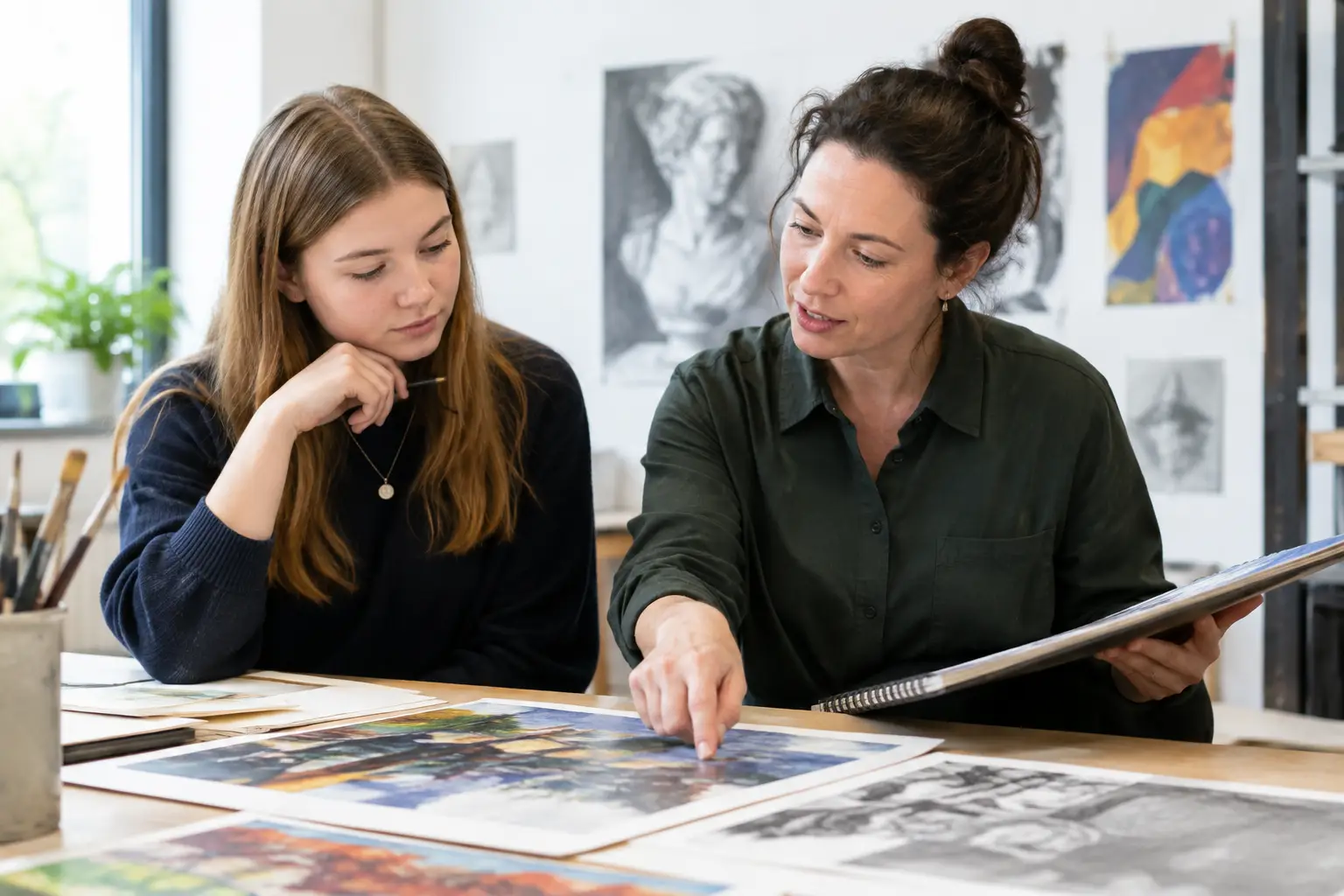
A sketchbook can look busy and still leave an examiner asking one question: where is the development? That is why useful portfolio feedback is not simply praise for a strong drawing or an attractive final piece. It shows you what your work is proving against AO1, AO2, AO3 and AO4, what evidence is missing, and what to do next.
For GCSE and A Level Art and Design, the aim is not to make every page perfect. The aim is to build a connected body of work that makes your ideas, decisions, experiments and refinements visible. Good feedback helps you see your portfolio as an examiner sees it: as evidence of a creative journey, not a collection of separate tasks.
What strong portfolio feedback should tell you
Comments such as “add more detail” or “develop this further” can be frustrating because they are too vague to act on. You may know something needs improving, but not whether the problem lies in your research, recording, experimentation, annotation or final response.
Useful feedback identifies a specific strength, explains why it matters, and gives you a practical priority. For example, rather than being told that an artist page is weak, you need to know whether your research is descriptive rather than analytical, whether your practical response copies the artist too closely, or whether the page has not influenced later work. Each issue needs a different response.
The best feedback also protects your time. Coursework deadlines are real, and you cannot remake every page. An experienced review should help you distinguish between changes that will strengthen assessment evidence and changes that are merely decorative. Adding borders, rewriting neat titles or filling blank spaces may make a sketchbook appear more complete, but these jobs rarely solve a weakness in the Assessment Objectives.
Portfolio feedback through AO1-AO4
The Assessment Objectives give feedback a clear structure. They are not four separate boxes to complete once. Strong portfolios show them working together from the first investigation to the final outcome.
AO1: Develop ideas through contextual research
AO1 feedback should look beyond whether you have included artists. Examiners want to see relevant research that genuinely informs your own direction. If you are studying a photographer because you like their images, explain what specifically interests you: their use of lighting, viewpoint, composition, subject matter, editing or message.
Your next step may be to make a focused practical response using one or two visual qualities from that artist, then annotate what happened. A direct copy can be useful as an initial study, but it should lead somewhere personal. For instance, if an artist uses dramatic shadows in portraits, test that approach in your own original photo shoot and assess whether it suits your theme.
AO2: Refine work through experimentation
AO2 is often where a portfolio becomes more ambitious. Feedback here should ask whether you have taken creative risks, reviewed results and made choices. A page of different materials is not automatically experimentation. It becomes evidence of refinement when you explain the purpose of each test and show how one result leads to the next.
If your work feels repetitive, do not simply produce more versions of the same image. Change a meaningful variable. In Fine Art, this could be scale, surface, media or composition. In Photography, it might be depth of field, lighting, cropping, viewpoint or digital editing. In Graphic Communication, it could be typography, layout, colour palette, image treatment or audience.
Then record your judgement. Which experiment best communicates your idea? Which one failed, and why? Honest annotation is valuable because it demonstrates decision-making. You do not need to pretend every test succeeded.
AO3: Record ideas, observations and insights
AO3 feedback often reveals a gap between what a student can create and what the portfolio actually shows. You may have a strong idea in your head, but unless your photographs, observational studies, notes and collected references record that idea, an examiner cannot award credit for unseen thinking.
For Photography students, original images are especially important. A well-planned photo shoot gives you material that belongs to your project and can be revisited in experiments, compositions and outcomes. For Fine Art and Graphic Communication students, recording might include primary drawings, photographs, visual notes, plans, colour studies and carefully selected secondary references.
The key is relevance. Ten rushed drawings of unrelated objects are less useful than three close observational studies that inform your next composition. Feedback should point out where your recording needs to become more purposeful, not just more plentiful.
AO4: Present a personal and meaningful response
AO4 is not only the final piece. It is the point at which your ideas, research, recording and experiments come together in a convincing personal response. Feedback on AO4 should therefore examine the links leading towards it.
A final outcome can be technically impressive but still feel disconnected if it does not use discoveries from earlier pages. Before committing to a large piece, create small composition plans or mock-ups. Select elements from your own photos, studies, artist research and experiments. Explain why you have chosen them.
If feedback tells you that your outcome lacks development, the answer is not always to start again. Sometimes you need a clearer bridge: a refined design sheet, a compositional trial, a colour test or an annotation that explains how earlier work shaped your final decisions.
How to use feedback without losing your own ideas
Receiving criticism can feel personal, particularly when you have invested hours in a project. Try to treat feedback as information about the evidence on the page, not a judgement on your talent. Even highly capable students can lose marks when their development is not visible enough.
Start by sorting comments into immediate actions and longer-term habits. An immediate action might be adding a focused annotation beside an experiment or producing a better set of original photographs. A longer-term habit could be writing brief reflections after each practical session, so your decisions are captured while they are fresh.
Do not follow feedback blindly. Your portfolio should retain your interests, visual language and intentions. If you are asked to develop an idea, you do not need to abandon your theme for a completely different one. Instead, ask how you can make your existing direction clearer, more personal and better supported by evidence.
It also helps to work in a sequence. Make one improvement, photograph or scan the page if needed, then review what it has changed. A single thoughtful practical response to an artist may create stronger AO1, AO2 and AO4 links than several rushed pages completed just to look productive.
When should you ask for portfolio feedback?
Do not wait until your portfolio is finished. Early feedback is particularly useful when choosing a starting point, selecting artists or photographers, and planning your first recording. At this stage, advice can prevent a project from becoming unfocused.
A second review is valuable once you have experiments and possible outcome ideas. This is where you can check whether your work is developing logically or whether you are repeating yourself. Near a deadline, feedback should become more selective: focus on the most important missing evidence, the clearest links to your final response and presentation choices that help an examiner read the work.
The right timing depends on your course stage and confidence. If you are beginning GCSE Art, feedback may need to explain the Assessment Objectives in straightforward terms. If you are aiming for an A* at A Level, you may need more demanding questions about independence, sustained investigation and the sophistication of your visual decisions.
A personalised GCSE Art portfolio feedback review from Portfolio to A Star can focus on the Assessment Objectives you choose, helping turn broad concerns about your sketchbook into clear, examiner-aligned actions. The most useful outcome is not a page of comments. It is a confident plan for what to make, annotate, refine or present next.
Your portfolio does not need to look like anybody else’s to achieve highly. It needs to show that your ideas have been explored with purpose, tested with curiosity and developed into a response you can explain with confidence. Seek feedback that helps you make that progress visible, then let the next page prove it.
No responses yet