
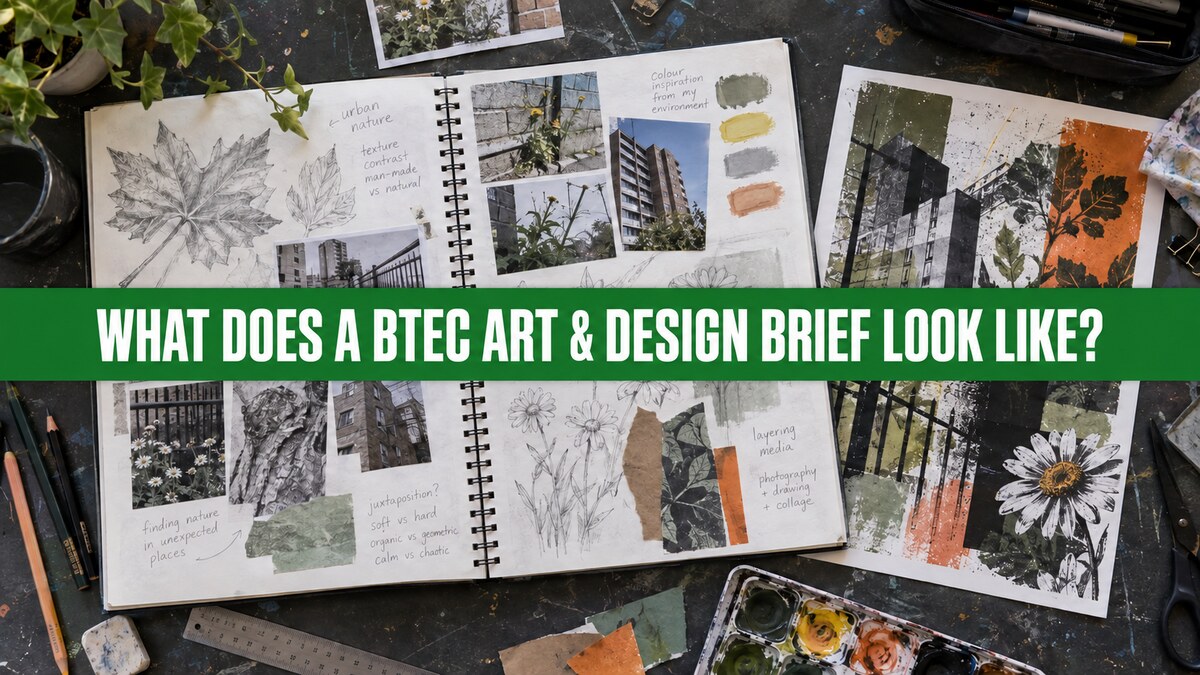
A typical BTEC Art and Design brief looks more like a creative commission than a traditional GCSE starting point. It normally gives you a purpose, an audience or client, a context and a set of requirements. Your job is not simply to make an attractive piece of work. You must show how your research, experiments and decisions help you produce an appropriate response.
In simple terms: the brief explains what is needed and why, but it usually leaves enough room for you to interpret the theme in your own way.
Important: “Hidden Nature”, used below, is an illustrative practice brief created to demonstrate the structure of this kind of project. It is not an official Pearson assessment brief and must not be used in place of the current Pearson Set Assignment or external task.
What information does a BTEC Art and Design brief contain?
- A client or context: who has requested the work, or the situation in which it will be used.
- A target audience: the people who should see, use or respond to the outcome.
- A purpose: what the work should communicate, achieve or encourage people to do.
- A theme or starting point: a broad idea that you can investigate and interpret.
- Requirements: particular information, formats, practical limitations or outcomes that must be considered.
- Evidence to submit: development work, a review, a final response and a clearly presented portfolio.
The wording will change from one assignment to another. Some briefs identify a named client, while others provide a broader creative situation. Always read the actual assignment carefully rather than assuming that every BTEC project follows exactly the same format.
Illustrative BTEC Art and Design practice brief
Creative brief: Hidden Nature
A community arts organisation is planning a small exhibition encouraging young people to notice natural forms, colours and textures in urban environments.
The organisation would like you to develop an original art or design response to the theme Hidden Nature. The work should appeal to young people aged 13–18 and encourage them to look more carefully at the environment around them.
You may work in one area or combine approaches from Fine Art, Graphic Communication, Photography, Textiles and Fashion, or Three-dimensional Design.
Your final response could be an artwork, poster campaign, publication, photographic series, garment, product, installation or another suitable outcome.
You should research appropriate creative practitioners and visual sources; generate and communicate several ideas; experiment with relevant materials, techniques and processes; review and refine your work; and produce a finished response that meets the needs of the client and audience.
Present your development and final response in a clear portfolio suitable for showing to the client.
How might a Level 1/2 student respond?
The following example shows a believable route through the brief. It is not intended to be a perfect formula. Different students could produce completely different—and equally valid—responses.
1. Identify what the brief is asking
Before collecting pictures, the student highlights the key information:
- Client: a community arts organisation
- Audience: young people aged 13–18
- Purpose: to make people notice nature in urban places
- Theme: Hidden Nature
- Possible direction: a mixed-media campaign poster
This prevents the project becoming a collection of unrelated nature studies. Each decision can be checked against the intended message and audience.
2. Gather relevant research
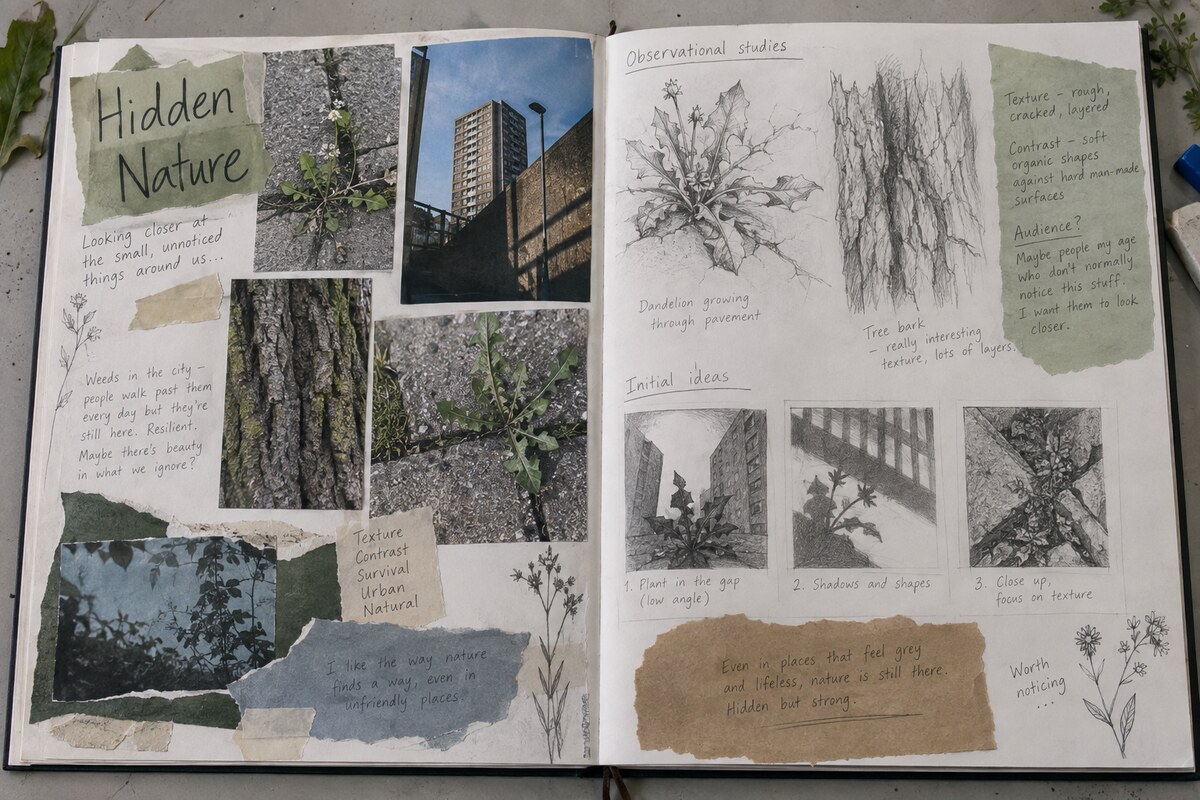
The student takes photographs of weeds growing through paving, tree bark, concrete walls, fences and shadows from nearby buildings. They add a few observational drawings and investigate creative practitioners who combine natural and constructed forms.
The most useful annotation is direct and specific. A 15-year-old does not need to write like an art historian. For example:
“I like the contrast between the small plant and the massive concrete wall. It makes the plant look quite stubborn. I could exaggerate the scale so that nature feels more powerful.”
That short comment identifies a visual quality, explains its effect and suggests a possible next step.
3. Generate more than one idea
The student produces several quick possibilities rather than immediately committing to the first idea:
- a photographic series showing plants in overlooked places;
- a set of hand-cut posters combining buildings and leaves;
- a small folded guide to finding nature around the local area;
- a textile panel contrasting rough architectural marks with organic forms.
The ideas do not have to be highly finished. At this stage, small drawings, contact sheets, collages, colour tests and rough digital layouts can communicate possibilities efficiently.
4. Experiment and record what happens
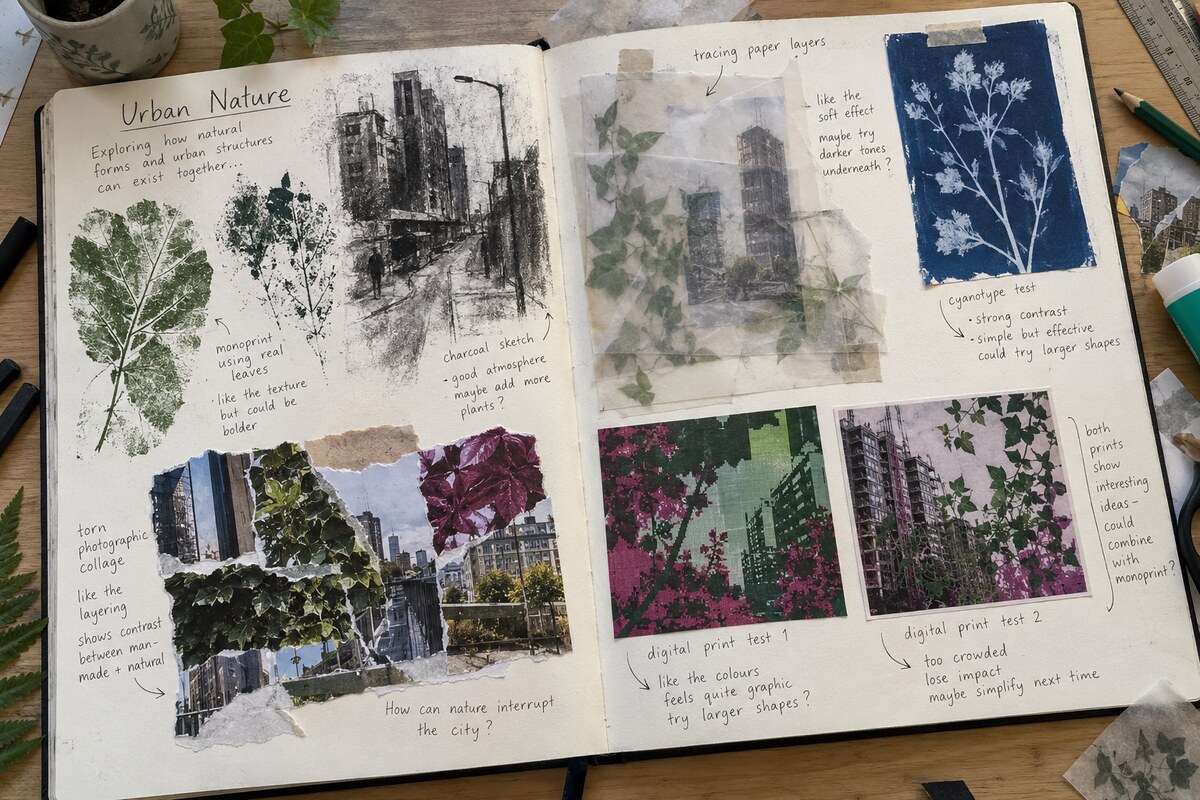
The student tests leaf monoprints, charcoal architectural marks, torn photographic collage, translucent layers and simple digital combinations. Some trials are successful and others are not. Both are useful if the student explains what has been learned.
“The tracing paper creates depth, but the building disappears when I add too many leaves. Next I will use one larger plant shape and keep more empty space around the title.”
This is stronger than writing “I like it” because it connects a practical result to a clear improvement.
5. Review, select and refine
The student compares the experiments with the brief. The hand-cut collage has energy and suits a teenage audience, but the first layout is too crowded. They enlarge one focal image, simplify the wording and improve the contrast so the message can be understood quickly.
Feedback could also influence the development:
“Two people said they noticed the building before the plant. I want nature to be the focus, so I will make the leaf overlap the building and reduce the dark area behind it.”
6. Produce and present the final response
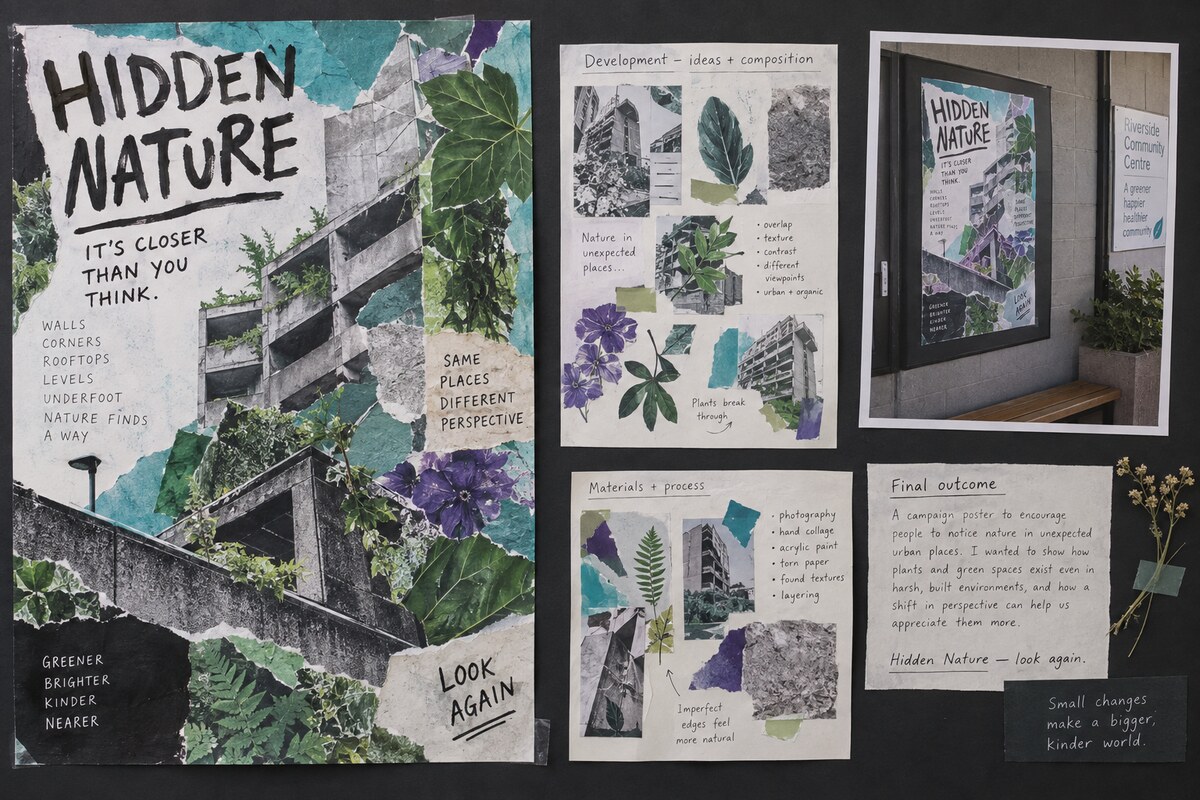
The finished poster does not need to look as though it came from a professional design agency. At Level 1/2, assessors are looking for an effective response supported by visible development, appropriate practical skills and sensible decisions. The final work should, however, be complete, carefully presented and clearly related to the brief.
What is actually assessed?
The current Pearson BTEC Level 1/Level 2 Tech Award in Art and Design Practice has two components:
| Component | What it involves | Weighting |
|---|---|---|
| Component 1: Creative Practice in Art and Design | Investigating creative practice, generating and communicating ideas, developing practical skills, recording progress and improving work. | 60% |
| Component 2: Responding to a Brief | Applying learning from across the course to develop and produce work in response to a Pearson-set creative brief. | 40% |
Both assessed components currently include 20 hours of supervised sessions. Component 1 is a Pearson Set Assignment marked by the centre and moderated by Pearson. Component 2 is an external synoptic task marked by Pearson. Check the current Pearson qualification guide and the assignment issued for your assessment series for definitive instructions.
Pearson’s published sample marked work for Component 2 organises feedback under Project Development, Development Review, Final Response and Client Portfolio. This shows why the journey, written review, outcome and presentation all matter. You can view the Pearson sample marked learner work alongside the specification.
How much freedom do students have?
A brief places boundaries around the project, but it does not usually prescribe one correct-looking answer. One student might respond through photography, another through painting and collage, and another through graphic communication or textiles. What matters is whether the chosen direction answers the purpose, audience and requirements.
This balance is central to BTEC working: creative freedom inside a defined situation. Ignoring the client to pursue an unrelated personal idea is risky, but copying a predictable example without genuine investigation is unlikely to demonstrate strong development.
Common mistakes when responding to a brief
- Starting the final piece too quickly: this leaves little evidence of alternative ideas or purposeful development.
- Forgetting the audience: an outcome may be visually attractive but unsuitable for the people it is meant to reach.
- Producing disconnected experiments: practical tests should help you make decisions, not simply fill pages.
- Describing without reviewing: explain what changed, why it changed and how it improves the response.
- Hiding the practical process: photograph stages, especially when making three-dimensional, textile or time-based work.
- Overloading portfolio pages: select and organise evidence so that the development can be followed easily.
BTEC Art and Design brief checklist
- Can I identify the client or context, audience, purpose and requirements?
- Have I gathered relevant primary and secondary research?
- Have I investigated appropriate artists, designers or other practitioners?
- Have I communicated several possible ideas?
- Do my experiments help me make decisions?
- Have I recorded changes and explained why I made them?
- Does my final response answer the brief rather than merely match the theme?
- Is my portfolio clear, selective and appropriate for the client?
Frequently asked questions
Is a BTEC brief the same as an exam question?
Not exactly. It is a structured creative task rather than a conventional written examination question. In the formally assessed components, work must be completed under the conditions specified by Pearson, including supervised sessions.
Does every brief name a real company?
No. A brief may describe a client, organisation, audience or creative context without naming a real business. Students should respond to the information actually supplied rather than inventing unnecessary restrictions.
Can I choose Fine Art, Photography or Graphic Communication?
The qualification supports work across art and design practices, but the options available depend on the brief, your centre’s course and its facilities. Your selected approach must be appropriate to the task and allow you to show the required skills.
Is the final outcome the most important part?
It is important, but it is not the whole assessment. Research, idea development, practical exploration, review and portfolio communication provide essential evidence. A polished outcome cannot compensate fully for a missing creative process.
Is Hidden Nature an official Pearson brief?
No. It is an illustrative practice brief used on this page to explain what a vocational art and design task might look like. Students and teachers must use the official materials issued for their own assessment series.
Continue exploring BTEC Art and Design
Understanding the brief is the first step. The next challenge is making your research, practical exploration and final response work together as one visible creative journey. Visit BTEC Art and Design Help for more guidance, or compare the course with GCSE in BTEC Art and Design vs GCSE Art: Which Is Easier?
No responses yet