
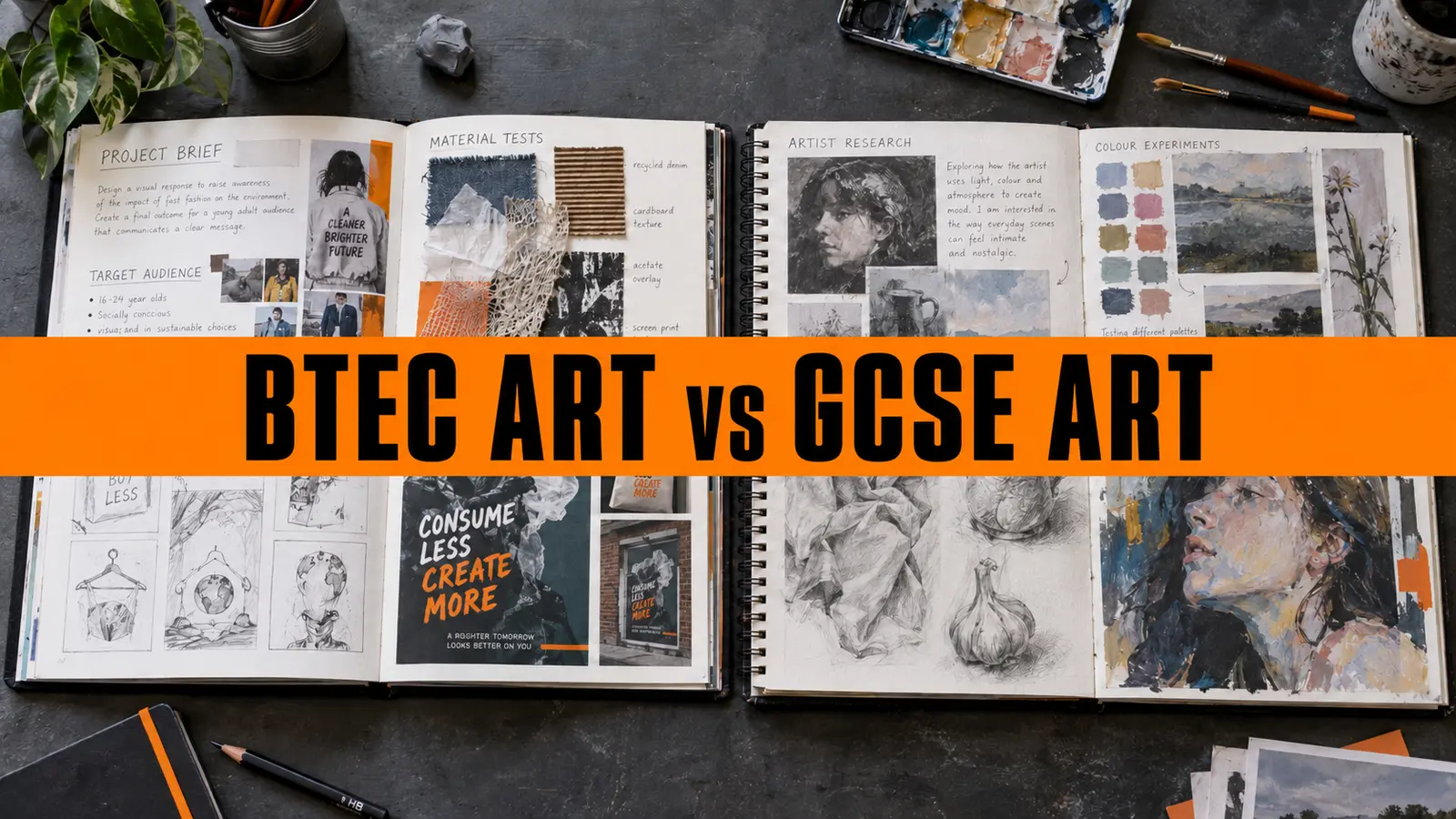
If you are choosing your Key Stage 4 subjects, you may be wondering whether to take BTEC Level 1/Level 2 Art and Design Practice or GCSE Art and Design. Both qualifications involve practical creative work, research, experimentation and developing ideas, but the way you work and the way your work is assessed are different.
Which is easier: BTEC or GCSE Art? Neither qualification is automatically easier. BTEC may feel more manageable if you prefer clearly structured tasks, practical briefs and fixed assessment periods. GCSE Art may suit you better if you enjoy developing a personal project over a longer period and want more freedom over its direction. The best choice depends on how you work—not simply on which qualification sounds easier.
BTEC Art and GCSE Art at a glance
| Feature | BTEC Level 1/2 Art and Design Practice | GCSE Art and Design |
|---|---|---|
| Approach | Practical and vocational | Personal and investigative |
| Starting point | A creative brief with a purpose, audience or context | A theme, stimulus, question or starting point |
| Components | Two | Two |
| Main component | Creative Practice in Art and Design: 60% | Portfolio: normally 60% |
| Final component | Responding to a Brief: 40% | Externally set assignment or task: normally 40% |
| External assessment | Component 2 is marked by Pearson | The board sets Component 2; the school normally marks it and the board moderates it |
| Conventional written exam | No | No |
| Grades | Level 1 Pass to Level 2 Distinction* | Grades 1–9 |
GCSE details vary slightly between examination boards, so always check the specification used by your school.
What is BTEC Level 1/Level 2 Art and Design Practice?
The Pearson BTEC Level 1/Level 2 Tech Award in Art and Design Practice is a practical, vocational qualification. “Vocational” means that it introduces you to ways of working that resemble the creative industries.
You might respond to a brief with a particular purpose, audience, client, message, product or set of requirements. Depending on how your school delivers the course, projects could involve Fine Art, Photography, Graphic Communication, Fashion and Textiles, 3D Design, Product Design or a combination of creative disciplines.
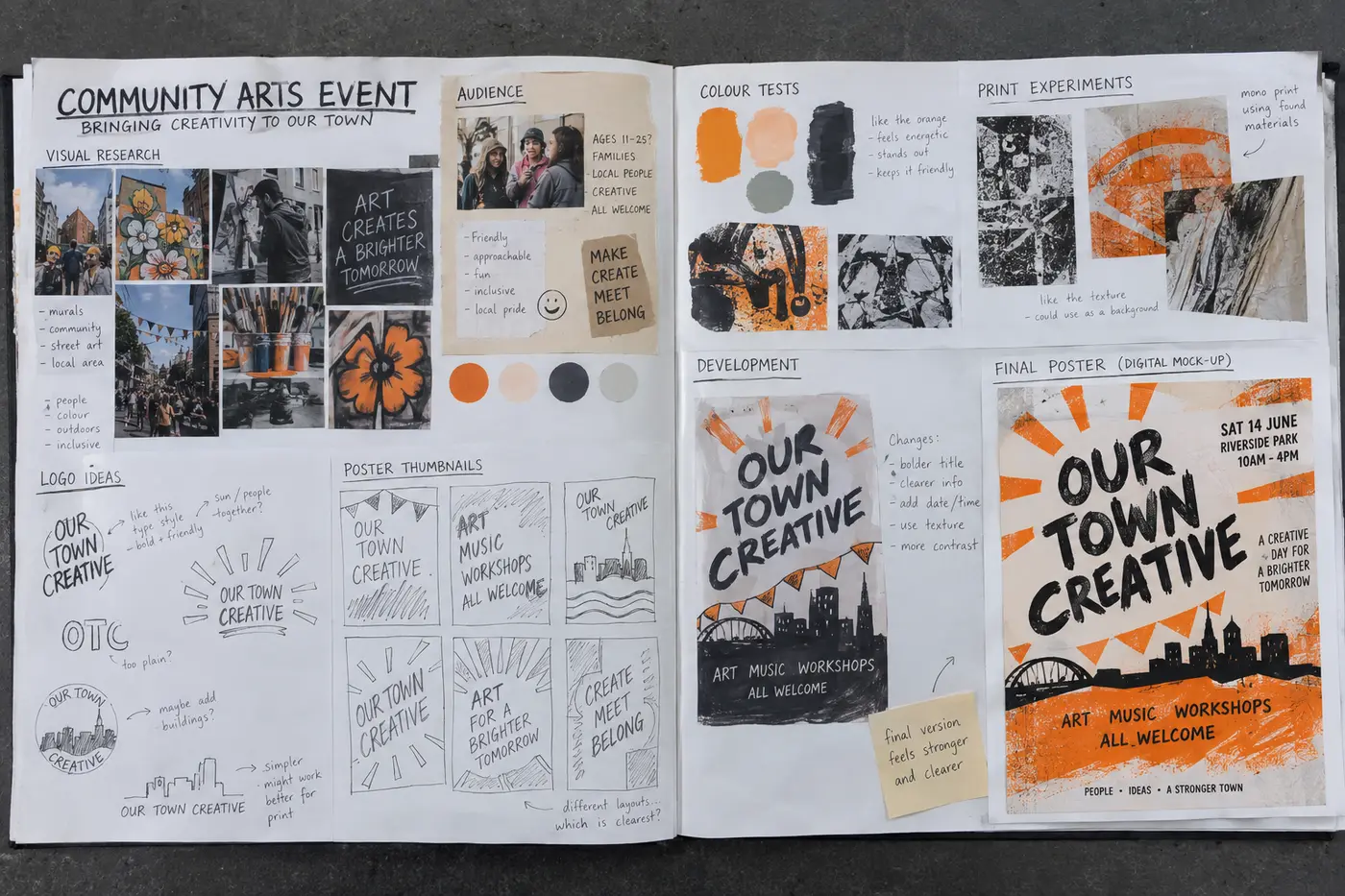
The course is entirely practical and project-driven. There is no conventional written examination, although you still need to document, explain and review your creative decisions. Find more guidance in the BTEC Art and Design Help section.
How is BTEC Art and Design assessed?
Component 1: Creative Practice in Art and Design
Component 1 is worth 60% of the qualification. Pearson provides a set assignment containing four tasks. Your teachers mark the work and Pearson moderates their decisions. The assessed assignment is completed during 20 hours of supervised sessions.
You will be expected to show how you can:
- Investigate the work and practices of artists and designers
- Use research and experimentation to inform ideas
- Generate and communicate creative ideas
- Explore materials, techniques and processes
- Develop and review practical skills
- Record and present the development of your work
Before the formally assessed assignment begins, your teacher will normally provide projects and workshops that help you build the skills you need.
Component 2: Responding to a Brief
Component 2 is worth 40% of the qualification. This is an external synoptic assessment, meaning that you bring together and apply the knowledge and skills developed throughout the course.
Pearson releases a creative brief and you complete your response in 20 hours of supervised sessions. The work is marked externally by Pearson. You must interpret the brief, develop ideas and produce an appropriate creative response for its purpose or audience.
What is GCSE Art and Design?
GCSE Art and Design is also a practical qualification. Depending on your school, you may study Art, Craft and Design, Fine Art, Graphic Communication, Photography, Textile Design, Three-Dimensional Design or another available title.
GCSE students normally develop a portfolio from themes, project titles or starting points. Although teachers provide guidance and structure, you are expected to develop increasingly personal ideas and make purposeful connections with relevant artists, photographers, craftspeople or designers.

GCSE Art has no conventional written examination, but annotation, analysis and evaluation remain important supporting evidence. Visit GCSE Art Help for guidance on sketchbooks, materials, assessment objectives and developing ideas.
How is GCSE Art and Design assessed?
Component 1: Portfolio
The portfolio is normally worth 60% of the GCSE. It contains selected work produced during the course and must provide evidence of all four assessment objectives:
- AO1: Develop ideas through investigations and demonstrate critical understanding of sources.
- AO2: Refine work by exploring ideas and experimenting with appropriate media, materials, techniques and processes.
- AO3: Record ideas, observations and insights.
- AO4: Present a personal and meaningful response that realises intentions.
Each assessment objective normally contributes an equal share of the marks. A successful portfolio is not simply a collection of finished artwork. It should show research, observation, experiments, decisions, changes, improvements and resolved responses.
Component 2: Externally Set Assignment or Task
The externally set component is normally worth 40% of the GCSE. The examination board provides themes, visual material or starting points. You select one and develop a personal response during the preparatory period.
The project ends with a 10-hour supervised period, during which you produce your final response or complete an important part of it. Although this is often called the “Art exam”, your preparatory studies are also assessed. You earn marks through research, recording, experimentation and development—not only through the final piece.
How do the different ways of working compare?

BTEC work is usually driven by a brief
In BTEC, you are more likely to begin with a problem, purpose or creative requirement. You still need original ideas, but your choices must relate clearly to the brief. A visually impressive outcome may not achieve the highest marks if it does not meet its intended purpose or communicate effectively with its audience.
GCSE work is usually driven by personal investigation
GCSE projects often begin with a broad theme such as Identity, Structures, Natural Forms or Journeys. Two students can begin with the same theme and produce completely different projects. GCSE rewards personal decision-making, sustained development and meaningful connections between research, experimentation and final outcomes.
BTEC assessment is more tightly structured
BTEC assignments are divided into defined tasks and assessed work is produced during controlled periods. Some students find this helpful because they know what must be completed and when. However, the structure can also feel restrictive, and falling behind during a supervised assessment period can be difficult to recover from.
GCSE projects develop over longer periods
A GCSE portfolio usually allows ideas to develop over weeks or months. This provides time to revisit experiments, improve work and change direction. The disadvantage is that work can accumulate. Students who repeatedly postpone sketchbook work may face a serious workload later.
Is BTEC Art easier than GCSE Art?
BTEC Art is not automatically easier than GCSE Art. The qualification that feels easier will depend on your strengths, working habits and response to different kinds of pressure.
BTEC may suit you if you:
- Like clear instructions and defined tasks
- Enjoy responding to practical briefs
- Work effectively to fixed deadlines
- Prefer projects with a purpose or audience
- Can make decisions efficiently during supervised sessions
BTEC may feel harder if you:
- Need a long time to develop ideas
- Find it difficult to interpret briefs
- Dislike controlled working conditions
- Struggle to organise evidence into set tasks
- Prefer complete freedom over what you create
GCSE may suit you if you:
- Enjoy exploring broad themes
- Want to develop personal ideas
- Work independently over longer periods
- Enjoy artist research and visual connections
- Regularly review and improve your work
GCSE may feel harder if you:
- Struggle to manage a large portfolio
- Leave work until the last minute
- Find open-ended projects confusing
- Produce outcomes without showing development
- Find sustained projects difficult to maintain
Does BTEC involve less work than GCSE Art?
Not necessarily. BTEC assignments are completed within set supervised periods, but you still need to develop your practical abilities before the assessments begin. GCSE students may produce a larger long-term portfolio, but they also have more time in which to develop and improve it.
The workload also depends on how your school organises the course, the projects you complete and the standard you hope to achieve. In both qualifications, purposeful development matters more than simply filling as many pages as possible.
Is BTEC only for students who are not good enough for GCSE Art?
No. This is an unhelpful misconception. Pearson describes BTEC Tech Awards as being the same size and level of rigour as GCSEs. BTEC simply uses a more vocational approach to learning and assessment.
A highly creative student interested in Graphic Design, Photography, Fashion, Illustration or Product Design may be very well suited to BTEC. GCSE Art is not only for students who are already excellent at traditional drawing either. Both qualifications require effort, independence, experimentation and thoughtful development.
How do the grades compare?
GCSE Art and Design is graded from 9 to 1. The BTEC Tech Award is graded from Level 1 Pass to Level 2 Distinction*, with Level 1 and Level 2 Pass, Merit and Distinction grades between them.
Both qualifications recognise achievement at Level 1 and Level 2, but the grading systems are different. Do not assume that every BTEC grade has a simple, exact GCSE number attached to it. Schools, colleges and sixth forms may set their own entry requirements.
Can you study A Level Art after BTEC?
A successful BTEC Art and Design student can progress to an A Level or a Level 3 vocational Art and Design qualification. Individual sixth forms and colleges decide their own entry requirements, and for creative courses the quality of your portfolio may be as important as the exact title of your Key Stage 4 qualification.
Which qualification should you choose?
Choose BTEC Art and Design Practice if you are attracted to practical briefs, vocational contexts, defined tasks and creative work produced for a purpose or audience.
Choose GCSE Art and Design if you want to investigate broad themes, develop highly personal ideas and build a sustained portfolio over a longer period.
Before deciding, ask your school which specialism is taught, which materials and facilities are available, what previous students have produced and what level of independent work is expected. The quality of teaching, resources and course organisation can make as much difference as the qualification title.
Final verdict: BTEC or GCSE Art?
Neither qualification offers an easy route to a high grade. BTEC provides a more structured and vocational way of working, but you must respond accurately to briefs and perform effectively during supervised assessments. GCSE provides greater opportunity for sustained personal development, but you must manage a substantial portfolio and provide convincing evidence across all four assessment objectives.
The better course is the one that fits your interests, strengths and working habits. If you enjoy making, experimenting and developing ideas—and you are prepared to work consistently—you can build an excellent creative portfolio through either route.
Frequently asked questions
Is there a written exam in BTEC Art and Design?
No. The current Pearson BTEC Tech Award is practical and project-driven. However, you must still document, explain, review and communicate your creative decisions.
Is there a written exam in GCSE Art?
No. GCSE Art and Design is assessed through practical portfolio work and an externally set project. Annotation and written analysis may still form part of the evidence.
Does BTEC Art have an externally assessed component?
Yes. Component 2, Responding to a Brief, is worth 40% and is externally marked by Pearson.
Is the GCSE externally set task externally marked?
Normally, no. The examination board sets the task, but the school generally marks the work and the board externally moderates it. Check the arrangements for your examination board.
Is BTEC Art equivalent in size to one GCSE?
Yes. The Pearson BTEC Level 1/Level 2 Tech Award in Art and Design Practice has 120 guided learning hours and is the same size as one GCSE.
Which course is best for Graphic Communication or Photography?
Either qualification can include digital, photographic and graphic work, depending on what your school offers. Ask to see the planned course because qualifications with the same title can be delivered differently by different schools.
No responses yet