
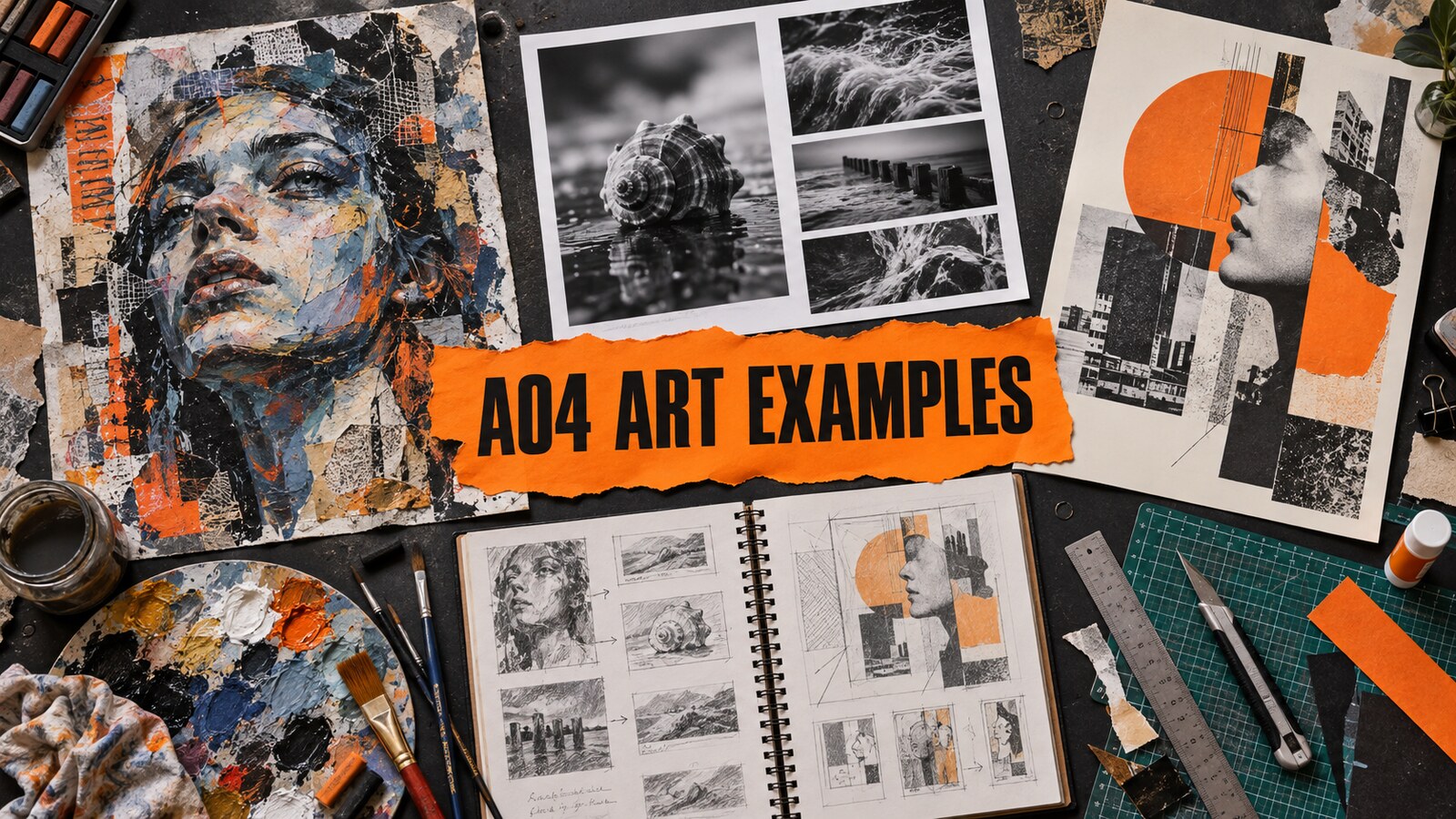
A successful AO4 final piece should feel like the logical result of your project—not a new idea introduced at the end. It should bring together your research, experiments, refinements and intentions in a personal, informed and visually resolved response.
This guide uses AO4 art examples from Fine Art, Photography and Graphic Communication to show how GCSE and A Level students can plan a convincing final piece or final series. The examples are starting points for discussion, not formulas to copy.
About the images: every project image on this page is an AI-generated illustrative teaching exemplar created for Portfolio to A Star. They are not real student submissions and do not represent an awarded grade.
What does AO4 mean in Art and Design?
AO4 asks you to present a personal and meaningful response that realises intentions and demonstrates understanding of visual language. In practical terms, the examiner should be able to see a clear connection between what you investigated, what you tested, the decisions you made and the outcome you produced.
Your final response does not always have to be one large finished artwork. Depending on your specialism and project, it could be a painting, installation, photographic series, publication, poster campaign, animation, identity system or another appropriate outcome. Read more in What Is AO4 in GCSE Art? Assessment Objective 4 Explained.
Start with evidence, not decoration
Before planning the final outcome, spread out your strongest work from AO1, AO2 and AO3. Look for decisions you can justify. A final piece becomes more convincing when its subject, composition, materials, processes and presentation have all grown from evidence already visible in the project.
- AO1: Which artists, photographers or designers changed your thinking?
- AO2: Which materials, techniques or processes created the most useful effects?
- AO3: Which observations, photographs, drawings or recordings contain the strongest visual information?
- AO4: How will you bring those discoveries together in a personal response?
Six steps for planning a successful final piece
- Return to your intention. Write one clear sentence explaining what you want the viewer to notice, feel or understand.
- Select, do not include everything. Choose the most relevant visual ideas and processes from your development. Strong editing is more effective than trying to squeeze every experiment into one outcome.
- Test the arrangement. Make thumbnails, contact sheets, mock-ups or storyboards. Compare at least three possibilities before committing.
- Decide format, scale and audience. Consider where and how the work will be seen. The size, sequence, surface and presentation should support its meaning.
- Rehearse technical risks. Test unfamiliar joins, printing, exposure, type sizes, colour settings, drying times or digital exports before the final session.
- Make a realistic production plan. Break the outcome into timed stages and leave space for evaluation, adjustment and presentation.
GCSE and A Level: what should change?
At both levels, the final outcome should connect clearly to the project. GCSE students benefit from a focused plan that identifies the chosen composition, materials and sequence of making. A Level students should show greater independence, conceptual depth and critical selection: the outcome should resolve a sustained investigation rather than simply demonstrate technical skill.
Fine Art AO4 examples
GCSE Fine Art example: natural forms
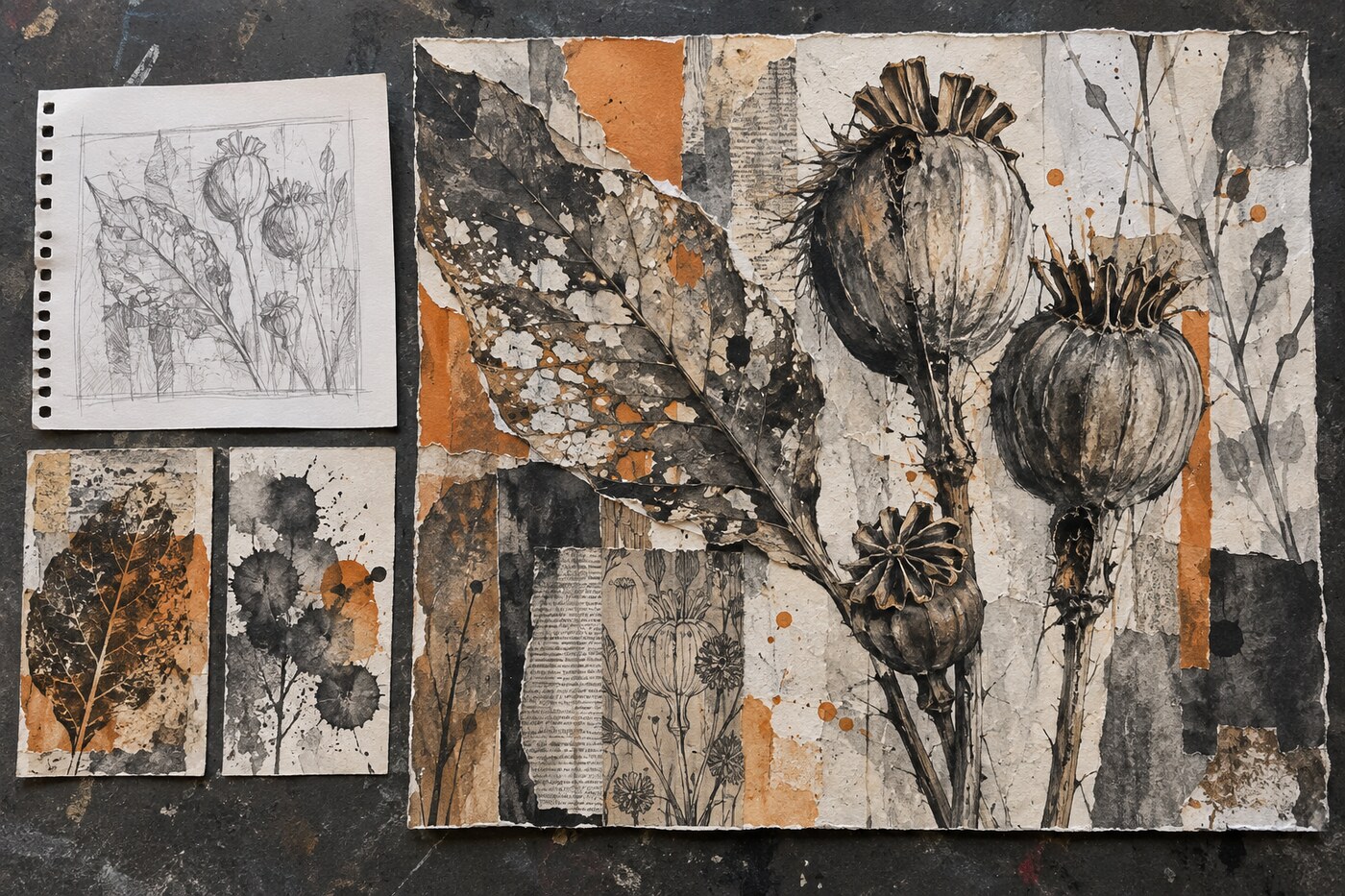
In this example, repeated seed-pod shapes connect the observational studies to the final composition. The restricted earthy palette, layered paper and drawn marks feel selected from earlier experiments. The final response does not copy every test; it combines the most successful qualities into a more controlled arrangement.
- GCSE exercise: circle three features that visibly connect the planning work to the outcome.
- Next decision: test whether a larger change of scale would create a clearer focal point.
A Level Fine Art example: memory and place
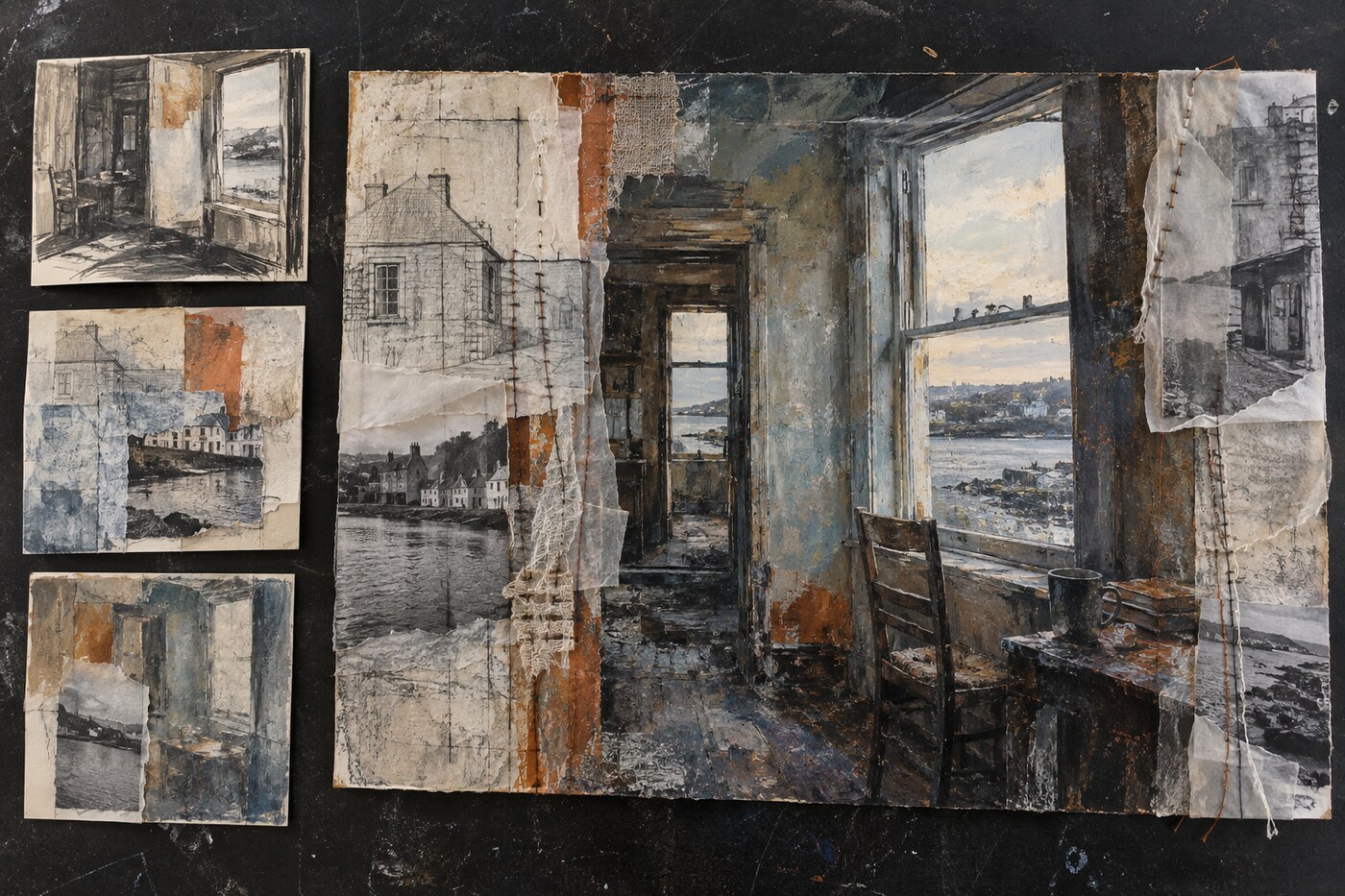
The A Level example treats the interior as a psychological space. Fragments, erased areas and shifting viewpoints suggest uncertain memory rather than describing one room literally. The preparatory compositions show that placement and absence have been tested before the larger response was resolved.
- A Level exercise: explain how material choices and spatial ambiguity contribute to the idea—not just the appearance—of the work.
- Next decision: justify whether the outcome needs one further layer or whether restraint would make it more powerful.
Photography AO4 examples
GCSE Photography example: everyday objects

Here, the final response is a triptych rather than one photograph. Similar lighting, close cropping and repeated curves unify the images. The contact sheet and crop tests demonstrate selection: the student would need to explain why these three frames work together and why their order matters.
- GCSE exercise: rearrange the sequence and describe how the visual rhythm or meaning changes.
- Next decision: print a small proof to check tone, sharpness and spacing before producing the final version.
A Level Photography example: thresholds and isolation
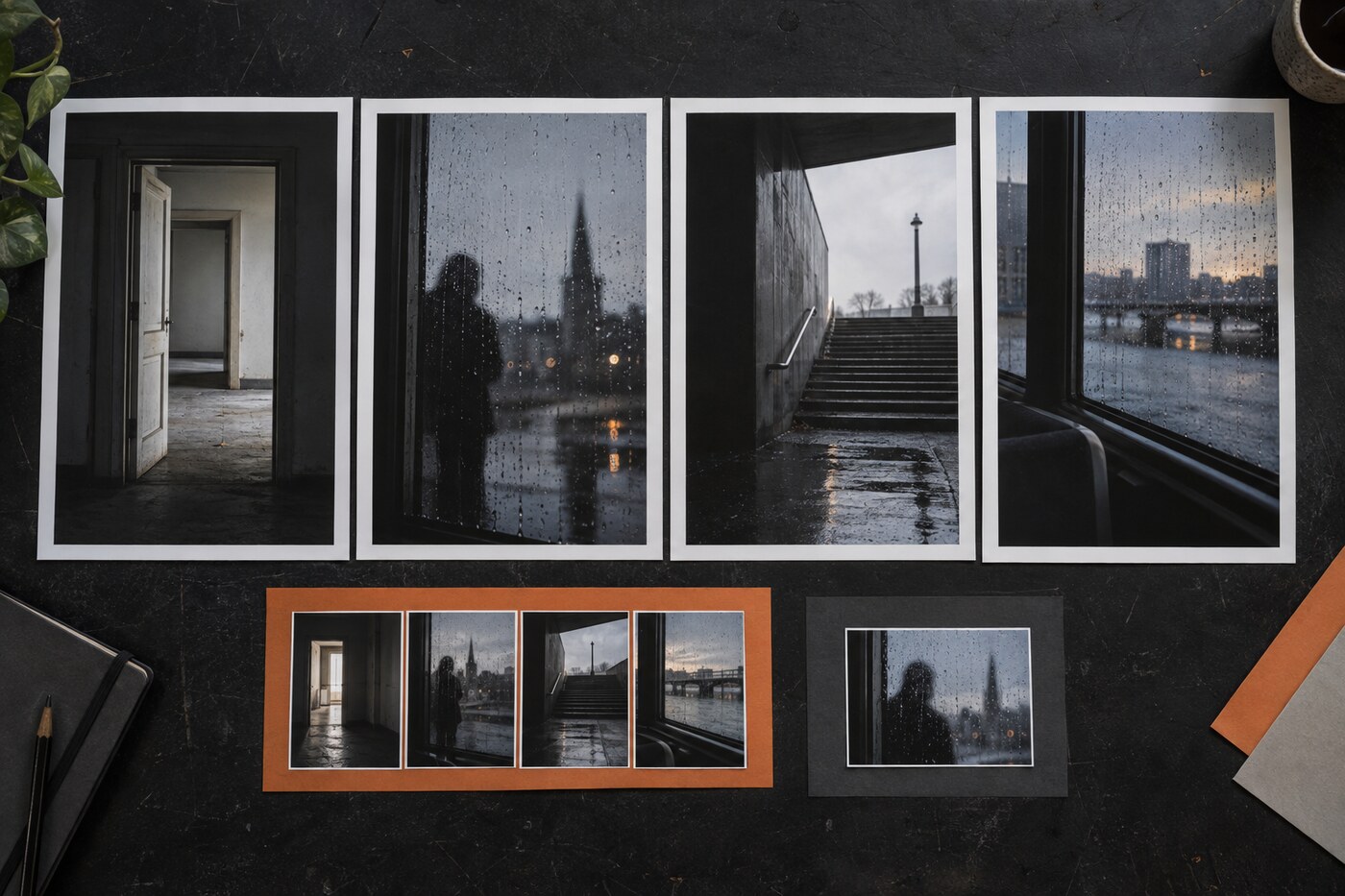
The A Level series uses doors, windows and transitional spaces as a visual language for distance and isolation. Repetition gives the work coherence, while changes in viewpoint and obstruction prevent the sequence from becoming predictable. The success of AO4 depends on both the individual photographs and the editing, order, scale and display of the group.
- A Level exercise: remove one frame, substitute a crop test and defend the stronger edit using visual and conceptual evidence.
- Next decision: test whether equal-sized prints or a varied hierarchy best supports the intended reading.
If Photography is your specialism, the guide to the A Level Photography course gives further help with expectations and project development.
Graphic Communication AO4 examples
GCSE Graphic Communication example: campaign poster
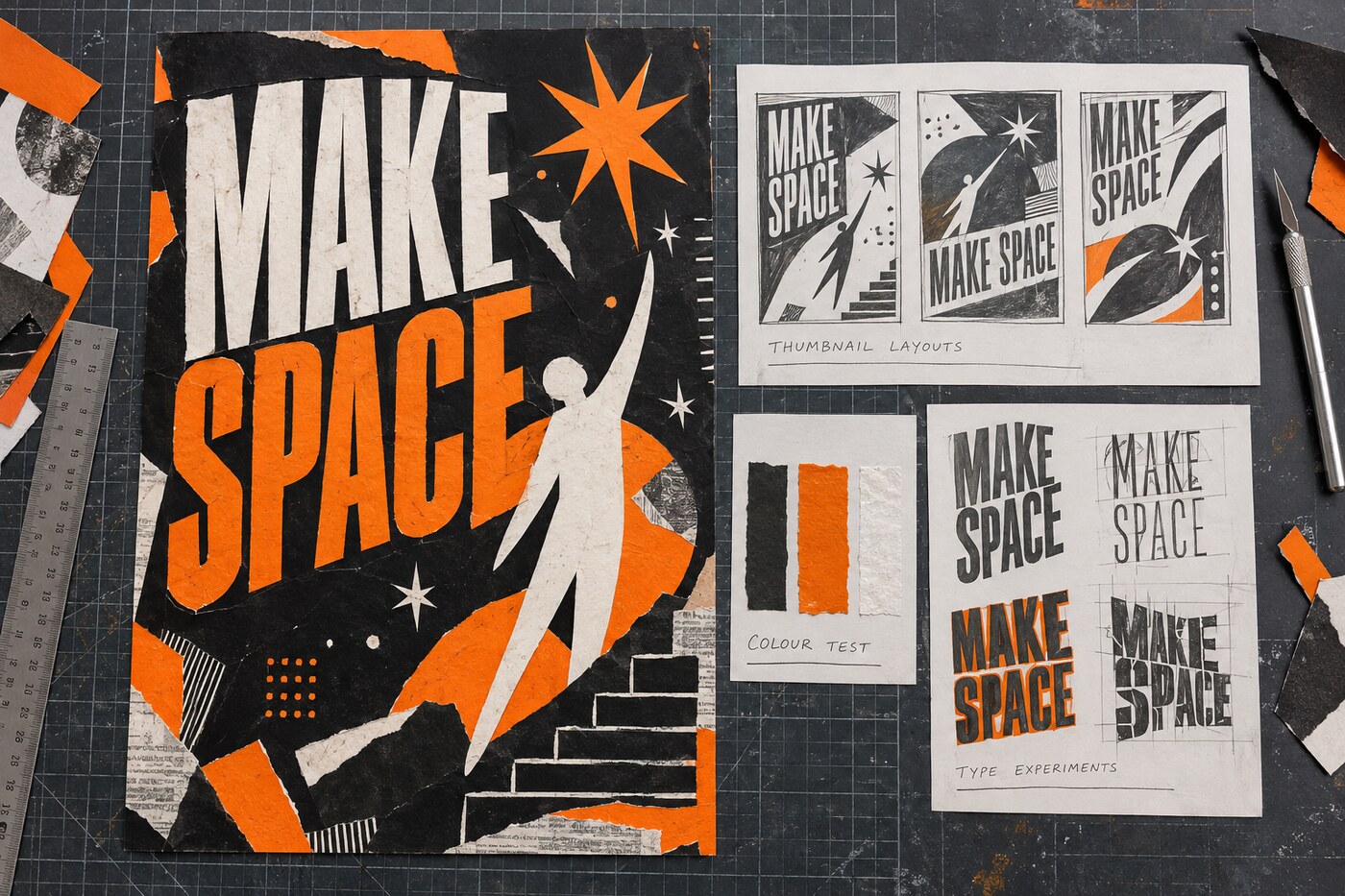
The poster uses a short message, strong contrast and a clear hierarchy. Thumbnail layouts and type experiments show that the final arrangement was selected rather than guessed. A successful graphic outcome must communicate to an audience, so readability and purpose matter alongside visual impact.
- GCSE exercise: identify the first, second and third things you notice, then explain how scale, contrast and placement create that order.
- Next decision: test the design at its intended size and from a realistic viewing distance.
A Level Graphic Communication example: identity campaign
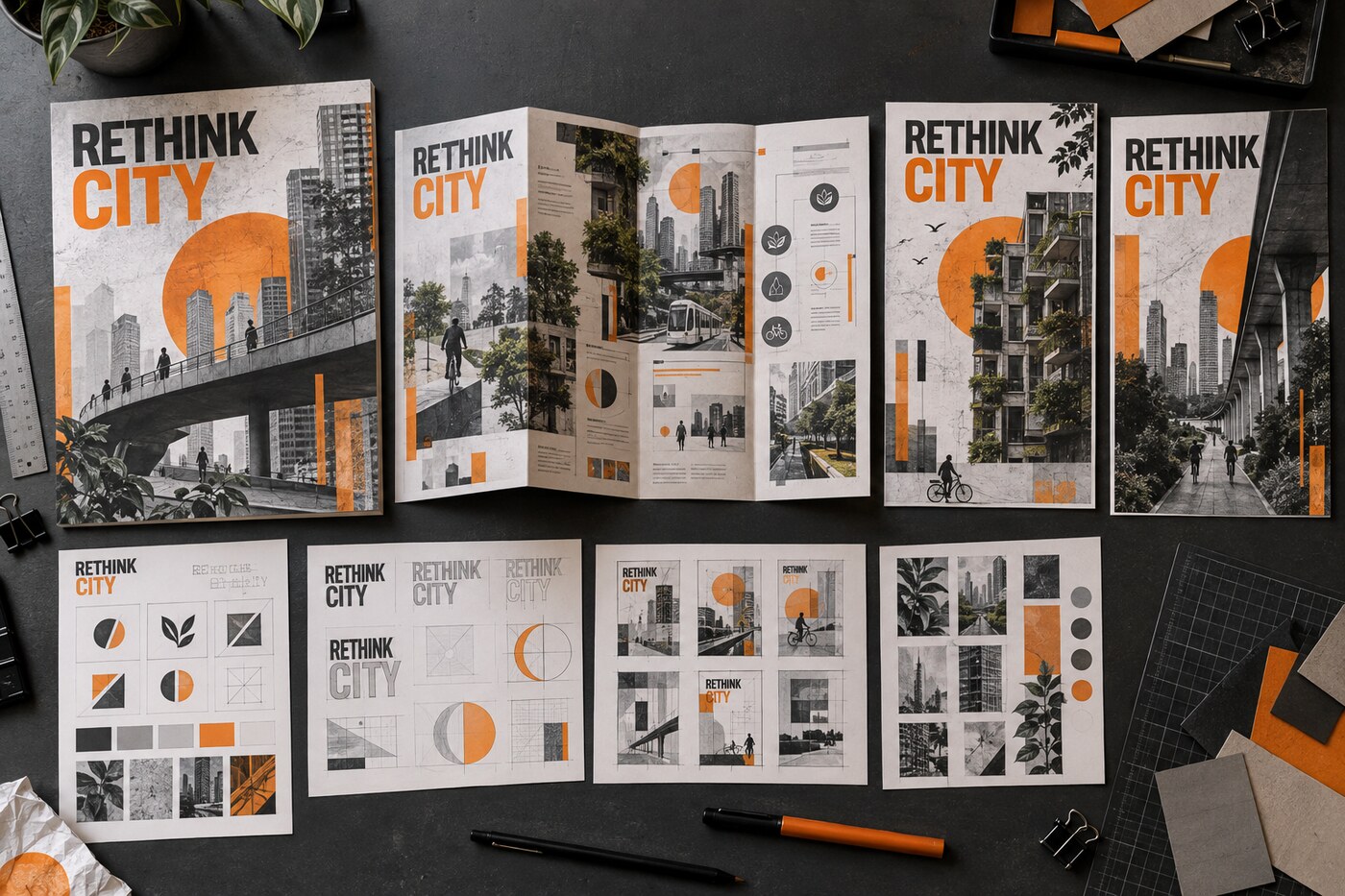
This A Level response extends a visual identity across posters and a leaflet. Repeated typography, colour and modular forms make the campaign coherent, but each format has a different communication job. The outcome demonstrates refinement through the relationship between concept, audience, format and visual system.
- A Level exercise: audit the campaign for consistency and purposeful variation. Which decisions form the identity, and which respond to the individual format?
- Next decision: test the system on one additional application to reveal any weak or inflexible rules.
How to explain the link between development and outcome
Good annotation makes decisions visible. Avoid simply describing what you did. Use evidence from the project to explain why each choice belongs in the outcome.
- “I selected… because my earlier test showed…”
- “The final composition develops the idea of… by…”
- “I rejected… because it distracted from…”
- “The format is appropriate for the audience because…”
- “Compared with my first plan, I refined… so that…”
- “If I developed the response further, I would…”
Common AO4 mistakes to avoid
- Starting a completely new idea that has little connection to the project.
- Copying one artist’s work instead of applying relevant learning personally.
- Including every experiment rather than selecting and refining.
- Making the final response larger without improving its composition or meaning.
- Ignoring presentation, print quality, sequence, scale or audience.
- Leaving technical risks until the final session.
Final AO4 checklist
- Can I state my intention clearly in one or two sentences?
- Does the outcome connect visibly to my artist research, experiments and observations?
- Have I tested composition, format, scale or sequence?
- Have I selected the strongest ideas instead of including everything?
- Are my materials and processes appropriate for the intended effect?
- Have I tested the main technical risks?
- Does the presentation help the viewer understand the work?
- Can I explain what changed during development and why?
Need focused advice before your final piece?
Portfolio to A Star offers personal online feedback to help you identify strengths, gaps and practical next steps in your GCSE or A Level Art and Design portfolio.
No responses yet