
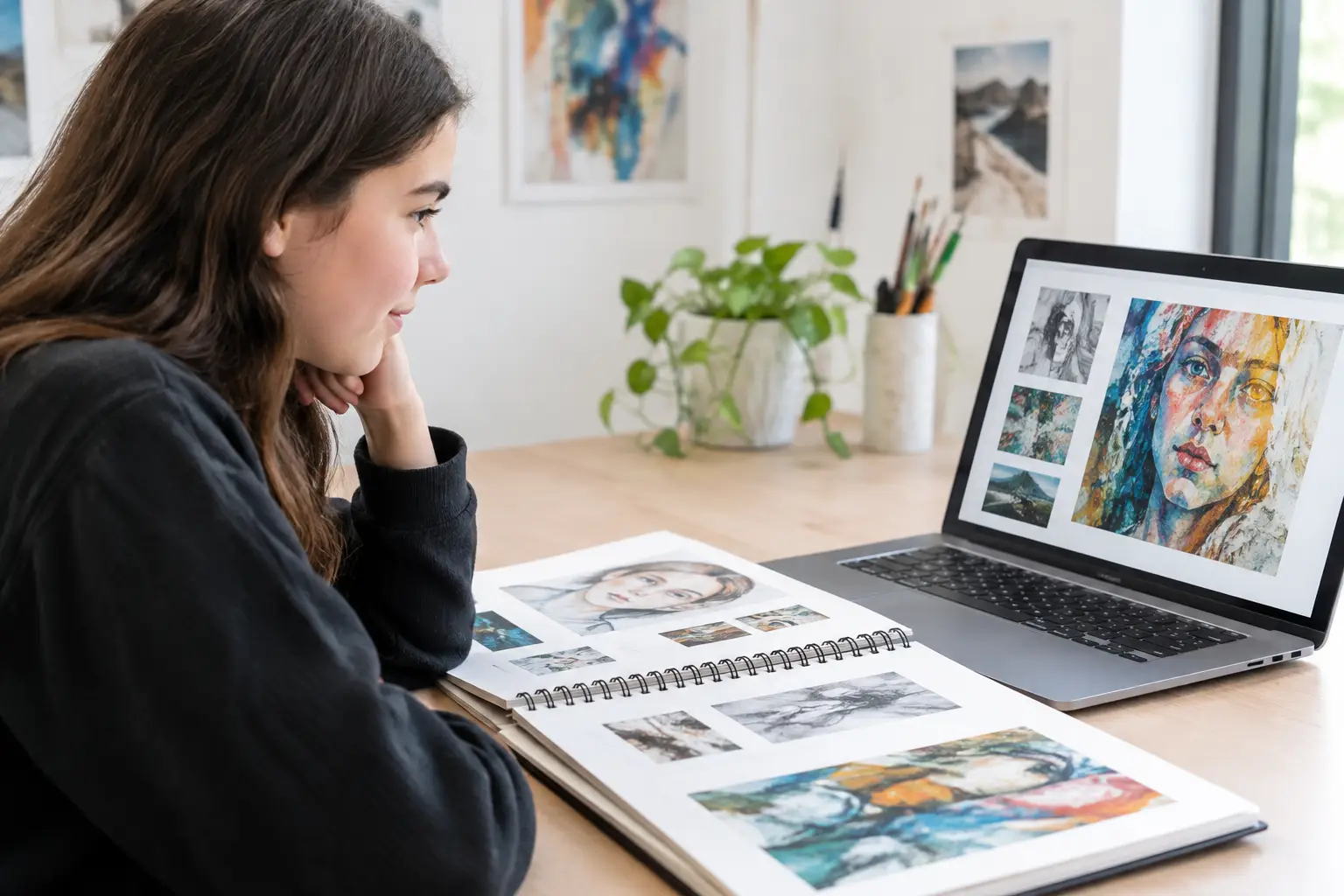
A sketchbook can look busy and still leave marks on the table. You may have produced strong drawings, gathered artist images and tried several materials, yet be unsure whether the pages show genuine development. This is where online art portfolio feedback can make a meaningful difference. It gives you a clear view of what an assessor can actually see in your work, not simply what you intended to show.
For GCSE and A Level Art and Design, marks are not awarded for a single impressive final piece alone. Your portfolio needs to show a connected journey: ideas researched, visual decisions tested, observations recorded, outcomes refined and intentions explained. Good feedback helps you identify the missing evidence, while there is still time to act on it.
What online art portfolio feedback should assess
The most useful review does more than say that a page is ‘good’ or that you should ‘add more annotation’. Those comments may be encouraging, but they do not tell you what to do next. Effective feedback should relate your own work to the Assessment Objectives and turn each objective into practical actions.
For most GCSE and A Level coursework portfolios, that means looking at AO1, AO2, AO3 and AO4 together. The strongest portfolios do not treat these as four separate boxes to complete. They show how research leads to experiments, how observation informs design choices, and how those choices shape a personal final response.
A reviewer should be able to spot where that chain is working and where it breaks. Perhaps your artist research is visually attractive but does not influence your own photography or drawing. Perhaps you have experimented extensively, but the experiments are not labelled or evaluated, so the development is difficult to follow. Or perhaps your final outcome is technically capable but feels disconnected from the pages before it.
These are common issues, and they can be improved when feedback is specific.
AO1: Are your ideas and artist references purposeful?
AO1 is about developing ideas through investigations informed by contextual and other sources. In practical terms, this means showing that an artist, photographer, designer or movement has helped you think differently about your own theme.
Feedback at this stage should question whether your research goes beyond copying a style or collecting facts. Have you selected artists because they connect to your project? Have you analysed particular visual features, such as composition, distortion, mark-making, colour, symbolism or lighting? Most importantly, can a reader see what you chose to take forward?
For example, writing that an artist is ‘inspiring’ is not enough. A stronger annotation might explain that their cropped compositions have prompted you to take close-up photographs of hands, then test unusual framing in your own drawings. That is visible, personal development.
AO2: Do your experiments move the project forwards?
AO2 requires you to refine work by exploring ideas, selecting and experimenting with appropriate media, materials, techniques and processes. Quantity can help, but a page full of unrelated trials is not automatically strong experimentation.
Online art portfolio feedback can help you judge whether each experiment has a reason. If you are creating a portrait project, for instance, you might test ink washes to create mood, collage to introduce fragmented identity, and layered digital imagery to explore memory. The key is to explain what each trial taught you and what you will change next.
A useful review may point out that you need more variation in scale, material or process. Equally, it may advise you to stop producing new experiments and begin refining the most successful direction. This is an important trade-off. Students sometimes mistake more pages for more development, when careful selection and improvement would be stronger.
AO3: Is there enough first-hand visual evidence?
AO3 focuses on recording ideas, observations and insights that are relevant to your intentions. Original photographs, direct drawings, contact sheets, observational studies and process images can all contribute, provided they relate clearly to the project.
This is often the area that makes a portfolio feel genuinely personal. Internet images can support contextual research, but they cannot replace your own visual investigations. If your theme is urban decay, for example, a set of photographs taken around your local area gives you material that no other student has used. It also gives you stronger starting points for drawing, editing, collage or print.
Feedback can identify whether your recording is too dependent on secondary sources, too repetitive, or not sufficiently linked to later work. It may suggest a focused photo shoot, a series of drawings from different viewpoints, or closer studies of texture and detail. These are not extra tasks for the sake of filling space. They create the visual evidence needed to support your ideas.
AO4: Does your final response feel earned?
AO4 is about presenting a personal and meaningful response that realises your intentions and demonstrates understanding of visual language. Your final piece does not have to include every technique you have tried. In fact, forcing everything into one outcome can make it confused.
Instead, the outcome should feel like the logical result of your most successful investigations. A review should ask: which artist influences remain? Which photographs, drawings or experiments led to this composition? Why have you chosen these materials, colours, images or typefaces? Can you explain the decisions confidently?
If the answer is unclear, you may not need to restart. You may need to strengthen the bridge between your development pages and the final response. A small compositional study, a material sample, a planning page or a short evaluation can make that connection much easier for an assessor to see.
How to prepare work for an online portfolio review
The quality of the feedback partly depends on what the reviewer can see. Photograph or scan pages in good natural light, keeping images straight, in focus and complete. Include double-page spreads where the relationship between pages matters, rather than sending isolated close-ups only.
Arrange the work in project order. Start with your initial idea or starting point, then show research, recording, experiments, development and outcome. If there are pages you know are unfinished, include them. Hiding weaker areas may feel safer, but it prevents you from receiving advice where you most need it.
It also helps to state your course, discipline and deadline. GCSE Fine Art, A Level Photography and Graphic Communication all use the Assessment Objectives, but the evidence may look different. A Photography student might need feedback on contact sheets, editing and shoot planning, while a Fine Art student may need more support with drawing from observation, material exploration or annotation.
Before submitting, write down two or three questions that matter to you. You might ask whether your artist research is analytical enough, whether your experiments are connected, or whether your final piece meets AO4. Focused questions can make a review even more useful, although a strong assessor should also identify priorities you have not noticed yourself.
Turning feedback into better coursework
Receiving feedback is only the first step. The progress comes from using it strategically. Read the comments once, then identify the actions that will have the greatest impact on the assessment evidence. Do not try to fix everything in one evening.
A helpful response usually involves three stages. First, clarify the priority: for example, ‘my project needs clearer links between my primary photographs and my mixed-media experiments’. Next, choose a manageable action, such as adding annotations beside two key experiments and producing one new page that develops your own photographs. Finally, evaluate the improvement. Explain what worked, what you selected and where it will lead.
This approach protects you from a common problem: adding pages without improving the project’s direction. Every new piece of work should answer a question, solve a problem or lead naturally to a next decision. If it does none of these, it may be interesting, but it is probably not the priority.
Keep your reviewer’s advice visible while you work. A short checklist can be useful when it contains real actions rather than vague targets. ‘Add more AO1’ is difficult to act upon. ‘Compare the use of shadow in two photographs, then test this lighting in your own shoot’ is clear, achievable and easy to evidence.
When professional feedback is most valuable
You do not need to wait until your portfolio is finished. In fact, feedback is often most valuable at the point where you have enough work to reveal a direction, but enough time to make informed changes. For many students, this is after initial research and experiments, before committing fully to a final outcome.
It can also be valuable near the end of a project, when you need to check the clarity of your presentation and decide what final refinements will genuinely improve the work. The advice will differ depending on your stage. Early feedback may focus on broadening research and gathering stronger primary sources; late feedback may focus on selection, annotation and making the development route visible.
Portfolio to A Star reviews work against the Assessment Objectives, helping you understand not only what is strong, but what should happen next. That examiner-aligned perspective can be particularly reassuring when you are aiming for the highest grades and need to move beyond general classroom advice.
Your portfolio does not need to be perfect before someone sees it. It needs to be honest enough for the next decision to become clear. Make that decision purposeful, show the evidence of it on the page, and your creative confidence will have something solid to grow from.
No responses yet