
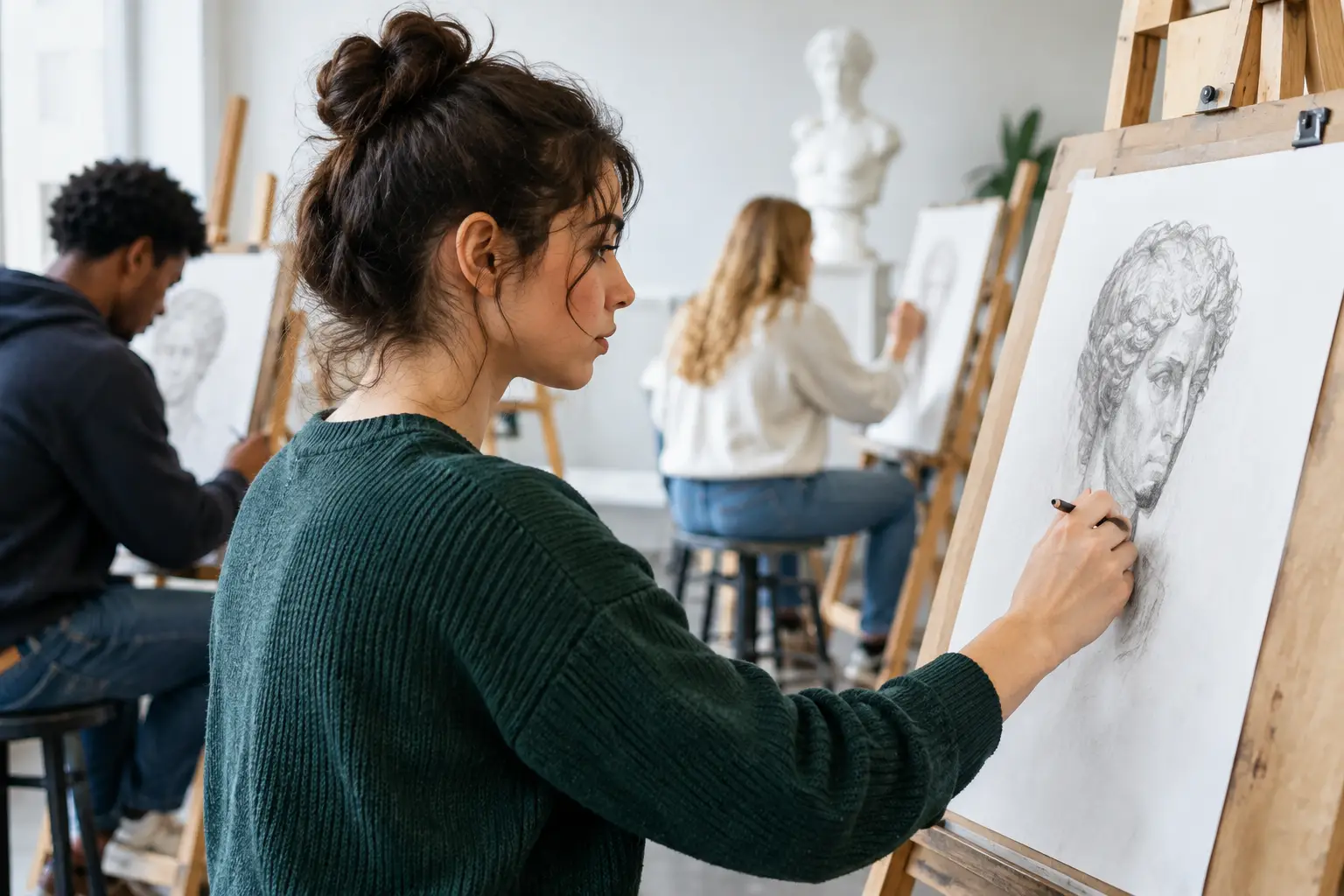
A sketchbook with six artist pages can still underperform if every page says the same thing: copied image, short biography, one sentence of praise. Equally, a sketchbook with two well-chosen artists can show excellent development when the research clearly changes what you make next. So, how many artist studies should you include? The honest answer is that there is no single number that guarantees a Grade 9 or A*. What matters is whether each study earns its place in your project.
For GCSE and A Level Art, Photography, Fine Art and Graphic Communication, artist research is evidence for AO1: developing ideas through relevant investigations into artists, designers and other sources. Your studies need to connect to your theme, inform practical work, and help your project move forward. Quantity can support this, but purposeful development is what an examiner can reward.
How many artist studies are enough?
As a sensible starting point, most GCSE projects benefit from researching around two to four artists, photographers or designers in depth. At A Level, three to five strong contextual references across a sustained project is often appropriate. This is not a rulebook. A broad theme developed over several months may naturally need more references than a tightly focused project.
The key word is in depth. One artist study might take several sketchbook pages or a digital sequence because it includes visual analysis, your own practical responses, experiments, annotation and decisions about what to develop. It is far more valuable than a single decorated page containing facts copied from a website.
You may also use brief references beyond your main studies. For example, you could mention a film still, textile pattern, album cover, architect or contemporary illustrator that influences one experiment. These can enrich your visual journey, but they do not need the same level of detailed investigation as your core artists.
Start with your project, not a target number
Students often ask for a number because they want a clear checklist. That is understandable, especially when coursework feels large and open-ended. However, choosing artists simply to reach a quota can make your sketchbook feel disconnected.
Begin by asking what your project needs next. If your theme is identity, perhaps you need an artist who uses portrait photography, another who distorts the figure, and a third whose use of collage could help you combine personal images and objects. Each reference now has a job. You are not researching three names because someone said three was enough. You are building a route towards your own outcome.
A useful project may include artists who offer different possibilities: subject matter, composition, materials, process, colour, mood or message. Do not choose three artists who all make almost identical work unless comparing their approaches is central to your idea. Variety creates more opportunities for meaningful experimentation under AO2.
A practical GCSE approach
For a GCSE project, start with two artists that strongly suit your initial theme. Complete practical responses to both, then review your work. Has one approach given you much more to explore? Has your own photography, drawing or material testing taken the project in a new direction? Add a third artist only when they help solve a genuine creative problem or extend an idea.
For instance, a project on decay could begin with an artist known for detailed observational drawing and a photographer who records abandoned spaces. If your experiments then become more abstract, a third reference using expressive mark-making might help you develop surface and mood. The progression makes sense because each study responds to what came before.
A Level students need greater independence, not endless pages
At A Level, examiners expect more sustained and selective investigation. You may work with three to five key artists over a project, sometimes returning to one artist at different stages. A later revisit can be particularly effective: after trying their methods, explain what you now understand differently and how you will adapt the idea further.
Avoid treating every artist study as a separate mini-project. Your sketchbook should show connections. A strong page might compare how two photographers crop the figure, then lead into your own contact sheet testing similar viewpoints. That visible chain of research, action, review and refinement is much stronger than a collection of unrelated artist pages.
What a strong artist study actually includes
A high-quality study does more than prove you have looked at an artist. It shows what you noticed, what you tried and what you learned. The best balance depends on your discipline, but your investigation should normally include these connected elements:
- Relevant visual research into selected works, with a clear reason for choosing the artist.
- Focused analysis of specific features such as composition, colour, materials, symbolism, typography, lighting or technique.
- Your own practical response, using appropriate media, photographs, designs or processes.
- Annotation that evaluates results and identifies a clear next step.
Notice that biography is missing from this list. A short piece of context can be useful if it helps you understand the work, such as the cultural background behind a series or the purpose of a campaign. Long life stories rarely strengthen AO1 on their own. Spend your limited time on visual understanding and personal development.
When should you add another artist?
Add another artist study when your current work has reached a point where a new reference will move it forward. This could happen when you need a different technique, a stronger compositional approach, a fresh way to communicate your message or a more suitable route towards a final piece.
Do not add one merely because you have finished a page and feel you should keep researching. Before selecting someone new, look back through your work and identify the gap. Write it plainly: “My photographs are too literal, so I need to investigate fragmentation.” Or: “My ink studies have strong texture, but I need ideas for combining them with type.” That sentence can guide a far more relevant search.
Sometimes the right decision is not another artist. You may need to spend time improving your own photography, making larger-scale studies, refining a composition or testing materials more carefully. Assessment rewards purposeful experimentation and refinement, not research for its own sake.
Avoid the common artist-study traps
The first trap is copying an artwork too closely. A careful copy can help you understand technique, but it should be followed by adaptation. Change the subject, scale, materials, format or intention so that your response becomes yours. If you only reproduce another artist’s image, there is little evidence of personal development.
The second trap is generic annotation. Phrases such as “I like this because it is colourful” do not explain artistic decisions. Be precise. Identify what you see, then state how it affects your work: “The limited blue-grey palette creates a cold atmosphere. I will test a reduced palette in my portrait photographs to make the setting feel isolated.”
The third trap is leaving research behind. If an artist has influenced your thinking, let that influence appear later in your project. Refer back to it in experiments, composition plans and final outcome development. This makes your portfolio coherent and shows that AO1 is connected to AO2, AO3 and AO4.
Use page count as a check, not a goal
There is no ideal number of pages per artist either. A simple research response may need two pages. A key influence could justify four, six or more pages because it leads to several practical experiments. Digital portfolios may show this development through slides, contact sheets, process images and annotations instead.
Ask yourself a better question than “Have I done enough?” Ask: “Can someone clearly see how this artist changed my ideas?” If the answer is yes, your study is doing useful assessment work. If the answer is no, add a practical response, improve your analysis or show what you developed afterwards.
Aim for enough artist studies to give your project direction, variety and depth, then give yourself permission to develop your own visual voice. Your strongest portfolio will not be the one with the most names in it. It will be the one where every reference leads to a confident, visible next step.
No responses yet