
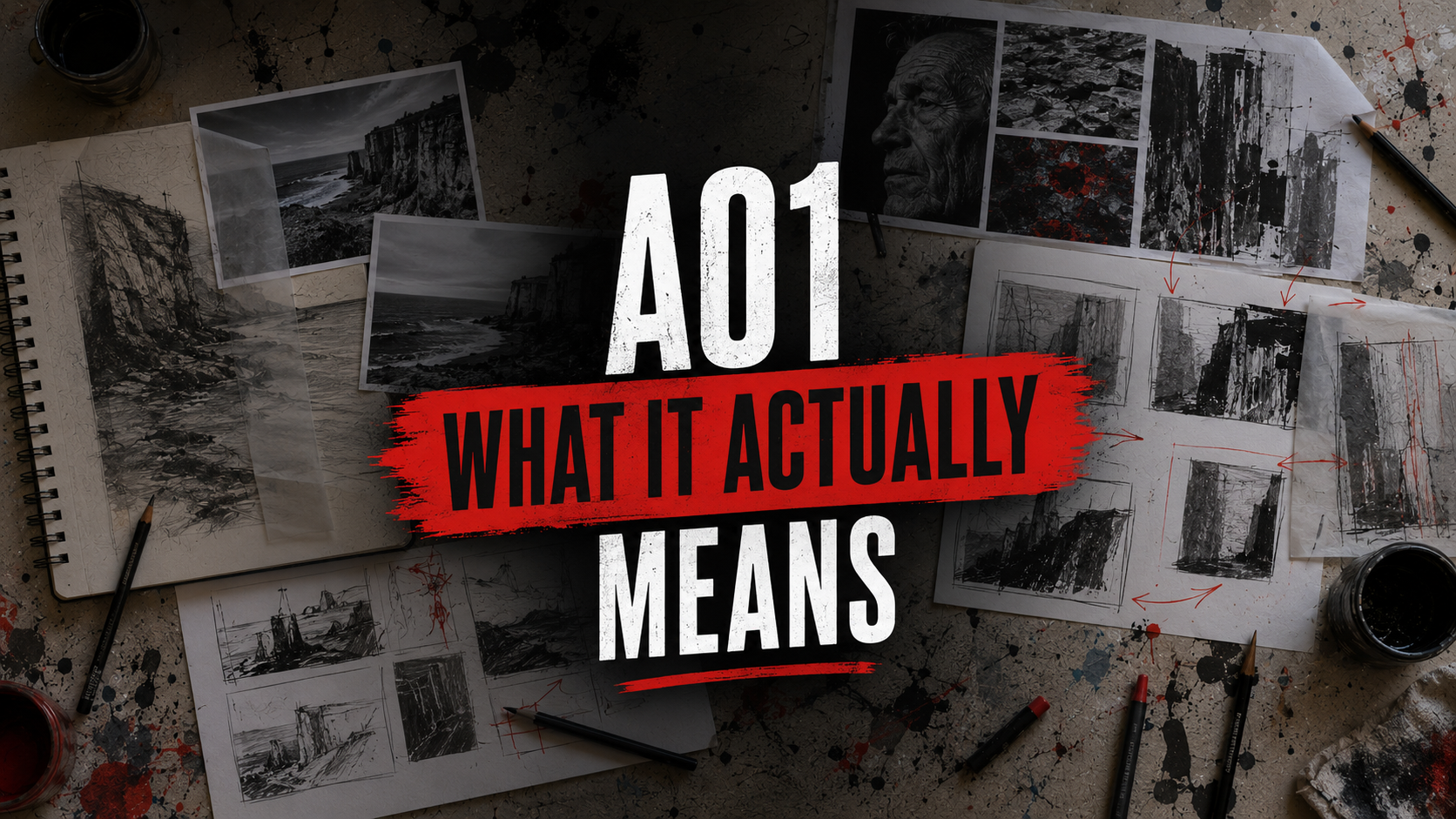
Assessment Objective 1: What It Actually Means
Stop Researching Artists… Start Developing Ideas
If you’ve ever searched for “What is AO1 in Art?” or wondered “How do I get higher marks in Assessment Objective 1?”, you’re not alone.
Assessment Objective 1 (AO1) is probably the most misunderstood part of GCSE and A Level Art & Design.
Many students believe AO1 simply means researching an artist and filling a sketchbook page with images and facts copied from the internet.
It doesn’t.
In fact, this misunderstanding is one of the biggest reasons students fail to achieve the highest grades.
This guide explains exactly what AO1 means, what examiners are looking for, how to avoid the most common mistakes, and how to produce the kind of sketchbook pages that achieve Grade 9 and A* marks.
What is Assessment Objective 1?
The official wording varies slightly between examination boards, but they all expect students to:
Develop ideas through investigations, demonstrating critical understanding of sources.
At first glance, this sounds complicated.
In simple terms, AO1 asks you to:
- investigate ideas
- explore artists and designers
- study photographers and craftspeople
- research themes and concepts
- understand materials and techniques
- explain what you’ve discovered
- use that knowledge to improve your own work
Notice something important?
Nowhere does it say:
“Write a biography about an artist.”
AO1 Is About Developing Ideas
This is the key phrase.
Everything you research should help answer one question:
How will this help me develop my own ideas?
Every artist you study…
Every gallery you visit…
Every photograph you analyse…
Every documentary you watch…
Every experiment you carry out…
…should move your own project forward.
That’s what examiners reward.
AO1 Is Much More Than Artist Research
Researching artists is only one way of achieving AO1.
Students can also investigate:
- photographers
- graphic designers
- architects
- sculptors
- ceramicists
- fashion designers
- illustrators
- filmmakers
- typographers
- galleries
- museums
- exhibitions
- books
- documentaries
- interviews
- podcasts
- cultural influences
- historical movements
- personal experiences
- locations
- natural forms
- materials
- processes
- techniques
- colour theory
- composition
- symbolism
The strongest portfolios combine several of these.
What Examiners Want to See
High-marking students don’t simply collect information.
They show that they have thought carefully about what they have discovered.
For every investigation, ask yourself:
- What have I learned?
- Why is this important?
- How does this influence my own work?
- Which techniques could I use?
- Which colours could I borrow?
- Which compositions inspire me?
- What would I change?
Your sketchbook should show your thinking.
The Biggest AO1 Mistake
Many students create pages that look impressive but score surprisingly few marks.
Why?
Because they spend hours producing beautiful artist pages without ever explaining:
- why they chose the artist
- what they learned
- how the work influenced them
- what they intend to develop next
Beautiful presentation is useful.
Thoughtful investigation is essential.
What Does a Grade 9 or A* AO1 Page Look Like?
An outstanding AO1 page usually contains:
- carefully selected artist images
- visual analysis
- meaningful annotation
- comparisons between artists
- colour studies
- composition notes
- material investigations
- links to personal photography
- thumbnail sketches
- experimental ideas
- clear evidence of independent thinking
Every element helps develop the student’s own project.
Annotation Matters
Annotation is not there simply to fill empty space.
Good annotation explains:
- observations
- decisions
- successes
- problems
- influences
- intentions
Instead of writing:
“I like this artist.”
Explain:
“I am interested in the way the artist simplifies facial features using elongated proportions. I intend to investigate similar proportions in my own portrait studies while introducing a contemporary colour palette.”
That tells the examiner something useful.
Developing Ideas Through Investigation
AO1 should feel like a conversation between your research and your artwork.
Research…
↓
Think…
↓
Experiment…
↓
Develop…
↓
Refine…
↓
Create.
The Assessment Objectives are connected.
AO1 naturally leads into AO2.
Practical Ways to Improve AO1
Try to:
- visit galleries and museums
- produce your own photography
- compare more than one artist
- investigate contemporary practitioners
- include first-hand observations
- experiment with different media
- analyse techniques instead of describing them
- connect every investigation to your own work
- annotate regularly throughout the project
- review and reflect on your decisions
Common AO1 Myths
❌ AO1 is just artist research.
No.
Artist research is only one part of AO1.
❌ I need lots of writing.
No.
You need meaningful writing.
Quality always beats quantity.
❌ I should copy the artist.
No.
Examiners want to see your own ideas developing from your investigations.
❌ I only need one artist.
Usually not.
Most successful projects investigate several relevant sources.
How AO1 Links to the Other Assessment Objectives
AO1 is the starting point for every successful project.
Your investigations naturally lead into:
AO2 — experimenting with materials and techniques
AO3 — recording observations through drawing, photography and annotation
AO4 — producing a personal final outcome
The highest-marking portfolios don’t treat the Assessment Objectives as separate chapters.
They develop all four simultaneously.
Final Thoughts
Assessment Objective 1 isn’t about proving how much information you can collect.
It’s about showing how effectively you can investigate, analyse and develop ideas that make your own work stronger.
Every artist, photographer, designer or source you explore should help move your project forward.
When examiners see thoughtful investigation leading naturally into experimentation, recording and a personal final outcome, they’re seeing exactly what AO1 is designed to reward.
Need Professional AO1 Feedback?
Not sure whether your sketchbook demonstrates enough investigation or critical understanding?
At Portfolio to A Star, you’ll receive personalised feedback explaining exactly how to strengthen your AO1 work, improve your annotation and develop ideas that lead to higher GCSE and A Level Art grades.
Because understanding AO1 isn’t about researching more — it’s about researching with purpose.
One response
[…] AO1: Research and contextual sources […]