
Assessment Objective 2: What It Actually Means
Stop Random Experimenting… Start Purposeful Refinement
If you have ever searched for “What is AO2 in Art?”, “How do I improve AO2?” or “What does experimentation actually mean in GCSE Art?”, you are asking one of the most important questions in Art & Design.
Assessment Objective 2, usually shortened to AO2, is one of the most misunderstood parts of GCSE and A Level Art.
Many students believe AO2 simply means trying lots of different materials and filling sketchbook pages with paint samples, random mark-making and colour swatches.
It does not.
Experimentation without purpose rarely scores highly.
The highest-marking students do not experiment simply for the sake of it. They experiment to solve problems, improve ideas, test possibilities and make better creative decisions.
This guide explains exactly what AO2 means, what examiners are looking for, the most common mistakes students make and how to produce the kind of experimentation and refinement that can lead to Grade 9 and A* portfolios.
What Is Assessment Objective 2?
Although the wording differs slightly between examination boards such as AQA, OCR, Pearson Edexcel and WJEC/Eduqas, the meaning is broadly the same.
AO2 asks students to:
Refine work by exploring ideas, selecting and experimenting with appropriate media, materials, techniques and processes.
At first, that wording can sound complicated.
In simple terms, AO2 is about testing ideas and making them better.
It is about asking:
What happens if I try this instead?
Every experiment should help improve your project in some way.
AO2 Is About Refining Your Ideas
The most important word in AO2 is:
Refine.
Refining means improving, adjusting, developing and making more considered choices.
Your experiments should help you answer questions such as:
- Which material works best?
- Which colour palette is most effective?
- Which composition communicates my idea most clearly?
- Which viewpoint creates the strongest image?
- Which process produces the mood I want?
- Which technique should I take forward?
- What should I change next?
Examiners reward students who make thoughtful decisions based on practical investigation.
AO2 Is Not Just Trying Lots of Materials
Many students think experimentation simply means using:
- watercolour
- acrylic paint
- oil pastel
- charcoal
- pencil
- ink
Material experiments are useful, but AO2 is much broader than that.
Students can experiment with:
- media
- materials
- techniques
- processes
- colour palettes
- composition
- scale
- cropping
- viewpoint
- lighting
- photography
- digital editing
- typography
- printmaking
- mixed media
- surface texture
- image manipulation
- layering
- transparency
- mark-making
- distortion
- abstraction
- presentation
The strongest GCSE and A Level Art portfolios explore several possibilities before deciding which ideas are the most successful.
What Examiners Want to See
Examiners are looking for evidence that you are thinking like a creative practitioner.
They want to see that you are:
- exploring possibilities
- testing materials and methods
- taking creative risks
- learning from mistakes
- comparing outcomes
- making informed decisions
- improving ideas over time
Most importantly, they want to see that your experiments have a clear purpose.
For every practical investigation, ask yourself:
- What was I trying to achieve?
- Why did I choose this material or process?
- Did the experiment work?
- What was successful?
- What was unsuccessful?
- What would I change?
- What should I try next?
- How will this influence my final outcome?
These questions demonstrate refinement.
The Biggest AO2 Mistake
One of the biggest misconceptions is that more experiments automatically mean more marks.
They do not.
Twenty pages of random experiments will usually be less successful than five carefully planned pages that clearly show ideas improving.
Quality is more important than quantity.
A strong AO2 page should not simply say:
I tried watercolour, acrylic and ink.
It should explain:
- why those materials were chosen
- what effect each one created
- which result was most successful
- what the student learned
- how the work will be developed next
Without that thinking, experimentation can become decoration rather than development.
What Does a Grade 9 or A* AO2 Sketchbook Look Like?
Outstanding AO2 sketchbook pages often include:
- colour palette experiments
- material investigations
- mixed-media studies
- photography experiments
- digital manipulation
- composition studies
- cropping investigations
- scale changes
- lighting tests
- layering techniques
- surface texture experiments
- printmaking trials
- thumbnail developments
- comparisons between outcomes
- clear annotation
- reflection on successes and failures
- evidence of ideas being refined
Every experiment should move the project forward.
Nothing should feel completely random.
Experimenting Does Not Mean Everything Has to Work
Some students become worried when an experiment goes wrong.
In reality, unsuccessful experiments can be extremely valuable.
Professional artists, photographers and designers rarely produce the perfect result on their first attempt.
A failed experiment can still earn marks when the student explains what happened and how they intend to improve it.
For example:
This process did not create the effect I wanted because the texture became too dominant and distracted from the portrait. I will repeat the experiment using a thinner acrylic wash and fewer layers so that the facial features remain clearer.
That shows genuine refinement.
The student has:
- identified a problem
- explained why it happened
- suggested a practical solution
- planned the next stage
That is strong AO2 evidence.

Annotation Is Essential
AO2 is not only about making artwork.
It is also about explaining your decisions.
Instead of writing:
I tried acrylic paint.
Try writing:
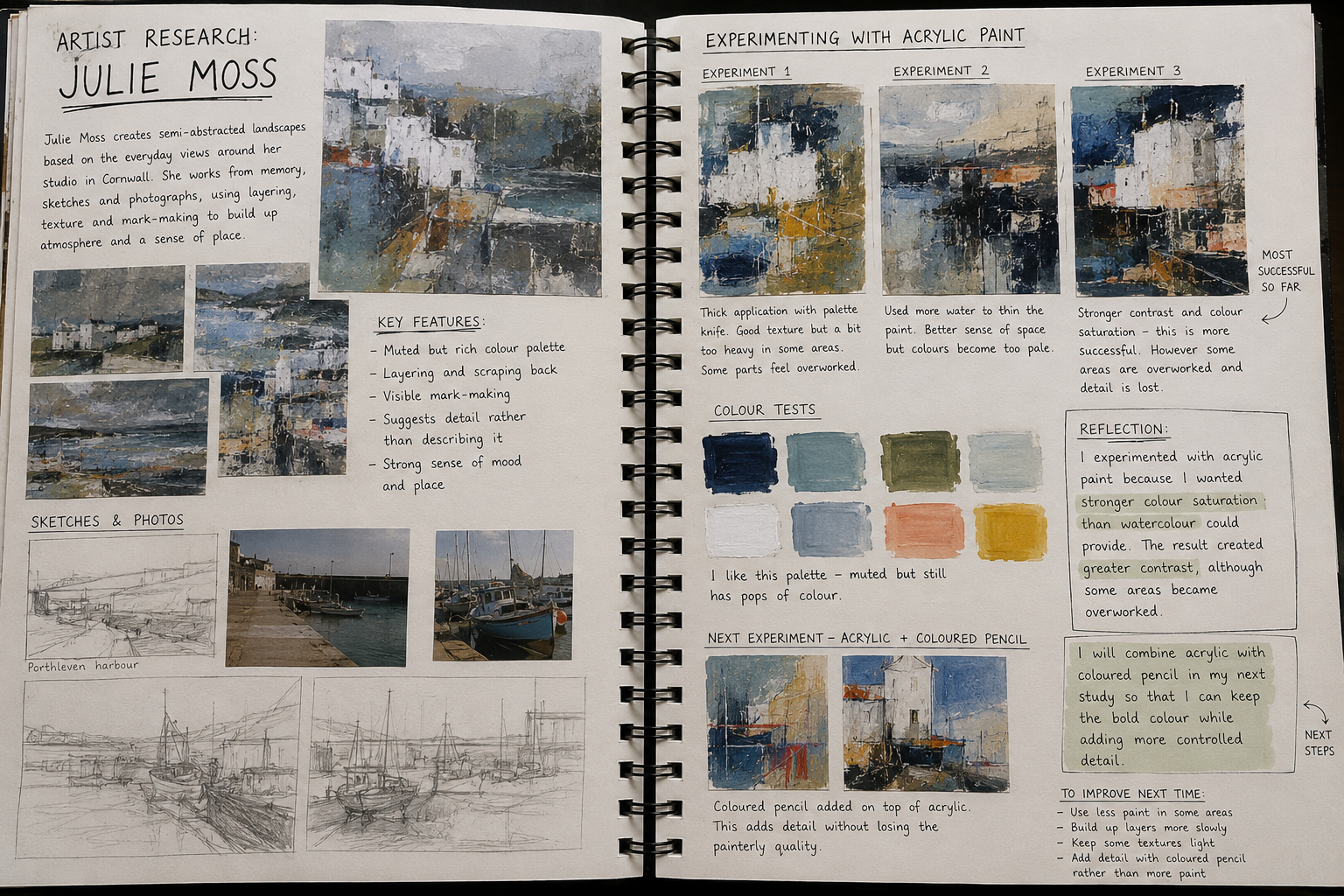
I experimented with acrylic paint because I wanted stronger colour saturation than watercolour could provide. The result created greater contrast, although some areas became overworked. I will combine acrylic with coloured pencil in my next study so that I can keep the bold colour while adding more controlled detail.
The second example tells the examiner:
- why the material was chosen
- what happened
- what was learned
- what will happen next
That is exactly what AO2 is designed to assess.
Developing Ideas Through Experimentation
AO2 should feel like a continuous cycle.
Research
↓
Experiment
↓
Evaluate
↓
Improve
↓
Experiment again
↓
Refine
↓
Develop
↓
Create
Every experiment should teach you something.
Every decision should make your project more focused.
Every refinement should bring you closer to a successful final outcome.
AO2 in Fine Art
In Fine Art, AO2 might include experimenting with:
- drawing materials
- painting techniques
- colour mixing
- brushwork
- impasto
- glazing
- collage
- printmaking
- scale
- composition
- surface texture
- abstraction
- mixed media
A student might test several ways of painting a portrait, compare the results and then combine the most successful features in a later piece.
AO2 in Photography
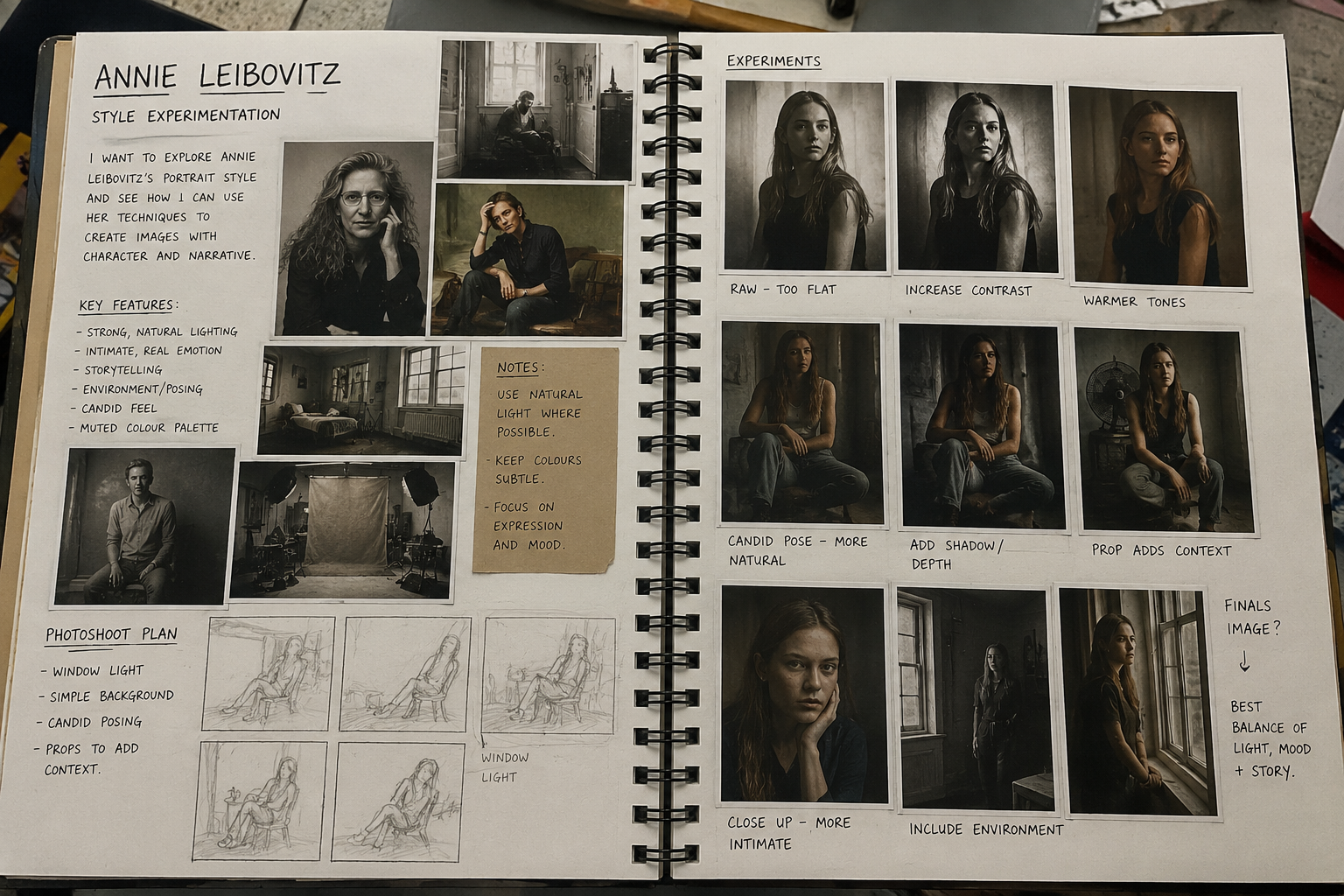
In Photography, AO2 might include experimenting with:
- camera angles
- depth of field
- shutter speed
- lighting
- reflections
- framing
- cropping
- colour grading
- black-and-white conversion
- multiple exposure
- digital manipulation
- sequencing
- printing methods
- different lenses
A photography student should show more than a contact sheet. They should explain which images were strongest, why they were successful and how the next shoot will be improved.
AO2 in Graphic Design
In Graphic Design, AO2 might include experimenting with:
- typography
- font combinations
- scale
- hierarchy
- layout
- colour schemes
- image placement
- negative space
- logos
- symbols
- collage
- digital software
- print processes
- poster variations
- packaging mock-ups
A strong graphic design project often shows several versions of the same idea, followed by clear decisions about which elements should be refined.
AO2 in Textiles and Three-Dimensional Design
In Textiles, AO2 could include:
- fabric manipulation
- stitching
- embroidery
- dyeing
- printing
- layering
- weaving
- construction methods
- surface decoration
In Three-Dimensional Design, AO2 could include:
- model-making
- material tests
- joining techniques
- structural experiments
- scale models
- surface treatments
- prototypes
- different forms and shapes
The principle is always the same:
Explore possibilities, evaluate them and improve the work.
Practical Ways to Improve AO2
To improve your AO2 marks:
- repeat successful experiments
- revisit unsuccessful experiments
- compare different materials
- test more than one composition
- experiment with scale
- explore unusual viewpoints
- change the lighting
- crop images in different ways
- combine traditional and digital techniques
- work on different surfaces
- photograph each stage
- annotate your decisions
- explain what you learned
- show how your ideas changed
- identify what you will do next
Always remember:
Experiment with purpose, not just for presentation.
Common AO2 Myths
AO2 Is Just Trying Lots of Materials
False.
Trying materials only becomes useful when it helps you develop or refine an idea.
Every Experiment Must Be Successful
False.
Unsuccessful experiments can be valuable when you explain what went wrong and how you would improve them.
More Pages Mean Higher Marks
False.
A smaller number of thoughtful, connected experiments can score more highly than lots of unrelated work.
AO2 Only Involves Practical Work
False.
Evaluation, decision-making and annotation are also important parts of refinement.
I Should Only Show My Best Work
False.
Showing how weaker ideas were improved can demonstrate a much stronger creative journey.
How AO2 Links to the Other Assessment Objectives
AO2 does not work in isolation.
Your investigations in AO1 give you ideas and influences.
Your experiments in AO2 test and refine those ideas.
Your drawing, photography and observations in AO3 provide visual evidence and source material.
Your final response in AO4 brings the strongest ideas together.
The highest-marking portfolios do not treat the Assessment Objectives as four completely separate sections.
They move naturally between all four.
For example, you might research a photographer for AO1, conduct a photoshoot for AO3, experiment with editing techniques for AO2 and use the strongest image in an AO4 final outcome.
What Strong AO2 Development Looks Like
A strong AO2 journey might look like this:
- choose an idea
- test several materials
- compare the results
- identify the strongest technique
- change the colour palette
- adjust the composition
- repeat the experiment
- combine successful elements
- refine the final design
The important thing is that the examiner can see a clear progression.
Your later work should be more resolved because of what you learned earlier.
Questions to Ask Yourself
Use these questions throughout your project:
- What am I trying to communicate?
- Why have I chosen this technique?
- What worked well?
- What needs improvement?
- Which result is most successful?
- What could I combine?
- What would happen if I changed the scale?
- What would happen if I cropped the image?
- Does this colour palette support my theme?
- How has this experiment changed my ideas?
- What will I do next?
These questions help turn practical work into meaningful development.
Final Thoughts
Assessment Objective 2 is not about filling your sketchbook with random paint samples.
It is about making informed creative decisions through practical investigation.
Every experiment should teach you something.
Every page should show progress.
Every material, technique and process should help communicate your ideas more effectively.
The strongest GCSE and A Level portfolios do not simply demonstrate experimentation.
They demonstrate purposeful refinement.
When examiners can clearly see your ideas evolving through thoughtful practical investigation, you are showing exactly what AO2 is designed to assess.
Need Help With Your AO2?
Not sure whether your experimentation is strong enough?
At Portfolio to A Star, I provide personalised GCSE and A Level Art portfolio feedback, explaining exactly how to improve your experimentation, strengthen your refinement pages and maximise your marks across all four Assessment Objectives.
Whether you are aiming for a Grade 9 at GCSE or an A* at A Level, expert feedback can help you identify weaknesses, develop stronger ideas and turn experimentation into meaningful progress.
Experiment with purpose. Reflect honestly. Refine continuously. That is what Assessment Objective 2 is really all about.
No responses yet