
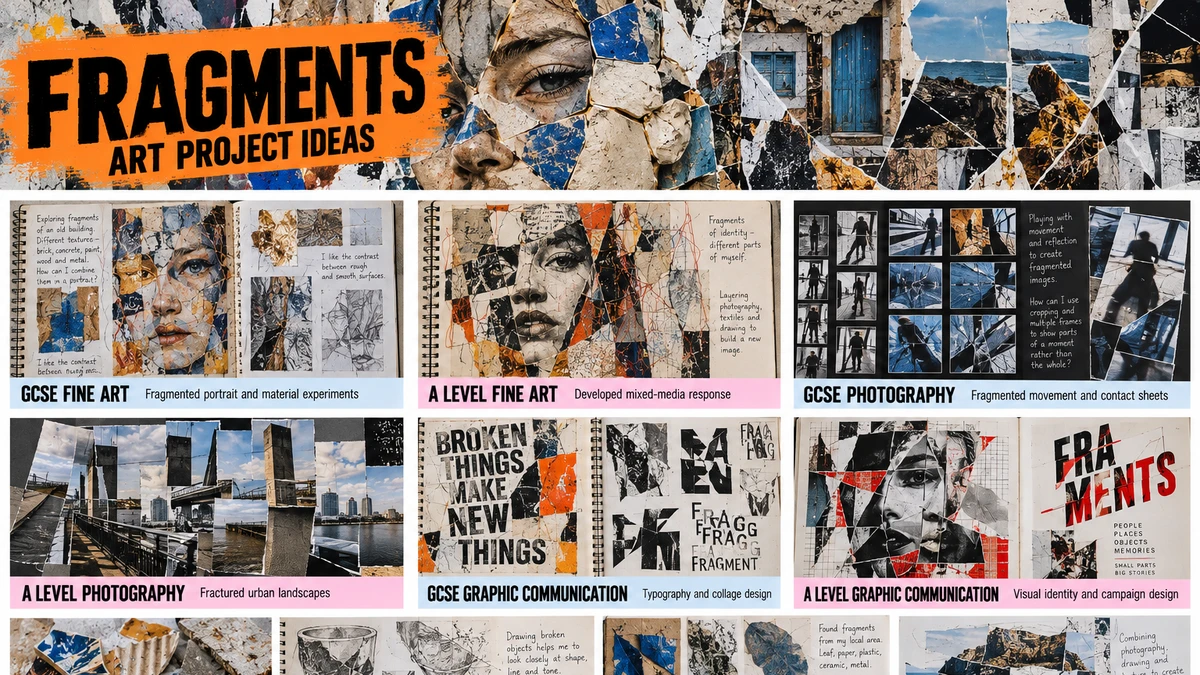
Looking for a GCSE or A Level art project idea? Fragments is a theme you can explore through torn paper, damaged surfaces, cropped photographs, broken patterns, memories and experimental typography. You do not need expensive materials: start by looking closely at ordinary things.
Fragments: Parts of a Bigger Picture
A fragment is a small part of something larger. It might be a piece of an object, a section of a photograph, a scrap of text, a memory or a surface that has been worn away. Your challenge is to collect, investigate and rearrange fragments to communicate a new idea. Think about what is lost, revealed or changed when something is separated from its original context.
GCSE Fine Art: Torn, Layered and Rebuilt
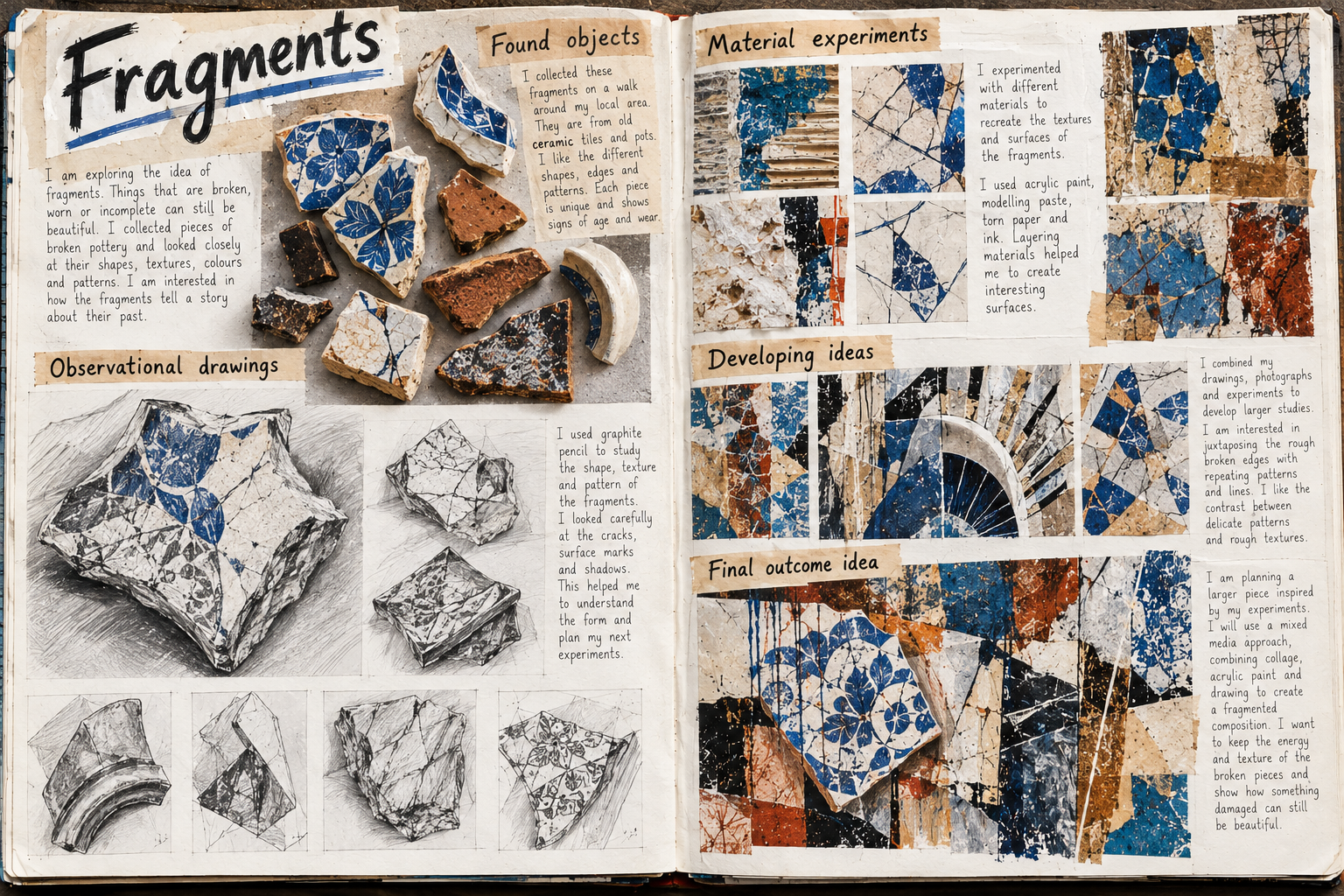
Collect discarded packaging, textured paper, fabric offcuts or drawings of damaged surfaces. Make observational studies, then experiment with tearing, cutting, folding, overlapping, painting and rubbing. Compare three compositions before choosing one to develop into a mixed-media piece. Photograph each stage and annotate why you made changes.
A Level Fine Art: Memory and Reconstruction
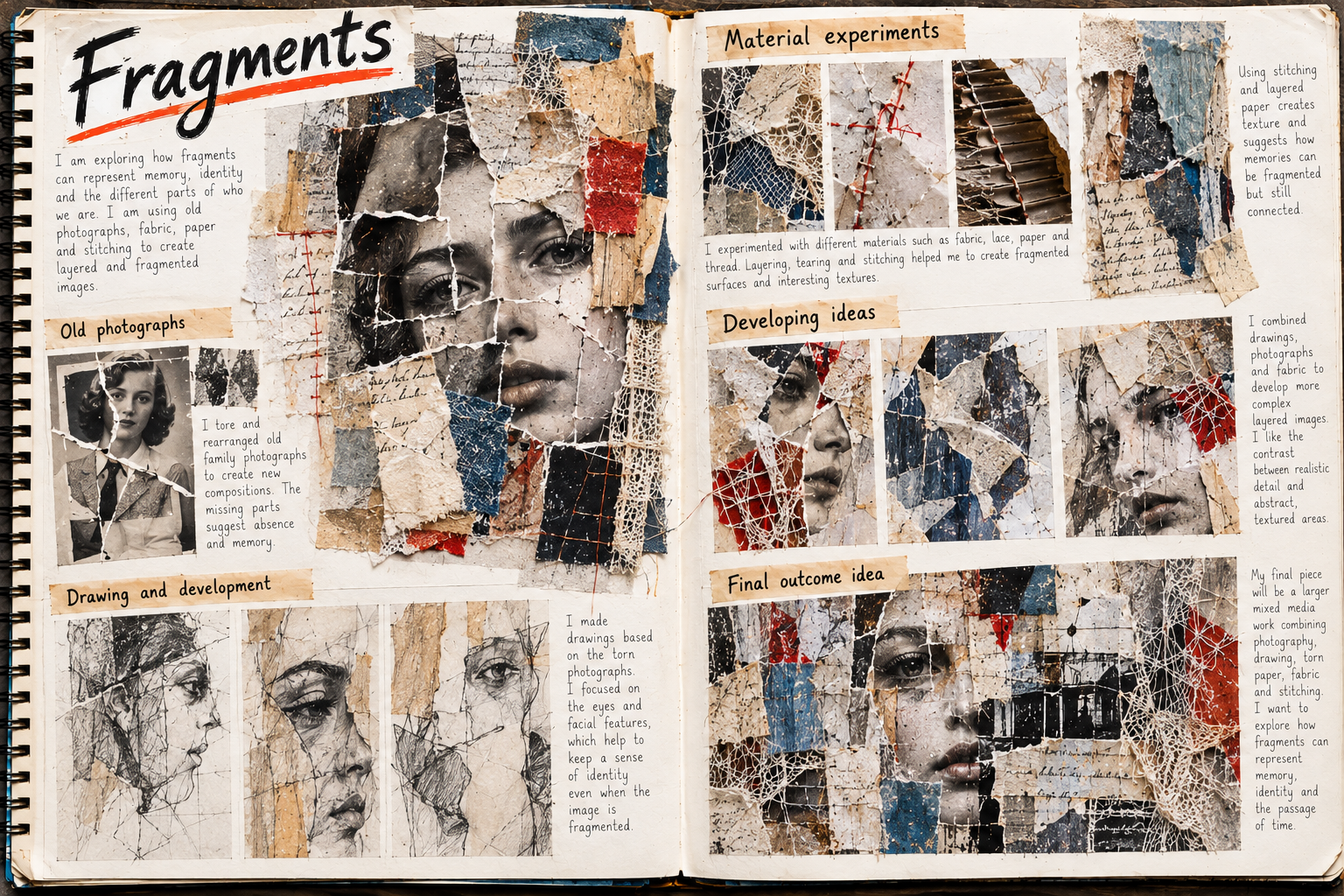
Build a sustained investigation around a question such as: Can fragments tell a more interesting story than a complete image? Work from your own photographs, found materials and personal observations. Experiment with scale, negative space, abstraction, stitching or assemblage. Record how your decisions affect meaning rather than simply producing a decorative collage.
GCSE Photography: Cropping and Repetition
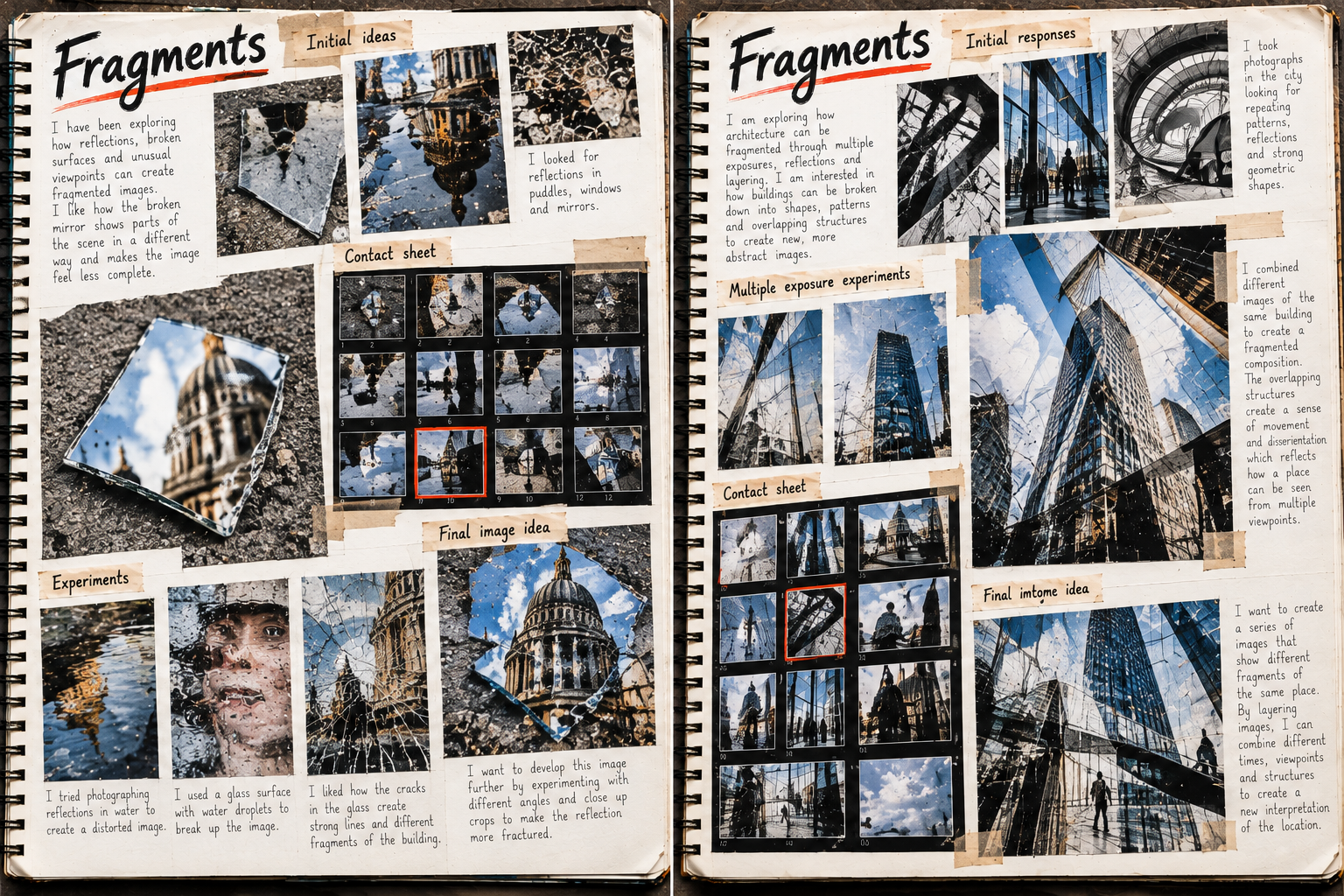
Photograph fragments of your surroundings: cracked paint, reflected faces, signs, windows, broken shadows or tiny details of objects. Make contact sheets and select images that work well together. Test close-up viewpoints, unusual framing, multiple exposure or simple digital layering. Create a short series that encourages the viewer to imagine the whole.
A Level Photography: Fractured Time and Identity
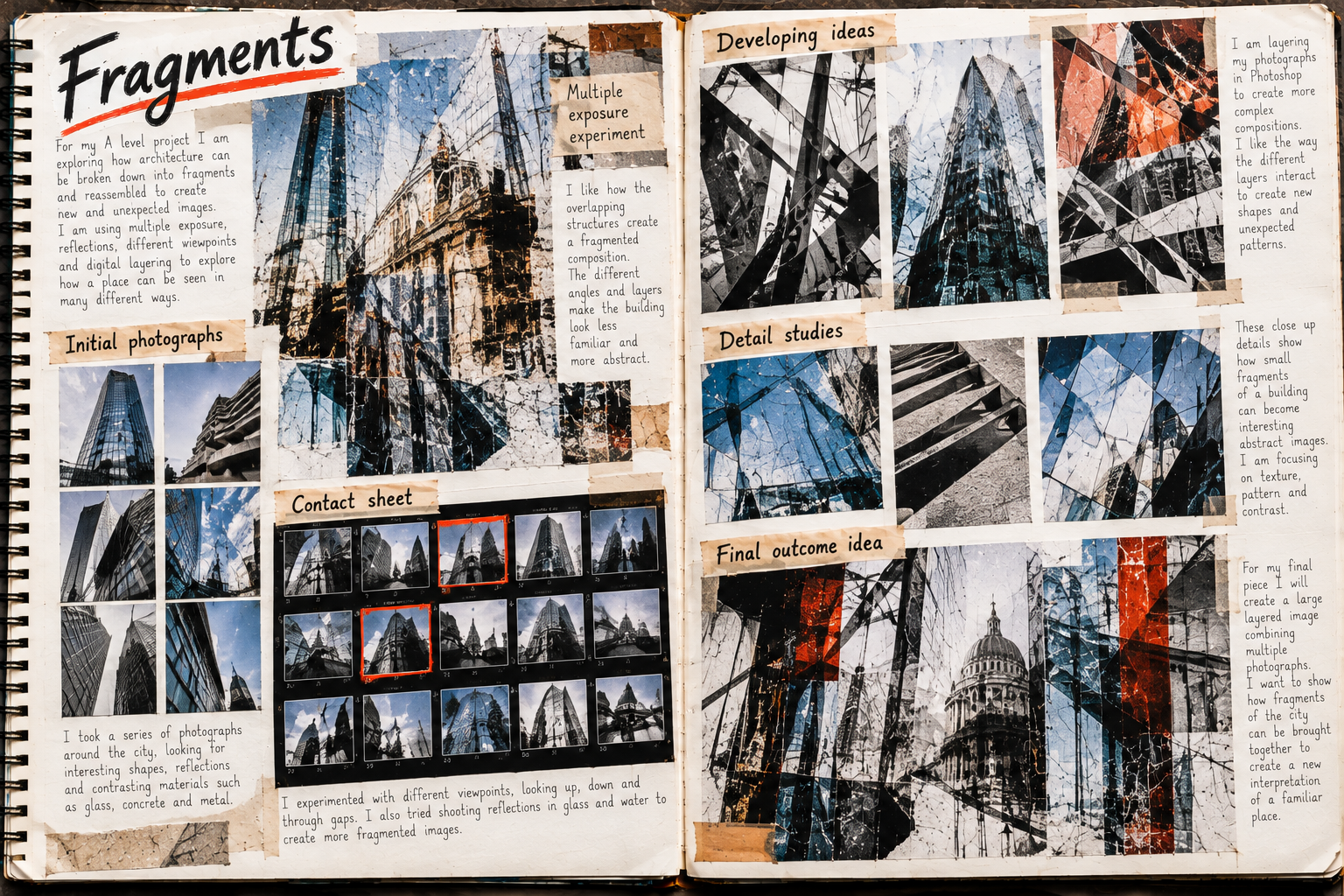
Develop a photographic enquiry into memory, change, movement or identity. Photograph a subject repeatedly, explore controlled shutter speeds, reflections, sequencing and constructed compositions, then compare alternative edits. Your final series should have a clear visual argument, with purposeful selections and critical reflection.
GCSE Graphic Communication: A Poster Made of Pieces
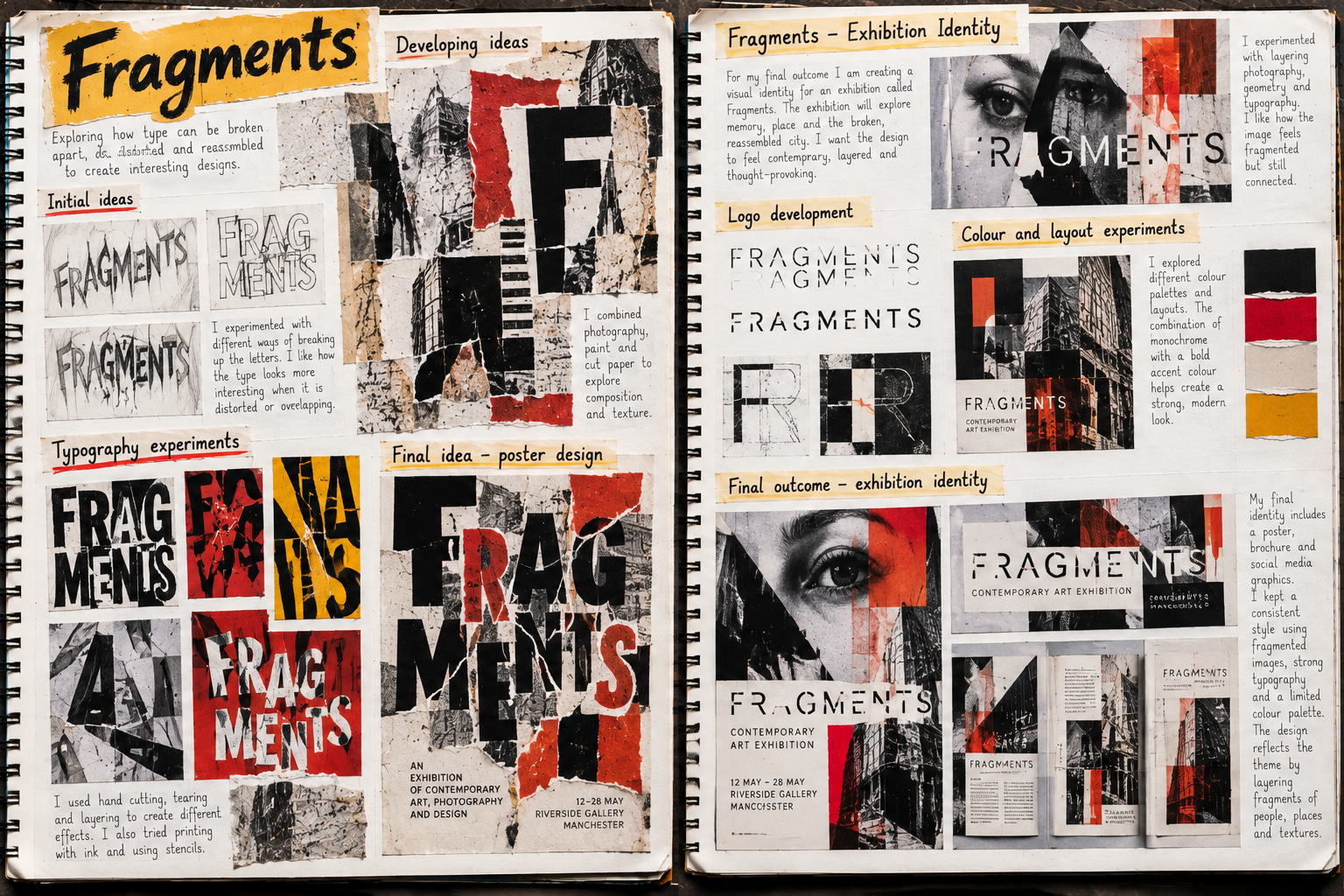
Invent a local exhibition, music event or community project called Fragments. Create an original poster using your own photographs, cut-out shapes and hand-made letterforms. Experiment with hierarchy, legibility, contrast and layout. Test two versions with classmates and explain how their feedback changes your design.
A Level Graphic Communication: Fragmented Editorial Identity
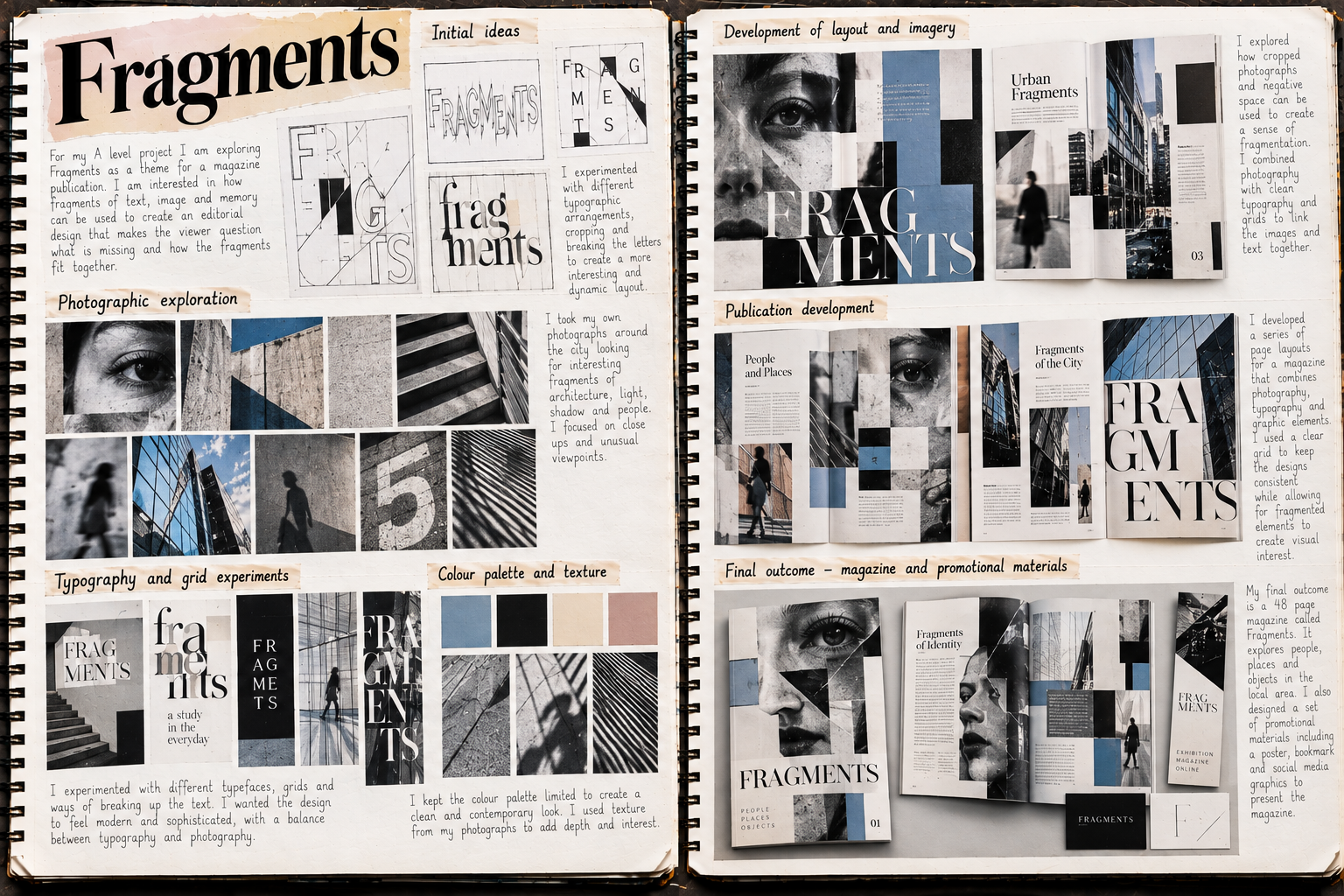
Design an identity and editorial spread for a hypothetical exhibition about repair, memory or urban change. Develop a flexible visual system using modular grids, cropped photography, typographic interruption and a controlled palette. Identify your audience, research relevant graphic design approaches and show how the system works across print and digital formats.
Artists and Makers to Research
Research practitioners whose ideas connect with your chosen direction. Sharon Louise Barnes uses layered materials and abstraction; Shelley Rhodes explores fragmentation and repair through mixed media and textiles; Bouke de Vries transforms damaged ceramics into new sculptural arrangements. Look at their official websites to understand ideas and processes, but develop your own visual language rather than reproducing their compositions. For photography and illustration, choose further practitioners relevant to your own enquiry and verify image permissions before reproducing any artwork.
How Fragments Can Address AO1–AO4
AO1: Investigate artists, photographers or designers and develop your own idea. AO2: Experiment with processes such as tearing, cropping, stitching, layering and sequencing, then refine your choices. AO3: Record your observations, contact sheets, drawings and reflections. AO4: Present a personal and meaningful final outcome that connects to your investigations.
Five Ways to Start Today
1. Collect ten interesting fragments or photograph ten details. 2. Sort them by shape, texture, colour or meaning. 3. Make three quick arrangements. 4. Try two contrasting techniques. 5. Choose one direction and explain what you want your viewer to notice.
GCSE Versus A Level: What Changes?
At GCSE, focus on a clear visual journey: investigate, experiment, record and present. At A Level, narrow the enquiry, sustain it over time, evaluate competing approaches and explain how your decisions support a personal intention. Both levels benefit from primary research and honest annotations about what did not work.
15 Fragments Art Project Ideas to Try
Fragments can be physical, visual or conceptual. Physical fragments include broken tiles, discarded cardboard, scraps of fabric and weathered surfaces. Visual fragments might be cropped photographs, repeated shapes or sections of lettering. Conceptual fragments include memories, incomplete stories and traces of people who are no longer present. Choose a direction that interests you personally, then collect primary research rather than relying only on Pinterest.
Try one of these starting points: torn self-portraits; cracked pavements; fragmented architecture; pieces of handwritten letters; broken reflections in shop windows; leaves and seed pods; recycled packaging; incomplete maps; scraps of local history; worn clothing; shattered patterns; overlapping silhouettes; distorted type; fragmented movement; or a visual diary made from small details of one place. Each could become a GCSE sketchbook project or the basis of a more sustained A Level investigation.
GCSE Art Sketchbook Ideas for the Fragments Theme
A strong GCSE Fragments sketchbook should show more than a collection of attractive images. Begin with photographs or drawings of things you have actually observed. Select details that interest you, enlarge them and investigate their shapes, lines, textures and colours. Place your studies alongside brief notes explaining what you noticed and what you might try next.
Create a page of material experiments using collage, frottage (texture rubbing), monoprinting, paint transfer, torn edges, masking and stitching. Annotate which processes create the most interesting sense of separation or reconstruction. On the next page, combine your two strongest experiments. This visible progression from observation to selection and refinement helps your teacher understand how your ideas developed.
Do not feel that every page must look finished. Quick thumbnail sketches, unsuccessful tests and contact sheets can provide useful evidence when you explain what you learned. The important thing is to show why you changed direction.
Fine Art Techniques: Collage, Assemblage and Mixed Media
Collage is an accessible way to explore fragments because the joins, overlaps and gaps become part of the meaning. Start with your own drawings and photographs, cut or tear them into sections and test different arrangements before gluing anything down. Try a limited colour palette, strong contrast or deliberate areas of empty space.
Assemblage takes this approach into three dimensions. Small discarded objects, packaging or fragments of safe, non-sharp materials can be combined to create a sculpture or relief. Think about weight, balance, scale and the shadows between pieces. Photograph your experiments from several viewpoints to compare their impact.
At A Level, take the investigation further by considering whether your material choices reinforce your concept. Repaired fabric could suggest care or memory; repeated architectural fragments might suggest urban change. Write critically about these connections and test whether your audience understands them.
Fragments Photography Project Ideas and Camera Experiments
Photography students can make the familiar look unfamiliar by changing the frame. Take a series of close-up photographs of one subject, then compare how cropping changes the viewer’s understanding. Investigate reflections, transparent materials, movement and shadow. Use a contact sheet to show how you selected your most effective images.
For a GCSE Photography project, try photographing the same location in ten different ways. Include wide views for context, close-ups for texture, and unusual angles for abstraction. Print your photographs and physically cut and rearrange copies, or combine your own images digitally. Keep the original photographs as evidence of your starting point.
At A Level, build a more coherent photographic investigation. For example, you might explore fragments of a disappearing industrial landscape or partial views of identity through mirrors and windows. Consider sequence, scale, printing surface and presentation. Explain why each image belongs in the series and whether the order changes its meaning.
Graphic Communication: Fragmented Typography and Design Briefs
Graphic Communication students can use fragments as both subject matter and design method. Break letters into geometric shapes, combine different type weights, crop photographs into grids or reconstruct a map from separate pieces. The challenge is to create visual interest without losing communication.
A GCSE brief could ask you to design a poster and ticket for an imaginary exhibition titled Fragments. Begin with audience research and thumbnail layouts, then test typography, imagery and colour. Compare which designs are easiest to read at a distance and which communicate the theme most clearly.
An A Level brief might involve a complete exhibition identity, including a logo system, editorial spreads, social graphics and wayfinding. Develop rules for how the fragments behave across formats. Consider accessibility, legibility and consistency, and justify your design decisions using feedback and comparisons with relevant professional work.
How to Research Artists Without Copying Their Work
Artist research should help you make decisions, not give you a finished composition to imitate. Start by identifying what interests you about a practitioner’s ideas: the use of damaged materials, the tension between parts and wholes, or the way images are layered. Record the source and discuss the approach in your own words.
Then make a response using your own subject matter and a noticeably different visual solution. For example, if you are interested in the idea of repair, investigate stitched paper from your own drawings rather than recreating an artist’s arrangement. If you are drawn to fragmented photographs, experiment with images you have taken yourself.
Where you need to reproduce an artwork for research, check the image’s licence or permission requirements and credit the maker. For a public website, linking to an artist’s official portfolio is usually a safer starting point than copying and republishing their images.
How to Develop a Fragments Project From AO1 to AO4
AO1 – Investigate and develop: Research a small number of relevant artists, photographers or designers. Identify ideas and methods that genuinely connect with your theme. Use this research to shape your own question rather than simply producing artist copies.
AO2 – Experiment and refine: Test several processes such as tearing, folding, masking, sequencing, layering, stitching or digital compositing. Compare outcomes, explain what worked and use those conclusions to develop your next experiment.
AO3 – Record and reflect: Keep primary photographs, observational drawings, contact sheets, thumbnails and brief reflective annotations. Show evidence of looking, selecting and thinking throughout the project, not only at the beginning.
AO4 – Present a personal response: Resolve your strongest idea in a final piece, photographic series or design outcome. Make the connections between your investigation, experiments, recordings and final decisions visible.
These objectives are interconnected. A good Fragments project does not complete AO1, AO2, AO3 and AO4 as four isolated tasks; research, experimentation and recording should inform one another throughout the creative process.
Common Mistakes in GCSE and A Level Fragments Projects
One common mistake is collecting random scraps without a clear idea. A collection can be a useful beginning, but ask what connects the fragments and what you want to communicate. Another mistake is relying on a single technique. Test different approaches and show how you selected the strongest one.
A third mistake is producing a polished final outcome too early. Give yourself time to compare compositions, change scale and review materials. For Photography, avoid presenting only edited final images: contact sheets and selection notes reveal your process. For Graphic Communication, make sure experimental typography still serves the intended audience.
Finally, do not fill sketchbook pages with long copied biographies. A short, thoughtful comparison between a practitioner’s approach and your own experiments is more valuable than pages of unrelated facts.
A Simple Four-Week Fragments Project Plan
Week 1 – Collect and investigate: Choose a focused question, photograph or draw at least ten examples, and research two relevant practitioners. Identify recurring shapes, materials or ideas.
Week 2 – Experiment: Produce quick trials using at least three different techniques. Compare their strengths and weaknesses and select a direction.
Week 3 – Develop: Make larger or more ambitious versions, test alternative compositions and gather feedback. Record why you changed or rejected particular ideas.
Week 4 – Resolve and evaluate: Create your final outcome, photograph or present it clearly, and write a concise evaluation of how your work answers the original question. Adapt the timescale to your teacher’s brief and your qualification.
Frequently Asked Questions
What can I use for a Fragments GCSE art project?
Try torn drawings, packaging, leaves, old tickets, cracked surfaces, fabric scraps or your own photographs. Choose materials that connect to an idea rather than collecting random pieces.
Does Fragments have to involve broken objects?
No. A cropped photograph, partial memory, incomplete sentence or repeated detail can be a fragment too.
How do I make a Fragments project original?
Begin with your own observations and photographs, ask a specific question and test several ways of rearranging the material. Explain why your final decisions matter.
Can I use images found online in my portfolio?
Use online images for clearly credited research where appropriate, but do not assume they are free to republish. For your practical work and public presentations, prefer your own photography, your own artwork or material with suitable permission.
No responses yet