
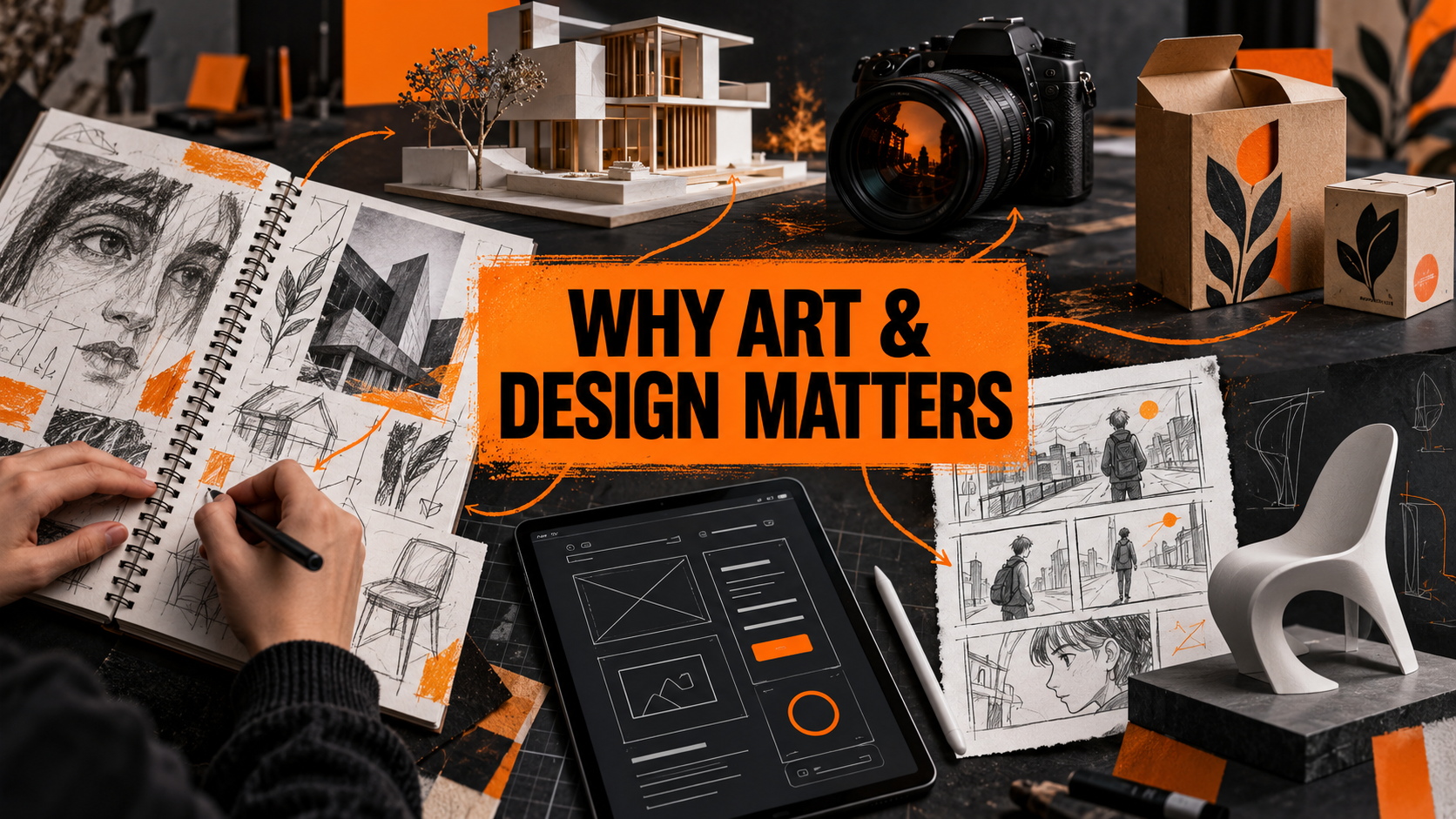
Home > Art Education & Careers > Why Study Art and Design?
Art and Design is not a filler subject, an easy option or simply a way to relax between “serious” lessons. It develops ways of thinking that are increasingly valuable across the UK economy: investigating unfamiliar problems, generating original ideas, making informed decisions, communicating visually and turning a rough concept into a resolved outcome.
That does not mean every Art student will become a fine artist—or that every creative career is automatically secure and highly paid. It means the subject offers far more academic, practical and professional value than its outdated reputation suggests. For students choosing GCSEs, A Levels or future pathways, the better question is not “Is Art useful?” but “What could I learn to do through Art that other subjects do not teach in quite the same way?”
Why study Art and Design? The short answer
- It teaches students to research, question, experiment, select, refine and present—not just to draw.
- It connects naturally with science, mathematics, computing, English, history, geography, business, engineering and psychology.
- It develops visual literacy at a time when images, interfaces, video and data visualisation shape how information is understood.
- It supports routes into design, digital technology, architecture, film, photography, advertising, heritage, product development, games and many other industries.
- It provides visible evidence of transferable skills through a portfolio: ideas, decisions, practical development, resilience and communication.
Enjoyment and rigour are not opposites. A student can find Art absorbing and still be engaged in demanding intellectual, technical and organisational work.

Creative subjects are economically relevant—not a luxury
The UK’s creative industries are not a small cultural extra. A House of Commons Library briefing reports that they contributed approximately £124 billion in gross value added in 2023, around 5% of total UK economic output. Creative UK reports that the cultural and creative industries employed about 2.4 million people between July 2023 and June 2024—just over 7% of the UK workforce.
These figures describe a broad sector. They include film, television, music, museums, architecture, advertising, design, games, publishing and parts of software and digital services; they should not be mistaken for the value of school Art or fine art alone. However, they demonstrate something important: the ability to create, design, communicate and improve experiences is woven into a substantial part of modern economic life.
£124bn
Approximate creative-industries GVA in 2023.
2.4m
People working in the cultural and creative industries, July 2023–June 2024.
The UK Government has identified the creative industries as a priority growth sector. Its 2025 sector plan included a £380 million package and an ambition to increase annual business investment from £17 billion to £31 billion by 2035. The government’s investment information also highlights the potential of Createch—the meeting point of creativity and technology—to add £18 billion in gross value and 160,000 jobs over the following decade. Forecasts are not guarantees, but the direction is clear: creative capability is being treated as part of growth, innovation and regional development.
What students really do in Art and Design
From the outside, an Art lesson can look less structured than a page of calculations or a written test. That is partly because much of the structure sits inside the student’s decisions. A successful portfolio records a sustained process:
- Investigate. Find relevant sources, study artists and designers, observe closely and establish a purposeful line of enquiry.
- Experiment. Test media, processes, compositions and visual possibilities without knowing in advance which solution will work.
- Record. Use drawing, photography, annotation, samples and digital tools to capture observations, ideas and changes.
- Evaluate. Identify strengths and weaknesses, explain decisions, respond to feedback and decide what to develop.
- Refine and realise. Resolve technical problems and bring research, experimentation and personal meaning together in a final response.
This is reflected in the GCSE and A Level assessment objectives. Students develop ideas through research (AO1), refine through experimentation (AO2), record observations and insights (AO3) and present a personal, meaningful response (AO4). In other words, assessment rewards an evidence-based creative process—not decoration or talent in isolation.

How Art and Design connects with other subjects
Creative work rarely stays inside one subject boundary. Artists and designers borrow knowledge, evidence and methods from elsewhere, then translate them into forms people can see, use or experience.
| Subject | Cross-curricular connection | Example in an Art or Design project |
|---|---|---|
| Mathematics | Scale, proportion, geometry, pattern, perspective, measurement and data | Constructing an architectural model; using ratios to enlarge an image; designing repeat patterns |
| Science | Light, colour, materials, anatomy, ecology, chemical and physical change | Photography experiments; botanical drawing; testing sustainable materials or ceramic glazes |
| Computing | Digital imaging, user interfaces, animation, 3D modelling, creative coding and AI literacy | Prototyping an app; building an animation; preparing assets for a game environment |
| English | Interpretation, narrative, symbolism, persuasion, audience and critical writing | Creating a visual narrative; analysing an artist’s intentions; designing a campaign |
| History | Context, primary sources, changing beliefs, power and representation | Examining propaganda; responding to archives; studying art as evidence of social change |
| Geography | Place, identity, migration, cities, landscape, climate and sustainability | Documentary photography; public-space design; artwork responding to environmental change |
| Business | Branding, audiences, markets, intellectual property, budgets and pitching | Developing packaging and brand identity for a defined customer |
| Engineering and DT | Function, materials, prototyping, testing, ergonomics and manufacture | Designing a product, wearable structure, exhibition display or spatial installation |
| Psychology | Perception, emotion, behaviour, identity and user needs | Designing an accessible interface or testing how visual choices affect an audience |
These are not superficial links. A designer cannot create an accessible product without considering bodies and behaviour. An animator needs timing, movement and narrative. An architect combines cultural context, environmental performance, geometry and human experience. A medical illustrator needs scientific accuracy as well as visual clarity. Art and Design often acts as the place where knowledge becomes tangible.
The transferable skills behind a strong portfolio
A grade matters, but a portfolio can reveal capabilities that are difficult to show in an exam paper. It gives future teachers, universities, apprenticeships and employers evidence of how a student works.
- Independent enquiry: framing a question, finding reliable sources and deciding which information is relevant.
- Problem-solving: generating several responses when the first solution is weak or technically impossible.
- Visual literacy: reading and creating images with an awareness of composition, hierarchy, symbolism and audience.
- Critical judgement: comparing options and supporting choices with evidence rather than personal preference alone.
- Resilience: treating an unsuccessful experiment as useful information, then adapting.
- Project management: breaking a long brief into stages, balancing ambition with time and meeting a deadline.
- Communication: explaining complex ideas through images, objects, annotation and presentation.
- Technical adaptability: learning unfamiliar materials, cameras, software, fabrication processes or display methods.
- Receiving feedback: listening, evaluating advice and retaining ownership of the work while making improvements.
These skills are valuable within creative work, but they are not confined to it. They support entrepreneurship, research, communication, product development, education, marketing, engineering and any role in which a person must make sense of ambiguity and produce a useful response.
What careers can Art and Design lead to?
“Artist” is only one possible destination. Many creative professionals work inside organisations whose main purpose is technology, healthcare, retail, construction, science, education or public service. Job titles also change quickly, so it is often more helpful to explore career families.
Visual communication and commercial design
Graphic designer, brand designer, illustrator, art director, packaging designer, advertising creative, information designer, editorial designer and motion designer. These roles translate ideas into clear visual systems for particular audiences.
Digital products, games and interactive media
UX or UI designer, digital product designer, game artist, concept artist, animator, 3D artist, virtual-production artist and creative technologist. These careers combine visual judgement with user needs, storytelling and technology.
The built environment and physical products
Architect, interior or spatial designer, product designer, furniture designer, exhibition designer, theatre designer, landscape designer and model maker. The work must balance appearance with function, materials, safety, cost and sustainability.
Film, photography and media
Photographer, cinematographer, editor, storyboard artist, production designer, costume designer, set decorator, colourist and content producer. Students interested in this direction can start with the GCSE Photography guide or A Level Photography guide.
Fashion, textiles and material innovation
Fashion designer, textile designer, surface-pattern designer, costume maker, stylist, footwear designer and sustainable-materials researcher. These roles can involve drawing and aesthetics, but also technical construction, sourcing, trend research and responsible production.
Culture, heritage, science and public life
Curator, conservator, museum learning officer, exhibition producer, arts therapist (with the required specialist training), medical or scientific illustrator, archaeological illustrator, forensic artist and public-engagement designer. Here, visual skills support preservation, explanation, wellbeing or access to knowledge.

No single qualification guarantees entry into these roles. Some require a degree or accredited training; others are accessible through college, apprenticeships, specialist courses, entry-level employment or a strong portfolio. Students should investigate current routes, course costs, working conditions and regional opportunities rather than relying on a list of exciting job titles.
Art, technology and AI: becoming more connected, not less
New technology does not remove the need for creative judgement. It changes where that judgement is applied. Someone still has to define the problem, understand the audience, recognise weak or misleading output, make ethical decisions, combine references responsibly and direct the work towards a coherent result.
AI tools can produce images quickly, but speed is not the same as meaning. Students need to understand copyright, bias, attribution, privacy and the difference between generating an attractive surface and developing an authentic personal response. Their strongest evidence will still include first-hand observation, purposeful research, material or digital experimentation, editing, reflection and decisions they can explain. Read more in Can I Use AI Image Generation in GCSE or A Level Art?
The growing field often called Createch combines creative ideas with technologies such as immersive media, real-time production, games engines, interactive experiences, virtual or augmented reality and advanced digital design. Students who combine visual sensitivity with computing, science, engineering or business knowledge may be particularly well placed to contribute.
Is GCSE Art useful if you do not want to become an artist?
Yes—provided the student understands the workload and engages with the process. GCSE Art can be useful for someone interested in architecture, engineering, media, marketing, psychology, environmental design, teaching, technology or entrepreneurship. It can also offer balance in a timetable dominated by written subjects while still demanding analysis, planning and sustained effort.
However, it should not be chosen because it is assumed to be easy. Coursework develops over many weeks; deadlines accumulate; refinement takes time; and the strongest results usually come from regular, independent work. A student who dislikes practical experimentation, maintaining a portfolio or revisiting ideas may find another subject a better fit. Honest subject choice is more helpful than either dismissing Art or overselling it.
What parents and carers should look for
A productive conversation about Art should move beyond “Are you good at drawing?” Try asking:
- Does the student enjoy investigating ideas and making things, even when the outcome is uncertain?
- Can they work steadily over time rather than relying on a final burst?
- Are they curious about people, places, objects, images or social questions?
- Do they respond constructively when a teacher suggests changes?
- Which combination of practical, digital, written and academic subjects keeps future routes open?
Parents can help by valuing process as well as the final piece, providing a workable routine, visiting galleries or public spaces where possible, discussing advertising and visual media critically, and encouraging students to document development. Expensive materials are not a substitute for good thinking. Many strong projects grow from ordinary materials, first-hand photography and sustained observation.
Choosing the right Art and Design pathway
“Art” is not one narrow course. Depending on the school or college, students may be able to choose Fine Art, Photography, Graphic Communication, Textile Design, Three-Dimensional Design or another endorsed title. The best match depends on how a student likes to investigate and communicate.
- GCSE Fine Art may suit students interested in drawing, painting, printmaking, sculpture, installation or mixed media.
- GCSE Photography explores image-making, observation, editing, sequencing and communication through photographic media.
- GCSE Graphic Communication suits students drawn to typography, branding, illustration, advertising, packaging and digital design.
- The corresponding A Level routes allow a more sustained, independent and conceptually developed body of work.
Course titles and requirements vary, so students should read their own school or college specification, look at real portfolio examples, speak to the subject teacher and consider how the course is taught locally.
Frequently asked questions
Is GCSE Art a soft or easy subject?
No. GCSE Art is assessed through sustained portfolio evidence and usually requires regular independent work. It develops different kinds of knowledge from an entirely written subject, but different does not mean less rigorous. Research, experimentation, recording, critical decisions, technical control and personal resolution all need to be evidenced.
Do creative careers pay well?
Some do, but earnings vary considerably by role, experience, location, sector and employment type. Creative work can include salaried, freelance, contract and self-employed routes. Students should compare current job advertisements, training requirements, progression and working conditions for the careers that interest them. Art and Design can open possibilities; it does not guarantee a particular salary.
Does AI make Art and Design careers pointless?
No, but it is changing tasks and expectations. Routine production may be automated or accelerated, while human strengths such as problem definition, taste, cultural understanding, ethics, editing, art direction and communication become more important. Students should learn to use new tools critically and transparently while continuing to build first-hand, technical and conceptual skills.
Which subjects combine well with Art and Design?
Almost any subject can form a useful combination. Mathematics and Physics support architecture and spatial design; Computing supports UX, games and animation; English and History support narrative, interpretation and context; Biology supports medical or scientific illustration; Business supports branding and entrepreneurship. The right combination depends on the student’s strengths and possible next steps.
Do you need to be naturally talented at drawing?
No. Drawing is useful in many courses, but it is a learnable way of observing, testing and communicating—not a fixed gift. Photography, sculpture, installation, textiles, digital media, film and graphic communication also require different strengths. Progress, curiosity, practice and thoughtful development matter more than arriving with a polished style.
Can Art lead to university or an apprenticeship?
Yes. Routes include foundation diplomas, university degrees, specialist colleges, higher technical qualifications and apprenticeships in areas such as content creation, design, museums, digital production and the screen industries. Entry requirements differ, and many courses consider a portfolio as well as grades.
What if a student is interested in design rather than fine art?
That is a strong reason to investigate the available endorsed course titles. Graphic Communication, Photography, Textile Design and Three-Dimensional Design may align more directly with particular interests. Fine Art can still develop relevant research, visual and portfolio skills, but students should understand the content offered by their own centre.
Is Art useful for a student who prefers STEM?
It can be extremely useful. STEM ideas need people who can visualise systems, design usable products, model possibilities and communicate complex information. Art and Design can strengthen observation, spatial thinking, visual communication and human-centred problem-solving alongside technical knowledge.
The real value of a creative subject
Art and Design should not have to pretend to be Mathematics or Science in order to deserve respect. Its value lies partly in what is distinctive: students learn to work with uncertainty, connect research to personal experience, test ideas in visible form and make judgements for which there may be several possible answers.
That combination of imagination and discipline is relevant to a large creative economy, to careers across many other sectors and to life in a culture saturated with images and designed experiences. Not every student should choose Art. But no student should reject it because they have been told it is merely a filler.
Ready to explore the subject properly?
Start with the GCSE Art Help hub, browse the free GCSE and A Level Art resources, or get personalised guidance on the evidence visible in a current portfolio.
Sources and further reading
- House of Commons Library: Contribution of the arts to society and the economy
- Creative UK: Cultural and creative industries statistics
- UK Government: Creative Industries Sector Plan funding and investment ambitions
- Department for Business and Trade: Invest in UK creative industries
- Design Council: The Design Economy
Economic figures are dated because datasets use different reporting periods and definitions. They should be reviewed when this article is updated.
No responses yet