
Harvard Bibliography for A Level Art: A Student Guide
You have written the final paragraph of your A Level Art personal study, checked your spelling and placed your images carefully. Then you remember the bibliography.
It is tempting to treat it as a rushed list of books and websites added just before the deadline. That is a mistake. A well-constructed Harvard bibliography for A Level Art shows that your research is genuine, your sources can be traced and you understand how other people’s ideas and images have informed your own work.
The good news is that a bibliography is not difficult when you collect the right details as you work. This guide explains the conventions, gives you templates for the sources Art & Design students commonly use and shows you how to carry out a final check.
The principle is simple
Every borrowed word, idea, fact or image must lead your reader to a complete source entry. Think of the citation in your writing as a label and the bibliography as the full address.
Why Does an A Level Art Bibliography Matter?
Your written component is part of a larger investigation. It should show how contextual research has helped you question, test, develop and refine your own visual ideas. The bibliography provides evidence of the research behind that thinking.
For example, the AQA A Level Art & Design specification requires the written material for the Personal Investigation to include a bibliography identifying contextual references drawn from sources such as books, journals, websites and first-hand study during museum, gallery, site or residency visits.
- It acknowledges the people whose ideas, words and images you have used.
- It helps protect you from accidental plagiarism.
- It allows your teacher, moderator or reader to locate your evidence.
- It demonstrates the range and relevance of your research.
- It makes your study look organised, credible and academically mature.
Always follow the precise instructions given by your teacher or centre. “Harvard” is a family of closely related author–date systems, so punctuation and presentation can vary slightly between institutions. The most important rule is to use one approved version consistently.
Harvard Referencing Is a Two-Part System
1. A short citation appears in your writing
The citation normally gives the author or organisation and the year:
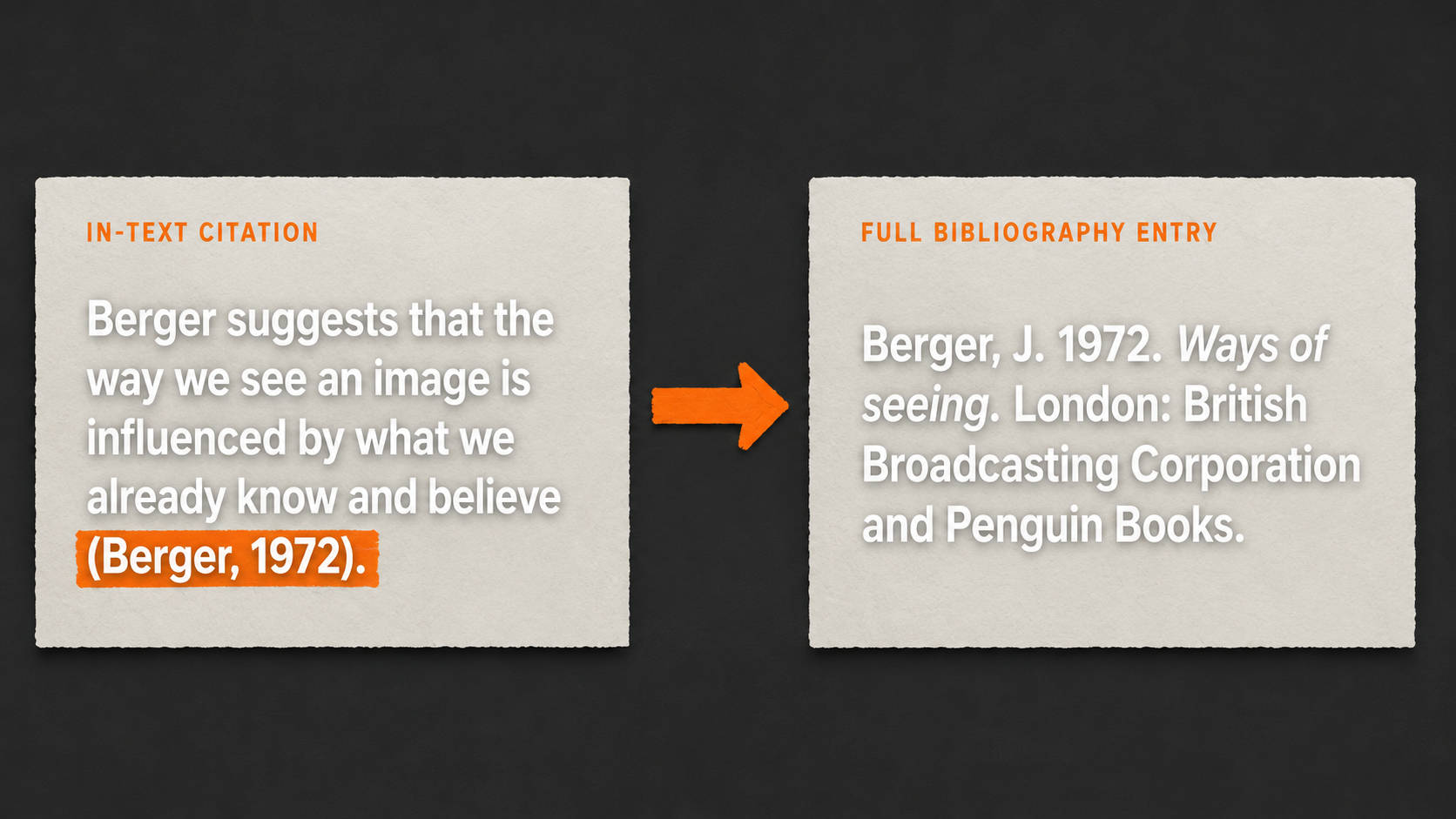
Berger (1972) argues that looking is shaped by what we know and believe.
Ideas about looking are influenced by knowledge and belief (Berger, 1972).
If you use an exact quotation, add the page number:
“Short quotation from the source” (Author, year, p.24).
Use p. for one page and pp. for a range, such as pp.24–27. Page numbers are also useful when you discuss a particular image, diagram or specific passage from a book.
2. A full entry appears at the end
The complete entry supplies enough information for someone else to find the source:
Berger, J. 1972. Ways of seeing. London: British Broadcasting Corporation and Penguin Books.
The name and date in the short citation must match the beginning of the full entry. If your text says (Berger, 1972), your bibliography must contain an entry beginning Berger, J. 1972.
Quick test: Highlight every citation in your written study. Tick it when you find the matching full entry. Then work through the bibliography and confirm that every cited entry appears somewhere in your writing or was genuinely consulted, depending on your centre’s instructions.
Reference List or Bibliography?
The two terms are often used as though they mean the same thing, but there is a useful distinction:
| Reference list | Bibliography |
|---|---|
| Includes only sources quoted, paraphrased, summarised or directly referred to in the work. | Includes the cited sources and other relevant material genuinely consulted during the investigation. |
| Every entry should connect to an in-text citation. | May also contain useful background reading that influenced your understanding without being mentioned directly. |
If your exam-board specification or teacher asks for a bibliography, use that heading and ask whether they want all consulted sources or only cited sources. Do not silently assume.
The Conventions You Must Follow
Put entries in alphabetical order
Arrange the list by the surname of the first author. If no named author is given, use the organisation responsible for the material, such as Tate, the National Gallery or the Victoria and Albert Museum. Do not divide the main list into separate “books” and “websites” sections unless your teacher specifically requires this.
Write names in a consistent form
Harvard entries normally begin with the author’s surname followed by initials:
Berger, J.
Hockney, D. and Gayford, M.
If an organisation created the page and no individual writer is identified, the organisation becomes the author. Do not write “Google” as the source: Google is usually how you found the page, not who created it.
Give the correct year
For a book, use the publication year of the edition you actually read. For a webpage, use the year it was published or last meaningfully updated. If no date is shown, use the wording required by your chosen Harvard guide—often no date or n.d.—and apply it consistently.
Use italics consistently
Book titles, journal titles, exhibition catalogue titles and titles of complete works are normally italicised. Article titles and webpage titles are usually not italicised in the version of Harvard used in this guide. Follow your centre’s chosen model.
Include an access date for online material
Web content can change or disappear. Record the day on which you viewed it:
[Accessed 28 July 2026].
Copy the direct address of the exact page, image or video—not a search-results page and not merely the website homepage.
Separate works from the same year
If the same author or organisation has two sources from the same year, add lower-case letters to both the citations and bibliography entries:
(Tate, 2025a) and (Tate, 2025b)
Keep the presentation tidy
- Start the bibliography on a new page or clearly separated final section.
- Use the heading Bibliography unless your centre requests another term.
- Use the same readable font and text size throughout.
- Keep line spacing and the spacing between entries consistent.
- Do not number or bullet the final entries unless instructed to do so.
- A hanging indent can make long entries easier to scan, but consistency matters more than decoration.
Build Your Bibliography While You Research
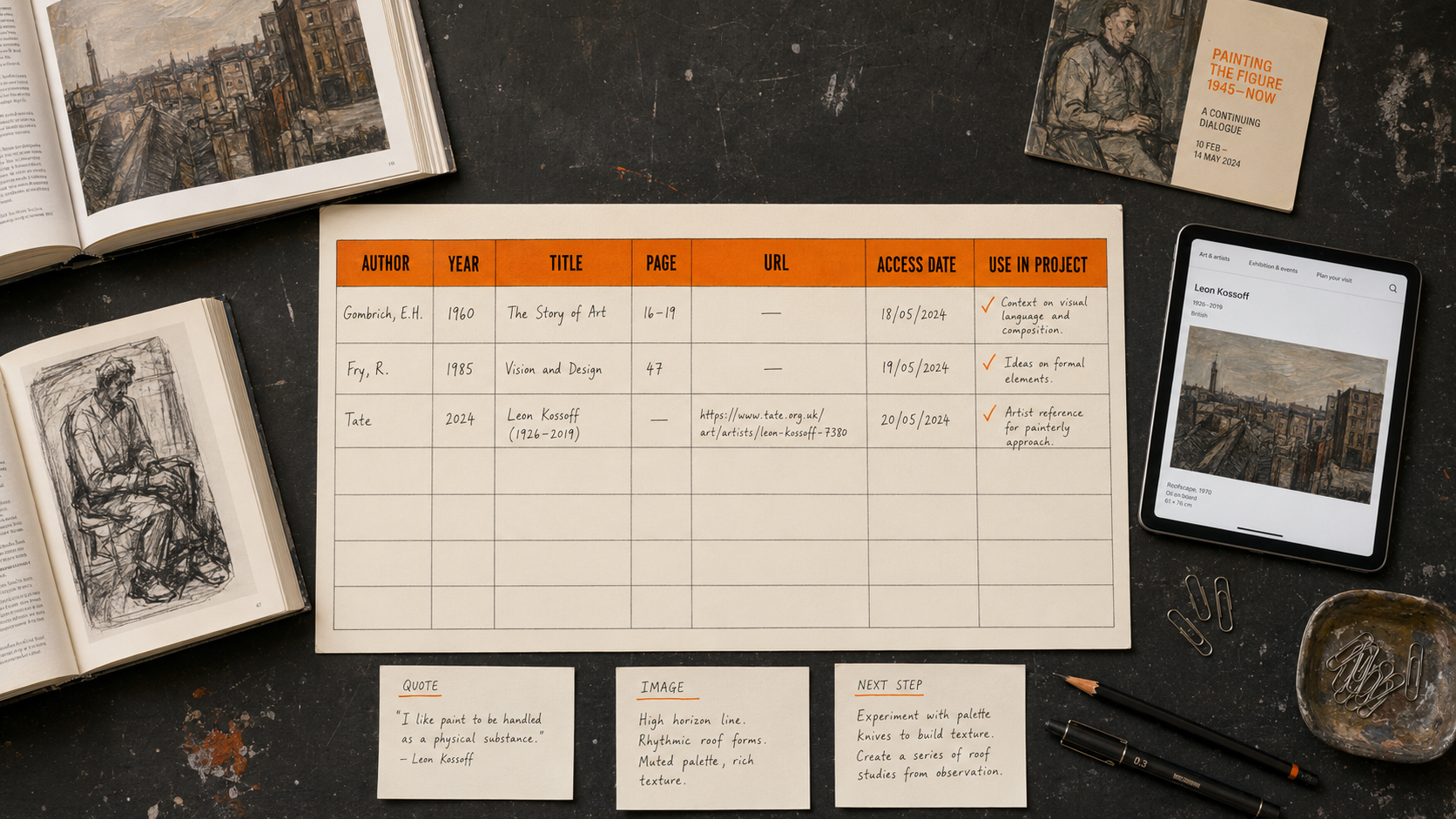
The safest bibliography is not assembled from memory at the end. Create a source log as soon as you begin the written component. A spreadsheet, table in a document or dedicated research page in your sketchbook will work.
| Record this | Why you need it |
|---|---|
| Author, artist or organisation | Forms the first part of the citation and entry. |
| Publication or creation year | Completes the author–date citation. |
| Exact title | Identifies the specific book, page, article, artwork or video. |
| Source type | Tells you which Harvard template to use. |
| Publisher, journal, gallery or museum | Shows where the source was published or where the work is held. |
| Edition, volume, issue and page numbers | Helps the reader locate precise material. |
| DOI or direct URL | Locates an online source. |
| Date accessed | Records when you viewed online material. |
| How you used it | Links the research to your argument and practical development. |
| Citation added? | Prevents sources from being lost between notes and the final study. |
Best habit: Photograph the book’s title page and publication-details page, and record the page number beside every quotation or useful idea in your notes. For websites, save the direct link and access date immediately. For a gallery visit, photograph the wall label where permitted or make an accurate written record.
Harvard Templates for A Level Art Sources
The following models use a clear version of the Harvard system. Replace the bracketed information with the exact details from your own source. If your school’s guide uses slightly different punctuation or places the year in brackets, follow that guide throughout.
Book
Template: Author surname, INITIAL(S). Year. Title of book. Edition if not the first. Place of publication: Publisher.
Example: Berger, J. 1972. Ways of seeing. London: British Broadcasting Corporation and Penguin Books.
Chapter in an Edited Book
Template: Chapter author surname, INITIAL(S). Year. Title of chapter. In: Editor surname, INITIAL(S). ed. Title of book. Place: Publisher, pp.xx–xx.
Webpage or Museum Page
Template: Author or organisation. Year or no date. Title of page. [Online]. [Accessed day month year]. Available from: direct URL
In-text citation: (Organisation, year) or (Organisation, no date)
Online Journal Article
Template: Author surname, INITIAL(S). Year. Title of article. Full Journal Title. [Online]. Volume(issue), pp.xx–xx. [Accessed day month year]. Available from: DOI, or URL if no DOI is available.
Artwork Viewed in a Gallery or Museum
Template: Artist surname, INITIAL(S). Year. Title of work. [Material or medium]. At: Town or city: Gallery or museum, collection or identifier if available.
Example: Van Gogh, V. 1888. Sunflowers. [Oil on canvas]. At: London: National Gallery.
If you use information from the wall label rather than simply studying the work, identify it as a gallery label according to your centre’s chosen Harvard guide.
Artwork or Image Viewed Online
Template: Artist or image-maker surname, INITIAL(S). Year. Title of work or image. [Online image or material type]. [Accessed day month year]. Available from: direct URL
Place a brief citation in the image caption as well as a full entry at the end. If the image was reproduced in a book, reference the book and include the page number. Your own photographs and artwork normally do not need bibliography entries, although labels such as Photograph by the student can make authorship unmistakable.
Exhibition Catalogue
Template: Author or editor surname, INITIAL(S). Year. Title of exhibition, venue, exhibition dates. [Exhibition catalogue]. Place: Publisher.
Online Video, Documentary Clip or Artist Interview
Template: Creator, organisation or channel name. Year. Title of video. [Online video]. [Accessed day month year]. Available from: direct URL
For a precise spoken point: add a timestamp to the in-text citation, for example (Creator, year, 04:32).
Personal Interview or Email
Template: Interviewee surname, INITIAL(S). Year. Interviewed by your name. [Interview or email]. Place if relevant, day month.
Ask permission before quoting a private conversation, interview or email. Your teacher may require personal communications to be cited in the text but not placed in the bibliography, so check the centre’s rule.
AI Tool or AI-Generated Image
First ask your teacher whether AI use is permitted for this assessment. If it is allowed, current JCQ guidance requires you to acknowledge the tool, explain how it was used, retain the prompt and output in a non-editable form such as screenshots, and independently verify and reference factual sources. You cannot gain credit for material that the AI produced in place of your own assessed work.
Basic acknowledgement model: Tool and version. URL. Date the content was generated. Brief explanation of what was generated and how it was used.
For an AI image: Company and software name. Year. AI-generated image of [description]. [Online]. [Accessed day month year]. Available from: share link or tool homepage.
A Harvard entry alone may not satisfy the assessment rules for AI use. Follow your teacher’s instructions and the current JCQ requirements exactly.
How to Cite Images Inside Your Written Study
Art students use more images than students in many other subjects, so image referencing deserves special attention. Number each reproduced image and provide a concise caption:
Figure 3. Artist, Title of work, year, medium (Artist, year).
If you copied the image from a book, add the page number to the citation. If you found it online, include the complete online-image or webpage entry in the bibliography. A caption does not replace the full bibliography entry.
- Cite the original artist or maker whenever that information is available.
- Record where you found the reproduction.
- Use the direct museum or gallery collection page where possible.
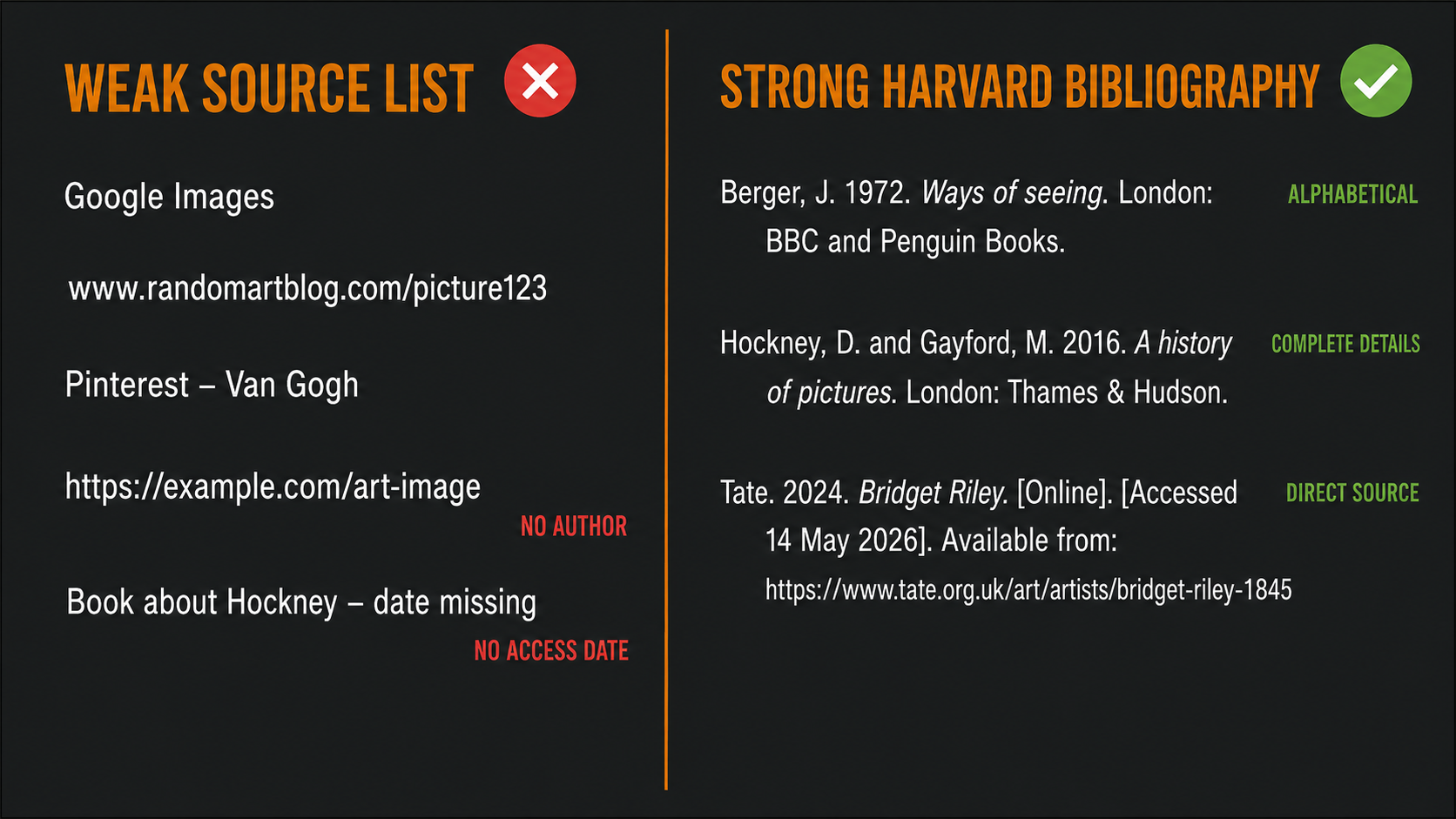
- Do not cite Pinterest, Google Images or a search engine when they merely led you to the original source.
- If no title is available, use a short factual description in square brackets.
- If you have adapted another person’s image, make this clear in the caption.
What a Well-Organised Bibliography Looks Like
Imagine that your research includes books by John Berger and David Hockney, a National Gallery collection page, a Tate artist page and an exhibition catalogue. The final list should be one continuous alphabetical sequence:
Bibliography
Berger, J. 1972. Ways of seeing. London: British Broadcasting Corporation and Penguin Books.
Hockney, D. and Gayford, M. 2016. A history of pictures: from the cave to the computer screen. London: Thames & Hudson.
National Gallery. Year or no date. Exact title of collection page. [Online]. [Accessed day month year]. Available from: direct URL
Tate. Year or no date. Exact title of artist or artwork page. [Online]. [Accessed day month year]. Available from: direct URL
Writer or editor surname, INITIAL(S). Year. Exhibition title, venue, exhibition dates. [Exhibition catalogue]. Place: Publisher.
The last three entries are deliberately shown as models rather than invented references. Your final bibliography must contain the exact titles, dates and links from the sources you actually used.
Common Bibliography Mistakes
| Mistake | Better approach |
|---|---|
| Listing “Google” or “Google Images” | Trace the material to the original book, article, artist, museum or webpage. |
| Pasting a list of unexplained URLs | Give author or organisation, date, title, online status, access date and direct URL. |
| Adding a bibliography but no citations | Place author–date citations beside borrowed ideas, facts, quotations and images. |
| Citing a quotation without a page number | Add the precise page, or a timestamp for spoken material where appropriate. |
| Mixing several Harvard variants | Choose the version required by your centre and use it consistently. |
| Inventing missing information | Use the approved convention for no author, no date or no title. |
| Trusting a citation generator without checking | Compare every generated entry with your school’s guide and the original source. |
| Forgetting images | Reference reproduced artworks, photographs, diagrams and AI-generated imagery. |
| Building the list on deadline day | Maintain a source log throughout the project. |
Can You Use a Citation Generator?
A citation generator can save time, but it cannot decide whether the information it collected is correct. It may mistake the website name for the author, use the copyright year instead of the publication year, capitalise titles incorrectly or omit an exhibition venue.
Use a generator as a drafting tool, not as an authority. Check the result against:
- The original source.
- Your centre’s Harvard referencing guide.
- The other entries in your bibliography for consistency.
The Ten-Minute Bibliography Audit
- Have I used the heading my teacher requested?
- Are all entries arranged alphabetically by author surname or organisation?
- Does every quotation, paraphrase, factual claim and borrowed image have a citation?
- Does every in-text citation lead to a matching full entry?
- Have I included the page number for every direct quotation?
- Have I recorded the exact page title rather than only the name of the website?
- Do all online sources have direct links and access dates?
- Have I referenced artworks, photographs, videos and exhibition material as well as written sources?
- Have I used 2026a and 2026b where the same author has two sources from the same year?
- Have I checked names, dates, titles, italics, punctuation and spacing?
- Have I removed sources that I did not genuinely consult?
- Have I followed current centre and JCQ instructions for any permitted AI use?
The best way to make sure you include everything
Do not separate researching from referencing. The moment you decide that a source may be useful, capture its full details. Add the citation when you add the idea or image. At the end, carry out the two-way check: writing to bibliography, then bibliography back to writing.
Frequently Asked Questions
How many sources should an A Level Art bibliography contain?
There is no magic number. A shorter list of relevant, varied and genuinely used sources is stronger than a long list added to look impressive. Aim for an appropriate mixture of first-hand and published sources that supports the focus of your investigation.
Do I need to cite a source if I rewrite it in my own words?
Yes. Paraphrasing changes the wording, not the ownership of the idea. Add an author–date citation after the paraphrased point.
Should Wikipedia appear in my bibliography?
It can help you gain an initial overview or locate stronger sources, but it is rarely the best evidence for a focused personal study. Follow its references to museum collections, books, journals and reputable organisations, then read and cite those original sources.
What if a webpage has no named author?
Use the organisation responsible for the page as the corporate author. If neither a person nor an organisation can be identified, follow your centre’s rule for a source with no author; this may mean beginning with the title.
Do my own photographs need bibliography entries?
Usually not, because your own work is assumed to be yours. However, clear captions such as “Photograph by the student, 2026” can help distinguish your primary research from sourced imagery. Follow your teacher’s presentation instructions.
Does the bibliography count towards the written-component word count?
Bibliographies are normally treated separately from continuous prose, but word-count rules vary between specifications and centres. Ask your teacher and follow the instructions for your particular exam board.
Reliable Referencing Help
Use your school or college guide first. These external sources provide further guidance and examples:
- AQA A Level Art & Design specification
- University of Leeds: Harvard referencing introduction
- University of Leeds: Harvard reference examples
- University of Sheffield: Harvard referencing guide
- JCQ: AI use in assessments
For more help with organising the practical and written parts of your course, visit the A Level Art Hub.
Would Detailed Feedback Help?
Portfolio to A Star offers expert A Level Art & Design portfolio feedback. Your review identifies what is working, where evidence is missing and the most useful next steps for strengthening your practical and written work.

No responses yet