
When you request a GCSE or A Level Art & Design portfolio review from Portfolio to A Star, you receive more than a general opinion or an estimated grade. Your feedback report is designed to show where your work is now, what is already working, what is limiting your progress and what you should do next.
The feedback proforma examines the evidence visible in your sketchbook, portfolio or project and organises the advice around the four Assessment Objectives: AO1, AO2, AO3 and AO4. It then turns that detailed feedback into a manageable improvement plan.



The report has one main purpose
It helps you replace uncertainty with a clear sequence of actions.
Instead of wondering whether you need more research, more experiments, better annotation or a stronger final outcome, you receive specific advice about the evidence that is missing or underdeveloped.
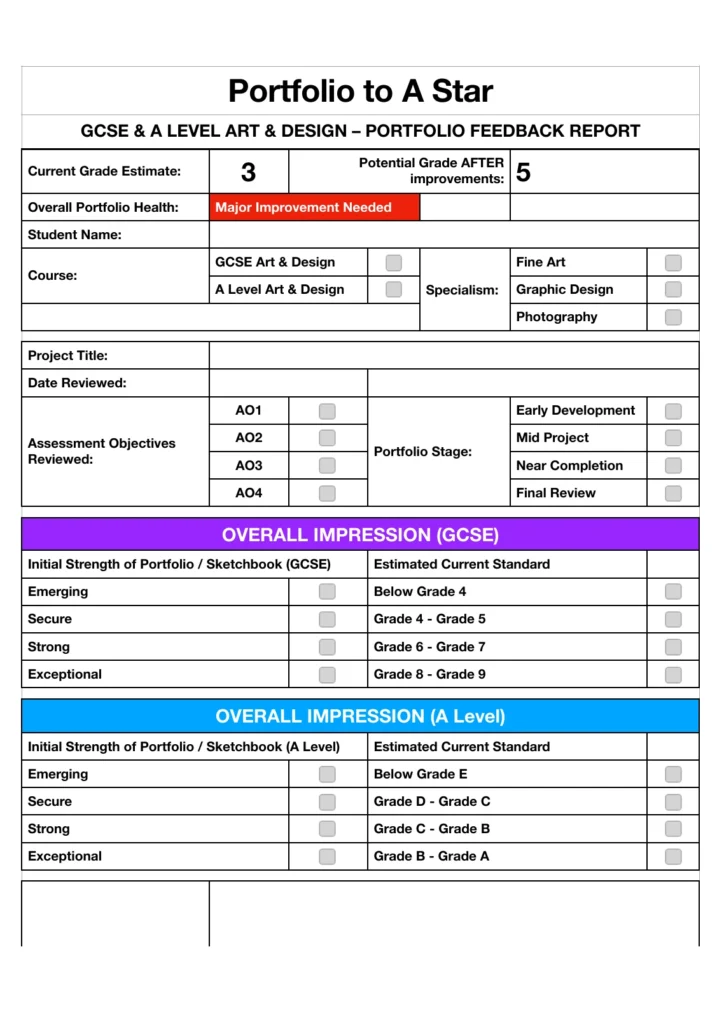
1. Your course, specialism and project details
The opening section identifies the student, course, specialism, project title and date of review. It also records whether the work is GCSE or A Level and whether the submission is Fine Art, Photography or Graphic Communication.
This information matters because successful evidence can look different in each specialism. A Fine Art student may demonstrate development through drawing, painting, printmaking or mixed media. A Photography student may use contact sheets, technical tests, reshoots and editing comparisons. A Graphic Communication student may show thumbnails, typography tests, layout variations, original imagery and design refinements.
The report also records the project title so that every recommendation can be judged against the student’s actual theme, intentions and visual direction.
2. Assessment Objectives reviewed
This section shows whether the review covers AO1, AO2, AO3, AO4 or a selected combination of objectives. It confirms the precise scope of the feedback package and helps you see which areas have been examined in detail.
If you have requested feedback on only one or two Assessment Objectives, the report keeps the advice focused on those areas. If all four are reviewed, you receive a more complete picture of how investigation, experimentation, recording and final outcomes work together across the project.
3. Portfolio stage
Your reviewer records whether the portfolio is in early development, mid-project, near completion or at final review. This prevents the feedback from expecting the wrong kind of evidence at the wrong time.
| Portfolio stage | How the feedback helps |
|---|---|
| Early development | Helps you establish worthwhile sources, first-hand research and promising directions before committing too early to one idea. |
| Mid-project | Identifies where investigation or experimentation needs extending and which possibilities deserve further development. |
| Near completion | Finds gaps, weak connections or unresolved decisions while there is still time to improve them. |
| Final review | Prioritises the most achievable changes before submission and checks whether the final response is supported by the preceding journey. |
4. Current grade estimate
The current grade estimate is a snapshot of the standard demonstrated by the work submitted for review. It is based on the evidence that can actually be seen—not on effort, good intentions or work that the student plans to complete later.
This estimate helps you understand your present position. If it is lower than expected, the detailed sections of the report will explain why. It may be that ideas have not developed far enough, experiments are disconnected, first-hand recording is limited or the final response is not yet supported by the project.
Important: The grade estimate is independent, advisory feedback. It is not an official examination-board mark, a guaranteed result or a replacement for your teacher’s assessment.
5. Potential grade after improvements
This section shows the standard that may become realistic if the recommended improvements are completed successfully. It is intended to show that the present grade is not fixed and that carefully chosen changes can make a meaningful difference.
The potential grade is not awarded simply for completing a checklist. The quality, relevance and independence of the new work still matter. However, it helps you see why the priority actions are worth completing and gives you a sensible improvement target.
6. Overall portfolio health
“Overall Portfolio Health” gives you a quick, plain-language judgement about the condition of the portfolio. It indicates whether the project is developing securely or whether important weaknesses need urgent attention.
This is useful because two portfolios with a similar estimated grade may need very different advice. One might be progressing steadily but require refinement. Another may have attractive pages but lack the connected development needed to support the Assessment Objectives.
7. Overall impression and estimated current standard
The report includes separate overall-impression scales for GCSE and A Level. The portfolio is considered in broad terms such as emerging, secure, strong or exceptional and then related to an estimated grade band.
This gives context to the numerical estimate. It helps distinguish between work that is only beginning to demonstrate the required skills and work that is confident, sustained, personal and increasingly independent.
The scale is not intended to label the student. It describes the evidence currently visible in the submitted portfolio. That evidence can change as the student investigates, experiments, records, evaluates and refines more effectively.
8. Examiner-style summary
The examiner-style summary gives you the big picture before the report moves into AO1-AO4. It explains the most important overall qualities of the portfolio, identifies recurring weaknesses and describes the main reason the work currently sits within its estimated band.
This section is especially helpful for parents and students who may find the Assessment Objectives confusing. It translates the detailed analysis into a concise explanation of what the portfolio communicates as a whole.
9. How each Assessment Objective section works
Each AO section follows a consistent structure. Once you understand it, you can quickly locate the information you need.
| Report section | What it means | How it helps you improve |
|---|---|---|
| Current Strength | A quick visual indication of how convincingly the submitted work currently addresses that Assessment Objective. | Shows whether this AO is relatively secure or needs to become a priority. It is a report indicator rather than an official exam-board mark. |
| Biggest Strength | The most successful feature within that AO. | Identifies something worth protecting, repeating or developing further rather than changing everything indiscriminately. |
| What is working well? | Specific positive evidence found in the portfolio. | Helps you understand why particular pages or approaches are effective so you can apply the same thinking elsewhere. |
| Areas for improvement | The clearest weaknesses, omissions or underdeveloped evidence. | Replaces vague advice such as “do more” with a focused explanation of what needs strengthening. |
| Next Practical Action, Recommended Experiments or Suggested Evidence | A selection of appropriate tasks connected to that AO. | Turns the diagnosis into something you can actually make, photograph, test, annotate or refine. |
| Notes | Personalised observations about the submitted work. | Explains how the general assessment requirements apply to your particular project, theme and specialism. |
| Examiner Tip | A concise assessment-focused insight. | Highlights a common misunderstanding or a change that may make your evidence clearer to a moderator. |
| What would a Grade 9 student do? | An example of the greater depth, independence or refinement associated with the highest GCSE standard. | Shows what progression beyond the current response could look like. For A Level students, read this as the kind of thinking expected from a confident top-grade student. |
10. AO1 feedback: investigation and developing ideas
AO1 considers how your ideas grow through investigation and how well you understand the sources that influence your work. Sources might include artists, designers, photographers, architecture, places, objects, cultures, first-hand experiences or other relevant visual material.
The report may recommend researching an additional source, extending an investigation, recording decisions more clearly or developing a more personal response. These actions help prevent artist research from becoming an isolated biography page. The aim is to show how investigation changes your own visual choices.
- Research an additional source: adds a new influence, contrast or perspective rather than repeating the same information.
- Record and annotate your decisions: makes the connection between research and your own development visible.
- Develop your personal response further: moves the project away from imitation and towards your own intentions.
- Extend your investigations: encourages greater depth instead of stopping after the first obvious idea.
Strong AO1 evidence answers the question: How did this investigation help my own idea become more thoughtful, focused or personal?
11. AO2 feedback: experimentation, selection and refinement
AO2 examines how purposefully you explore media, materials, techniques and processes. It is not about filling pages with unrelated experiments. Examiners want to see that you compare possibilities, learn from results, select intelligently and refine your intentions.
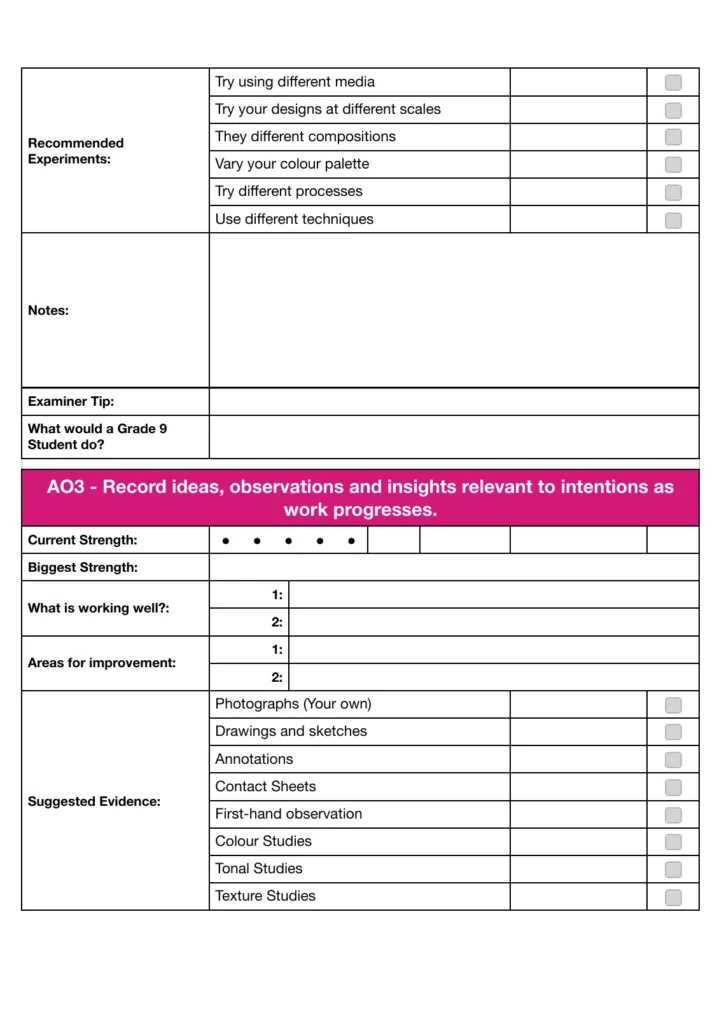
The recommended-experiments section may suggest changing media, scale, composition, colour palette, process or technique. Your reviewer will select or expand upon the approaches most relevant to your project.
- Different media: tests whether another material communicates the subject more effectively.
- Different scales: explores how size changes detail, impact, control or physical engagement.
- Different compositions: prevents the first layout from automatically becoming the final one.
- Alternative colour palettes: compares mood, atmosphere, contrast and visual emphasis.
- Different processes and techniques: helps you discover combinations that support your intentions.
The most important part comes after the experiment: identify what you discovered and show how that discovery influenced the next stage.
12. AO3 feedback: recording ideas, observations and insights
AO3 is about relevant recording as the project progresses. This includes much more than polished drawing. Depending on your specialism, it may include your own photographs, observational sketches, contact sheets, technical information, colour studies, tonal studies, texture studies and thoughtful annotation.
The suggested-evidence checklist helps identify what would make your intentions and development easier to follow.
- Your own photographs: provide personal first-hand source material and greater control over viewpoint, light and composition.
- Drawings and sketches: demonstrate looking, recording, planning and visual understanding.
- Annotations: explain discoveries, decisions, comparisons, problems and next steps.
- Contact sheets: show the range of a shoot, selection process and reasons for reshooting.
- First-hand observation: gives the project specificity and authenticity.
- Colour, tonal and texture studies: record visual qualities that may later inform practical development.
Good AO3 evidence helps another person understand what you noticed, what you intended and why your work changed.
13. AO4 feedback: the personal and meaningful response
AO4 considers how successfully your final response realises your intentions and demonstrates understanding of visual language. The outcome should not appear suddenly. It should make sense as the result of the investigations, recording, experiments, evaluations and refinements that came before it.
The suggested-evidence section may include planning the final piece with timings, completing preparatory drawings, checking materials, producing a mock-up and making sure you can explain how the project led to the outcome.
- Timings: make the intended outcome achievable within the available controlled-assessment or studio time.
- Preparatory drawings and sketches: resolve composition, scale, viewpoint and practical problems before the final piece.
- Necessary media: prevent avoidable interruptions and unplanned substitutions.
- A mock-up: tests how the outcome may look at its intended scale or in its final format.
- A clear explanation of the journey: confirms that the outcome is connected to and supported by the portfolio.
For AO4, technical finish matters—but meaningful connections and the successful realisation of intentions matter too.
14. Your top three priority actions
A detailed review can identify several possible improvements. Trying to complete everything at once may feel overwhelming, so the report reduces the advice to three priorities.
These are the actions most likely to strengthen the portfolio or remove the clearest barriers to progress. They are placed in order so you know where to begin.
Portfolio to A Star tip: Complete priority one before spending time decorating, remounting or redesigning pages. Better evidence is usually more valuable than more elaborate presentation.
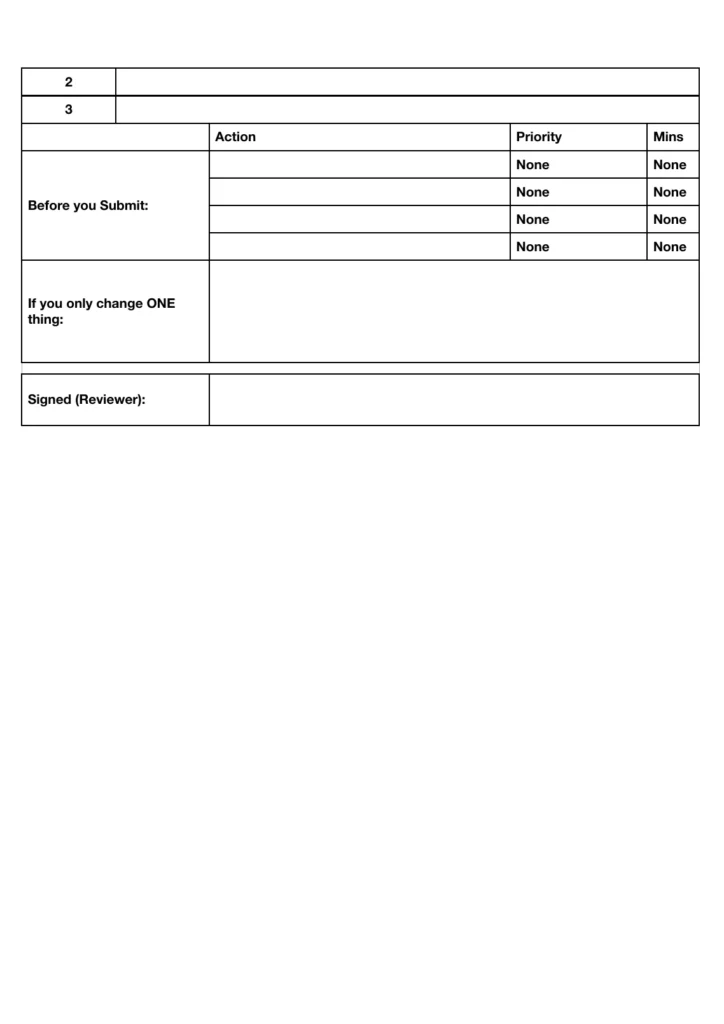
15. Before you submit: action, priority and minutes
This section turns the review into a short working schedule. Each remaining task can be given an action, a priority level and an approximate number of minutes.
This helps students use limited time sensibly. A focused twenty-minute annotation task or a carefully planned one-hour reshoot may improve the evidence more than beginning an ambitious new piece that cannot be completed.
| Action | Priority | Estimated time |
|---|---|---|
| Add reasons for selecting and rejecting three experiments. | High | 25 minutes |
| Produce two alternative composition thumbnails. | High | 35 minutes |
| Improve headings or remount one page. | Low | 20 minutes |
The example above shows why prioritising matters: improvements to development and decision-making should normally come before cosmetic changes.
16. If you only change one thing
This is the report’s highest-impact recommendation. It identifies the single change that is most likely to improve the clarity, quality or assessment evidence within the submitted work.
This might involve creating first-hand source material, showing how an artist influenced your decisions, comparing experiments, resolving the link to the final outcome or making your annotation more evaluative.
If time is extremely limited, start here.
17. Reviewer signature
The reviewer signs the completed report to show that the feedback has been personally considered and prepared for the submitted portfolio. The report is not an automated grade generator: its value comes from connecting assessment knowledge with the evidence present in the student’s actual work.
How to use your report effectively
- Read the report once without editing anything. Understand the overall pattern before concentrating on individual comments.
- Compare the feedback with the relevant portfolio pages. Find the precise evidence the reviewer is discussing.
- Begin with the top three priorities. Avoid completing easy decorative jobs simply because they feel more comfortable.
- Turn each recommendation into a visible piece of evidence. This might be a reshoot, drawing, comparison, experiment, annotation or refined composition.
- Show the effect of each change. Explain what you discovered and how it influenced the next decision.
- Use the “Before you Submit” table. Allocate realistic time and complete high-priority tasks first.
- Review the project as a connected journey. Check that research, experiments, recording and the final response clearly influence one another.
Frequently asked questions
Is the estimated grade guaranteed?
No. It is an independent estimate based on the work available at the time of review. Final marks and grades are determined through your school or college and the relevant awarding organisation.
Does the report replace feedback from my teacher?
No. The report provides an additional independent perspective. Continue following your teacher’s instructions because they know your course, centre requirements, deadlines and work completed under supervision.
Do I need to complete every suggested task?
Not necessarily. The selected recommendations, top three priorities and “If you only change one thing” section show which changes matter most. Relevance and quality are more important than completing a large number of disconnected tasks.
Can I request feedback before my portfolio is finished?
Yes. Early and mid-project reviews can be particularly useful because there is more time to investigate alternatives, carry out targeted experiments and strengthen the route towards the final response.
Is the report suitable for Photography and Graphic Communication?
Yes. The review is adapted to Fine Art, Photography or Graphic Communication. The Assessment Objectives remain connected, but the most appropriate evidence and practical recommendations will reflect the student’s specialism.
Would you like clear, personalised portfolio priorities?
Portfolio to A Star provides independent GCSE and A Level Art & Design feedback for Fine Art, Photography and Graphic Communication. Your report explains what is working, what is missing and what to do next.
No responses yet