
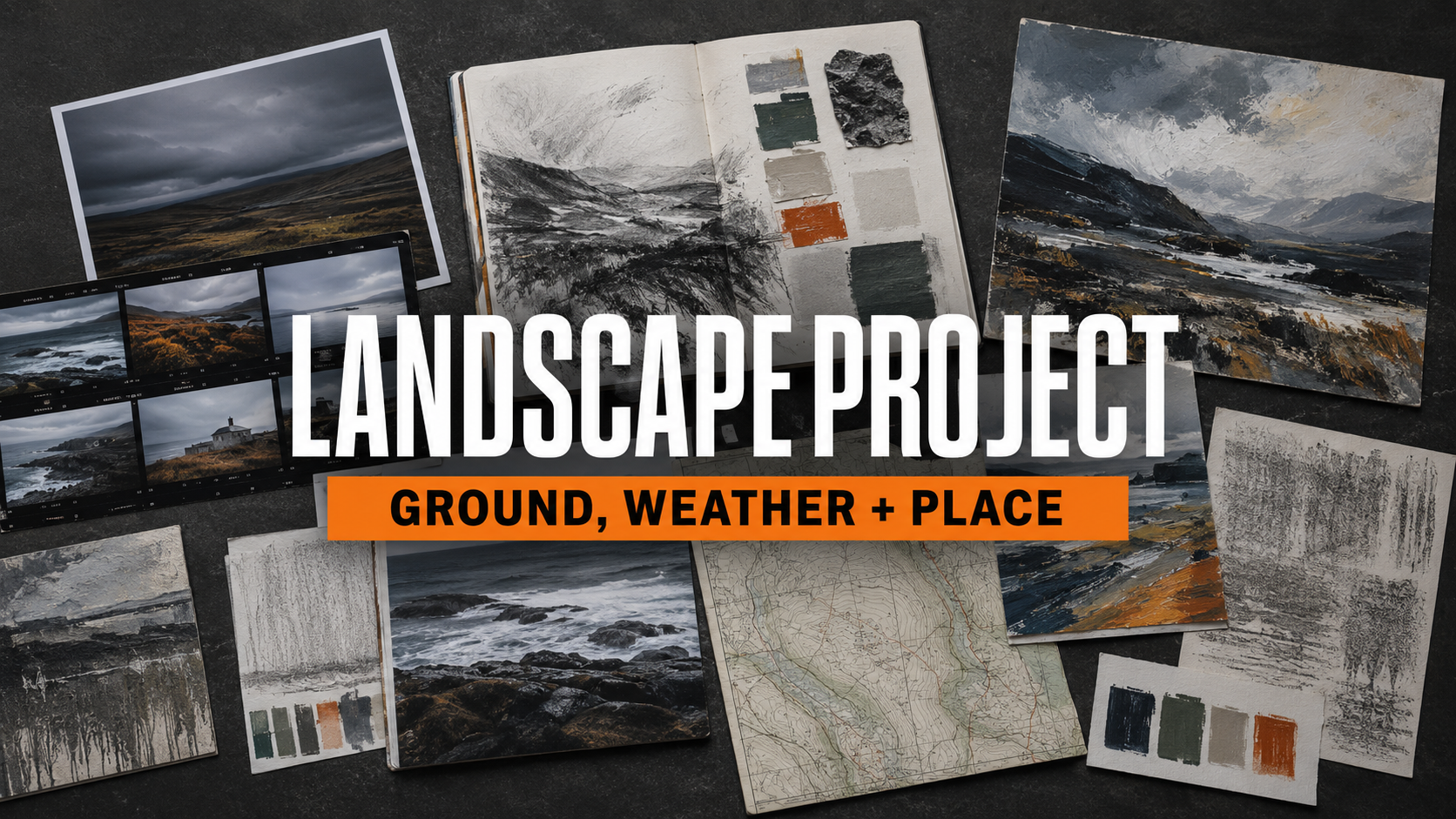
Ground, Weather and Place: A Landscape Project for GCSE and A Level
Landscape can be dramatic, ordinary, beautiful, damaged, remembered, designed or completely reimagined. It might be a vast stretch of open country, a wet pavement seen from a bedroom window, a quarry photographed from above, a garden planned around human movement or the cracked surface of a sea wall examined at close range. This makes it an exceptionally flexible starting point for GCSE and A Level Fine Art or Photography.
This guide offers an original controlled-test question, relevant practitioners, practical starting points and several different routes through the theme. You are not expected to attempt everything. Select a direction that interests you, collect your own source material and allow investigation and experimentation to shape a personal response.
Suggested project or controlled-test starting point
Ground, Weather and Place
Every place carries evidence of natural forces and human decisions. Shifting light can turn familiar ground into something unfamiliar; weather can stain, erode or conceal a surface; farming, industry and design can reorganise the land; and memory can change how a location is understood. Artists and photographers have responded to place through observation, colour, material, sequence, construction and invention. Investigate sources that connect with your interests, gather first-hand evidence and develop a personal response exploring how a landscape can be seen, experienced or transformed.
Important: artist research should influence your thinking, not give you an image to copy. Record the creator and source of every reference, analyse the decisions that matter to your project, and then use your own photographs, drawings, observations and experiments to develop something distinct.
What can “landscape” include?
You do not need access to mountains or an impressive coastline. A successful project can begin with somewhere close enough to revisit: an estate, canal, park, playing field, motorway edge, allotment, construction site, riverbank, shopping precinct, industrial ruin, suburban garden or view from a regular journey. The important question is not “Is this place spectacular?” but “What can I notice, investigate and communicate here?”
Natural
Hills, woodland, rivers, coast, rock, soil, vegetation, cloud, weather and seasonal change.
Human-shaped
Farms, quarries, roads, pylons, reservoirs, housing, waste ground, boundaries and industrial sites.
Experienced or imagined
Memory, belonging, exclusion, folklore, journeys, maps, dreams, climate anxiety and invented places.
Route 1: light, colour and changing weather

Weather does more than provide a background. It changes visibility, colour, contrast, edges and mood. Mist can remove detail; rain can intensify colour and reflections; low sun can divide a scene into glare and shadow; wind can be suggested through repeated marks or movement blur.
Fine Art possibilities
- Return to one view in different conditions and make rapid colour studies rather than one highly finished copy.
- Reduce the scene to bands of tone, directional marks or overlapping colour fields.
- Compare transparent washes with thick, scraped or textured paint to suggest different kinds of weather.
- Work from memory after leaving the location, then compare the result with an observational study. What did your memory exaggerate or remove?
Photography possibilities
- Photograph before, during and after a change in weather while keeping the viewpoint consistent.
- Expose for highlights, then for shadows, and compare how the emotional character changes.
- Use reflections, condensation, wet glass or translucent material to interrupt a straightforward view.
- Create a colour palette from the location, then apply a controlled colour grade based on what you actually observed.
Useful references include David Stanley, whose semi-abstract paintings use layered colour and expressive marks to create atmosphere; J. M. W. Turner for light, weather and the sublime; and David Hockney for heightened colour, multiple viewpoints and seasonal observation. Compare their visual decisions, but construct your response from your own place and experience.
Route 2: the landscape people have changed

Landscape is rarely untouched. Even apparently rural views may contain paths, drainage, fences, plantations or traces of extraction. You could investigate the tension between control and regrowth, beauty and damage, access and exclusion, or usefulness and abandonment.
Photographer Edward Burtynsky examines large-scale landscapes reshaped by industry. Ingrid Pollard questions who is represented in ideas of the British countryside and how landscape connects with history, identity and belonging. Fay Godwin offers a poetic but unsentimental approach to the British land, while the neutral-looking photographs associated with New Topographics show how ordinary, developed places can become serious subjects.
Possible investigations
- Document the edge where housing, industry or transport meets plants and open ground.
- Map every barrier, shortcut, warning sign or unofficial path within one small area.
- Photograph evidence of use without including people: tyre marks, litter, worn surfaces, repairs, footprints or improvised structures.
- Combine maps, planning lines, photographs and observational drawing to reveal how the land has been reorganised.
- Contrast an attractive distant view with uncomfortable details discovered close up.
A designed landscape can also be a valuable route. Examine how paths control movement, how planting reveals or screens a view and how material choices affect atmosphere. The project portfolio of Andy Sturgeon Design can prompt questions about rhythm, enclosure, contrast and the relationship between built and planted forms. Rather than designing a generic “dream garden”, begin with a real site, identify its users and purpose, then show how your visual and practical choices respond to those needs.
Route 3: surfaces, erosion and geological memory
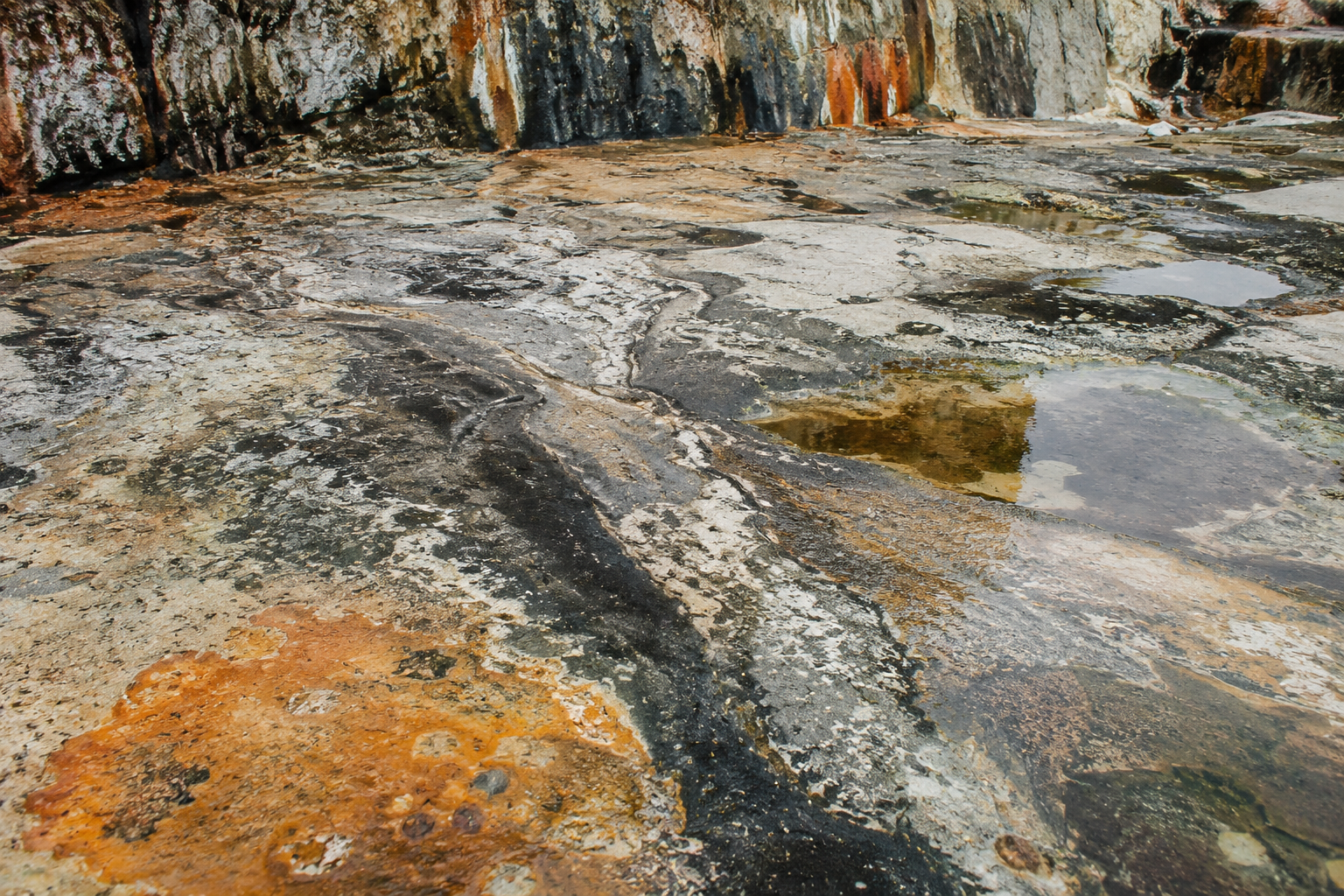
A landscape project does not have to remain panoramic. Moving close to rock, bark, mud, rust, lichen, cracked paint, tide lines or weathered concrete can turn place into texture and texture into abstraction. This approach is especially useful if you enjoy material experimentation.
Textile artist Amanda Hislop responds to land, sea, sky and trees through drawing, painting and stitch. Her work is useful for considering how marks gathered through observation can be translated into layers, fibres and tactile surfaces. Ceramic artist Claudi Casanovas treats clay as a material with geological presence, using processes that create abrasion, cracking, density and erosion-like surfaces.
Fine Art experiments
- Make graphite, wax or oil-pastel rubbings from permitted surfaces and combine them with drawn contours.
- Layer tissue, fabric, paper pulp, thread, sand or modelling medium, then abrade or cut back through the surface.
- Create a series of ceramic or plaster relief tiles based on cracks, strata, shorelines or contour maps.
- Enlarge a tiny photographed detail until it reads as an invented landscape.
Photography experiments
- Build a typology of one surface category—cracks, stains, edges, repairs or tide marks—using consistent framing.
- Test side-light, diffused light and direct flash to see how each changes relief and texture.
- Remove scale clues so the viewer cannot immediately tell whether they are seeing a wall, rock face or aerial landscape.
- Print onto textured or translucent material, or physically distress test prints, while retaining a clear reason for doing so.
Route 4: altered, imagined and unreliable landscapes
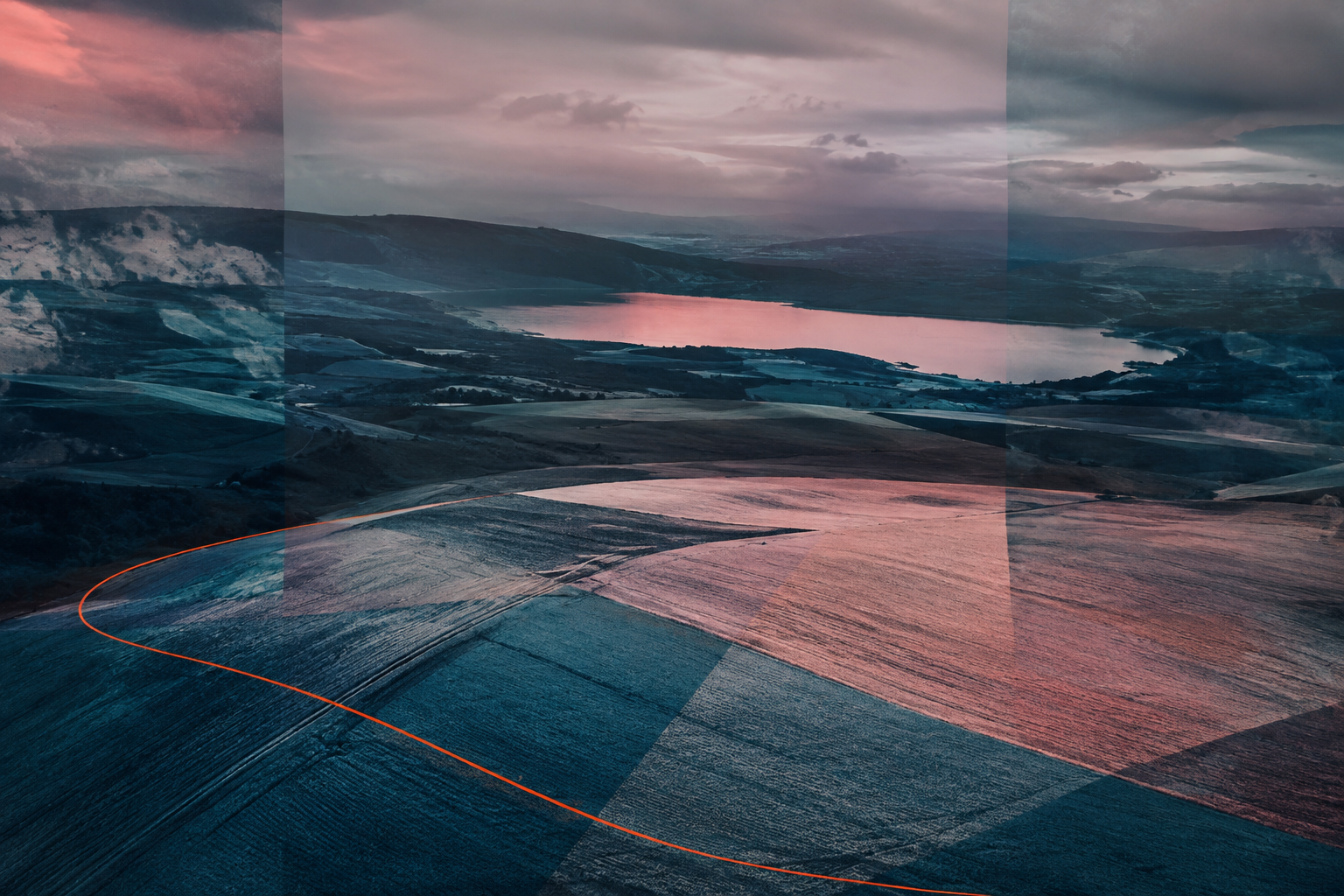
A photograph does not have to claim complete objectivity. Colour, viewpoint, exposure, montage and digital intervention can turn a recognisable place into something uncertain. The purpose should be stronger than “making it look unusual”: decide what your alteration communicates. Is it about heat, memory, pollution, ownership, anxiety, nostalgia or the gap between a map and an experience?
Florian Maier-Aichen combines photographic processes, digital intervention and hand-made elements to create landscapes that sit between observation and fiction. His work can prompt experiments with colour tinting, double exposure, drawing over prints, deliberate light leaks, collage and elevated viewpoints. Study the way techniques contribute to an idea; do not reproduce one of his compositions or apply an effect without a reason.
Ways to transform your own imagery
- Apply two or three different colour treatments to the same file and evaluate which best supports the intended mood.
- Combine ground-level and aerial or map-like viewpoints to make spatial relationships deliberately unstable.
- Overlay historical maps, weather data, flood lines or hand-drawn routes that relate directly to the site.
- Project images back onto the place, photograph the projection and allow the surface to distort it.
- Construct a fictional landscape from fragments of several local locations, then leave small visual clues to the joins.
Route 5: one place, many times

Repeated observation turns landscape into a record of time. Photographer Jem Southam has documented subtle changes in places over extended periods. This offers an alternative to travelling in search of a single spectacular view: work patiently with one accessible location and allow small differences to become the subject.
- Mark a fixed camera position and return at different times, in different weather or after particular events.
- Create a sequence rather than selecting only one “best” photograph.
- Record sound, temperature, wind direction, water level or a short written observation alongside each visit.
- For Fine Art, work on one surface over several visits, adding and removing marks as the place changes.
- Explore decay, repair, regrowth, flooding, drought, construction or seasonal use.
Different styles and genres to investigate
| Approach | What to notice | A possible student response |
|---|---|---|
| Atmospheric or sublime | Scale, unstable weather, dramatic light, awe or vulnerability. | Make one small figure, structure or path emphasise the scale of the environment. |
| Impressionistic | Fleeting light, broken colour, repeated observation and visible touch. | Produce several timed studies from the same viewpoint rather than one photographic copy. |
| Semi-abstract | Rhythm, directional marks, colour relationships and simplified shapes. | Crop and reduce a landscape until its structure becomes more important than description. |
| Documentary | Evidence, context, visual neutrality, sequence and social meaning. | Record an ordinary local landscape consistently and let details reveal its use. |
| Environmental | Extraction, climate, pollution, recovery, conflict and responsibility. | Compare beauty at a distance with evidence of damage or consumption close up. |
| Surreal or manipulated | Unexpected colour, montage, scale shifts, fiction and unstable space. | Alter only selected elements so the viewer gradually realises the place is impossible. |
| Conceptual or Land Art | Walking, mapping, measurement, temporary action and documentation. | Create a route, repeated action or temporary arrangement, then present photographs and records as the work. |
| Constructed landscape | Movement, viewpoint, planting, boundaries, material and intended users. | Redesign a real neglected space through drawings, models, collage or photographic mock-ups. |
More artists and photographers to explore
- Peter Lanyon — consider how movement through, above and around a place can be translated into energetic abstract painting.
- Kurt Jackson — useful for sustained first-hand observation, mixed media and the integration of written field notes with visual work.
- Richard Long — explore walking, repeated action, simple materials, maps and photographic documentation within Land Art.
- Ansel Adams — investigate tonal range, sharpness, controlled printing and the visual drama of black-and-white landscape photography.
- Fay Godwin — examine how landscape photography can be poetic, direct and connected with access, history and human presence.
- Jem Southam — consider extended observation, repeated locations, seasonal change and the slow development of a photographic series.
- Edward Burtynsky — investigate scale, aerial structure, industrial intervention and the uneasy visual attraction of altered environments.
- Ingrid Pollard — question who belongs within representations of countryside and how landscape imagery carries cultural assumptions.
Twelve project beginnings you could make your own
- The view I usually ignore: investigate an ordinary place passed every day and reveal what repeated looking uncovers.
- After the rain: explore reflections, saturated colour, dripping surfaces, puddles and temporary changes.
- Edges and boundaries: examine fences, walls, hedges, shorelines, thresholds and who or what they separate.
- The land as a record: trace erosion, extraction, cultivation, repair, footprints or buried histories.
- A landscape without people: show human activity only through objects, wear, paths and changes to the ground.
- One square kilometre: restrict the project to a mapped area and build depth through close observation.
- False colour, true feeling: transform colour to communicate a remembered or emotional experience of place.
- From panorama to fragment: move from wide views to increasingly close surface details.
- Night ground: investigate darkness, artificial light, long exposure and spaces that change character after sunset.
- Designed nature: study a park, garden or planted public space as a sequence of controlled views and movements.
- Return: revisit a place connected with childhood, family or change and compare memory with present evidence.
- Future landscape: imagine how a familiar place might respond to climate, development, abandonment or restoration.
A Fine Art route through the project
- Collect: make location drawings, take original photographs, gather permitted rubbings and record colour, weather, sound and personal reactions.
- Investigate: select two or three practitioners whose ideas or processes genuinely connect with your intentions.
- Translate: turn observations into different media—drawing, paint, print, collage, textiles, relief, clay or digital layers.
- Disrupt: change viewpoint, scale, palette, surface, format or level of abstraction. Compare rather than merely collect experiments.
- Refine: combine the most successful decisions in increasingly resolved studies and explain why they support your intention.
- Realise: produce a final response that grows visibly from the investigation rather than appearing as a separate last-minute picture.
A Photography route through the project
- Define a question: decide what you want to discover about the place before deciding which equipment or effect to use.
- Shoot broadly: vary distance, height, orientation, time, weather and focal length while keeping organised contact sheets.
- Review critically: mark successful and unsuccessful frames and explain what each selection teaches you.
- Reshoot purposefully: return with a narrower intention. A second shoot should answer questions raised by the first.
- Experiment: test black and white, controlled colour, sequence, long exposure, multiple exposure, physical collage, projection, photograms, cyanotype or book format where appropriate.
- Edit as a body of work: sequence images so that relationships, changes and contrasts communicate the idea.
- Present intentionally: consider size, spacing, paper, screen, projection, installation or publication as part of the meaning.
For more course-specific advice, see the guides to GCSE Photography and A Level Photography.
GCSE and A Level: what should be different?
| GCSE | A Level |
|---|---|
| A clear, personal interpretation supported by relevant first-hand sources. | A more sustained and conceptually focused enquiry in which intentions are challenged and refined. |
| Purposeful research showing what was noticed and how it influenced decisions. | More independent contextual selection and deeper critical understanding of relationships between sources and practice. |
| A manageable range of media or photographic methods tested with increasing control. | Technically assured experimentation that questions conventions and is evaluated against a clear conceptual purpose. |
| Visible progress from initial observation to developed response. | A coherent body of work in which process, presentation and meaning operate together. |
| Annotation explains choices and next steps in straightforward language. | Written and visual reflection is more analytical, precise and capable of addressing ambiguity or alternative interpretations. |
Both levels require development, experimentation, recording and a personal response. A Level is not simply “more pages” or a larger final piece. It should show greater independence, depth, selectivity and awareness of why a particular visual language is appropriate.
Questions to keep the project moving forward
- What is distinctive about this place, and what only becomes visible after repeated observation?
- Am I showing the land itself, my experience of it, or a particular issue connected with it?
- Which visual choices communicate that intention most effectively?
- What have I learned from an artist or photographer beyond a surface-level “style”?
- How have my own photographs, drawings or field observations shaped the outcome?
- What did my latest test reveal, and what exactly will I change next?
- Could a different scale, sequence, crop, material or presentation make the meaning clearer?
- Does the final direction still feel like my response, or has an artist reference taken over?
Your landscape does not need to look important to become important
The strongest starting point is often a place you can reach, revisit and understand. Careful looking can turn an overlooked site into a project about weather, time, ownership, change, surface, memory or belonging. Begin with first-hand evidence, remain open to unexpected discoveries and let each experiment lead to a more informed decision.
No responses yet