
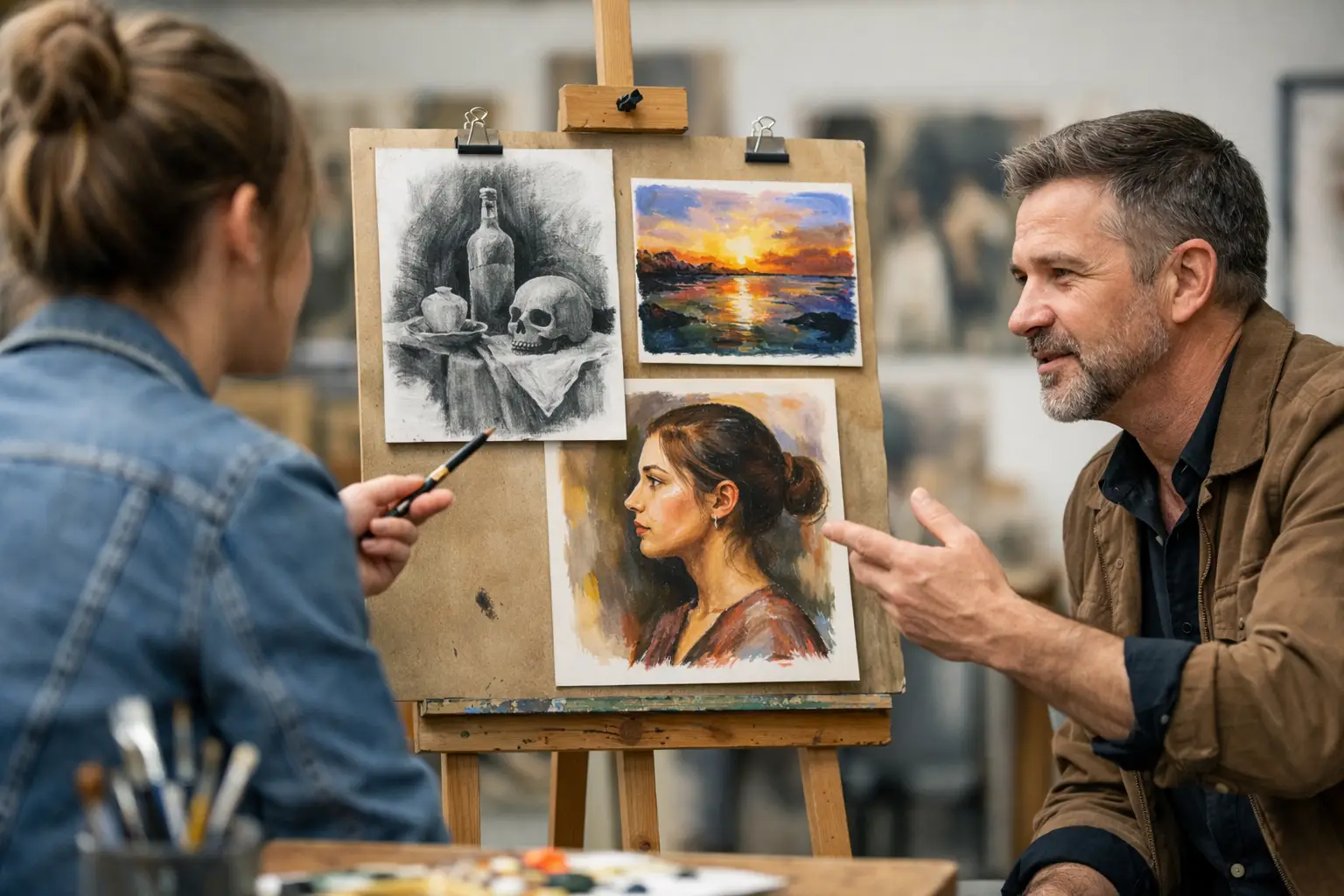
A sketchbook can look full and still leave marks on the table. The difference is often not talent or effort. It is whether each page gives clear evidence of decisions, development and purposeful refinement. A GCSE artwork critique helps you see your portfolio as an examiner will: not as a collection of individual drawings, but as a connected visual journey towards a personal final response.
The most useful critique does not simply tell you whether your work is ‘good’. It identifies what the work proves, what it currently suggests, and what needs to happen next. That is how you turn vague advice such as ‘develop this more’ into practical actions that strengthen AO1, AO2, AO3 and AO4.
What a GCSE artwork critique should assess
A productive critique begins with the assessment objectives, because these are the framework used to assess GCSE Art and Design coursework. Your portfolio does not need four separate sections labelled AO1 to AO4. In fact, forcing your work into isolated boxes can make a project feel disconnected. Instead, the objectives should be visible across the natural development of your project.
AO1 is about researching relevant artists, photographers, designers or contextual sources, then showing how those investigations influence your own ideas. A critique should ask whether your artist research goes beyond copying an image and adding a biography. Can a viewer see what you noticed? Have you selected a technique, composition, material, theme or visual language that informs your next experiment?
AO2 considers experimentation and refinement. This is where many students produce plenty of work but do not always show why one direction was taken further than another. A strong critique looks for purposeful testing. You might experiment with media, scale, composition, viewpoint, layering, collage, editing or mark-making, but each trial needs to help answer a creative question.
AO3 is your recording of observations, ideas and insights. This can include first-hand drawings, photographs, written reflections, collected visual material and annotated studies. The key question is whether your recording is specific to your project. Generic internet images rarely carry the same weight as an original photograph taken to explore your own subject matter.
AO4 is the personal response. This includes your final outcome, but it is also evident in the choices that lead to it. A critique should consider whether the outcome feels like a logical resolution of the project, rather than an attractive piece that could have appeared at the beginning of the sketchbook.
Start with the project story, not the prettiest page
When reviewing your own work, lay out your sketchbook pages in order or photograph them as a sequence. Then ask yourself a simple question: could someone unfamiliar with the project explain how your ideas changed from the first page to the final piece?
If the answer is no, do not panic. It usually means the links between pages need making clearer. Perhaps you researched a painter, but the next page jumps to an unrelated pencil drawing. Perhaps your photography experiments are strong, but your final piece uses a composition that was never tested. A critique should locate these missing connections.
Look for a line of development. Your starting point might be a theme such as identity, urban decay, structures or natural forms. From there, you need visual investigation, contextual research, experimentation, selection and refinement. The order can vary, and projects are not always neat, but your decisions should make sense when viewed together.
A useful test is to complete this sentence for each double page: ‘This page moves my project forward because…’ If you cannot finish it clearly, add an experiment, a short reflection or a follow-up study that gives the page a purpose.
How to critique AO1 without writing more biography
Weak artist research often looks polished at first glance. There may be a printed image, a few facts and a careful copy. However, if the artist’s work does not change what you do next, it has limited value within your portfolio.
A better GCSE artwork critique asks you to identify one or two precise features that matter to your project. For example, you may respond to the fractured surfaces in an artist’s paintings, their unusual camera angles, a restricted colour palette or their use of layered text. Then test that feature in your own subject matter.
Your annotation should explain a decision, not describe the obvious. Instead of writing, ‘I used watercolour because the artist uses watercolour’, explain what happened: ‘I diluted the paint to create uneven transparent layers, because this reflects the faded textures in my own photographs of weathered walls. The result is effective in the lighter areas, but the darker sections lack the contrast I need.’
That short comment shows understanding, practical experimentation and an honest judgement. It also gives you a clear next step: test stronger tonal contrast, another layer, or a different material.
Check whether AO2 experiments actually lead somewhere
Experimentation earns more credit when it is selective and reflective. Ten small material tests can be useful, but only if you compare them and develop the most successful direction. Filling pages with unrelated techniques may show activity, yet it can weaken the sense of personal intention.
When critiquing AO2, ask what you were trying to find out in each experiment. You could be testing which medium best communicates movement, whether cropping an image creates tension, or how to combine a photograph with drawing. The creative question gives the experiment a reason.
Afterwards, make a judgement. State what worked, what did not, and what you will take forward. This does not need to be a long paragraph. A few accurate sentences beside the work are far more valuable than broad claims that everything was successful.
There is also a trade-off to manage. Repeating one technique can build skill and coherence, while too much repetition can make the project predictable. Introducing several materials can create richer outcomes, but only when they support the same idea. Your critique should help you decide whether you need greater depth in one direction or broader testing before making a final choice.
Strengthen AO3 with specific, first-hand recording
Original recording gives your project authority. If your topic involves people, places, objects or environments you can access, take your own photographs and make direct studies from them. Photograph a subject from different angles, distances and lighting conditions. Make quick observational drawings before producing more ambitious studies.
During a critique, examine whether your source material gives you enough to work from. One photograph may be sufficient for a small study, but it rarely provides enough information for sustained development. A varied photo shoot can lead to different compositions, close-up details, tonal studies and interesting crops.
Your annotations can also record the decisions behind your images. Explain why you chose a low viewpoint, cropped out the background, focused on a texture or photographed in harsh side lighting. These details show that recording is active research, not simply collecting reference material.
Judge AO4 by the journey behind it
A final outcome should feel personal, resolved and visibly connected to the work before it. It does not have to include every technique you tried. Often, the strongest final pieces are selective. They take the most relevant ideas from earlier pages and use them with control.
Critique your final response against the preparatory work. Does it develop a composition you tested? Does it use a material choice you refined? Can you point to artist research or first-hand sources that influenced it? If the answer is yes, your outcome is more likely to read as the culmination of a genuine project.
If the final piece is technically strong but disconnected, create a bridge before submission. Produce a final planning page with thumbnail compositions, colour or material trials, and a short explanation of your chosen direction. This can make your thinking visible without pretending every experiment was perfect.
Turn critique into clear next steps
Feedback is only useful when it changes what you do next. After a review, avoid trying to improve every page at once. Choose the two or three actions that will have the greatest impact on the portfolio as a whole. That might mean completing an original photo shoot, extending one artist-inspired experiment, improving annotations on key pages, or making a more considered final-piece plan.
Be honest about what is missing, but do not treat critique as proof that you have failed. Every strong portfolio contains adjustments. The aim is not to make your sketchbook look effortless. It is to make your thinking, risk-taking and refinement visible.
A well-timed critique can replace last-minute guesswork with a focused plan. Review your work as a developing project, act on the clearest priorities, and give each new page a reason to exist. If you want an independent assessment of the whole project, GCSE Art portfolio feedback can help identify the strongest evidence and the most useful next steps. That is how you present your work with confidence and give your best ideas the evidence they deserve.
No responses yet