
GCSE Art AO3 Explained: Recording Ideas, Observations and Insights
GCSE Art AO3 is about making your thinking and looking visible. It rewards the drawings, photographs, studies, plans, notes and reflections that record what you observe, what you discover and how your intentions change as your project develops.
AO3 is sometimes described as “drawing and annotation”, but that is only part of the story. Strong recording can be visual, written, photographic, digital, three-dimensional or a purposeful combination of these. What matters is that it is relevant and helps the examiner understand your creative journey.
This guide explains the official wording, the evidence that can count, how AO3 differs across Art & Design specialisms and how to make recording genuinely useful rather than decorative.
The most important principle
AO3 is not simply a record of what you did. It should record what you noticed, understood and decided. A photograph, drawing or paragraph becomes valuable when it is relevant to your intention and affects what happens next.
What Is AO3 in GCSE Art?
For GCSE Art & Design qualifications in England, the official AO3 wording is:
Record ideas, observations and insights relevant to intentions as work progresses.
Ofqual GCSE Art & Design assessment objective AO3
GCSE Art AO3 is worth 25% of the total marks. It applies to both the portfolio and the externally set assignment. The wording is short, but each part carries an important expectation.
GCSE Art AO3 – Record ideas
Ideas may be recorded through thumbnails, diagrams, storyboards, contact sheets, compositional sketches, design proposals, maquettes, written plans or digital drafts. These do not need to look finished. Their purpose is to capture possibilities before they disappear and make development visible.
GCSE Art AO3 – Record observations
Observation means looking carefully and recording what is actually there. This might involve drawing from an object, photographing a location, studying light on a face, measuring a structure, recording texture, noticing how a material behaves or documenting the needs of a design audience.
Record insights
An insight is something you come to understand. You might realise that a close crop creates tension, that backlighting hides important detail, that a rough surface suits your theme, that one typeface weakens legibility or that a repeated form makes a composition feel more unified.
Keep recording relevant to intentions
Your intention is what you are trying to investigate, communicate, design or improve. Recording should help that intention move forward. A technically impressive drawing can still be weak evidence if it has no clear relationship to the project.
GCSE Art AO3 – Record as work progresses
AO3 should appear throughout the project rather than being added in one rushed section at the end. Record the starting point, discoveries, changes of direction, practical problems, decisions and refinements while they are still meaningful.
What Can Count as AO3 Evidence?
There is no single correct format. Strong GCSE Art AO3 evidence can include:
- Observational drawings from objects, people, places, structures or natural forms
- Original photographs, contact sheets and clearly identified selections
- Close-up studies of colour, texture, shape, pattern, tone, light or surface
- Thumbnail compositions, layout studies, storyboards and design variations
- Sketches that record an idea before, during or after practical work
- Plans, diagrams, measurements, prototypes, maquettes and construction notes
- Material samples accompanied by observations about behaviour and effect
- Short written reflections, comparisons and independent judgements
- Annotations that explain changes of intention and identify the next step
- Digital screenshots or editing stages when they reveal a meaningful decision
- Photographs documenting temporary, three-dimensional or large-scale work
- Gallery, museum, site-visit or location records connected to the project
A balanced project usually combines several kinds of recording. The best method is the one that captures the information you need at that point in the investigation.
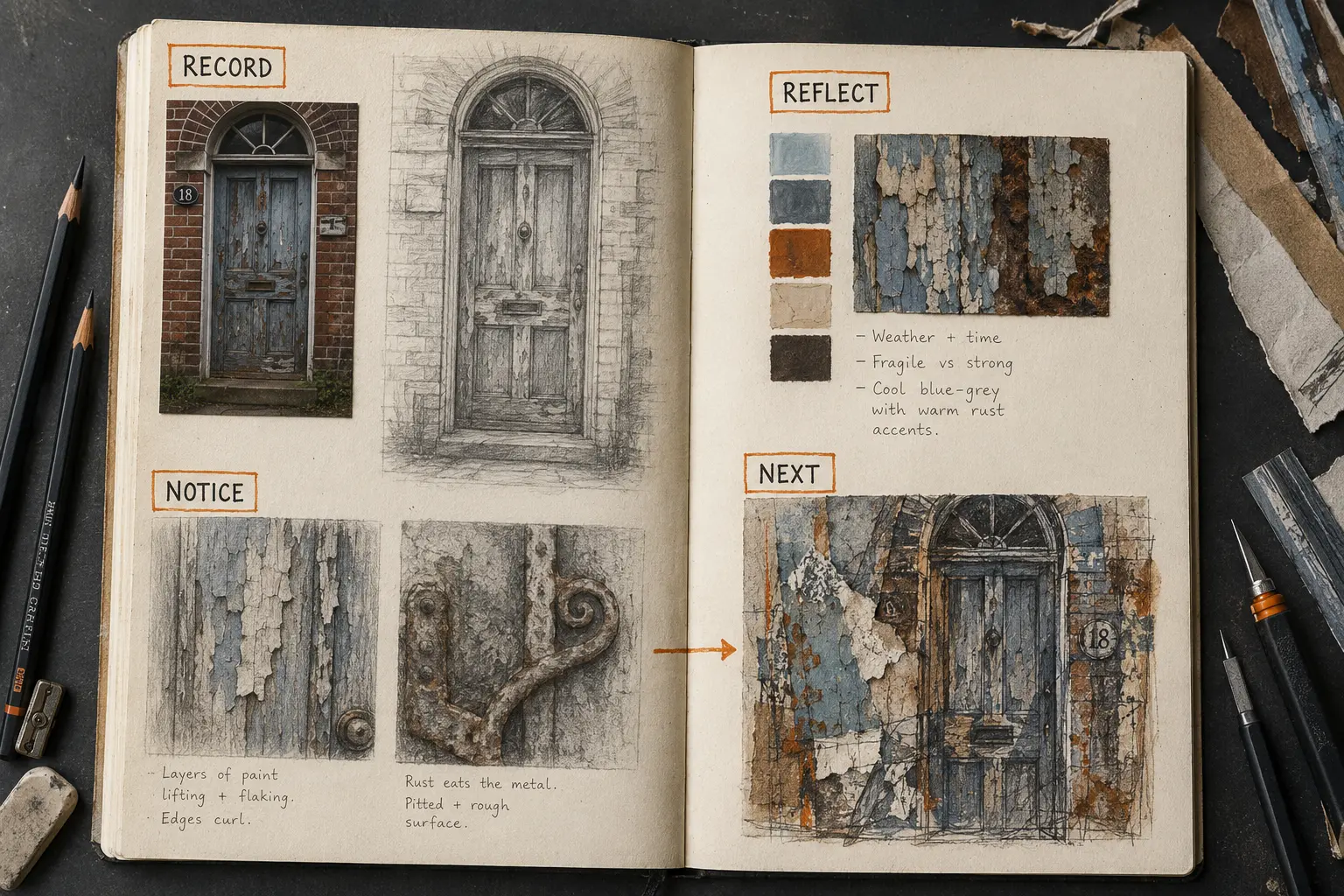
AO3 Is More Than Annotation
Writing can clarify your intentions and decisions, but long paragraphs cannot replace visual evidence. If you write that the light created strong shadows, show the photograph or drawing. If you explain that a composition changed, place the alternatives nearby. If you say a process failed, include enough evidence for the reason to make sense.
| Recording method | What it can reveal |
|---|---|
| Drawing | Careful looking, structure, proportion, form, tone, texture, space and selective emphasis |
| Photography | First-hand sources, viewpoint, timing, light, sequence, location, detail and changing conditions |
| Practical study | How materials, processes, construction or visual language behave |
| Written annotation | Intentions, observations, comparisons, judgements, changes and next steps |
| Diagram or plan | Structure, order, scale, layout, movement, function or production thinking |
| Digital record | Editing choices, layers, versions, technical settings and design development |
Useful rule: show visually what can be shown visually; use concise writing to explain what cannot be seen easily.
First-Hand Recording Makes a Difference
First-hand recording comes from direct experience: an object in front of you, a place you visit, a photograph you take, a person you observe, a texture you collect or a practical process you test. It gives you information that is personal to your project and cannot be copied exactly from an internet image.
Secondary sources can still be useful, especially when something cannot be accessed directly. The stronger approach is to use them selectively and combine them with your own observation, photography, drawing, research or testing.
- Photograph the same subject from several viewpoints instead of relying on one downloaded image.
- Draw selected details to understand structure rather than copying the entire photograph mechanically.
- Record changes in light, movement, scale, texture or atmosphere that matter to your intention.
- Keep dates, contact sheets or sequence photographs when they help prove how the investigation developed.
- Make the distinction between your own sources and contextual material clear.
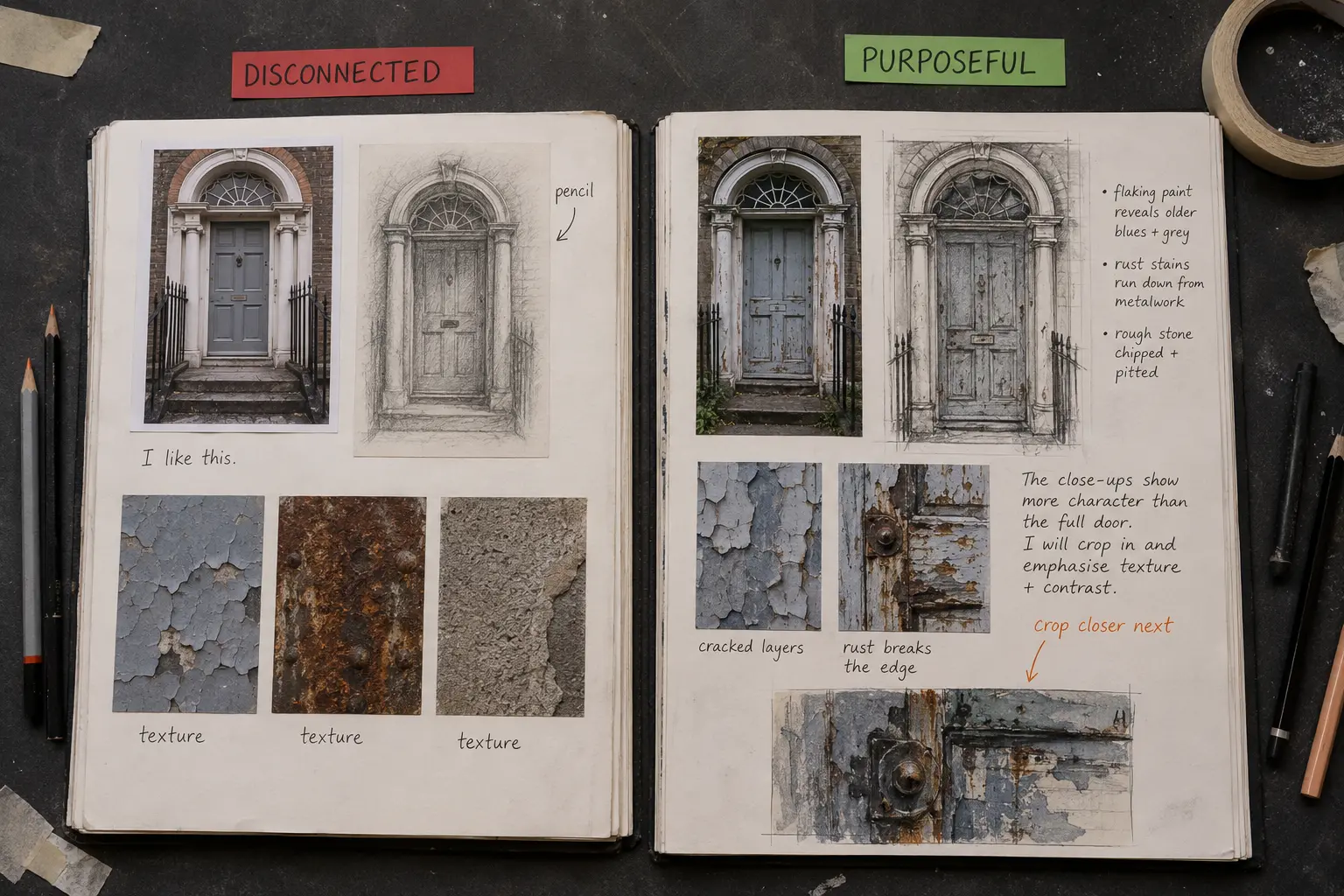
Weak and Strong AO3 Recording
| Weaker AO3 evidence | Stronger AO3 evidence |
|---|---|
| One copied image used without explanation | Relevant first-hand sources are gathered, selected and developed |
| A drawing is included only to fill a page | The drawing investigates a visual question connected to the intention |
| Annotation describes materials or actions | Annotation records observations, judgements, changes and next steps |
| Contact sheets contain no selection or reflection | Selections identify what was learned and direct a targeted reshoot |
| Only polished successes are shown | Useful difficulties and changes of direction are recorded honestly |
| Most recording is added retrospectively | Evidence appears naturally as ideas and intentions develop |
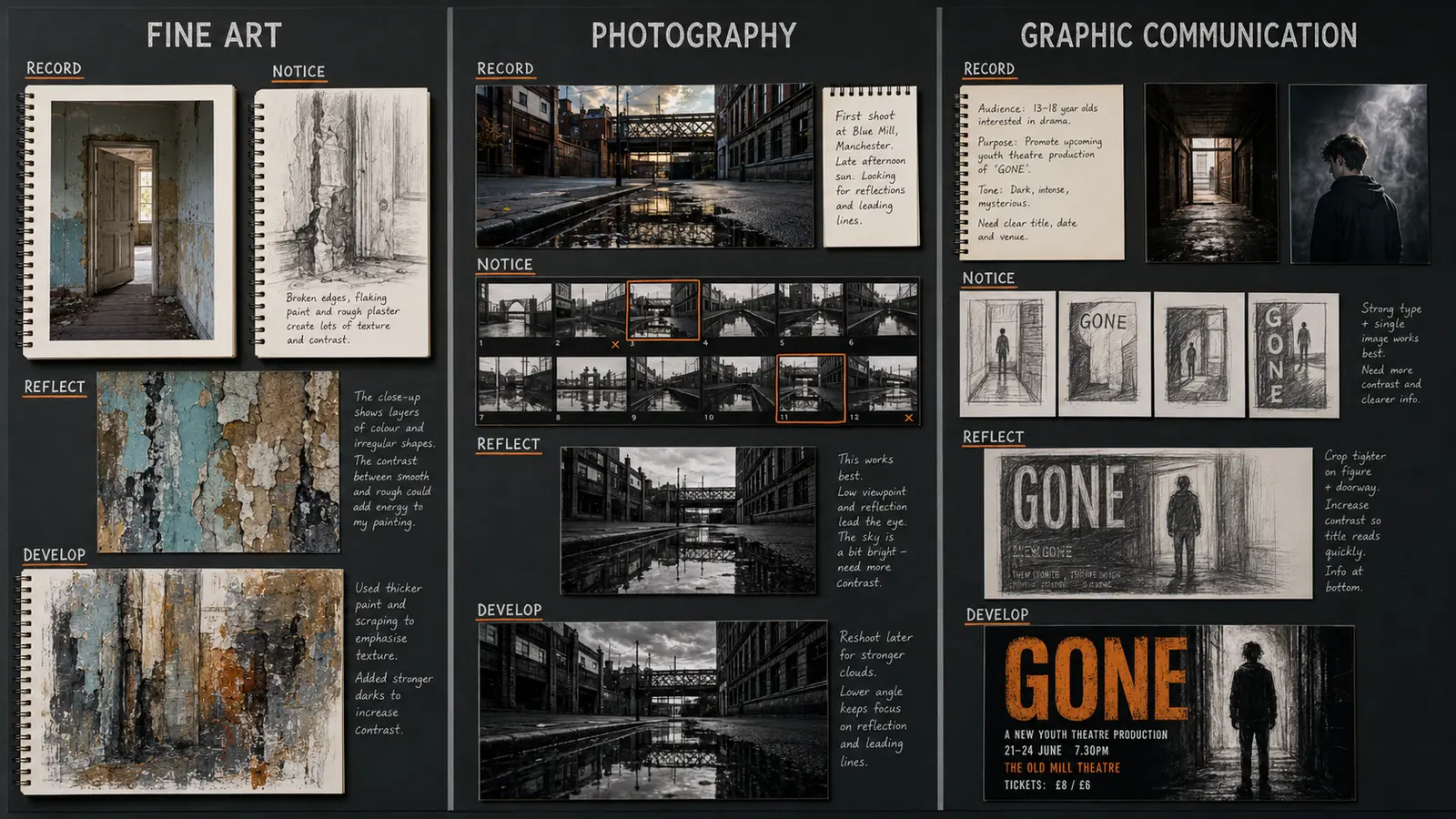
AO3 in Different GCSE Art Specialisms
The assessment objective stays the same across specialisms, but the most useful forms of recording vary.
| Specialism | Useful AO3 evidence | What the evidence should reveal |
|---|---|---|
| Fine Art | Observational drawing, original photography, colour and surface studies, compositional sketches, practical notes | What was noticed and how observation or reflection changed the visual response |
| Photography | Shoot plans, contact sheets, camera settings, selection marks, editing comparisons, sequencing and reshoot notes | How technical and visual decisions developed the photographic intention |
| Graphic Communication | Audience notes, original imagery, thumbnails, grids, hierarchy studies, type tests, mock-ups and evaluations | How recording and review improved communication, purpose and audience suitability |
| Textile Design | Pattern drawings, colour studies, fabric photographs, stitch diagrams, repeat plans, samples and construction notes | How visual and tactile discoveries informed pattern, surface and function |
| Three-Dimensional Design | Measured drawings, site photographs, diagrams, maquettes, prototypes, material tests and user observations | How structure, scale, ergonomics, stability, function and form were understood |
A Practical Fine Art Example
Imagine that your project investigates weathered doors as evidence of time and use.
- You take your own photographs of several doors in different light.
- You select close-ups that reveal cracked paint, scratches, rust and repeated repairs.
- You make graphite and ink studies to understand structure and surface.
- You notice that the most interesting areas show contrast between careful geometry and accidental damage.
- You record this insight and decide to crop the subject more tightly.
- Your next mixed-media study exaggerates that contrast through controlled lines and broken layers.
The photographs and drawings are not isolated exercises. They generate information, reveal an insight and change the next response.
A Practical Photography Example
Suppose your intention is to communicate isolation in a busy urban location.
- You plan a first shoot using several viewpoints and different distances from the subject.
- You present a contact sheet and mark images in which the figure appears visually separated.
- You notice that a high viewpoint and repeated architectural lines make the figure feel smaller.
- You record that the midday light is too flat and weakens the atmosphere.
- You plan a targeted reshoot from an elevated viewpoint in lower, directional light.
- You compare the two shoots and explain how the changes strengthen your intention.
A Practical Graphic Communication Example
Imagine that you are designing a poster for a youth-theatre production.
- You record the audience, purpose, required wording and formats.
- You take original photographs and draw objects connected to the play.
- You produce small thumbnails to test hierarchy before developing detail.
- You notice that one dramatic crop creates a stronger focal point than several competing images.
- You test the selected layout at poster and social-media size.
- You record that the subtitle becomes unreadable when reduced and revise the scale and spacing.
How to Write Useful AO3 Annotation
Useful GCSE Art AO3 annotation is specific, concise and connected to visible evidence. It does not need to sound academic. Write what you genuinely noticed and what you will do with that understanding.
A descriptive comment
I took photographs of the building and then made a pencil drawing.
A reflective comment
The low viewpoint makes the repeated windows appear more imposing, but the parked cars interrupt the pattern. I will return earlier, crop above street level and use stronger side light to emphasise the building’s rhythm.
The second comment identifies a visual observation, evaluates a weakness and turns both into a practical next step.
Useful sentence starters include:
- I recorded this because…
- The most important detail is… because…
- Looking closely helped me notice…
- This source is relevant to my intention because…
- The contact sheet shows that…
- This version communicates… more effectively because…
- The main weakness is…
- I changed my intention when I realised…
- I will keep… but alter…
- My next drawing, shoot, test or design will focus on…
Show AO3 as a Developing Sequence
A strong creative journey often follows this pattern:
Intention → Observe → Record → Notice → Reflect → Decide → Record Again
This is not a rigid formula. It simply reminds you that recording should lead to understanding, and understanding should influence later recording. Dates, arrows, comparisons, selection marks and short next-step notes can make the sequence easy to follow.
What Separates Developing AO3 from High-Level AO3?
A GCSE grade is based on evidence across all four assessment objectives, so no single drawing or annotation can guarantee a result. However, stronger AO3 usually shows the following differences.
| Developing AO3 | High-level AO3 |
|---|---|
| Some relevant recording, with occasional reliance on secondary imagery | Purposeful, selective recording supported by strong first-hand enquiry |
| Observation captures general appearance | Observation identifies specific qualities that matter to the intention |
| Annotation describes actions and preferences | Reflection explains discoveries, judgements, changes and consequences |
| Ideas are recorded at several points | Recording forms a clear, coherent thread throughout the project |
| Technical information is present | Technical information is selected because it helps explain meaning or improvement |
| Later work shows some connection to earlier evidence | Later decisions convincingly grow from observation and reflection |
At the highest GCSE level, recording feels confident, relevant and independent. It provides convincing evidence that the student is looking carefully, thinking critically and using discoveries to direct the project.
How GCSE AO3 Differs from A Level AO3
The central principle is similar at both levels, but A Level students must record and reflect with greater depth, independence and sustained critical understanding.
| GCSE AO3 | A Level AO3 |
|---|---|
| Relevant visual and written recording supports a developing project | More extensive and selective recording sustains a focused personal enquiry |
| Observation should be careful and increasingly purposeful | Observation is more perceptive, analytical and technically assured |
| Reflection identifies discoveries, strengths, weaknesses and next steps | Critical reflection explores more complex meanings, alternatives and consequences |
| Intentions develop through connected decisions | Intentions are reviewed independently and may evolve through a sustained investigation |
GCSE students are not expected to produce A Level quantities of research or lengthy critical writing. They are expected to record with care, relevance and increasing independence.
AO3 Does Not Work Alone
The assessment objectives overlap throughout a successful project.
- AO1 provides investigations and sources that give you something meaningful to record and consider.
- AO2 creates experiments, comparisons and refinements that need to be documented and evaluated.
- AO3 records observations, insights and changing intentions across the journey.
- AO4 brings the strongest ideas, discoveries and processes together in a personal response.
You do not need a sealed “AO3 section”. Recording should happen whenever looking, making, testing or reflecting reveals something useful. Explore the wider process in the GCSE Art Hub, the GCSE Art AO1 guide and the GCSE Art AO2 guide.
Common GCSE AO3 Mistakes
- Treating AO3 as drawing alone. Use the form of recording that best captures the information you need.
- Relying heavily on internet imagery. Strengthen the project with first-hand photography, drawing, visits and practical enquiry.
- Producing drawings with no purpose. Decide what each study should help you observe or understand.
- Writing long descriptions. Focus on discoveries, judgements, changes and consequences.
- Presenting contact sheets without selection. Mark important frames and explain what they reveal.
- Hiding unsuccessful work. A useful difficulty can demonstrate insight when it changes your next step.
- Recording only at the beginning. Continue as ideas, materials and intentions develop.
- Adding annotation at the end. Reflect while the decisions are fresh and the evidence is nearby.
- Including technical data without relevance. Explain why a setting, measurement or method affected the result.
- Letting presentation overpower evidence. Clear connections matter more than decorative pages.
GCSE Art AO3 Checklist
- ☐ I have recorded from relevant first-hand sources wherever possible.
- ☐ My drawings, photographs, plans or studies have a clear purpose.
- ☐ My recording identifies details that matter to my intention.
- ☐ I have selected and organised evidence rather than including everything.
- ☐ My annotation explains observations, insights and independent judgements.
- ☐ Contact sheets, experiments and versions show clear selection or comparison.
- ☐ I have recorded changes of direction and useful difficulties honestly.
- ☐ Important discoveries lead to a visible next step.
- ☐ Recording continues throughout the project as work progresses.
- ☐ My AO3 connects naturally with research, experimentation and the personal response.
A final test
Choose one important page or group of studies. Can another person tell what you were trying to understand, what you noticed and how that discovery changed the work? If all three are clear, your AO3 is doing its job.
GCSE Art AO3 FAQs
Does GCSE Art AO3 mean I must be excellent at drawing?
No. Drawing is important, but AO3 rewards relevant recording rather than one narrow style of realistic drawing. Diagrams, photographs, contact sheets, plans, digital studies, prototypes and concise reflection can all contribute when appropriate.
How much annotation do I need for GCSE Art AO3?
There is no fixed word count. Use enough writing to make important intentions, observations, judgements and next steps clear. Several precise notes are often more useful than one large paragraph.
Can photographs count as observational recording?
Yes. Original photography can be powerful first-hand recording. Show purposeful variation, select relevant images and explain what the photographs helped you notice or decide.
Do screenshots of digital work count?
They can, if the screenshots reveal meaningful stages, comparisons or decisions. Avoid filling pages with nearly identical interface images that do not explain how the work progressed.
Can unsuccessful work be included?
Yes. Include it selectively when it reveals an observation or insight and leads to a better-informed next step. The learning matters more than pretending every attempt succeeded.
Should AO3 have its own sketchbook section?
Usually no. Recording should be integrated throughout the creative journey. A separate checklist may help you review coverage, but the evidence should remain connected to the work it explains.
Official Guidance
Check the current Ofqual GCSE Art & Design requirements and your exam board’s specification. Useful starting points include AQA GCSE Art & Design, Pearson Edexcel GCSE Art & Design, OCR GCSE Art & Design and Eduqas GCSE Art & Design.
AQA has confirmed that its qualification update for first assessment in 2027 does not change the four assessment objectives or their equal weighting. Always follow your teacher’s instructions about the specification and evidence used by your centre.
Not Sure Whether Your AO3 Records Enough?
Independent feedback can identify gaps in first-hand recording, unclear annotation and missed opportunities to connect your observations and insights to later work.