
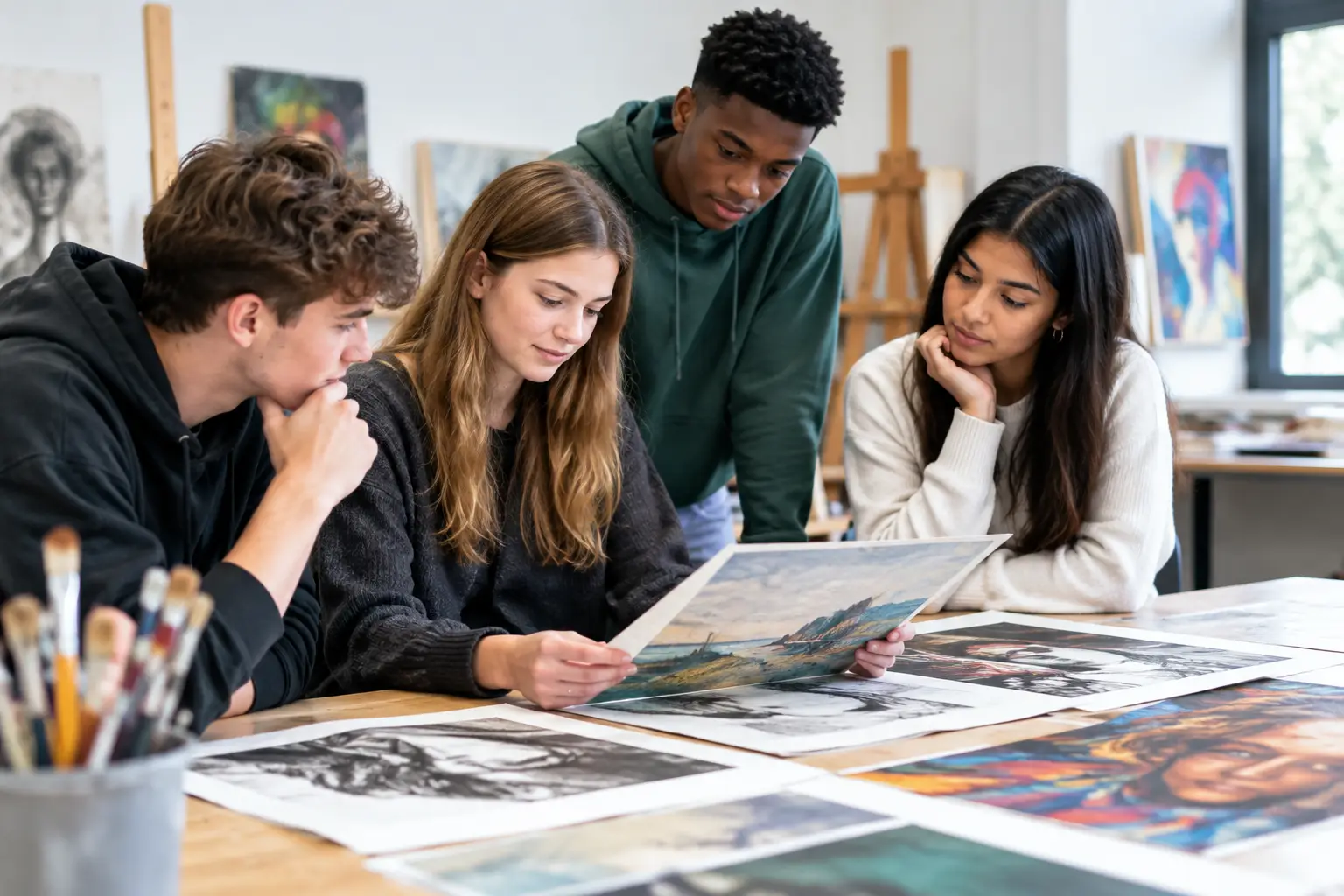
A final piece should not feel like a surprise at the end of your project. When you select final outcomes, you are choosing the response that best proves where your ideas, research, experiments and decisions have led. For GCSE and A Level Art, Photography or Graphic Communication, the strongest outcome is rarely just the neatest or most time-consuming piece. It is the one that makes your development visible.
This can take pressure off. You do not need to guess what an examiner wants or produce one huge piece that includes every idea you have had. You need to make a purposeful choice, then present that choice with confidence.
What does “select final outcomes” really mean?
A final outcome is your resolved response to a project theme. It might be a painting, photograph series, sculpture, textile piece, print, editorial spread, poster, book or digital design. It should bring together the most successful parts of your project in a way that feels intentional.
The word select matters. A high-marking portfolio shows judgement. You have tested possibilities, reviewed what happened, and chosen the visual direction with the greatest potential. This is much stronger than copying your first experiment onto a larger sheet simply because the deadline is close.
Your chosen outcome should connect clearly to all four Assessment Objectives:
- AO1 is evident through relevant artists, photographers or designers and the way their work has informed your own ideas.
- AO2 is shown through experimentation, material choices, refinements and risk-taking.
- AO3 appears in your observations, photographs, drawings, source material and recording.
- AO4 is the final response itself: a personal, meaningful and well-realised outcome.
AO4 is not separate from the rest of the project. A final piece becomes convincing because the pages before it explain why it exists.
Start with the strongest visual direction
Before deciding on materials or size, look back through your sketchbook, workbook or digital portfolio. Identify the moments where your project became most interesting. This may be a cropped photograph with dramatic lighting, a layered monoprint, a quick drawing with energetic marks, or a colour combination that changed the mood of your work.
Ask yourself: which idea could I develop further without repeating myself? The answer should be based on evidence, not just preference.
For example, imagine a project based on identity. You may have explored portrait photography, distorted drawings and collage. Your collage page may look colourful, but your photographs might communicate the theme more powerfully because they use reflections and obscured faces. A final photographic triptych with collage elements could be the better outcome. It draws from your research, develops your own photos and gives you room to refine composition, editing and meaning.
The best choice is sometimes not your favourite experiment. It is the idea with enough depth to carry a final response.
Look for development, not a finished-looking page
Students often choose an experiment because it already looks polished. That can be useful, but only if you can push it further. If the final outcome is almost identical to a small practice piece, it may suggest limited development.
Instead, choose an approach that gives you decisions to make. Could you alter the scale, composition, viewpoint, surface, colour palette or combination of media? Could you use your own primary photographs in a more unusual way? Could you take a technique from an artist study and adapt it to say something personal?
A final outcome needs resolution, but it should also show that you have moved forward.
Use a simple test before you commit
It is sensible to have more than one possible idea, especially early in the project. However, trying to make three different final pieces at once usually weakens your time, focus and refinement. Test your options against the same questions.
First, does this outcome answer the project theme clearly? Second, can you show where the idea came from in earlier work? Third, does it use your own observations, photographs or drawings? Finally, do you have the practical skills, materials and time to complete it to a strong standard?
If one idea is exciting but would require techniques you have not practised, do not automatically reject it. You may be able to build in a focused test before committing. But be honest about the deadline. Ambition helps only when it is supported by purposeful preparation.
A smaller, highly resolved outcome with clear connections to your project can achieve more than a large piece rushed in the final week.
Build a bridge from experiments to the final piece
The pages immediately before your final response are often where marks become clearer. They should show your plan taking shape. This does not mean every page needs to be a formal design sheet, but the viewer should be able to follow your decision-making.
Create a few composition studies based on your strongest source material. Try different crops, arrangements or viewpoints. If you are working in photography, make contact sheets or edit variations and explain which image has the strongest atmosphere. If you are producing a graphic design outcome, test typography, hierarchy, layout and colour before producing the final version.
Then annotate with specific decisions. Avoid writing, “I like this one best.” Explain what you have noticed: “The close crop removes unnecessary background detail and makes the reflection feel more unsettling.” This demonstrates visual understanding and gives your final outcome a clear purpose.
You can also make a small material trial. Test the paper, paint, printing method, photographic finish or digital process you plan to use. This is particularly valuable if you are combining media. It prevents technical problems from taking over the final piece and provides strong AO2 evidence.
Select final outcomes with AO4 in mind
AO4 asks you to present a personal and meaningful response. That does not mean your work needs a complicated message or a completely new invention. It means your choices should belong to this project and reflect your investigation.
A portrait of a family member can be personal because you took the photograph, chose the expression, edited the lighting and connected it to your theme. A still life can be meaningful because the objects have a story, and your composition has been informed by careful artist research. Even an abstract response can be personal when its marks, colours and structure grow from your own observations.
Avoid choosing an outcome only because it resembles an artist’s work. Artist research should give you methods and possibilities, not a finished answer to copy. Show what you learned, then change the subject matter, imagery, process or intention so your own voice is visible.
Make practical choices that improve presentation
Your final outcome should be presented carefully, but presentation is not only about mounting work neatly. Consider whether the scale supports your idea. A delicate pencil drawing may lose its impact if enlarged beyond the level of detail you can control. A bold graphic poster may need space to make its type and imagery work.
Choose materials that match the effect you want. Watercolour paper, cartridge paper, photographic paper, acetate, cardboard and a digital screen can all create different results. There is no single “best” material. The right choice is the one you can control and justify through testing.
Leave enough time to photograph or scan your completed work well, particularly for online portfolios. Check that images are in focus, evenly lit and cropped accurately. For 3D work, photograph it from more than one angle so its form and surface can be understood.
If your outcome does not go exactly as planned, do not panic. Evaluate it honestly. A short reflection explaining what worked, what you would improve and how it relates to your intentions can show mature judgement. Do not use evaluation as an excuse for unfinished work, but recognise that reflective practice is part of being an artist or designer.
Do not wait for permission to choose
Many students keep experimenting because they are worried about choosing the wrong idea. Experimentation is valuable, but endless testing can become avoidance. Once you have sufficient evidence, select a direction and give it the attention it deserves.
A useful sign that you are ready is when you can explain your plan in one clear sentence: “I will create a mixed-media portrait using my own photographs and stitched line to communicate the tension between public and private identity.” If you cannot explain it yet, your next step is not necessarily more work. It may be a clearer decision.
Your final outcome does not need to prove that you can do everything. It needs to show that you can develop an idea with purpose. Choose the response that carries your strongest visual evidence forward, then give yourself enough time to make it the work you know it can be.
No responses yet