
Home › Art Project Ideas › Light and Shadow
Light and Shadow is an excellent GCSE or A Level Art and Design theme because it can be observed, controlled and interpreted in many different ways. A lamp can turn an ordinary object into a dramatic Fine Art composition; sunlight can transform a familiar street into an abstract photograph; and a cast shadow can become the central idea behind a Graphic Communication campaign.
The strongest projects do not simply collect attractive silhouettes. They investigate how light reveals form, creates atmosphere, directs attention, changes colour and controls what an audience can see. Shadow can suggest absence, secrecy, fear, protection, passing time or an unseen presence. This guide contains practical starting points, artist links and original exemplar routes for GCSE and A Level Fine Art, Photography and Graphic Communication.
What can Light and Shadow mean in an art project?
| Interpretation | First-hand sources | Questions to explore |
|---|---|---|
| Form and tone | Simple objects, faces, hands, fabric, plants and sculpture | How does directional light make a flat image feel three-dimensional? |
| Time | One place recorded hourly, sundials, changing window light | Can a moving shadow show time passing? |
| Presence and absence | Empty rooms, doorways, footprints, clothing and partial figures | Can a shadow suggest someone who is not visible? |
| Revelation and concealment | Curtains, screens, masks, blinds, mist and projected light | What does the light reveal, and what remains hidden? |
| Identity | Portraits, silhouettes, personal possessions and domestic spaces | Can a shadow communicate character without showing a face? |
| Pattern and abstraction | Railings, staircases, leaves, lace, mesh and architecture | When does a shadow stop describing an object and become a design? |
| Drama and emotion | Single lamps, candles, stage lighting, coloured gels | How can contrast change the mood of the same subject? |
| Communication | Posters, packaging, projection, signs and public spaces | How can light or negative space make an audience look twice? |
GCSE and A Level: what should be different?
| GCSE | A Level |
|---|---|
| Choose one clear aspect of Light and Shadow that can be investigated thoroughly. | Develop a sustained enquiry around a question, contradiction or personal context. |
| Collect purposeful first-hand photographs, observations and tonal studies. | Build and edit a substantial body of interconnected primary research. |
| Investigate relevant artists and explain how their choices inform practical work. | Compare contexts, intentions and visual languages critically rather than producing biographies. |
| Test lighting, viewpoints, materials, crops, compositions and presentation. | Take informed risks with light, projection, scale, sequence, space and material. |
| Refine a personal outcome that clearly grows from earlier experiments. | Resolve a sophisticated body of work in which concept, technique and presentation reinforce one another. |
At both levels, the project should connect the four assessment objectives. Artist research should trigger practical responses; first-hand recording should supply material for experiments; evaluation should determine what you develop; and the final response should emerge logically from the journey. Use the GCSE AO1, AO2, AO3 and AO4 guides, or the corresponding A Level AO1, AO2, AO3 and AO4 guides.
Light and Shadow project idea generator
- Shadow walk: follow one familiar route and record shadows made by railings, bicycles, trees, signs and people.
- One object, six moods: light the same object from above, below, behind and each side using warm and cool light.
- Window rhythm: record stripes and grids created by blinds, curtains and window frames.
- Growing shadows: photograph the same object every hour as the sun changes direction.
- Distorted portrait: project leaves, lace, water, handwriting or geometric patterns across a face or hand.
- Absent person: suggest somebody through their shadow, clothing, chair or illuminated space without showing them directly.
- Domestic stage: transform an ordinary kitchen, bedroom or hallway using one controlled light source.
- Hidden words: arrange objects or cut card so their cast shadows spell a message.
- Paper theatre: create layered silhouettes for a story, animation or campaign.
- Negative-space portrait: build a face or figure from the unprinted area between dark shapes.
- Night journey: investigate pools of street light, headlamps, illuminated windows and darkness between them.
- Natural projection: trace shadows from leaves or branches as they move across walls and bodies.
- Scale illusion: move a small object close to a lamp so its shadow becomes monumental.
- Transparent layers: pass light through acetate, glass, coloured plastic, water or fabric.
- Light drawing: use a slow shutter and a small moving torch to draw in space.
- Photogram collection: arrange personal or natural objects directly on photographic paper where facilities allow.
- Safety and visibility: design a campaign about being seen when walking or cycling after dark.
- After-dark identity: create branding for a night-time arts, theatre, film or light festival.
- Energy and waste: use light and darkness to communicate energy conservation or light pollution.
- Memory: project old photographs or handwriting into present-day spaces.
- Surveillance: explore spotlights, exposure, anonymity and who controls what can be seen.
- Protection: treat shade as shelter from heat, attention or danger.
- Two viewpoints: show both an object and the unexpectedly different image made by its shadow.
- Temporary drawing: make an artwork that exists only while the light is in one position.
Fine Art Light and Shadow ideas
Fine Art students can begin with tonal observation and then allow light itself to become a material. Pencil, charcoal, chalk and ink are ideal for studying the transition between highlight, mid-tone, core shadow, reflected light and cast shadow. Paint can add temperature: warm illumination against cooler shadows often creates depth, while a restricted monochrome palette emphasises structure. Cut paper, wire, gauze, translucent fabric, acetate and projection can move the enquiry from the sketchbook into three-dimensional space.
GCSE Fine Art exemplar: ordinary objects transformed by light
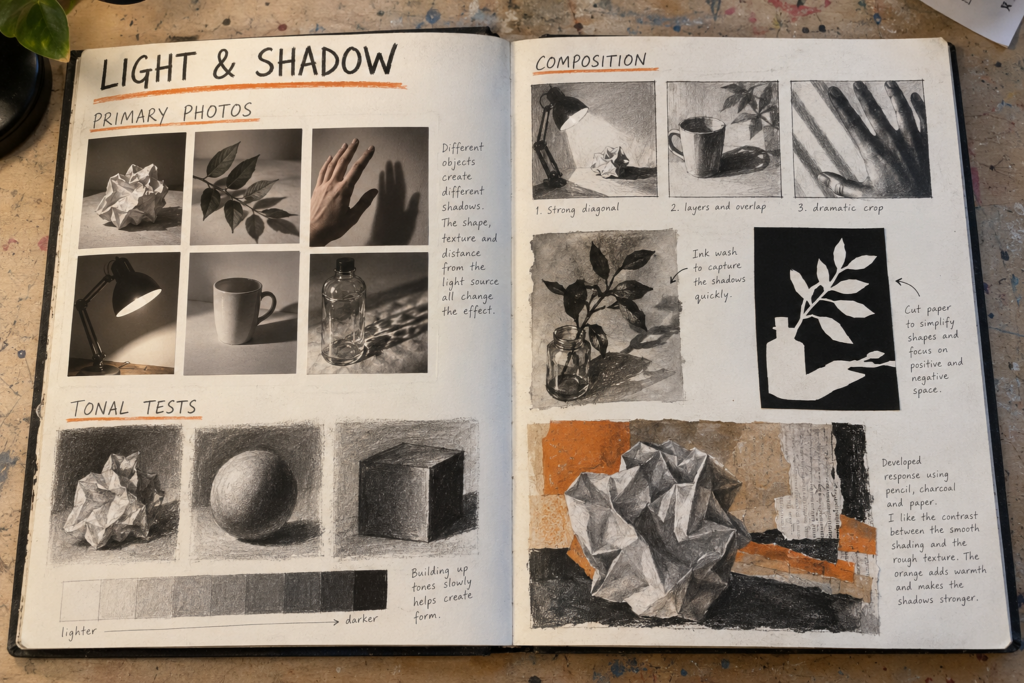
A focused GCSE question could be: “How can light make ordinary objects dramatic?” Arrange crumpled paper, a plant, a mug or a hand beside a movable desk lamp. Photograph each subject from several viewpoints and change the height and direction of the light. Produce a value scale, short timed drawings, a controlled charcoal study and a loose ink wash. Simplify one photograph into black-and-white cut paper, then combine the strongest shapes, texture and lighting in three composition thumbnails before making a larger response.
A Level Fine Art exemplar: absence and presence
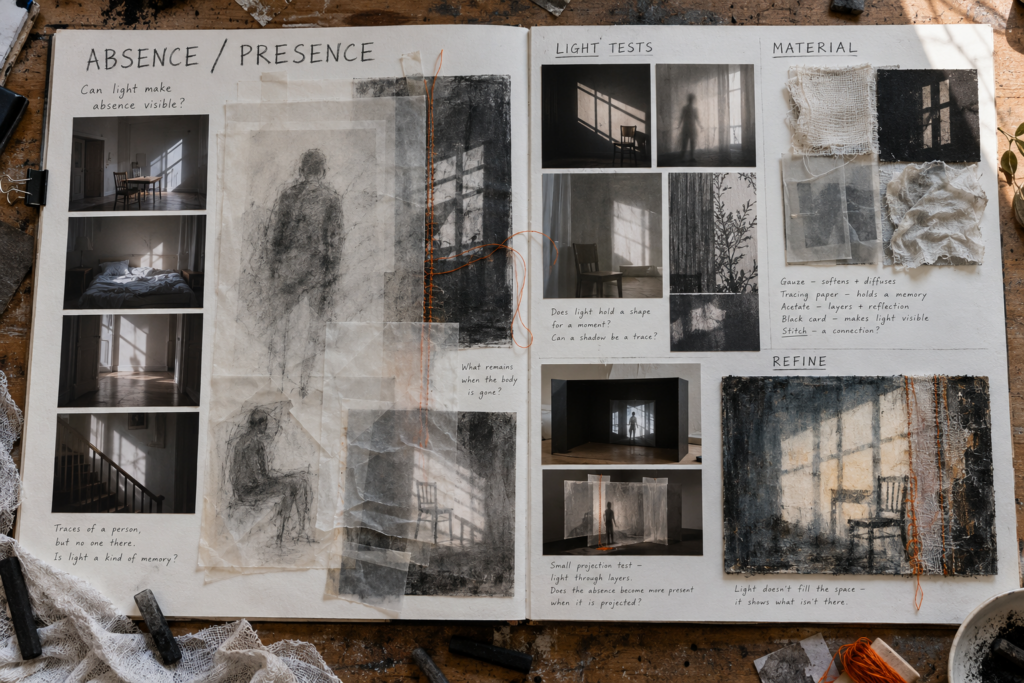
An A Level enquiry might ask, “Can light make absence visible?” Photograph empty domestic spaces at times when sunlight creates a strong presence. Introduce curtains, chairs, clothing or barely visible figures, then test what happens when information is erased or obscured. Layer tracing paper over charcoal; stitch the path of light; project photographs through gauze; and construct small installation models. A resolved work might combine projection, translucent panels and an incomplete drawing so the image appears differently as the viewer moves.
Further Fine Art possibilities include:
- paint the cast shadow rather than the object producing it;
- make a diptych showing the same room in strong sunlight and near darkness;
- draw with an eraser into a charcoal-covered surface;
- cut, fold or suspend paper so a lamp completes the artwork;
- trace one moving shadow repeatedly to record time;
- combine opaque and translucent materials in a layered portrait;
- use scale to turn a tiny object into an imposing shadow;
- create a temporary installation that changes throughout the day.
Photography Light and Shadow ideas
Photography literally depends on light, so this theme can support both technical learning and personal enquiry. Use a low ISO where possible for clean detail, but accept grain if it strengthens a night-time atmosphere. Exposure compensation or manual exposure helps prevent the camera from turning a carefully dark image into an evenly bright one. Meter for the illuminated area, check that important highlights are not completely clipped, and test whether detail in the shadow is necessary. Shoot in colour even if you may later convert to black and white, and keep every original beside edited versions.
GCSE Photography exemplar: Shadow Walk
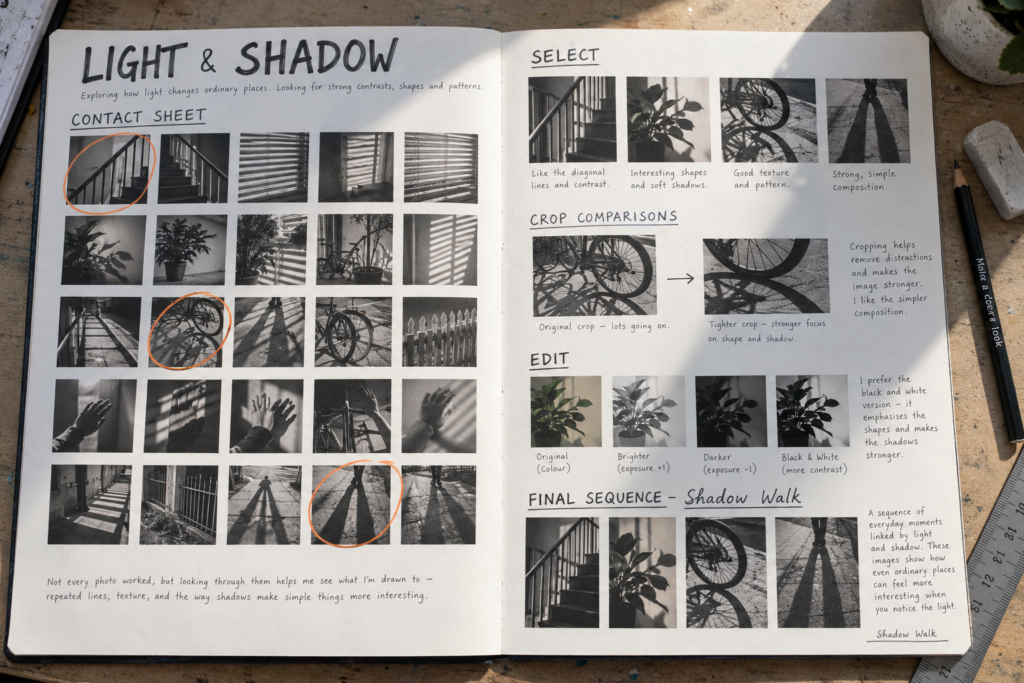
For GCSE, complete a “Shadow Walk” around school, home or a local route in low morning or late-afternoon light. Photograph stairs, railings, bicycles, fences, hands and plants. On a contact sheet, identify images with strong shape, pattern and viewpoint—not only the darkest photographs. Compare a loose and tight crop, then test colour, monochrome and controlled exposure adjustments. A final sequence of four to six images could move from recognisable subjects towards abstraction.
A Level Photography exemplar: Thresholds

An A Level project could investigate “Thresholds: what is revealed and concealed by light?” Photograph partial figures behind curtains, illuminated doorways, empty rooms and projected patterns across clothing. Repeat the shoot with different exposures, movement and warm or cool colour. Try long exposure, transparent prints and pairings in which one image changes the meaning of another. Edit the final sequence so the rhythm of visibility and darkness carries the idea; do not simply select five individually attractive photographs.
Further Photography approaches:
- photograph a face using side light, backlight and light from below;
- capture people only through their shadows or silhouettes;
- use blinds, lace or perforated card as handmade light modifiers;
- record light pollution and the boundary between city and night sky;
- make a typology of pools of light along one street;
- compare hard midday shadows with soft overcast light;
- make camera-less photograms using school darkroom procedures;
- use long exposure to record moving torches or passing lights;
- print one image at different brightness levels and sequence the disappearance of detail.
Graphic Communication Light and Shadow ideas
In Graphic Communication, light and shadow should help deliver a message to a defined audience. High contrast can establish hierarchy and distance legibility. Silhouette can reduce an image to its most recognisable shape. Negative space can hide a second meaning. Projection and shadow lettering can make an identity responsive to place or time. Suitable outcomes include posters, campaigns, editorial illustration, publishing, packaging, identity, animation, wayfinding and digital content.
GCSE Graphic Communication exemplar: BE SEEN
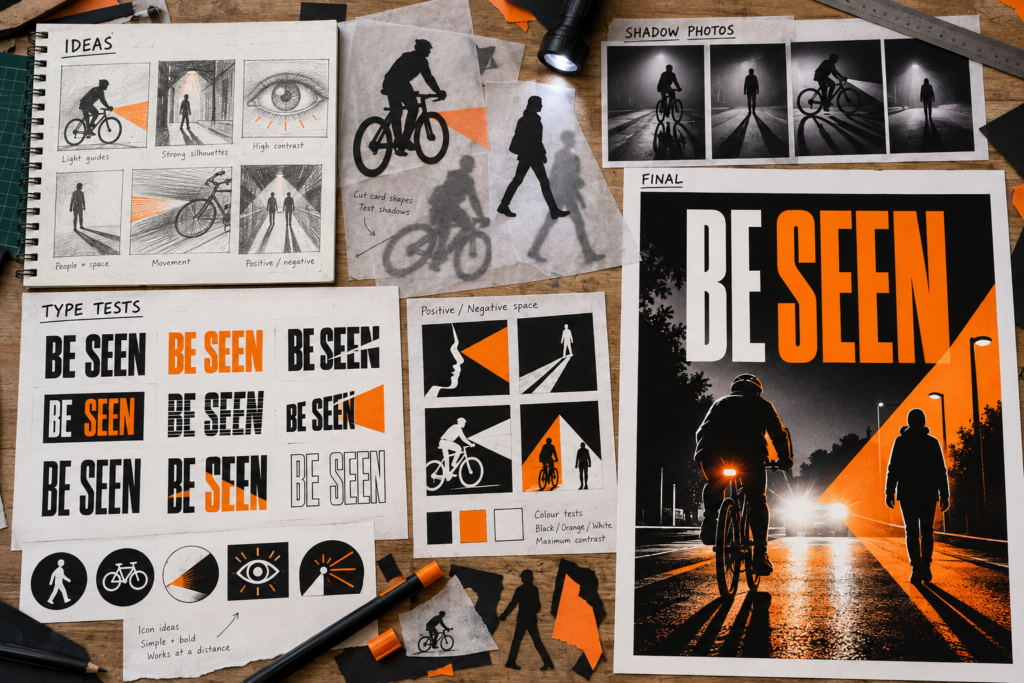
A GCSE brief could ask for a poster encouraging young cyclists and pedestrians to be visible after dark. Take your own torch-lit photographs and create simple cut-card silhouettes. Test bold condensed lettering, positive and negative space, pictograms and a restricted black, white and orange palette. Compare versions from a distance: is the message readable before the detail? Develop the strongest idea into an A3 poster and one social-media adaptation rather than adding unrelated formats.
A Level Graphic Communication exemplar: AFTER DARK
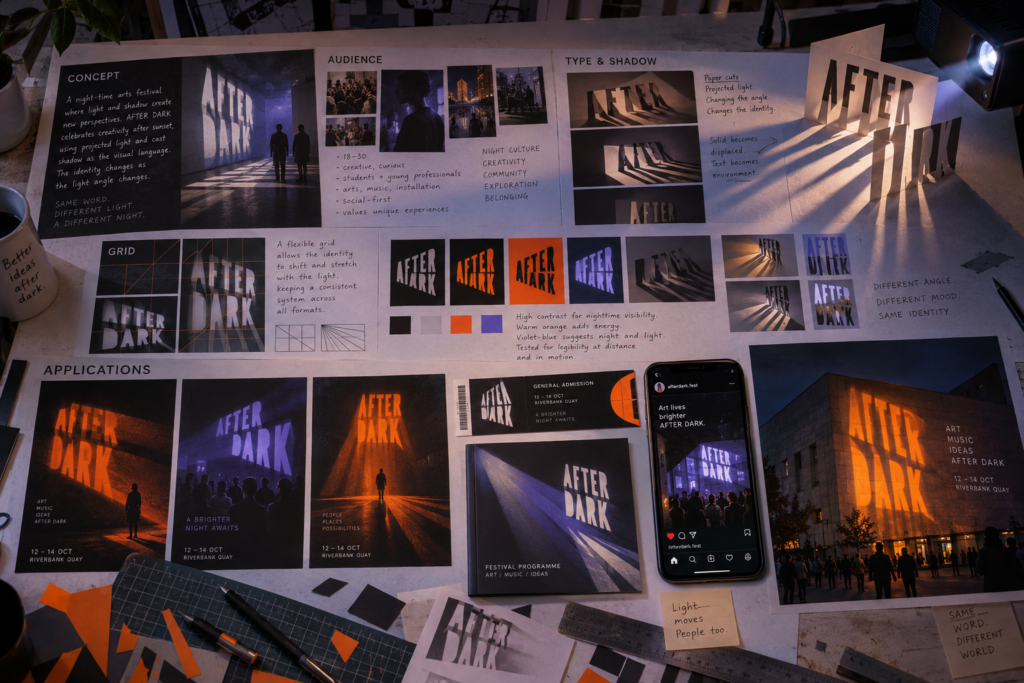
An A Level brief might develop a visual identity for a fictional night-time arts festival called “AFTER DARK”. Research the audience, venue, competing cultural events and after-dark legibility. Build letters from folded or cut paper, project light through them and photograph how their shadows change. Develop a modular grid and test whether the shifting identity remains recognisable. Resolve the system across posters, programme, ticket, social assets and an environmental projection, selecting formats that demonstrate a coherent idea rather than quantity.
Other Graphic Communication possibilities include:
- a book cover that uses negative space to reveal a second character;
- packaging whose message appears when light passes through a cut-out;
- a shadow-puppet animation for a public-information message;
- an energy-saving campaign using disappearing typography;
- wayfinding for a night exhibition or theatre venue;
- a projection-based music or performance identity;
- an editorial illustration about privacy or surveillance;
- a series of posters that changes from day to night;
- a photographic alphabet made from cast shadows.
Artists, photographers and designers to investigate
Research a small number of practitioners who genuinely connect with your direction. Analyse particular works, identify how light or shadow affects meaning, and follow the research with your own first-hand experiment. The purpose is not to copy an artist’s finished image or fill a page with biography. The guide to developing your own ideas from artist research explains this process in more detail.
| Practitioner | What to investigate | Possible personal response |
|---|---|---|
| Caravaggio | Chiaroscuro, directional light, focal emphasis and dramatic narrative. | Light one ordinary group or still life from the side and test how contrast directs attention. |
| Joseph Wright of Derby | Figures gathered around a luminous source; observation, knowledge and drama. | Arrange objects or hands around one central light and make warm/cool studies. |
| Kumi Yamashita | Constructed objects and a single light source working together to create shadow images. | Fold or arrange simple materials so the cast shadow reveals an unexpected figure. |
| Man Ray | Camera-less “rayographs”, transparency, silhouette and making familiar objects strange. | Produce a photogram or imitate the principle digitally using your own collected objects. |
| Fan Ho | Strong geometry, shafts of light, figures and atmosphere in urban black-and-white photography. | Return to one location when low sunlight forms strong diagonals and wait for a figure to enter. |
| Lotte Reiniger | Hand-cut silhouette, gesture, articulation, sequencing and visual storytelling. | Create jointed paper figures or a short sequence communicating without facial detail. |
| Noma Bar | Minimal shapes and negative space that produce a second image or meaning. | Reduce your own photograph to two tones and make the background carry another message. |
| László Moholy-Nagy | Experimental photography, photograms, transparency, movement and light as a creative medium. | Layer transparent materials, perforations and moving light in a series of tests. |
A step-by-step Light and Shadow project plan
- Turn the theme into a question. Choose a tension such as visible/hidden, safe/exposed, natural/artificial, temporary/permanent or presence/absence.
- Run a lighting investigation. Photograph one subject using several directions, heights, distances, colours and qualities of light.
- Collect wider primary evidence. Complete at least one location shoot or observational session connected to your question.
- Select evidence. Identify the images with the most useful structure or meaning and explain why they should be developed.
- Investigate relevant practitioners. Analyse specific work, context and process, then respond using your own subject matter.
- Experiment broadly. Test tone, crop, exposure, colour, material, scale, projection, negative space, typography or sequence as appropriate.
- Evaluate and narrow. Compare experiments against the original question. Preserve instructive failures and state the next change.
- Plan alternatives. Produce thumbnails, test prints, maquettes, storyboards or mock-ups before committing to the final format.
- Refine technical control. Repeat the strongest process with more purposeful lighting, composition, material or hierarchy.
- Resolve and review. Make the outcome, document it accurately and explain how the final decisions grew from the project.
Useful annotation prompts
- Where is the light coming from, and how does that control the composition?
- Which details are revealed, softened, exaggerated or lost?
- Is the shadow describing form, creating pattern or carrying an idea?
- How did the time of day, angle or distance change the result?
- What did I learn from the practitioner rather than merely imitate?
- Which experiment communicates my intention most clearly, and why?
- What needs to be repeated with greater control?
- How will scale, surface, sequence or display change the audience’s experience?
Common mistakes—and how to improve them
- Photographing random shadows. Create a question, route, subject group or repeatable rule.
- Crushing every shadow to pure black. Decide whether texture and information in the dark areas matter.
- Using a filter as development. Compare edits and explain which visual decision serves the intention.
- Relying on downloaded images. Generate the project from your own photographs, drawings and lighting tests.
- Copying a recognisable artwork. Borrow a principle—such as one light source or negative space—and change the subject and meaning.
- Making one polished outcome too early. Show alternatives, selection, rejection and refinement.
- Ignoring purpose in Graphic Communication. Define audience, setting, message, action and viewing distance.
- Adding projection without testing it. Record the projector angle, ambient light, surface and viewpoint that make the work effective.
Light-source safety and responsible photography
Use cool-running LED lamps wherever possible. Do not cover lamps, touch hot bulbs, overload sockets or leave cables across walkways. Clamp or stabilise lights and suspended materials securely. Never look directly into a powerful lamp, laser or projector beam, and obtain technician or teacher approval for electrical, darkroom, installation or public-space work. When photographing after dark, work with an appropriate adult or group, remain in safe public areas, use visible clothing and never stand in roads or distract drivers. Obtain permission before photographing identifiable people or private interiors.
Frequently asked questions
Is Light and Shadow too broad for an art project?
It is an excellent theme, but it needs narrowing. “Shadows” is a starting label; “How late-afternoon shadows alter my journey home” or “Can projected light reveal and conceal identity?” provides a clearer enquiry.
What is chiaroscuro?
Chiaroscuro means “light-dark” and describes clear tonal contrasts used to model form or create dramatic emphasis. Caravaggio and other painters used it powerfully, but your response should use your own subject and lighting rather than copy a historical composition.
Do I need specialist lighting?
No. A window, desk lamp, torch, phone light or sunlight can produce excellent primary research. Control the room light, stabilise the source, use tracing paper only with a cool LED and never place material over a lamp.
How can I create stronger shadows?
Use one small, directional source rather than several diffuse lights; move it closer to the subject; reduce surrounding light; and place the subject near a plain surface. Test the position rather than assuming darker is always better.
Should Light and Shadow photography be black and white?
Not necessarily. Monochrome emphasises tone, shape and pattern, while colour can communicate temperature, time, artificial light and atmosphere. Compare both, keep the original and justify your selection.
Can Graphic Communication students use this theme?
Yes. Silhouette, negative space, projection, high contrast, transparent materials and changing shadow can become purposeful devices in identity, editorial illustration, campaigns, packaging, animation and wayfinding.
Can I use AI-generated images?
Check the current rules of your examination board and centre. AI should not replace first-hand recording, practical skill or evidence of your own development. If its use is permitted, document the process honestly. Read Can I Use AI Image Generation in GCSE or A Level Art?
How do I make an A Level project more sophisticated?
Develop a sustained question, repeat primary research under controlled conditions, compare contexts, test how display affects meaning and edit your work rigorously. Sophistication comes from purposeful relationships and independent judgement—not simply from darker images, more pages or complicated vocabulary.
Would an independent portfolio review help?
If you are unsure which Light and Shadow direction has the greatest potential—or whether your development connects strongly enough with AO1–AO4—Portfolio to A Star can provide practical, personalised guidance based on the evidence visible in your work.
For course-specific guidance, visit GCSE Fine Art, GCSE Photography, GCSE Graphic Communication, A Level Fine Art, A Level Photography and A Level Graphic Communication. You can also browse GCSE Art Help, A Level Art Help and free Art and Design resources.
No responses yet