
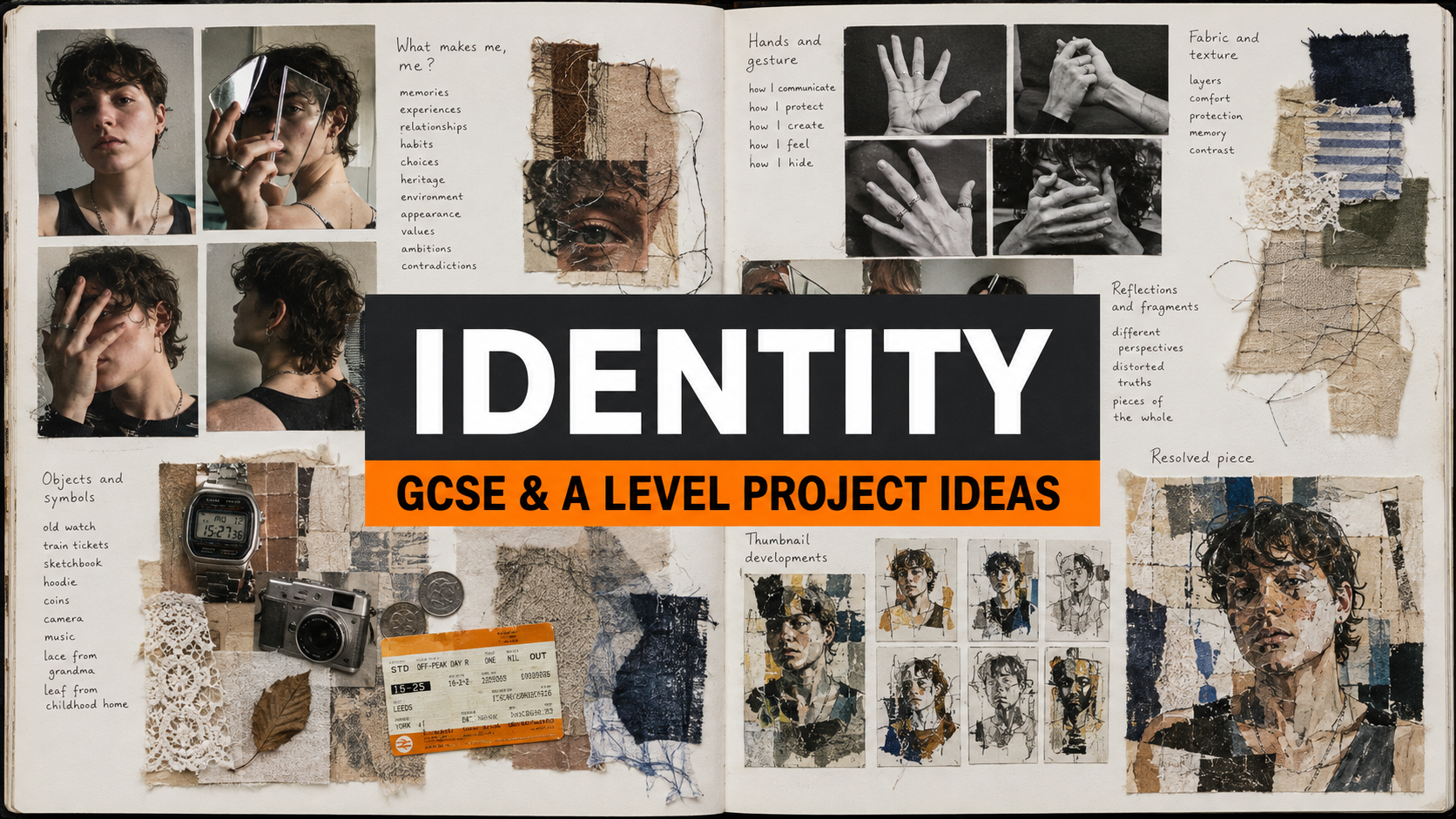
Identity can be visible, hidden, inherited, invented, performed or changed. It may be communicated through a face, but it can also be suggested by clothing, gesture, possessions, language, memory, place, family history, community, absence or the version of ourselves that we present to other people. This makes identity an exceptionally rich starting point for a GCSE or A Level Fine Art, Photography or Graphic Communication project.
This guide offers an original project or controlled-test starting point, artists and photographers to investigate, practical exercises, sketchbook directions and possible outcomes. You can also return to the Portfolio to A Star home page, explore the GCSE Art hub or visit the A Level Art advice hub.
Suggested project or controlled-test starting point
Who we are is shaped by the way we see ourselves, the way others see us and the histories, places, relationships and choices that surround us. Creative practitioners may communicate identity through portraiture, clothing, gesture, personal objects, constructed characters, archives, text, symbolism, materials or the spaces people inhabit.
Investigate relevant visual and contextual sources, then develop a personal response exploring one aspect of identity.
- the private self and the public self;
- belonging, heritage and place;
- identity expressed through objects, clothing or personal spaces;
- roles, masks, alter egos and performed identities;
- change, memory, ageing or the traces people leave behind;
- individual identity within a family, friendship group or community.
This is an independently written project suggestion. It is not an official examination-board question, and it does not reproduce the wording of any published examination paper.
Identity does not have to mean a conventional portrait
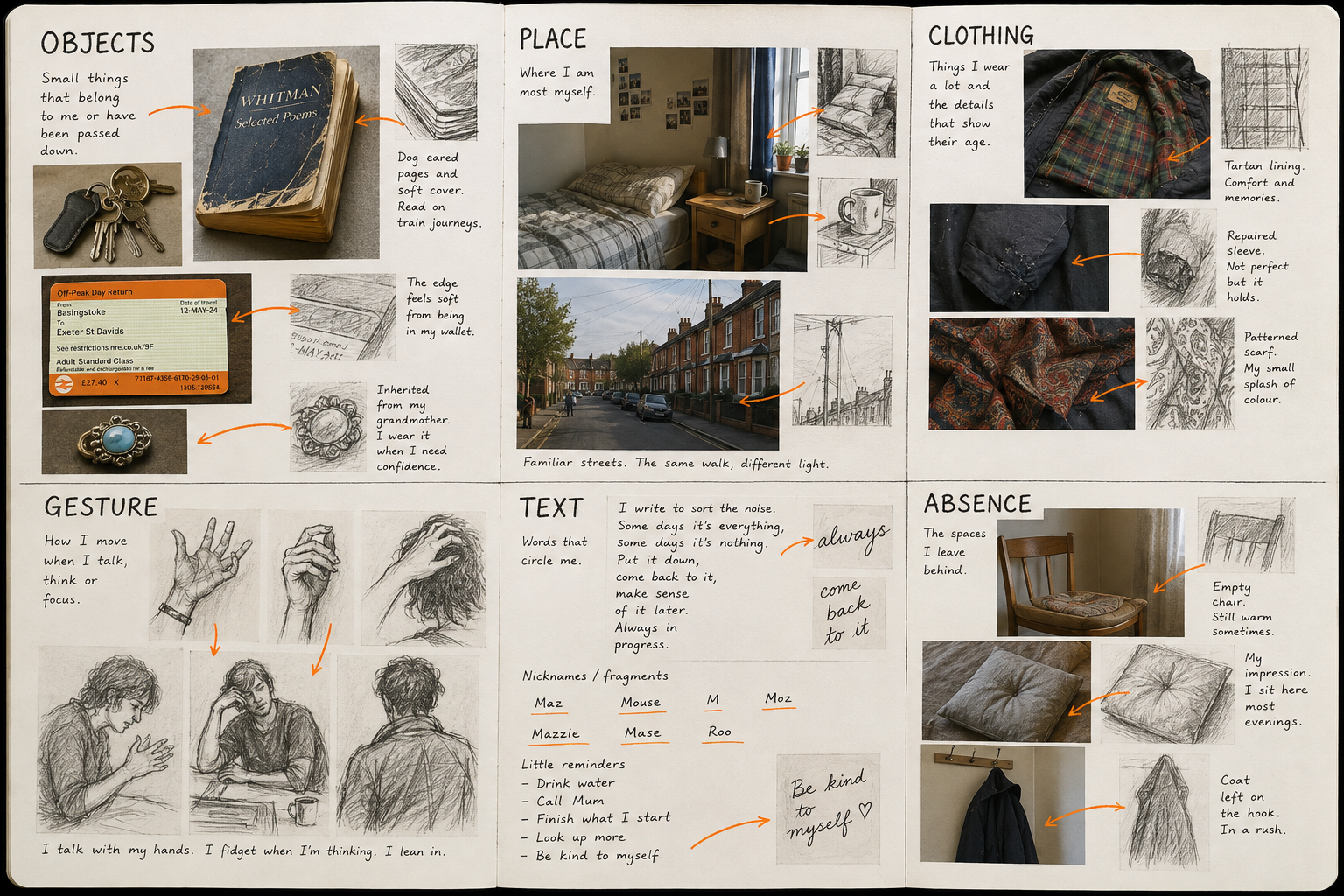
A face can reveal age, expression, mood and appearance, but it cannot show everything about a person. Stronger projects often compare what is immediately visible with what remains private, uncertain or deliberately constructed. Consider how identity might be communicated through:
- Possessions: keys, books, jewellery, shoes, tickets, collections, tools or everyday objects.
- Place: bedrooms, workplaces, streets, journeys, family homes or locations connected to belonging.
- Clothing and appearance: uniforms, inherited garments, handmade clothing, make-up, hair or deliberate styling.
- Gesture and posture: hands, stance, movement, nervous habits or repeated actions.
- Language: handwriting, names, nicknames, dialect, messages, diaries, labels or words imposed by others.
- Memory and archive: old photographs, documents, recipes, maps, audio recordings or family stories.
- Absence: an empty chair, a worn surface, an unoccupied room or objects left behind.
- Performance: costumes, masks, staged roles, avatars, online presentation or invented characters.
Artists and makers to investigate
Do not treat artist research as a biography exercise. Select a practitioner because a particular decision—material, viewpoint, symbolism, scale, narrative or way of representing a person—can help your own project develop. Analyse that decision, test it practically and then adapt what you discover to your own sources.
Lubaina Himid
Himid uses painting, installation, objects and staged figures to examine representation, history and Black British experience. A student might investigate how colour, pattern, pose and surrounding objects help a figure occupy space with confidence and agency.
Yinka Shonibare
Shonibare works across sculpture, painting, photography, film and installation to question cultural identity, history, class and ideas of authenticity. His work can prompt thoughtful investigation into hybrid identity, inherited narratives and the complicated meanings carried by clothing and decorative pattern.
Bisa Butler
Butler constructs large textile portraits using layered fabrics, colour and pattern. Rather than copying her appearance, investigate how different materials can carry associations with family, community, status, memory and cultural experience.
Photographers and performance-based artists
- Zanele Muholi uses portraiture and self-portraiture to address visibility, representation, community and self-definition. Consider lighting, direct gaze, tonal contrast and the politics of who controls an image.
- Gillian Wearing explores the distance between public appearance and private experience through masks, signs, confession and role-play.
- Cindy Sherman constructs fictional characters to examine stereotypes and the visual codes through which identities are recognised.
- Samuel Fosso uses theatrical self-portraiture, costume, pose and lighting to inhabit different social and historical roles.
- Jo Spence used photography to question class, health, family roles and the power relationships involved in making and viewing portraits.
- Claude Cahun used self-portraiture, costume, mirrors and performance to challenge fixed ideas about appearance and gender.
- Sophie Calle combines photographs, text, rules, observation and personal narrative. Her practice can inspire projects in which identity is assembled through fragments rather than revealed in one image.

Important: use these links for research and analysis. Do not copy an artist’s finished composition or download their artwork for use as your own. Acknowledge every external source and build practical responses from photographs, drawings, objects and experiences that belong to your investigation.
Fine Art project routes
1. A portrait made from possessions
Select five to ten objects connected to one person. Photograph and draw them individually, then arrange them by use, age, emotional importance, colour or scale. Explore close cropping, overlapping silhouettes, relief, casting, print, collage or an installation in which the absent person is suggested through what remains.
2. Layers of belonging
Begin with your own photographs of places, people, fabrics, handwriting or family objects. Test translucent layers, stitched paper, maps, transfer printing, repeated motifs, fragments of text and partially erased imagery. The aim is not to decorate a portrait but to discover how materials can suggest competing histories, attachments or cultural influences.
3. The face we show
Make paired studies of the same person: composed and unguarded, public and private, detailed and obscured, calm and exaggerated. Investigate masks, mirrors, repeated profiles, cut paper, expressive colour, distortion or sculptural fragments. Refine the contrast between the two states rather than making two unrelated portraits.

Fine Art styles and genres worth testing
- observational, expressive or symbolic portraiture;
- collage, photomontage and fragmented imagery;
- textile portraiture, appliqué, embroidery or constructed clothing;
- assemblage using personal or found objects;
- installation based on rooms, archives, clothing or absence;
- Surrealism using transformation, doubling, scale and dream-like association;
- Expressionism using colour, mark and distortion to communicate an internal state;
- a series of related works rather than one isolated final image.
Graphic Communication project routes
In Graphic Communication, identity can refer to a person or community, but it can also mean the visual identity through which an organisation, event, place or campaign presents itself. Strong work begins with a defined audience and message, then develops an appropriate system of imagery, typography, colour, pattern, layout and application.
1. A visual identity based on a person or place
Create an identity for an invented local exhibition, youth festival, archive, community project or cultural event. Gather original photographs, handwriting, signs, textures, colours and stories from the chosen place or group. Develop a visual system rather than one isolated logo, then test it across a poster, programme, social tile, ticket, wayfinding sign or publication cover.
2. Labels, assumptions and public image
Develop a campaign that questions the labels attached to age, appearance, interests, accent, occupation or community. Combine your own portrait or object photography with short statements, redaction, overprinting, scale changes and contrasting type voices. Test whether the message remains understandable at poster distance and on a small screen.
3. A collective portrait in editorial form
Create a zine, fold-out publication or short digital editorial feature representing a club, street, family, class or neighbourhood. Combine original photographs, interviews, objects, maps, quotations and observed lettering. Use grid, hierarchy, sequence and pacing to allow different voices to remain distinct while contributing to one coherent identity.
Designers and artists to investigate
- Barbara Kruger combines appropriated imagery and forceful text to question power, representation, consumer culture and the messages through which people are defined. Investigate hierarchy and the relationship between words and images, not a direct imitation of her familiar visual style.
- Paula Scher develops flexible identities across print, environments and public communications. Her work is useful when considering how one visual language adapts coherently across different formats.
- Morag Myerscough uses bold colour, pattern, type and spatial design to create a sense of place, participation and community identity.
- Corita Kent combined screen print, found language, advertising fragments and handwritten text to communicate personal values and social ideas with energy and immediacy.

Graphic Communication styles and genres worth testing
- visual identity and branding systems;
- campaign posters and social communications;
- editorial design, zines and artists’ books;
- expressive typography and hand lettering;
- photomontage, collage and image-text combinations;
- information design based on personal or community data;
- wayfinding, exhibition graphics and environmental design;
- motion graphics or short title sequences.
Photography project routes
1. Identity without showing a face
Photograph one person through their hands, clothing, room, routines, collections, reflected fragments or traces of activity. Begin with a broad shoot, edit ruthlessly and then reshoot the gaps. A final sequence could gradually reveal a character while never including a conventional head-and-shoulders portrait.
2. Performed selves
Create several fictional or exaggerated versions of the same subject using costume, setting, pose, lighting and facial expression. Keep the camera position or composition consistent so that differences can be compared. Ask what visual clues make the viewer assign a role, status, mood or personality.
3. People and place
Investigate how a location contributes to individual or shared identity. Photograph people in environments they have chosen, then record significant details without them present. Compare documentary, environmental portrait, typology and staged approaches. Sequence wide views, portraits and fragments so the place becomes an active part of the story.

Photography styles and genres worth testing
- documentary and environmental portraiture;
- staged, cinematic or constructed photography;
- self-portraiture and performance for the camera;
- typology using a repeated viewpoint or format;
- photographic diaries and autobiographical sequences;
- conceptual still life using possessions as evidence;
- photomontage, projection, reflection and multiple exposure;
- photobooks, diptychs, triptychs or extended sequences.
A practical route from starting point to outcome
- Choose a question. Replace a broad theme with something investigable: “How can possessions describe someone who is absent?” or “How does clothing alter the way a person is read?”
- Gather first-hand evidence. Make your own photographs, drawings, interviews, recordings or collections. Seek permission before photographing or discussing another person.
- Investigate two or three useful sources. Compare how they communicate identity and identify precise ideas you can test.
- Generate alternatives. Change viewpoint, light, crop, scale, material, colour, sequence, pose, surface or context.
- Select and reflect. Explain which possibilities strengthen the intention and which create the wrong meaning.
- Reshoot or remake. Apply what you learned rather than merely producing more images.
- Test presentation. Compare a single image with a series, book, installation, layered piece or group of related outcomes.
- Realise the response. Make the final work feel like the conclusion of the enquiry, not a new idea introduced at the end.
GCSE and A Level: how should the project differ?
| Area | Strong GCSE approach | Stronger A Level approach |
|---|---|---|
| Focus | A clear, personal and manageable aspect of identity. | A sustained question with greater conceptual depth, ambiguity or contextual complexity. |
| Sources | Relevant artists and strong first-hand material used to develop ideas. | More analytical comparison across artists, contexts, media or disciplines, with independent judgement. |
| Experimentation | Purposeful tests leading to visible selection and refinement. | More sustained exploration, technical control, risk and repeated refinement against a developing intention. |
| Recording | Relevant photographs, drawings, observations and reflection. | More selective and perceptive recording, supported by critical reflection and, where required, extended written work. |
| Outcome | A personal and meaningful response that clearly grows from the project. | A more sophisticated synthesis of ideas, sources, visual language, process and presentation. |
Building evidence for AO1–AO4
AO1: Develop ideas
Investigate identity through relevant artists, social or historical contexts and your own sources. Show how the research changes your use of symbolism, material, pose, sequence, viewpoint or meaning. Read more about purposeful research in the GCSE AO1 guide or the A Level AO1 guide.
AO2: Explore and refine
Test choices that matter: concealment, expression, lighting, colour, surface, costume, text, crop, material or sequence. Compare their effects and refine the strongest direction instead of including a collection of unrelated techniques.
AO3: Record and reflect
Produce first-hand photographs, drawings, interviews, notes, contact sheets or collected material relevant to the intention. Explain what each important stage reveals and identify a specific next step.
AO4: Realise the intention
Bring the most important discoveries together in a personal response. A resolved series, book, object, installation or group of works may communicate a layered identity more effectively than one conventional portrait.
Preparing for the controlled test
- Choose a route that gives you reliable access to people, objects or locations.
- Secure consent early and agree how photographs or personal material may be used.
- Complete more than one source-gathering session so later work can respond to earlier discoveries.
- Make a rehearsal, mock-up or smaller study using the essential final process.
- Decide the final scale, image order, surface, colour, printing method, construction and presentation before supervised work begins.
- Prepare permitted references, files, materials and backups in accordance with your centre’s rules.
- Write a realistic session plan with time for selection, drying, exporting, printing, assembly and correction.
- Keep the outcome achievable. A smaller, controlled and fully resolved response is stronger than an enormous unfinished ambition.
- Remember that preparation normally cannot be amended once supervised work starts. Follow the current instructions from your examination board and centre.
A realistic reminder
A personal response does not require you to disclose trauma, medical information, family conflict or anything you would rather keep private. You can investigate identity through ordinary routines, fictional characters, objects, materials, places or formal visual choices. Personal means that the decisions belong to you—not that the subject must be deeply private.
Identity project FAQs
Does an identity project have to include a self-portrait?
No. Identity may be communicated through another person, a group, a place, possessions, clothing, language, gesture, memory or absence. Choose the form that best serves your intention.
Can I photograph friends or family?
Yes, with informed permission. Explain the project, agree how the images will be used and avoid publishing sensitive material without explicit consent. Follow your school or college safeguarding guidance.
Can identity be explored abstractly?
Yes. Repeated marks, colour, material, scale, rhythm, erasure and layering can communicate conflict, belonging, concealment or change. Make the link between the formal choices and your intention visible in the development.
How do I avoid copying an artist?
Investigate a principle rather than reproducing an image. You might test concealment, repeated viewpoints, constructed character, textile layering or the combination of image and text—but apply it to your own subject matter, sources and intention.
The most important idea
Do not decide that “Identity” automatically means one large painted face or one edited self-portrait. Begin with a question, gather evidence, investigate how other practitioners communicate complex identities and allow your experiments to reveal the most appropriate outcome.
Would focused portfolio feedback help?
If you are unsure whether your research, experimentation, recording or final direction is strong enough, Portfolio to A Star can review the Assessment Objective or combination of objectives where you feel support is most useful.
No responses yet