
Home > Free Art Resources > How Your Work Will Be Moderated, Assessed and Standardised
How Your Work Will Be Moderated, Assessed and Standardised
If you are taking GCSE or A Level Art & Design, you may wonder who actually decides your mark. Is it your teacher? Does an examiner mark every sketchbook? Is your final piece more important than everything else? This guide explains the full process in straightforward language.
The short answer
For the main UK GCSE and A Level Art & Design qualifications, your teacher normally assesses both your coursework component and your externally set assignment. Teachers then standardise their marking within the school or college. Finally, an external moderator checks a sample to make sure the centre has applied the national standard accurately.
Your teacher proposes the marks. The awarding body confirms or adjusts them. The awarding body then uses the final moderated marks when awarding grades.
What does assessment mean in Art & Design?
Assessment is the process of comparing the evidence in your work with the published assessment criteria. Your teacher does not simply decide whether the work looks attractive. They look through the complete creative journey: research, observations, experiments, decisions, refinements, annotation, presentation and outcomes.

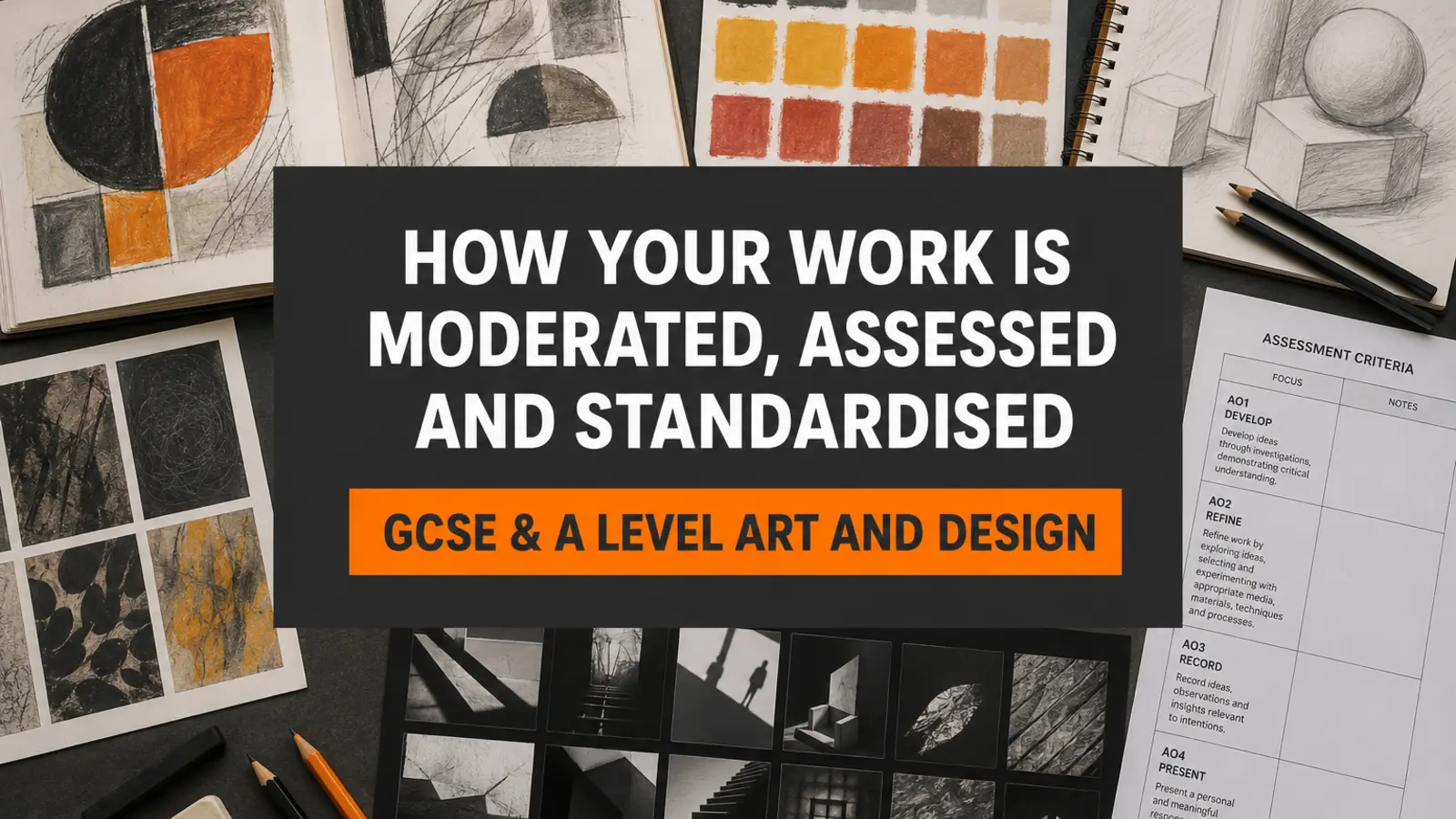
The four assessment objectives
Across the regulated GCSE and A Level qualifications covered here, the four assessment objectives are equally weighted. Each contributes 25% of the assessment, although the raw number of marks printed on a board’s assessment grid may differ.
| Assessment objective | What teachers look for | Typical evidence |
|---|---|---|
| AO1 — Develop | Ideas developed through relevant research and a growing understanding of artists, photographers, designers, craftspeople, cultures or other sources. | Artist research, analysis, comparisons, responses, intentions and ideas that change because of what you discover. |
| AO2 — Refine | Purposeful experimentation and increasingly thoughtful choices of media, materials, techniques and processes. | Trials, test pieces, contact sheets, edits, material experiments, comparisons, failures used constructively and refinements. |
| AO3 — Record | Relevant observations, ideas and insights recorded in ways that support your intentions. | First-hand drawing, photography, notes, visual studies, measurements, compositional sketches and reflective annotation. |
| AO4 — Present | A personal and meaningful response that realises intentions and shows understanding of visual language. | Resolved outcomes, final selections, presentation decisions and clear connections with the earlier journey. |
These objectives overlap. A photograph taken for AO3 may lead to an AO2 experiment; that experiment may help develop an AO1 idea and eventually contribute to AO4. Teachers therefore read the work as a connected body of evidence rather than four unrelated piles.
How teachers mark your work
- The work is authenticated. You and your teacher confirm that the submitted work is your own and that sources and permitted assistance have been acknowledged.
- The complete component is reviewed. This may include sketchbooks, loose sheets, mounted work, digital files, photographs of large or temporary work, preparatory studies and resolved outcomes.
- Evidence is considered AO by AO. The teacher identifies what is sustained, convincing and relevant—not simply how many pages you have filled.
- A performance band or level is selected. The teacher compares the overall evidence with the board’s published descriptors and marked exemplars.
- A precise mark is chosen within that band. Work securely meeting a descriptor may sit higher in the range; work only just meeting it may sit lower.
- The four AO marks are combined. This produces the raw mark for that component.
- The mark and rank order are checked. Teachers compare your work with other work in the centre and with national exemplars before the mark is submitted.
A simplified visual example
Imagine a project based on Structures. The student has researched two relevant practitioners, made strong first-hand photographs and drawings, tested collage and print, refined several compositions and produced a thoughtful final response.
| AO | Evidence noticed by the teacher | Assessment judgement |
|---|---|---|
| AO1 | Research affects the student’s shapes, viewpoints and composition; comparisons are analytical rather than biographical. | Consistent, relevant development of ideas. |
| AO2 | Several materials are tested, but the student selects and improves the most successful process rather than keeping every experiment. | Purposeful experimentation and refinement. |
| AO3 | First-hand photographs, drawings and written reflections clearly support the project. | Strong and relevant recording. |
| AO4 | The final response is personal and clearly connected to the earlier investigation, although one area could be resolved more confidently. | Meaningful response with a minor weakness. |
Notice that the teacher has described the quality of the evidence. They have not awarded marks for decoration, the thickness of the sketchbook or the number of artists mentioned.
What is standardisation?
Standardisation happens before marks are finally submitted. Its purpose is to make sure that different teachers, classes and specialist titles are applying the same assessment standard.

For example, one teacher may teach Fine Art while another teaches Photography or Graphic Communication. The work will look very different, but the level of achievement represented by the marks must be comparable. Teachers may:
- mark the same sample independently and compare decisions;
- review work from the top, middle and lower parts of the mark range;
- compare Component 1 with Component 2 standards;
- use current board exemplars and moderator reports;
- check difficult or borderline decisions;
- agree the rank order of students;
- raise or lower marks where a teacher has been more generous or severe than colleagues.
In a one-teacher department, the process may involve careful comparison with board exemplars, training materials and previous moderator feedback. Some schools also arrange cross-school standardisation where regulations and confidentiality permit.
What is moderation?
Moderation is the awarding body’s external check of the centre’s marking. A moderator is an experienced assessor trained to the board’s national standard. Depending on the board and the centre’s arrangements, moderation may involve a visit or a secure digital submission.

What happens during external moderation?
- The centre submits marks for all candidates.
- The awarding body or moderator identifies the sample that must be available.
- The moderator reviews the selected students’ complete assessed work and the centre’s records.
- The moderator compares the centre’s judgements with the national standard and checks that the rank order makes sense.
- If the sample confirms the marking, the centre’s marks are accepted.
- If the centre has been consistently generous or severe, marks for the relevant cohort or component may be adjusted.
- If the marking is inconsistent, the moderator may request more work or the awarding body may take further action under its procedures.
- The centre later receives feedback that can inform assessment the following year.
Important: the selected sample is not singled out for a different grade
The sample is evidence about the accuracy of the centre’s marking. A moderator does not normally give one sampled student an entirely separate personal mark while ignoring everyone else. Where adjustment is needed, it is normally applied systematically to the appropriate group of marks. Awarding-body procedures govern exceptional cases.
Do examination boards assess Art & Design differently?
The main principles are very similar, but the paperwork, raw-mark totals, names of performance bands, submission systems and moderation arrangements can differ. Always use the current specification for your exact qualification and assessment year.
| Board | What is broadly the same | Useful differences to know |
|---|---|---|
| AQA | Both GCSE components and both A Level components are centre marked and externally moderated. A visiting moderator checks a sample. | The current AQA grid uses 96 marks per component, with 24 available for each AO. AQA uses six mark bands. GCSE updates apply from first assessment in summer 2027, so centres must use the correct version. |
| Pearson Edexcel | UK GCSE and A Level work is internally assessed and externally moderated, normally through visiting moderation for UK centres. | Pearson uses its own assessment grid, taxonomy and exemplar gallery. GCSE components are marked out of 72, with 18 marks per AO. Pearson International GCSE Art & Design is a separate qualification and is externally assessed digitally rather than following the same internal-marking model. |
| OCR | GCSE and A Level components are internally assessed and externally moderated. | OCR uses its own forms, descriptors and raw-mark structure. At A Level, Component 1 is marked out of 120 and Component 2 out of 80, building the 60:40 weighting into the raw totals. |
| Eduqas | Both GCSE components and both A Level components are internally assessed and externally moderated. | Eduqas uses helpful short AO headings such as Critical Understanding, Creative Making, Reflective Recording and Personal Presentation. At GCSE, Component 1 is out of 120 and Component 2 out of 80. |
| WJEC | Centre assessment, internal standardisation and external moderation remain central to the process. | WJEC qualifications approved for Wales must be checked separately from Eduqas qualifications regulated for England. Names, dates, grading arrangements and current specifications may differ. |
The crucial point is that a mark of 60 means nothing without knowing the board, qualification and component maximum. Teachers work from the correct board grid; they do not translate marks casually from one board to another.
Is your centre mark the same as your final grade?
No. Your teacher awards a raw centre-assessed mark for each component. That mark is provisional until external moderation is complete. The moderated component marks are then combined according to the qualification weighting—normally 60% for the portfolio or personal investigation and 40% for the externally set assignment or task.
The awarding body sets the final grade boundaries for that examination series. Boundaries can change from year to year, so a teacher should not promise that a particular raw mark will definitely produce a particular grade.
Will you be told your teacher-assessed marks?
Yes. Under current JCQ requirements, centres must tell GCSE and A Level candidates their centre-assessed marks before submitting them to the awarding body. The school or college must also explain its internal review procedure and deadline.
If you believe the published assessment criteria have not been applied correctly, you may request a review through your centre’s procedure. This is a review of the marking of work already submitted—not an extra opportunity to add pages or improve the outcome. The reviewed mark can go up, remain the same or go down, and it is still provisional until external moderation.
Common myths about Art & Design marking
| Myth | What actually happens |
|---|---|
| “Only the final piece really counts.” | Both preparatory work and resolved outcomes contribute evidence. All four AOs are assessed. |
| “The moderator marks every student’s sketchbook.” | For the standard UK qualifications discussed here, the moderator normally checks a selected sample of centre-marked work. |
| “More pages automatically mean more marks.” | Relevance, quality, depth, independence and connections matter more than bulk. |
| “Neat work always gets the highest mark.” | Presentation helps communication, but adventurous experimentation, critical understanding and personal development may include rough tests, changes and productive failures. |
| “My teacher decides my final grade.” | Your teacher proposes raw marks; the awarding body moderates the marks and awards the final grade. |
| “If I am in the sample, my work is at risk.” | Selection is part of quality assurance. It is not a punishment and does not mean your work is suspected of being weak. |
How to make your evidence easier to assess
- Keep the creative journey clear: starting point, research, recording, experiments, refinements and resolution.
- Show how artists and other sources have genuinely influenced your decisions.
- Include first-hand recording that is relevant to your intentions.
- Keep experiments that demonstrate thinking, but avoid repetitive filler.
- Annotate important choices: what changed, why it changed and what you learned.
- Make connections between pages and stages rather than treating each task as isolated.
- Photograph large, temporary, moving or three-dimensional work carefully.
- Check that every submitted component contains convincing evidence for AO1, AO2, AO3 and AO4.
- Follow your teacher’s instructions about deadlines, authentication, file formats and supervised sessions.
The most important thing to remember
Assessment, standardisation and moderation are three connected safeguards. Assessment identifies the quality of your evidence. Standardisation makes marking consistent within your school or college. Moderation checks that the centre’s standard matches the national standard.
You cannot control which work is selected for moderation or where the final grade boundaries will fall. You can make your thinking, experiments, observations, decisions and personal response clear throughout the portfolio. That gives your teacher—and, if sampled, the moderator—the strongest possible evidence of what you have achieved.
Would you like an independent view of your portfolio?
Portfolio to A Star provides clear written feedback on the evidence currently visible in your GCSE or A Level Art & Design work, including strengths, gaps and practical next steps.
Explore more Art & Design help
Official guidance
- JCQ: informing candidates of centre-assessed marks
- AQA GCSE Art & Design: NEA administration and moderation
- Pearson Art & Design qualifications
- OCR GCSE Art & Design
- Eduqas GCSE Art & Design
- WJEC GCSE Art & Design
Accuracy note: qualification rules and administration arrangements can change. This article was checked against official information available in August 2026. Students and teachers should follow the current specification and instructions issued for their exact board, qualification and assessment series.
No responses yet