

Looking for GCSE Fine Art Changes project ideas? The theme is deliberately broad. You could investigate physical transformation, the passing of time, changes in identity, movement from one place to another, or the way a familiar place changes when people use it.
This independent guide takes inspiration from a past AQA GCSE Art and Design starting point from 2024. It does not provide a ready-made exam answer. Instead, it shows how a Fine Art student might turn one of three possible directions into a personal investigation supported by first-hand recording, relevant artists, purposeful experiments and thoughtful refinement.
Start with a question, not an answer
A promising project does not begin with “I will paint a flower” or “I will draw a train”. Begin with a question such as: How can I show a change that is too slow to notice? What remains constant as a person grows older? or How can an artwork express the journeys of a whole community?
How to interpret Changes for GCSE Fine Art
Your interpretation should give you access to primary sources: things you can observe, photograph, draw, measure, collect safely or experience yourself. A personal connection might come from a plant you have grown, family objects that carry memories, or the station and journeys that connect your local area.
- Choose a focus: reduce the large theme to one clear visual problem.
- Gather first-hand evidence: draw and photograph before deciding on a final outcome.
- Research selectively: connect with artists because their ideas, materials or processes can move your work forward.
- Experiment with purpose: change scale, viewpoint, surface, colour, material, composition or level of realism.
- Refine through decisions: explain what you kept, rejected, combined or changed and why.
AQA assesses investigation, experimentation, recording and the final personal response across the four GCSE Art and Design assessment objectives. The strongest project therefore shows a connected journey rather than four isolated sections.
Route 1: Changes as plants grow and decay
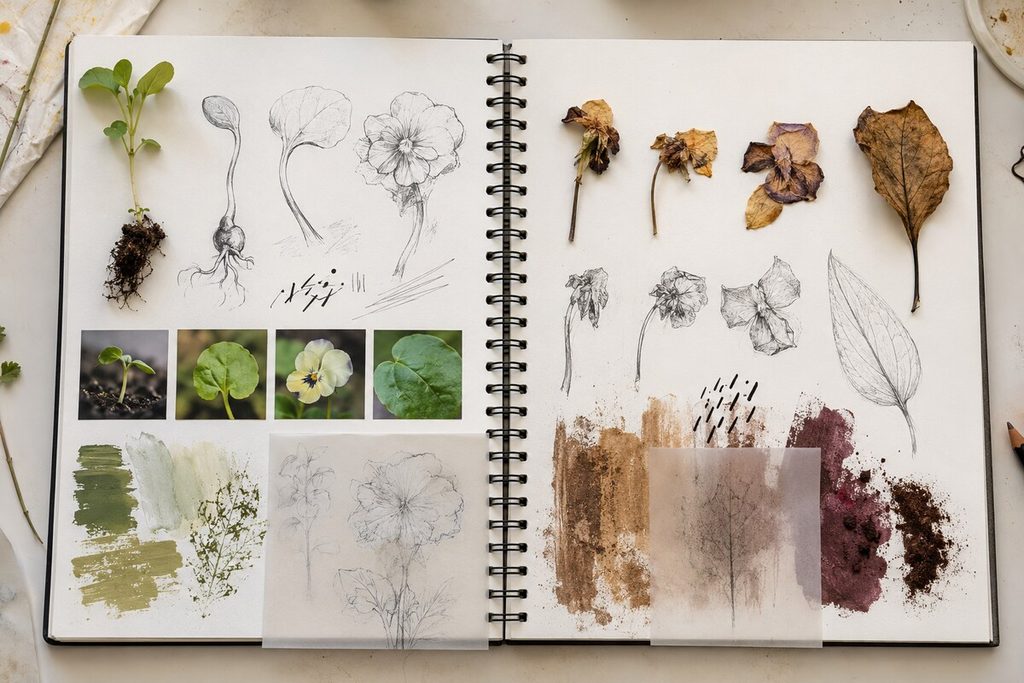
Plant growth and decay can become much more than a set of flower drawings. You could explore cycles, fragility, regeneration, changing colour, damaged surfaces, time, environmental pressure or the contrast between something living and something preserved.
Primary-source investigations
- Grow a fast-germinating seed and record it from the same viewpoint each day.
- Photograph a flower as its petals open, fall, curl, dry and lose colour.
- Make close observational drawings of roots, leaf veins, seed pods, bruising and torn edges.
- Use a macro lens or phone attachment to reveal structures that the eye normally misses.
- Compare a managed garden with weeds growing through cracks, or healthy leaves with leaves affected by weather or insects.
- Record shadows cast by the same plant at different times of day.
Artists to investigate
- Karl Blossfeldt used close, precise plant photography to emphasise structure, rhythm and repeated form. Consider how magnification and a plain background could transform an ordinary stem into something architectural.
- Anya Gallaccio has made installations from living or perishable material. Her work can help you think about whether change itself, rather than a permanent object, can be the artwork.
- Giuseppe Penone explores relationships between trees, time, touch and the human body. Look at how material and process can communicate growth without simply illustrating a plant.
Do not make a Blossfeldt-style photograph or copy Gallaccio’s installation and stop there. Identify something useful: cropping, repetition, real organic material, gradual deterioration, scale or surface. Test that idea using your own plant, viewpoint and intention.
Fine Art experiments and outcomes
- Make a sequence of monoprints from fresh and dry leaves, allowing the image to become fainter or more fragmented.
- Layer drawings on tracing paper so several stages of growth occupy the same space.
- Move from saturated greens to bruised purples, ochres and browns across a painted series.
- Enlarge a seed pod or root system until it resembles a landscape or body.
- Combine detailed observation with areas rubbed away, stained, cracked or stitched together.
- Develop a triptych, layered relief, hanging paper construction or time-based photographic sequence.
Safety: do not keep mouldy plant or food matter in a sketchbook. Photograph deterioration, work in a ventilated space, wash your hands and follow your teacher’s guidance before using soil, plant sap, wire, resin, wax or unfamiliar materials.
Route 2: Changes over a person’s lifetime
This route could focus on physical ageing, but it could also explore memory, changing roles, growing independence, loss, family resemblance, identity, health, fashion or the possessions that accompany different stages of life.

Ways to make the project personal
- Draw your own face or hands repeatedly under different light, expressions and viewpoints.
- With permission, compare family photographs and make new portraits that echo their pose or composition.
- Record objects linked to childhood, work, hobbies, celebrations or retirement rather than relying only on faces.
- Explore the similarities between your hand and that of an older relative through line, scale and surface.
- Build a fictional or composite person if using family material feels too private.
- Investigate an internal change such as confidence, responsibility or belonging through colour and composition.
Artists and photographers to investigate
- Rembrandt’s earlier self-portraits can be compared with his Self Portrait at the Age of 63. Look beyond wrinkles: compare pose, gaze, lighting, clothing, paint handling and emotional presence.
- Nicholas Nixon’s The Brown Sisters follows the same four people in annual photographs. Consider what a repeated pose and consistent arrangement allow a viewer to notice over time.
A useful artist connection leads to a decision. You might borrow the idea of repetition but change the subject, use Rembrandt’s directional light on studies of hands, or adopt a fixed composition while objects replace the people who owned them.
Fine Art experiments and outcomes
- Overlay portraits at different ages using tracing paper, acetate, thin fabric or digital transparency.
- Use erasure, smudging and redrawing to suggest unstable or fading memory.
- Contrast smooth, controlled marks with broken, heavily textured surfaces.
- Create a four-part portrait in which pose stays constant but material, colour or background changes.
- Combine a portrait with enlarged lines from fingerprints, maps, handwriting or fabric patterns.
- Develop an accordion book, layered portrait, stitched textile piece, relief or series of panels.
Privacy and consent: ask before using another person’s photographs, stories or likeness. Avoid sharing sensitive health or family information. You can crop to hands, use silhouettes, obscure identity or invent a character and still produce a meaningful response.
Route 3: Changing tracks as a railway-station artwork
This option is not simply an instruction to paint a train. It is a site-specific public art commission. Your proposal should respond to a foyer, the people who pass through it and the identity of a regional station. Think like both an artist and a visitor.
Questions a public-art proposal should answer
- Who uses this station and what different journeys bring them together?
- What is distinctive about the town, landscape, industries or communities nearby?
- Where would the artwork be seen from, and how long would a viewer spend with it?
- Should it be a wall work, floor-based sculpture, suspended piece, window artwork or sequence?
- How will scale, light, sound, durability, cleaning, accessibility and passenger movement affect the design?
- Could “changing tracks” mean a change of direction in life as well as a railway junction?
First-hand station research
Visit a station only where it is safe and permitted, following school guidance and travelling with an appropriate adult where necessary. Work from public areas, remain behind safety lines and never enter tracks or restricted land. You could:
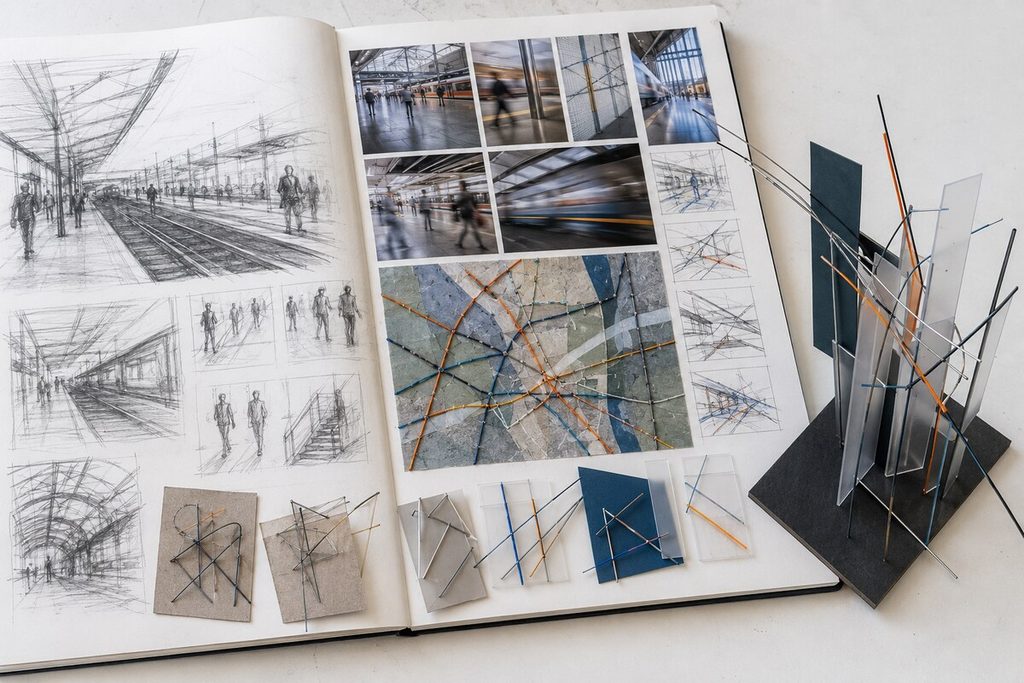
- draw converging rails, roof structures, stairs, clocks, windows and repeated signs;
- photograph reflections, shadows and motion blur without identifying strangers;
- map lines of movement through the foyer;
- collect permitted printed ephemera or make rubbings from safe public surfaces;
- record sounds, announcements or fragments of conversation as abstract rhythms rather than personal data;
- research how the station and surrounding area have changed over time.
Artists to investigate
- J. M. W. Turner, Rain, Steam and Speed: explore how directional marks, atmosphere and contrasts between nature and technology create the sensation of movement.
- Claude Monet, La Gare Saint-Lazare: consider how smoke, filtered light, iron architecture and modern urban life can become the subject rather than mere background.
- Simon Patterson, The Great Bear: investigate how a familiar transport map can be transformed into a new network of cultural connections.
- Tracey Emin, I Want My Time With You: consider how scale, handwritten language and location change the emotional effect of a simple phrase in a major station.
These sources solve different problems: atmosphere, modern architecture, mapping and communication with travellers. Select the source that genuinely helps your intention rather than including every artist in your sketchbook.
Possible concepts and materials
- Converging journeys: coloured thread, wire or painted lines intersect to represent travellers.
- Arrivals and departures: repeated silhouettes gradually appear and disappear across translucent layers.
- Changing industry: old station architecture merges with images of the region today.
- Personal turning points: tracks divide, cross and reconnect as a metaphor for decisions.
- Landscape seen in motion: views from a train fragment into strips, blurs or overlapping windows.
- A changing community: local patterns, languages, landmarks or recorded stories form a shared visual network.
Test collage, monoprint, painted acetate, cut paper, stitched lines, wire, card relief, plaster texture and projected light. Build two or three small maquettes. Photograph each from the viewpoint of someone entering the foyer, then annotate which version communicates most clearly.
Show AO1–AO4 as one connected journey
| Assessment area | Useful evidence for a Changes project | Question to ask yourself |
|---|---|---|
| AO1: investigate and develop | Focused artist research, comparisons, visual analysis and ideas that change because of what you discover. | What did this source help me understand or try? |
| AO2: experiment and refine | Purposeful material tests, alternative compositions, scale trials, rejected ideas and improved versions. | What did I change after evaluating the test? |
| AO3: record | Your own drawings, photographs, colour notes, measurements, observations, contact sheets and reflective annotation. | Is this first-hand evidence relevant to my intention? |
| AO4: personal response | A resolved outcome that grows logically from your research, recording and experiments. | Does the final piece communicate my interpretation without needing a long explanation? |
For help writing useful reflections rather than describing what is already visible, read GCSE Art AO3 Explained. You can also explore AO1 research and idea development, AO2 experimentation and refinement, the GCSE Fine Art course guide or the main GCSE Art help hub.
A practical sketchbook sequence
- Define your question. Write one sentence explaining what kind of change interests you and why.
- Collect primary sources. Produce several pages of drawings, photographs and observations before choosing a final composition.
- Compare two or three relevant artists. Analyse how they use visual language, material and process.
- Respond practically. Test one transferable idea from each source using your own imagery.
- Generate alternatives. Change viewpoint, crop, arrangement, scale, colour and surface.
- Select and combine. Make clear decisions based on what best communicates your interpretation.
- Make a developed study or maquette. Test the important practical problems before the final work.
- Realise and evaluate. Produce the outcome, document it well and explain how it fulfils your intention.
Remember: the best route is the one you can investigate
Do not choose the idea that sounds most impressive. Choose the one that gives you strong first-hand sources, materials you are excited to test and a personal question you genuinely want to answer. A modest subject investigated deeply will usually be more convincing than an ambitious theme treated superficially.
Frequently asked questions about the Changes GCSE Art theme
Can I combine more than one interpretation of Changes?
Yes, if the connection strengthens your idea. Plant growth could become a metaphor for a person’s development, or railway tracks could represent turning points in a lifetime. Avoid joining unrelated ideas simply to include more work.
Do I need to copy an artist’s work?
No. Demonstrate understanding by identifying what is useful in the artist’s approach and applying it to your own source material. A thoughtful experiment inspired by process, composition or material is more valuable than a close copy with no development.
Can photography be used in GCSE Fine Art?
Yes. Your photographs can provide primary evidence, test viewpoints, record time and become material for collage, printmaking, painting or mixed media. Select and edit them purposefully rather than filling pages with unanalysed images.
What if I cannot visit a railway station?
Work from a safe public viewpoint, your own journey photographs, drawings from station architecture nearby, objects such as tickets and maps, or a carefully constructed model. Explain your limitations and show how you adapted your research.
Develop your own Changes project
The theme becomes powerful when change is visible in both your subject and your creative process. Let the project evolve: record more than you think you need, test contrasting possibilities and allow each decision to grow from the last.
Copyright note: this is an independent educational commentary on a past examination starting point. The original examination material remains the property of AQA. Portfolio to a Star is not affiliated with or endorsed by AQA. The illustrative images in this article are original generated mock-ups and do not reproduce the work of the artists discussed.
No responses yet