
Home > A Level Art Help > What Makes an A Level Art Personal Investigation?
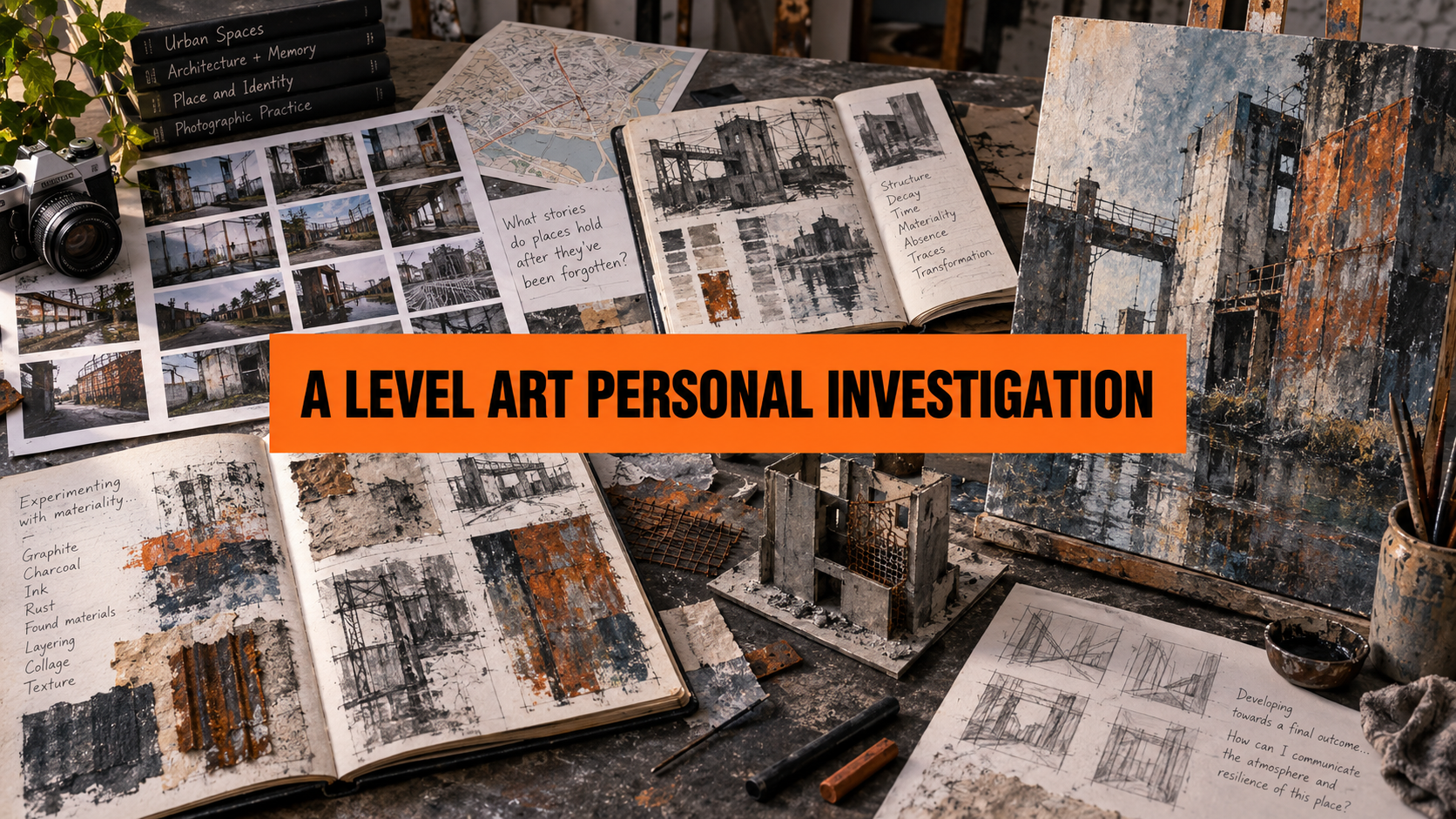
An A Level Art Personal Investigation is a sustained practical and written enquiry in which you explore a focused question, theme or problem through your own research, first-hand recording, experimentation, critical understanding and resolved outcomes.
What makes it personal is not simply choosing a topic you like or filling pages with autobiography. It is the evidence of ownership: the questions you ask, sources you select, observations you make, materials you test, connections you discover, judgements you reach and direction you develop.
Personal Investigation in one sentence
A focused question + relevant contextual research + first-hand sources + sustained practical development + critical writing + a personal resolution.
What is the A Level Art Personal Investigation?
The Personal Investigation is normally the major coursework component of an A Level Art and Design qualification. It brings together practical work and a substantial written element related to the same enquiry. It is internally assessed by the centre and externally moderated.
It is important to distinguish the whole Personal Investigation from the personal study, related study or extended written element. The written work is part of the investigation; it is not the entire component. Your practical portfolio, supporting studies, research, experiments, refinements and outcomes also provide assessment evidence.
Current exam-board requirements are not identical
| Exam board | Coursework component | Written requirement | Important detail |
|---|---|---|---|
| AQA | Component 1: Personal investigation, 60% | 1,000–3,000 words of continuous prose | Practical investigation supported by written material; presented as one continuous study or shorter linked passages. |
| OCR | Component 01: Personal investigation, 60% | Related written study of at least 1,000 words | Portfolio of practical work responding to a brief, scenario or stimulus provided by the student or centre. |
| Pearson Edexcel | Component 1: Personal Investigation, 60% | Separate personal study of at least 1,000 words of continuous prose | The personal study makes critical and analytical links to the student’s practical investigation and includes a bibliography. |
| Eduqas | Component 1: Personal Investigation, 60% | Extended written element with a 1,000-word minimum | Practical and theoretical work is integrated within a sustained personal enquiry. |
Always follow your own centre’s current specification and teacher guidance. Names, formats and submission arrangements vary. WJEC qualifications used in Wales have their own unitised structure and should not be assumed to match Eduqas exactly. You can check the current requirements directly through AQA, OCR, Pearson Edexcel, Eduqas or WJEC.
What does “personal” actually mean?
A Personal Investigation does not have to reveal private experiences. It can begin with architecture, natural forms, portraiture, typography, documentary photography, material culture, movement, consumer behaviour or almost any suitable area. It becomes personal through your intellectual and creative involvement.
- Personal curiosity: the enquiry grows from something you genuinely want to understand.
- Personal sources: you gather photographs, drawings, recordings, objects, interviews or observations rather than depending entirely on internet imagery.
- Personal selection: you decide which artists, designers, photographers, movements and contexts are relevant—and explain why.
- Personal decision-making: you test alternatives, compare them and choose a direction for clear reasons.
- Personal interpretation: you respond to research critically instead of repeating someone else’s opinion.
- Personal visual language: influences gradually combine with your own subject matter, processes and intentions.
- Personal resolution: the final outcome feels earned by the investigation rather than added at the end.
A personal project is not necessarily a private project. It is a project shaped by your questions and decisions.
The essential parts of a strong Personal Investigation
1. A focused line of enquiry
“Identity”, “nature”, “buildings” or “portraits” are broad starting areas, not yet investigations. A stronger enquiry identifies a relationship, tension or question that can be explored through making.
| Broad theme | More focused line of enquiry |
|---|---|
| Identity | How can clothing and personal objects communicate the difference between public and private identity? |
| Natural forms | How can fragile plant structures be enlarged and transformed into sculptural forms? |
| Architecture | How can the physical traces on neglected buildings reveal memory, use and change? |
| Portraiture | How can fragmented viewpoints communicate the unreliability of memory? |
| Graphic Communication | How can visual identity encourage young people to repair and reuse clothing? |
| Photography | How can artificial light alter the emotional character of familiar night-time spaces? |
| Textiles | How can inherited patterns be reconstructed to explore family migration? |
A question is useful when it is focused enough to guide selection but open enough to allow discovery. If you already know exactly what the final outcome will look like, the investigation may become an illustration of a plan rather than a genuine enquiry.
2. Relevant contextual research
Contextual research can include artists, photographers, designers, craftspeople, architects, filmmakers, movements, artefacts, exhibitions, written ideas, social histories and other sources. The aim is not to collect biographies. Research should help you see your question differently or suggest something useful to test.
For every source, ask:
- What is the work investigating?
- How do materials, process, composition or presentation support its meaning?
- What social, historical, cultural or personal context matters?
- What is my interpretation—and what visual evidence supports it?
- How does this connect with my practical investigation?
- What will I make, record or test because of this research?
The process explained in How to Turn Artist Research into Your Own Art Ideas is especially useful here: isolate relevant ideas, apply them to your own sources, experiment and evaluate.
3. Rich first-hand recording
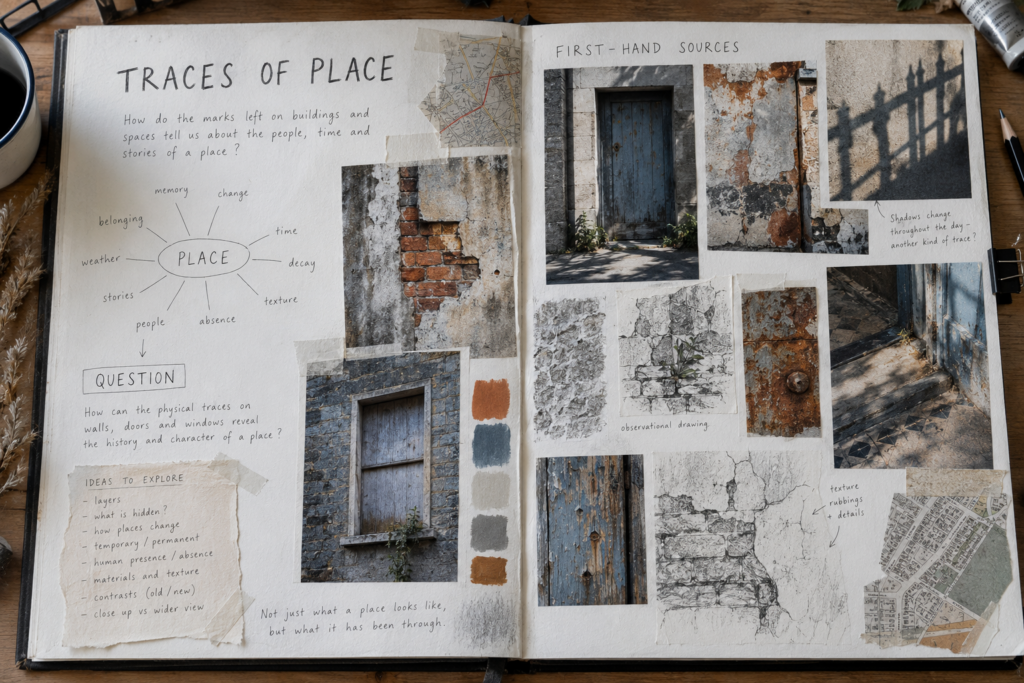
Your investigation needs material that belongs to your enquiry. Depending on the endorsed title, this could include observational drawing, photography, video, sound, interviews, maps, measured studies, colour notes, collected objects, material samples, typography found in your environment or records of a changing place.
First-hand recording creates specificity. A project about abandoned buildings becomes more convincing when it grows from places you have visited, photographs you have composed, surfaces you have examined and memories or histories you have investigated.
4. Sustained experimentation and refinement
Experimentation should not be a disconnected display of techniques. Each test should explore part of the enquiry or solve a developing problem. You might vary scale, viewpoint, sequence, material, surface, colour, duration, typography, lighting, construction or audience interaction.
Refinement means more than making a piece neater. It includes selecting, combining, simplifying, enlarging, reorganising, rejecting, repeating and reconsidering. Record the reasons for these changes so the development is visible.
5. Critical and reflective writing
The extended written element should be connected to the practical investigation. It is not a detached history essay and it should not merely describe images. Strong writing analyses selected sources, explores relevant context, makes comparisons, develops an argument and reflects on how research affected your own work.
6. A resolved personal outcome—or connected outcomes
The outcome should resolve the investigation as convincingly as possible, but it does not need to close the subject forever. It may be a painting, sculpture, installation, photographic series, film, publication, campaign, garment, spatial proposal, digital experience or connected body of work. The correct form is the one supported by the enquiry and your development.
How the four assessment objectives work together
A Personal Investigation should not feel like four unrelated folders. The assessment objectives overlap throughout the project:
| Assessment objective | What it contributes | Possible evidence |
|---|---|---|
| AO1 | Develop ideas through sustained, focused investigations informed by contextual and other sources. | Research, analysis, comparisons, project question, conceptual development and connections to practice. |
| AO2 | Explore and select resources, media, materials, techniques and processes; review and refine ideas. | Material tests, technical trials, alternatives, combinations, evaluations and purposeful refinement. |
| AO3 | Record ideas, observations and insights relevant to intentions; reflect critically on work and progress. | First-hand drawing, photography, notes, visual records, contact sheets, plans and critical reflection. |
| AO4 | Present a personal and meaningful response that realises intentions and connects visual and other elements. | Resolved outcome or series, presentation decisions and clear relationships between research, process and meaning. |
For example, taking your own photograph may provide AO3 evidence. Testing it through print, collage and transparent layers develops AO2. Relating those decisions to contextual research strengthens AO1. Combining the most effective qualities in a resolved response contributes to AO4. One purposeful sequence can therefore provide evidence across several objectives.
A Level Art Personal Investigation example: Traces of Place
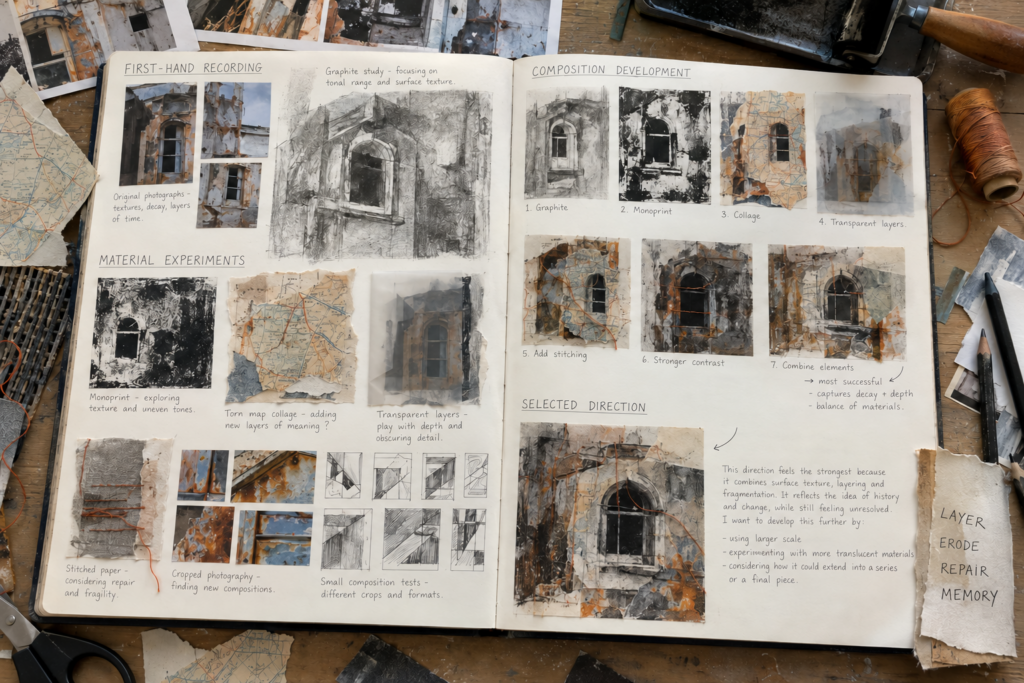
The following example demonstrates the structure of an investigation. It is not a project to copy. The evidence would become personal only through a student’s own locations, photographs, research, material discoveries and decisions.
Starting interest
The student is interested in old industrial and commercial buildings in their local area. They are particularly drawn to patched surfaces, boarded openings, rust, faded signs and evidence of repeated repair.
Focused question
How can the physical traces on neglected buildings reveal the history, change and character of a place?
First-hand investigation
- Photograph three accessible locations at different times and from varied distances.
- Make graphite and ink drawings of doors, window openings and layered walls.
- Record colour, texture, shadows, sounds and visible evidence of use.
- Collect permitted non-hazardous fragments, rubbings and local map material.
- Research the previous function of one building using local archives or conversations.
Safety matters: the student photographs from public or permitted spaces, avoids unstable structures and does not remove material without permission.
Contextual direction
The student could investigate practitioners concerned with time, place, absence, material transformation, architecture or traces. Possible starting points include Tacita Dean, whose practice can prompt questions about time, memory and disappearing subjects; Cornelia Parker, who can open questions about transformed objects and material histories; or photographers and local archive collections that record urban change.
These sources should not all be researched at once. Each is introduced when it helps the student investigate a particular problem.
Practical development
- Crop photographs to isolate scars, openings and layered surfaces.
- Translate selected images through graphite and monoprint to compare controlled and unpredictable marks.
- Collage fragments of reproduced maps beneath drawings to connect surface with location.
- Overlay tracing paper or acetate to suggest different times occupying the same space.
- Stitch through paper to investigate repair, connection and fragility.
- Create small composition studies that vary scale, empty space and viewpoint.
- Combine the strongest surface, structure and colour decisions in larger developments.
- Test whether the idea works better as one image, a sequence, an artist’s book or an installation.
Possible written-study question
How can artists use materials and images of place to make absence and memory visible?
The written study could compare two or three carefully selected practitioners, analyse particular works, establish relevant context and explain how the student’s understanding changed their own decisions. It should reach an argument or conclusion rather than becoming a sequence of biographies.
Possible outcome
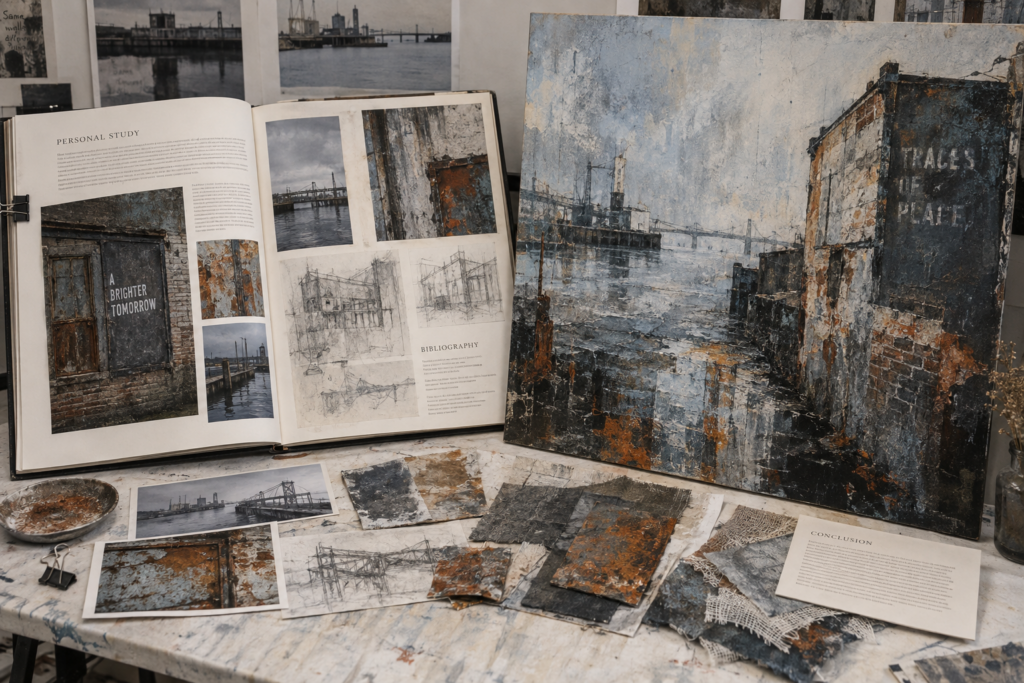
A large mixed-media work or connected series combines drawing, transferred photographs, map fragments, translucent layers and stitched repair. The final form is selected after trials: it is not decided before the investigation begins.
How to write the personal study or related study
The exact format depends on your specification, but the writing should normally demonstrate critical understanding, clear organisation, appropriate specialist vocabulary, relevant visual analysis, connections with your practice and accurate acknowledgment of sources.
A practical structure
- Title or question: focused enough to investigate, not simply a theme.
- Introduction: define the enquiry, explain its relevance and identify the sources or works you will examine.
- Context and first analysis: introduce a key practitioner or source, analyse selected work and connect it with your question.
- Comparison or second perspective: examine another source that extends, challenges or contrasts with the first.
- Connection with practical work: explain how research altered your materials, imagery, process, presentation or meaning, using specific examples.
- Developed argument: bring the evidence together rather than writing isolated artist sections.
- Conclusion: answer the question and reflect on what the investigation revealed.
- Bibliography and image references: acknowledge books, articles, websites, exhibitions, interviews and artworks according to centre guidance.
Move from description to analysis
| Mostly descriptive | More analytical |
|---|---|
| The artist uses old objects. | By retaining damage and wear, the artist allows the object’s previous use to remain visible rather than disguising its history. |
| The photograph is dark and grey. | The restricted tonal range reduces distracting detail and makes the empty structure feel distant and uncertain. |
| I used collage because the artist did. | I separated and reassembled my map and photograph to suggest that memory of a place is incomplete rather than continuous. |
| I like this artwork. | The suspended arrangement is relevant because it turns separate fragments into one unstable whole—a relationship I want to test through layered imagery. |
Quotations can support your argument, but they do not replace your interpretation. Keep quotations selective, place them in context and cite the source. Never copy text from websites or use AI-generated writing as if it were your own. Follow your school’s academic-integrity and authentication requirements.
A realistic Personal Investigation workflow
Your centre will set its own calendar, but the sequence below shows how a sustained investigation can develop. Several stages will overlap.
| Stage | Main activity | Evidence to retain |
|---|---|---|
| 1. Explore | Generate several interests, questions and possible sources. | Mind maps, visual collections, initial notes and quick practical responses. |
| 2. Focus | Choose a viable line of enquiry and explain why it matters. | Working question, intentions and early source plan. |
| 3. Record | Gather substantial first-hand material. | Photographs, drawings, recordings, samples, interviews or observations. |
| 4. Contextualise | Research sources that illuminate the enquiry. | Visual analysis, comparisons, contextual notes and practical responses. |
| 5. Experiment | Test materials, processes, formats and viewpoints. | Trials, technical notes, alternatives and selected unsuccessful tests. |
| 6. Review | Evaluate the evidence and sharpen the question. | Comparisons, annotations, tutorial notes and revised intentions. |
| 7. Extend | Combine promising ideas and work with greater depth. | Larger studies, sequences, prototypes, edits and material developments. |
| 8. Write | Develop the written investigation alongside practical work. | Plan, draft sections, image list, references and bibliography. |
| 9. Resolve | Test presentation and realise outcome or outcomes. | Plans, final trials, outcome, installation or presentation photographs. |
| 10. Select | Organise the submission so the journey is coherent. | Purposeful portfolio sequence, labels and final checks. |
What weakens a Personal Investigation?
- A theme that remains too broad: the portfolio gathers unrelated work without a developing question.
- A predetermined final piece: experiments become decoration because the outcome was fixed from the beginning.
- Second-hand imagery dominating: the work lacks specific personal observation and ownership.
- Artist biographies: research reports facts but does not analyse work or affect practical development.
- Technique sampling without purpose: materials are tried because they are available rather than because they serve the enquiry.
- Repeated outcomes: refinement is mistaken for remaking the same composition more neatly.
- Retrospective annotation: vague text is added at the end instead of recording decisions while they happen.
- A disconnected essay: written research and practical work appear to concern different projects.
- Too many sources: breadth replaces depth and no relationship is investigated fully.
- Poor selection: every experiment is included without hierarchy, explanation or editing.
How to choose a successful topic
Before committing, test the topic against these questions:
- Can I collect rich first-hand sources regularly?
- Does the topic contain a question, tension, change or problem—not merely a subject?
- Can I find relevant contextual sources of sufficient quality?
- Does it offer several practical processes or formats to explore?
- Can I investigate it safely, legally and ethically?
- Is it focused enough for depth but flexible enough to develop?
- Will it sustain my interest over many months?
- Can the written and practical elements genuinely inform one another?
A good topic is not necessarily unusual. Familiar subjects can produce excellent investigations when the question, sources and decisions are specific. An apparently original theme can remain weak if it produces shallow evidence.
Personal Investigation ideas for different endorsed titles
| Endorsed title | Possible enquiry |
|---|---|
| Fine Art | How can discarded domestic objects communicate absence and memory? |
| Photography | How does artificial light transform the emotional character of familiar spaces? |
| Graphic Communication | How can visual identity make local repair and reuse services appealing to young adults? |
| Textile Design | How can worn clothing be deconstructed and repaired to preserve personal history? |
| Three-Dimensional Design | How can adaptable furniture make limited living spaces feel more personal? |
| Art, Craft and Design | How can maps, sound and constructed forms communicate changing relationships with a place? |
These are starting models, not ready-made titles. Adapt the wording to your access, interests and specialism, then discuss viability with your teacher.
Personal Investigation checklist
- My investigation has a focused, workable question.
- I can explain why it matters to me without relying on vague claims.
- My first-hand sources are substantial, varied and relevant.
- Contextual research changes what I think or make next.
- Experiments answer questions rather than simply display techniques.
- I compare results and explain selection, rejection and refinement.
- My practical and written investigations address the same enquiry.
- I analyse particular works rather than writing long biographies.
- Sources, quotations and artwork images are acknowledged accurately.
- All four assessment objectives are evidenced across the portfolio.
- The outcome grows logically from the investigation.
- The final selection is coherent and shows depth, independence and ownership.
Frequently asked questions
Does a Personal Investigation have to be autobiographical?
No. Personal means that the investigation is shaped by your questions, sources, interpretations and decisions. It can concern a social, visual, material, historical, environmental or design issue without revealing private experiences.
How long is an A Level Art Personal Investigation?
It is normally a sustained coursework project developed over a substantial part of the course. The exact calendar is set by your centre. The written requirement varies: AQA specifies 1,000–3,000 words, while OCR, Pearson Edexcel and Eduqas specify at least 1,000 words in their relevant written element. Always check your current specification.
Is the Personal Investigation worth 60% of the A Level?
For the current AQA, OCR, Pearson Edexcel and Eduqas A Level Art and Design specifications discussed here, the coursework Personal Investigation component accounts for 60%. WJEC and other qualifications may use different structures or terminology, so confirm the details for your course.
When should I decide on my final outcome?
You can consider possible formats early, but avoid fixing the exact outcome before sufficient research and experimentation. Test scale, materials, composition and presentation so that the final form emerges from evidence.
How many artists should I research?
There is no ideal number that applies to every investigation. Depth, relevance and influence on your practice matter more than quantity. Two or three sources studied carefully and revisited may be more useful than ten brief biographies. Include wider sources where they genuinely advance the enquiry.
Can the written study include my own artwork?
Yes, and meaningful connections with your practical investigation are important. Refer to specific experiments or decisions and explain how contextual research affected them. Your own images support the discussion but do not replace the required continuous prose.
Can I change my question during the investigation?
Yes. A working question often becomes more focused as evidence develops. Record why you changed it and how the revised question better reflects your practical and contextual discoveries.
Can I use AI in my Personal Investigation?
Follow your centre and exam board’s current rules. Any permitted use must be transparent and must not replace your authenticated thinking, writing, first-hand recording or practical decision-making. Read the guidance in Can I Use AI Image Generation in GCSE or A Level Art? and ask your teacher before using it.
What makes the investigation convincing?
A strong Personal Investigation feels connected. The question influences the sources; the sources generate experiments; experiments produce judgements; writing sharpens understanding; and outcomes resolve what has been discovered. The examiner or moderator can follow both the creative journey and the reasoning behind it.
Do not aim to make every page look perfect. Aim to make the enquiry visible. Curiosity, depth, critical understanding, purposeful experimentation and increasingly independent decisions are what transform a collection of coursework into a genuine Personal Investigation.
Would an independent portfolio review help?
If you are unsure whether your question is focused, whether the written and practical elements connect, or whether your evidence is strong enough across AO1–AO4, Portfolio to A Star can provide practical, personalised guidance based on the work visible in your portfolio.
Continue with the A Level Art Help hub or browse the free Art resources.
Official specifications and further reading
- AQA A Level Art and Design specification
- OCR A Level Art and Design specification at a glance
- Pearson Edexcel A Level Art and Design
- Eduqas AS/A Level Art and Design
- WJEC AS/A Level Art and Design
Specification details were checked in September 2026. Requirements can change, so students and teachers should use the current specification for their own exam board and endorsed title.
No responses yet