
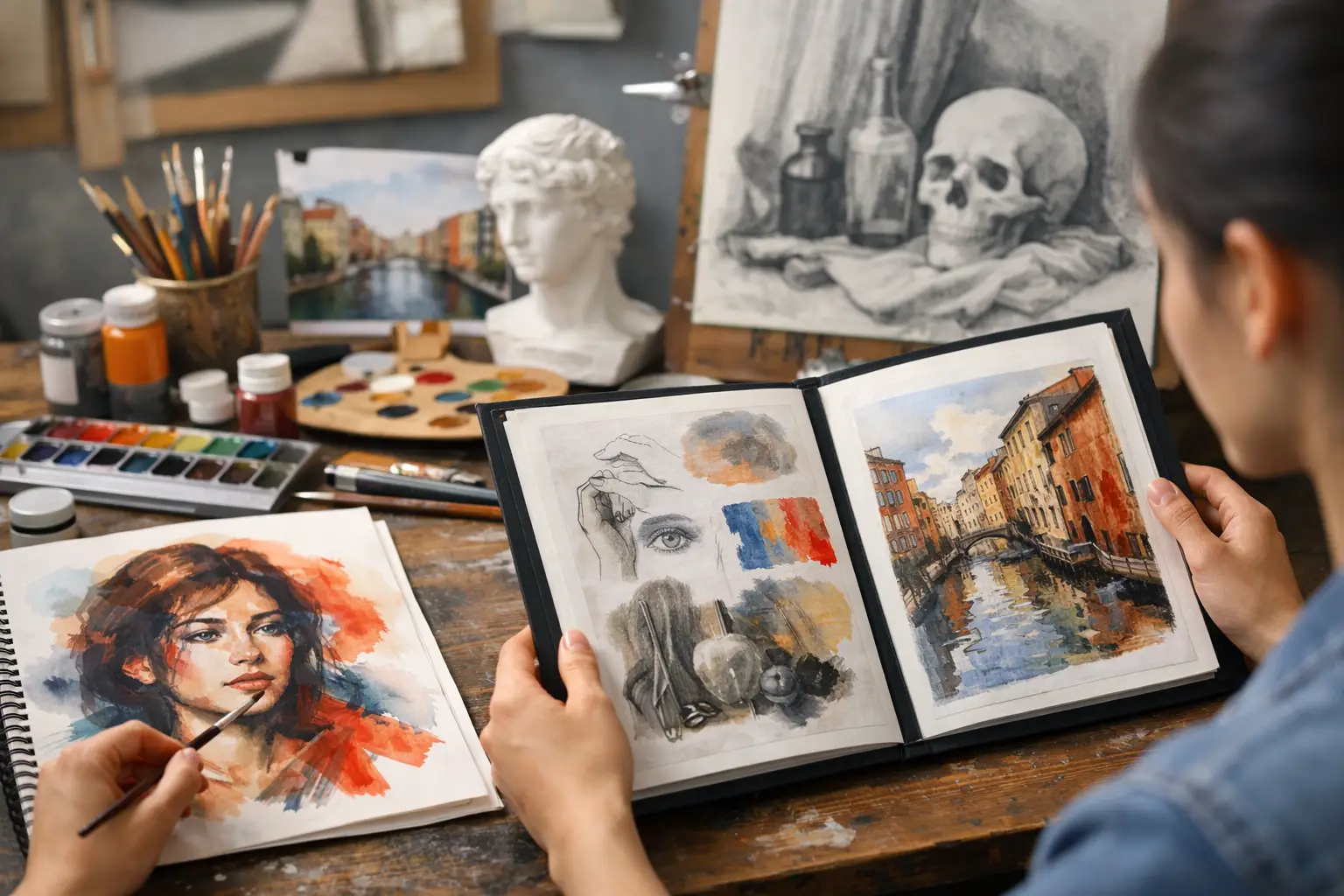
A high-grade portfolio is not a collection of your best-looking pages. GCSE art coursework is assessed as a connected creative journey: an idea begins, changes through research and practical investigation, then reaches a personal final response. Your sketchbook needs to make that journey easy for a teacher or moderator to follow.
This is good news if you feel your drawing is not naturally ‘perfect’. Strong coursework is built through purposeful decisions, not one impressive outcome at the end. Examiners are looking for clear evidence across the four Assessment Objectives, known as AO1, AO2, AO3 and AO4. When every page has a reason for being there, you can present your work with far more confidence.
What GCSE art coursework is really assessing
The assessment objectives are not four separate boxes to complete at the end of a project. They should work together throughout your portfolio.
AO1 is about developing ideas through relevant artists, photographers, designers or other sources. This means more than copying an artist’s image and writing a short biography. You need to show what interests you about their work and how their approach could move your own project forward.
AO2 is your experimentation and refinement. It is where you test materials, processes, compositions and visual ideas. A page of trials becomes much stronger when it shows comparison: what worked, what did not, and what you will develop next.
AO3 is your recording. This can include observational drawing, photographs, studies from primary sources, written observations and collected visual material. The key word is relevant. A beautifully drawn shell may be less useful than a simpler study of an object that directly supports your theme.
AO4 is your personal response. It includes resolved outcomes, but it is not only the final piece. Your response should show that earlier research, recording and experiments have informed the choices you make. The final outcome needs to feel like the logical result of your project, rather than a separate artwork added at the last minute.
A successful portfolio therefore has a clear thread. If your theme is identity, for example, your photographs, artist research, colour tests, observational studies and final piece should all contribute to your developing interpretation of identity.
Start with a question, not a vague theme
Broad starting points such as ‘nature’, ‘portraiture’ or ‘urban’ can work, but only if you narrow them quickly. A focused question gives your sketchbook direction and helps you choose meaningful sources.
Instead of working simply from ‘nature’, you might investigate: how can decaying flowers communicate memory and loss? Instead of ‘portraiture’, you might explore how cropping, distortion and shadow can suggest hidden emotions. Your question does not have to remain unchanged for the whole project. In fact, it often improves as you discover new possibilities. What matters is that your development is visible.
At the start, gather first-hand material wherever possible. Take your own photographs, make quick studies from real objects, visit a local location, arrange a still life or ask someone to sit for a portrait. Original source material gives you ownership of the project and provides far stronger evidence for AO3 than relying entirely on internet images.
Choose more images than you initially need, then select the most useful ones. Contact sheets, annotations and cropped photographic studies can show that you have made deliberate visual decisions. Explain why one angle, lighting condition or composition is more effective for your idea than another.
Build artist research that changes your work
Artist research often becomes weak when it is treated as a written homework task. Long life histories and copied facts do not demonstrate creative understanding. The most useful research is practical, selective and connected to your own intentions.
Choose artists or photographers because there is a genuine visual link to your project. You may be drawn to an artist’s fragmented composition, atmospheric colour palette, use of collage, unusual viewpoint or expressive mark-making. Be specific about the feature you want to investigate.
Then respond practically. Create a focused study using an aspect of their method, followed by a development that combines this learning with your own imagery. If you are studying a photographer who uses dramatic side lighting, do not stop at analysing their portraits. Set up and photograph your own subject under similar lighting, then decide how the effect supports your theme.
Your annotation can be concise, but it must explain thinking. Useful comments answer three questions: what have you noticed, what have you tried, and what will you do next? For example: “The compressed colour palette creates a tense mood. I tested a limited range of blue and grey ink washes with my own photograph. The layered effect is more successful than my pencil study, so I will use washes in my next composition.”
That final sentence matters. It turns research into development and creates a clear bridge from AO1 and AO2 towards AO4.
Make experimentation purposeful
Experimentation is not filling pages with random materials. Before beginning a test, decide what you are trying to find out. You could compare the effects of dry brush and palette knife, test whether acetate layers improve a collage, or explore how altering scale changes the impact of a photograph.
Work in a series when appropriate. Three related composition trials are usually more convincing than three unrelated techniques. Change one variable at a time so you can make a meaningful judgement. For instance, keep the same image but test different crops; then keep the crop and test different media.
Do not hide unsuccessful work. A less successful trial can strengthen your portfolio if you identify why it was less effective and show the improvement it prompted. Examiners are not expecting every experiment to succeed. They are looking for selection, refinement and evidence that you can learn from decisions.
As your project progresses, your experiments should become more ambitious and more personal. Early tests may help you learn a process. Later work should show you adapting that process to communicate your own idea. This is the difference between copying a technique and using it with intention.
Plan the route to your final response
A final piece should not be a surprise, even to you. Around the middle of the project, begin producing small composition plans based on your strongest photographs, drawings, artist responses and material tests. These do not need to be polished. Their purpose is to help you decide what your outcome will communicate and how it will be organised.
Consider focal point, scale, format, media and visual mood. Ask whether the composition makes full use of the developments already in your sketchbook. If you have spent several pages investigating layered photographs and translucent materials, but your final outcome is a straightforward pencil drawing, the connection may appear weak. There are exceptions, but you need a clear reason for a change in direction.
Before producing the final response, make at least one substantial preparatory study or mock-up. This gives you the chance to solve problems without risking the outcome itself. You may discover that the tonal contrast is too flat, the colours compete, or the format needs changing from portrait to landscape. Recording these adjustments is valuable evidence of refinement.
When you create the final piece, photograph or document key stages if this helps show your working process. Afterwards, evaluate it honestly. Explain which elements successfully communicate your intention, which earlier investigations informed it, and what you would improve if you had more time. A thoughtful evaluation is far more useful than simply writing that you are pleased with the result.
Keep your sketchbook connected and readable
A strong GCSE art coursework portfolio is not necessarily densely packed on every page. White space can help studies, photographs and annotations breathe. However, each spread should still communicate a clear purpose.
Use titles that reflect the activity or decision being made, such as “Testing layered portrait compositions” rather than simply “Experimentation”. Place annotation close to the image it discusses. Sequence pages so that one naturally leads to the next: source photograph, observational study, artist investigation, material test, composition plan, refined development.
If you notice a gap late in the project, resist the temptation to add disconnected pages just because you think you need more work. Instead, identify the missing evidence. Perhaps your final composition needs a clearer link to an artist, your photographs need more selective annotation, or a promising technique needs one further refinement. Targeted improvements are more effective than extra volume.
The best portfolios show growing creative confidence. Keep asking what each page proves about your idea, your choices and your progress. If you need clear next steps on your own work, a focused review from Portfolio to A Star can help you see which Assessment Objective needs attention before the final deadline.
Your coursework does not need to look like anyone else’s. It needs to show how you explored a personal idea with care, took creative risks, and used every stage of the project to make the final response stronger.
No responses yet