
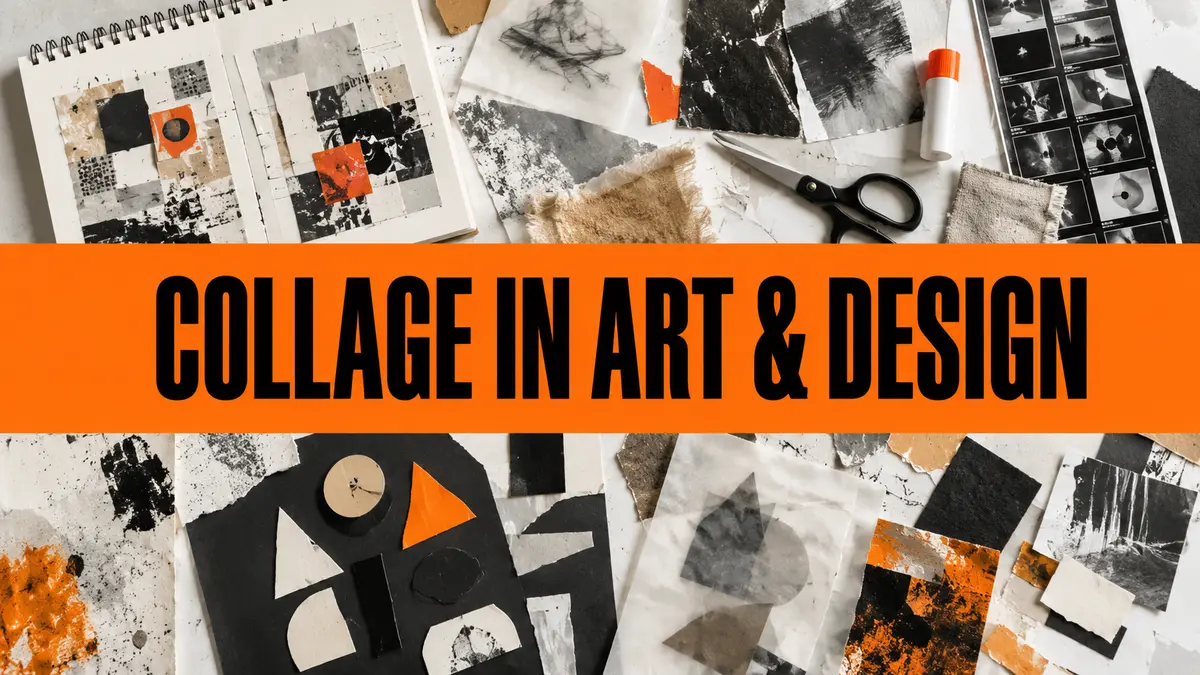
Collage is much more than sticking unrelated magazine pictures onto a page. Used thoughtfully, it allows an artist to collect, cut, rearrange, conceal, interrupt and combine images or materials until they communicate something new. A single fragment may carry its original meaning, contradict another image or become part of an entirely different visual world.
For GCSE and A Level Art & Design students, collage can be a powerful way to generate ideas, investigate artists, test compositions and connect drawing, photography, painting and design. It can support work in Fine Art, Photography and Graphic Communication—but only when the choices have a purpose.
A successful collage does not simply gather images. It creates a relationship between them.
What is collage?
The word collage comes from the French verb coller, meaning “to glue”. The term now describes both a process and a finished work in which pieces of paper, photographs, fabric and other materials are arranged and attached to a surface. The Tate introduction to collage provides a useful overview.
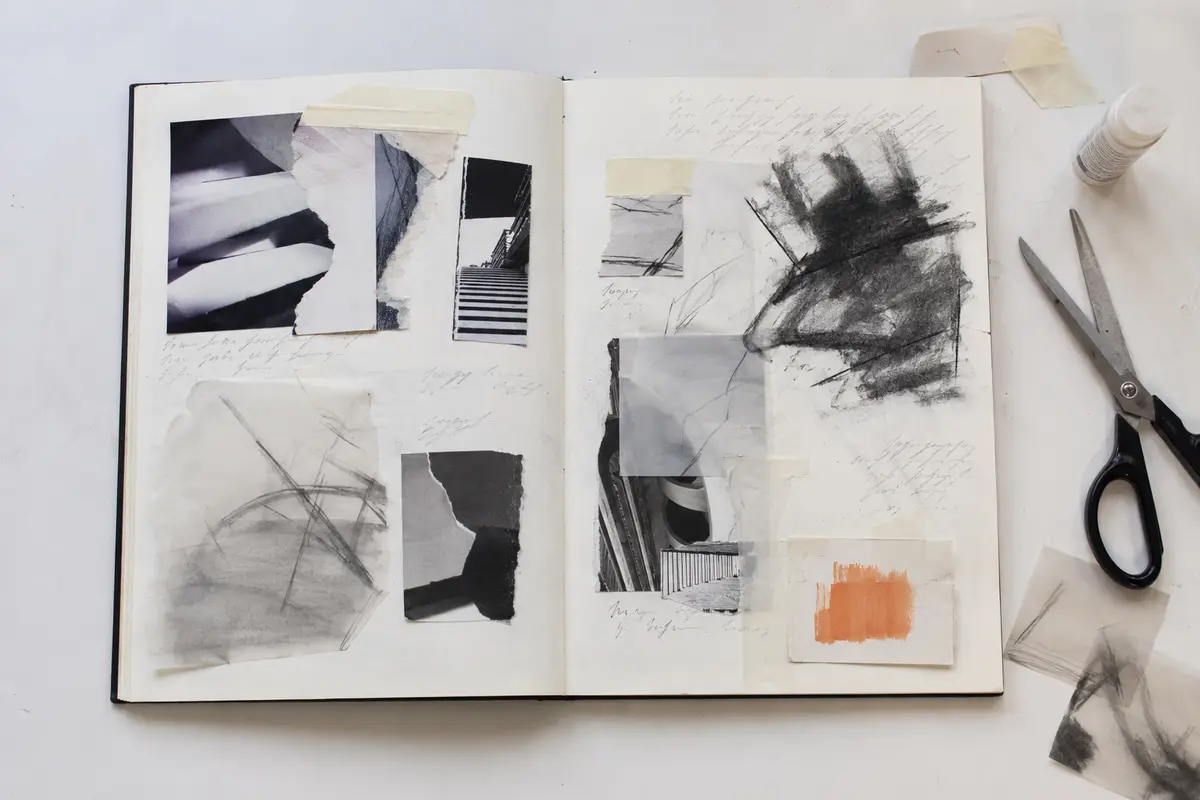
Collage can be physical, digital or a combination of both. A student might cut up their own photographs, scan painted textures, layer tracing paper over a drawing, stitch through found paper, construct a digital photomontage or photograph a temporary arrangement before taking it apart.
Useful forms of collage
- Paper collage: torn or cut papers, packaging, maps, tickets, envelopes, wallpaper and printed textures.
- Photomontage: a collage constructed mainly from photographs. It can combine different viewpoints, moments, scales or contexts.
- Mixed-media collage: paper and photographs developed with drawing, paint, print, thread, fabric, transfer, rubbing or surface texture.
- Digital collage: scanned, photographed or digitally created elements combined through layers, masks, cropping and transparency.
- Assemblage: a three-dimensional relative of collage that brings together found or constructed objects.
- Temporary collage: materials arranged, photographed and then moved, allowing many compositions to be tested without permanently fixing them.
The distinction between processes can be helpful, but students should not become trapped by labels. A project can move naturally between collage, photography, print, painting, drawing, textiles, installation and digital media when each decision supports the intention.
Why is collage useful in a GCSE or A Level project?
Collage makes decision-making visible. Before fixing anything permanently, you can move fragments, alter their scale, cover part of an image, change the background, rotate a shape or compare several arrangements. This produces evidence of exploration rather than one unexplained final composition.
- It helps generate alternatives when the first idea feels predictable.
- It allows photographs, drawings, research and material experiments to influence one another.
- It encourages decisions about scale, hierarchy, juxtaposition, cropping, rhythm and negative space.
- It can transform imperfect or rejected work into useful source material.
- It offers a practical way to investigate identity, memory, place, consumer culture, change and conflicting viewpoints.
- It supports purposeful experimentation for GCSE Art AO2.
Collage artists to investigate
Artist research should not become a collection of biographies. Look closely at particular works and ask what each artist selects, changes, hides, interrupts or combines. Then test a relevant principle using your own subject matter and source material.
Georges Braque and Pablo Picasso: introducing real materials
Georges Braque and Pablo Picasso began incorporating pasted papers into Cubist work in 1912. Newspaper, wallpaper and imitation wood grain did not merely decorate the picture: they introduced real manufactured surfaces while drawing attention to the flatness of the artwork. MoMA’s page for Braque’s Still Life with Tenora explains how contrasting paper fragments and drawing interact.
- Look for: the tension between a real material and the object it appears to represent.
- Try: draw an observed still life from more than one viewpoint, then introduce packaging, printed texture or paper that contradicts the drawn space.
Hannah Höch: photomontage and social criticism
Hannah Höch helped pioneer photomontage within Berlin Dada. She cut and recombined imagery from mass media to question politics, gender expectations and the way people were represented. Explore the Hannah Höch collection at MoMA and notice how changes of scale and unexpected combinations destabilise apparently familiar photographs.
- Look for: exaggeration, contradiction, humour, disruption and the politics of source imagery.
- Try: collect contemporary advertisements or self-made photographs that communicate conflicting expectations. Combine them to question rather than repeat the original message.
Kurt Schwitters: everyday materials and visual rhythm
Kurt Schwitters used the term “Merz” for collage and assemblage work made from fragments such as tickets, labels, printed scraps and discarded materials. These ordinary remnants become records of time and place while their colours, edges and lettering create visual rhythm. View Kurt Schwitters at Tate.
- Look for: repeated shapes, worn surfaces, changes of direction and the history carried by found materials.
- Try: gather paper evidence from one week or one journey. Edit it into several compositions before selecting the arrangement that communicates the experience most clearly.
Romare Bearden: memory, place and storytelling
Romare Bearden brought fragmented photographs, coloured paper, drawing and paint together to explore African American life, migration, music, memory and community. His figures and spaces often feel both recognisable and reconstructed. The Romare Bearden Foundation collage collection allows students to compare works from different periods.
- Look for: fragmented figures, compressed space, repeated motifs and scenes built from personal and cultural memory.
- Try: combine your own family, neighbourhood or journey photographs with drawing and colour to reconstruct a remembered place rather than illustrate it literally.
Eduardo Paolozzi: advertising, technology and popular culture
Eduardo Paolozzi collected imagery from magazines, advertisements, technology and popular entertainment. In works such as I was a Rich Man’s Plaything at Tate, desirable products, machines and media imagery collide. The result can be read as fascination, criticism or both.
- Look for: visual overload, slogans, machines, glamour and the mixed messages of consumer culture.
- Try: collect current packaging and advertisements for one product category. Rearrange the imagery to reveal what the advertising promises—and what it leaves out.
Richard Hamilton: the constructed modern interior
Richard Hamilton used imagery from advertising, interiors, entertainment and technology to examine modern consumer life. His collage for the 1956 exhibition This is Tomorrow compressed many desirable products and media messages into one deliberately artificial room. Explore Richard Hamilton at Tate.
- Look for: constructed space, scale relationships, focal points and the idea of identity being built through possessions.
- Try: design an imaginary room for a particular character using only objects and surfaces that reveal their priorities. Photograph or draw your own objects where possible.
John Stezaker: interruption and the uncanny
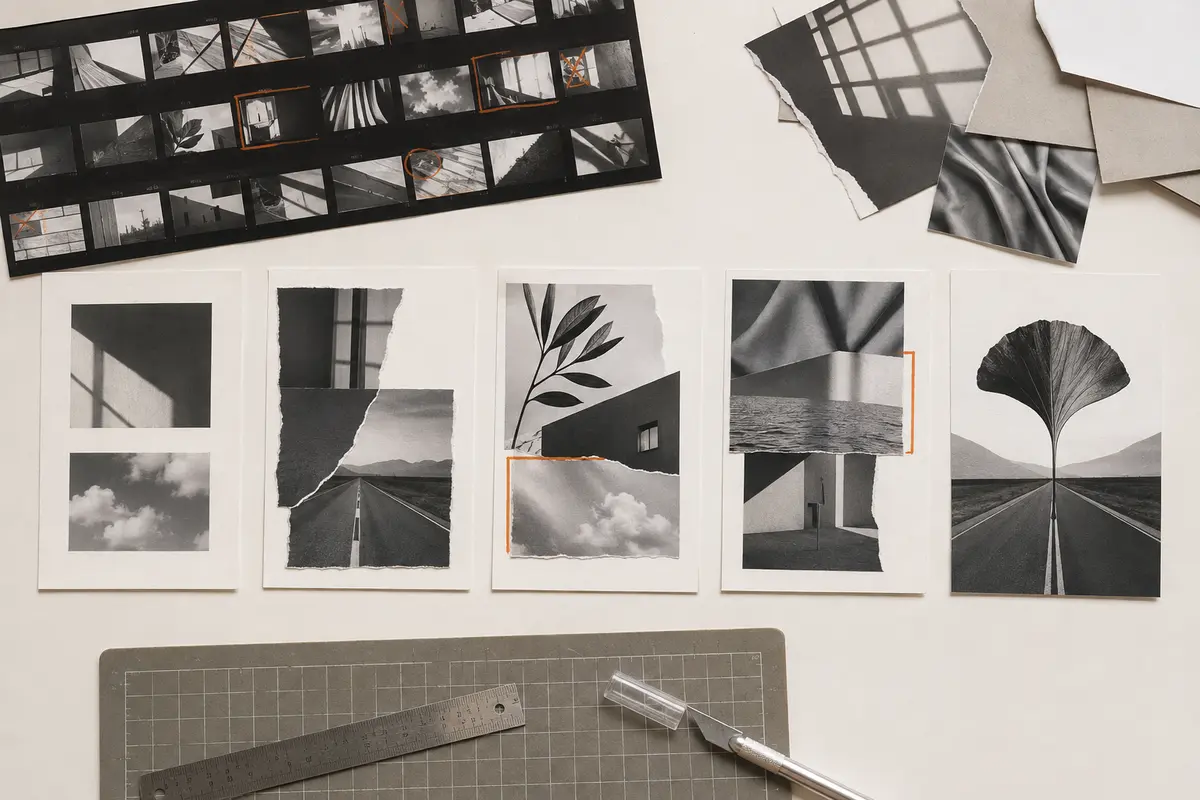
John Stezaker uses found photographs, film stills and postcards, often making a small number of precise cuts. A landscape may interrupt a portrait or two faces may be aligned into an unfamiliar identity. The economy of the intervention is important: one carefully positioned fragment can transform the whole image. See John Stezaker at Tate.
- Look for: alignment, concealment, symmetry, interruption and the unsettling gap between two images.
- Try: photograph two different locations from matching viewpoints. Make one precise cut that allows the spaces to meet, interrupt or replace one another.
Wangechi Mutu: hybrid figures and layered identity
Wangechi Mutu combines collage with drawing, ink, paint and other materials to construct hybrid figures and speculative worlds. Her practice addresses representation, gender, cultural histories, violence, resilience and transformation. MoMA describes collage and montage as central to her ideas of regeneration; explore Wangechi Mutu at MoMA.
- Look for: hybridity, altered bodies, layered surfaces and the meanings carried by source imagery.
- Try: combine your own photographs of natural and manufactured forms to invent a new organism, object or environment. Decide what the hybrid reveals about adaptation or identity.
When researching a living artist, investigate their thinking and processes without asking an image generator—or yourself—to imitate their recognisable style. Your practical response should transform a relevant principle through your own observations, photographs, materials and intentions.
Collage techniques worth testing
- Tear and cut: compare soft irregular edges with clean controlled shapes.
- Crop aggressively: remove the expected information and retain only the detail that matters.
- Change scale: enlarge an overlooked detail or reduce a dominant object.
- Interrupt: place one image across another so that neither can be read in its original way.
- Conceal and reveal: use tracing paper, flaps, apertures, erasure or partial coverage.
- Repeat: turn one fragment into a rhythm, pattern, crowd or sequence.
- Transfer: photocopy, scan, print, trace, rub or transfer a surface into another context.
- Combine physical and digital processes: scan a hand-made collage, edit it digitally, print it again and continue working into the surface.
- Re-photograph: change the lighting, shadows, depth or viewpoint of a temporary collage.
- Remove: simplify the composition by taking away anything that does not contribute to the intention.
Original collage project ideas
1. Identity in fragments
Investigate the different ways one person is represented at home, at school, online and in public. Use your own photographs, handwriting, objects and environments. Instead of producing one conventional portrait, construct several versions that reveal contradiction, concealment or change.
2. A map made from memory
Walk a familiar route and collect first-hand photographs, drawings, colour notes, rubbings, sounds and discarded paper. Reconstruct the place according to memory rather than geographical accuracy. Which details expand because they matter emotionally?
3. Consumer promises
Choose one group of advertisements—for beauty, food, technology, housing or travel—and analyse how desire is constructed. Reassemble packaging, slogans, original product photographs and rejected material to expose the gap between promise and reality.
4. Two places occupying one space
Photograph two contrasting environments using matching viewpoints, horizons or architectural lines. Physically splice or digitally mask the images so that the locations compete, merge or appear to transform into one another.
5. Natural and manufactured hybrids
Combine first-hand studies of plants, bones, shells, insects or weathered surfaces with photographs of machines, buildings or packaging. Develop the most convincing combinations through drawing, sculpture, photography or design.
6. Collage as sound or rhythm
Respond to a piece of music or the sounds of a location through repeated shapes, intervals, colour, fragmented text and changes of scale. Consider an accordion book, animation, poster sequence or installation rather than one flat sheet.
7. Evidence of a changing place
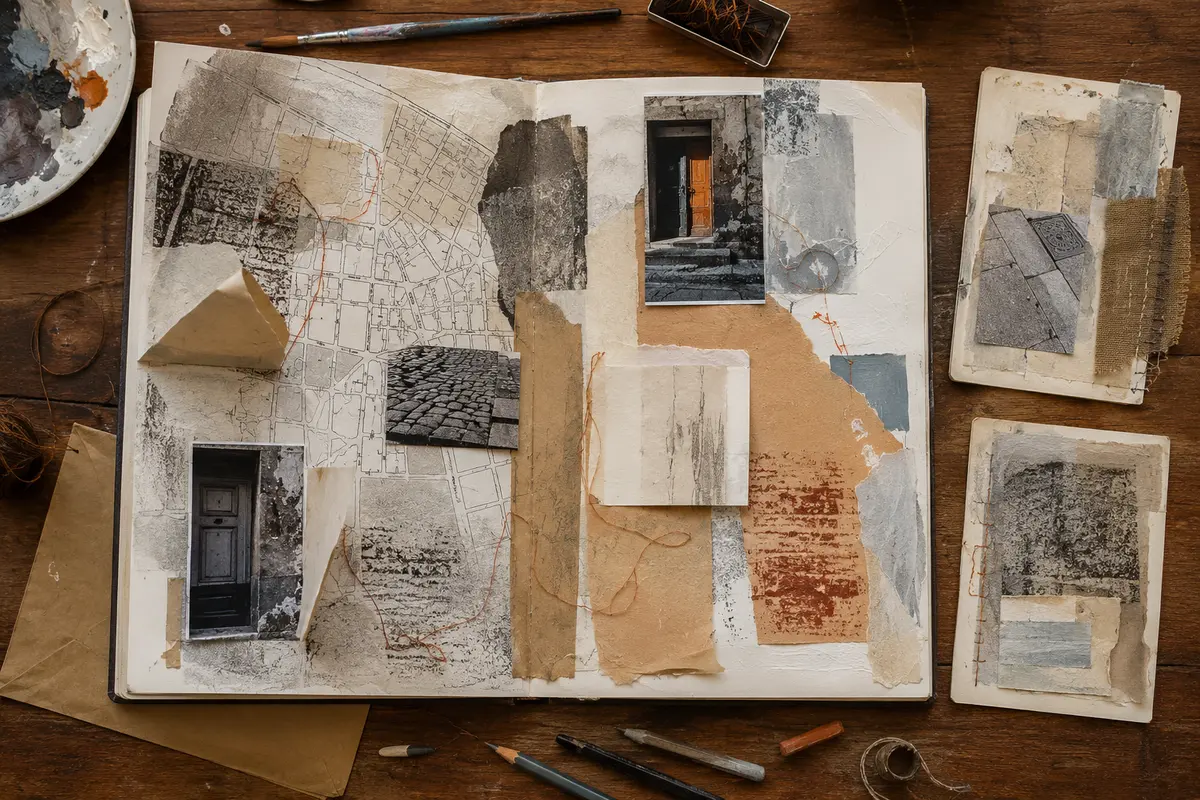
Combine historical maps or properly credited archive material with your own current photographs and observations. Explore demolition, regeneration, decay, environmental change or the traces left by previous occupants.
8. Editorial collage or campaign
Create a magazine spread, poster series, record sleeve, book cover or campaign around a meaningful issue. Test how image fragments, type, grid, scale and negative space guide the audience. The collage should communicate—not merely decorate.
Collage in Fine Art, Photography and Graphic Communication
Fine Art
Fine Art collage can emphasise material, surface, touch and physical history. Combine observational drawing with torn paper, print, paint, rubbings, transfers, thread, fabric or found objects. Test how the work changes when it is layered, folded, suspended, enlarged or made three-dimensional.
Photography
Photography students can use photomontage to combine viewpoints, moments, scales and locations. Work from your own contact sheets rather than relying entirely on internet imagery. Physical cutting, projection, re-photography, scanning and digital masking can each produce different evidence and meanings.
Graphic Communication
Collage can give Graphic Communication an energetic and distinctive visual language. It works particularly well in editorial design, campaigns, posters, publishing, packaging, illustration and moving graphics. Test the design at its intended size and make sure the hierarchy remains clear.
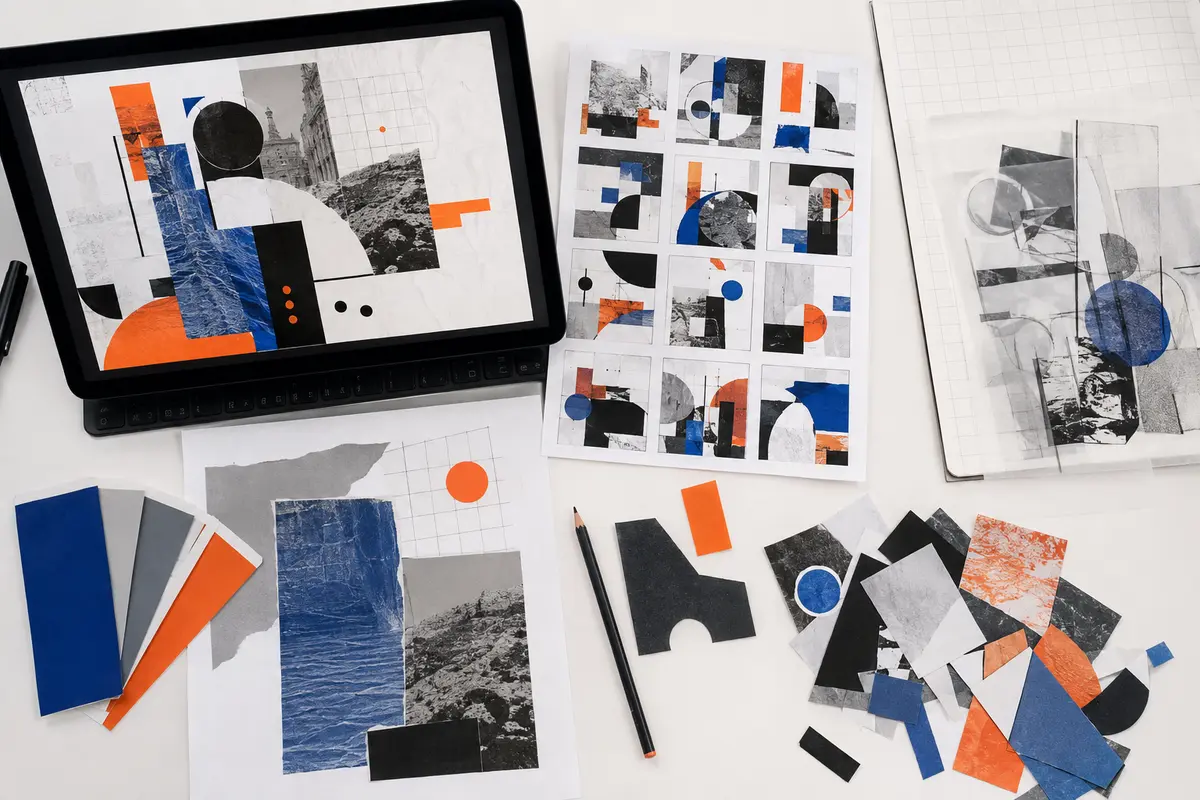
How collage can support AO1–AO4
| Assessment Objective | Useful collage evidence |
|---|---|
| AO1: Develop | Relevant artist research, analysis of particular collages, practical responses and evidence that sources change your direction. |
| AO2: Explore and refine | Alternative arrangements, material trials, physical and digital processes, comparisons, selection and purposeful refinement. |
| AO3: Record | Your own photographs, drawings, rubbings, maps, collected material, contact sheets and concise annotation explaining decisions. |
| AO4: Present | A personal, meaningful response that brings the strongest investigation, source material and technical learning together. |
Collage does not automatically satisfy an Assessment Objective. The value comes from the quality of the investigation, the relevance of the source material and the decisions made because of the experiments. Visit the GCSE AO1 guide and GCSE AO2 guide for more help with investigation and refinement.
A strong collage development process
- Define the question. Decide what the collage is investigating—not simply what it will contain.
- Collect first-hand material. Take photographs, draw, record textures, save relevant ephemera and document objects or places.
- Research selectively. Study particular artists because their decisions are relevant to your question.
- Create a material bank. Print photographs at different scales, photocopy drawings, prepare painted paper and scan useful textures.
- Make quick alternatives. Photograph each arrangement before changing it. Test one variable at a time where possible.
- Compare and annotate. Explain what changed, what the result communicates and which possibility deserves development.
- Transform the strongest direction. Enlarge, redraw, reshoot, reprint, animate, construct or redesign it rather than simply making a neater copy.
- Resolve the presentation. Decide whether the work belongs on a page, wall, screen, book, poster, object or installation.
Keep the development visible in your GCSE Art sketchbook. Photographs of temporary layouts, rejected alternatives and before-and-after comparisons can show more genuine thinking than a single immaculate page.
Common collage mistakes
- Random decoration: adding torn paper because a page looks empty rather than because it supports the idea.
- Only using internet imagery: producing a project with little first-hand recording or personal connection.
- Copying an artist’s finished composition: repeating appearance without understanding or transforming the method.
- Fixing the first arrangement: missing the opportunity to test scale, crop, position, surface and hierarchy.
- Hiding weak decisions under more layers: complexity is not the same as development.
- Ignoring copyright and sources: failing to record where published or archive imagery came from.
- Stopping at the experiment: never using what the collage revealed to develop a photograph, painting, design or resolved outcome.
Collage safety and responsible sourcing
Use cutting mats and follow your school or college rules for scissors, craft knives, adhesives, sprays and heat processes. Keep blades covered when they are not in use and protect tables and artwork from unsuitable glue or solvents.
Record the source of every image you did not make yourself. Where possible, prioritise your own photographs and drawings, openly licensed material, public-domain collections or physical ephemera that you can transform substantially. Acknowledging a source does not automatically grant permission to reproduce it publicly, so check the relevant licence before publishing work online.
Collage questions to ask yourself
- Why do these particular fragments belong together?
- What meaning does each source carry before I alter it?
- What becomes stronger when I crop, cover, enlarge or repeat something?
- Where does the viewer look first, and is that what I intended?
- Am I using my own photographs, drawings and observations?
- What did the least successful arrangement teach me?
- How has the artist research changed a practical decision?
- What should happen after this collage experiment?
Frequently asked questions about collage
Is collage suitable for GCSE and A Level Art?
Yes. Collage can support investigation, experimentation, recording and resolved outcomes in Fine Art, Photography and Graphic Communication. It must be purposeful and connected to the student’s developing intention.
Can digital collage count as experimentation?
Yes, when layers, masks, scale, cropping, colour and transparency are tested to answer a visual question. Applying several effects without comparison or selection does not show the same depth of understanding.
Should I use magazine images?
Magazine imagery can be useful when its original message is relevant to the investigation, particularly in projects about media or consumer culture. Balance it with your own source material, transform it purposefully and record where it came from.
How many collage experiments should I make?
There is no correct number. Make enough alternatives to learn something and make a reasoned selection. Five purposeful comparisons can be more valuable than twenty near-identical arrangements.
Does collage have to remain flat?
No. Collage can develop into relief, assemblage, sculpture, installation, artist books, garments, projection, animation or photographed temporary constructions.
Can I copy a collage artist as an experiment?
A short practical study may help you understand a process, but it should be clearly acknowledged and followed by substantial transformation. Stronger portfolio evidence shows how you applied the learning to your own sources and intentions.
Develop your own collage project
The most convincing collage projects do not begin with “I want to make a collage.” They begin with a question, experience, place, collection or contradiction that collage is particularly well suited to investigate.
Explore more guidance through the GCSE Art hub or the A Level Art hub. If you would like detailed independent comments on how clearly your research, experiments and development are communicating, visit Get Feedback.
No responses yet