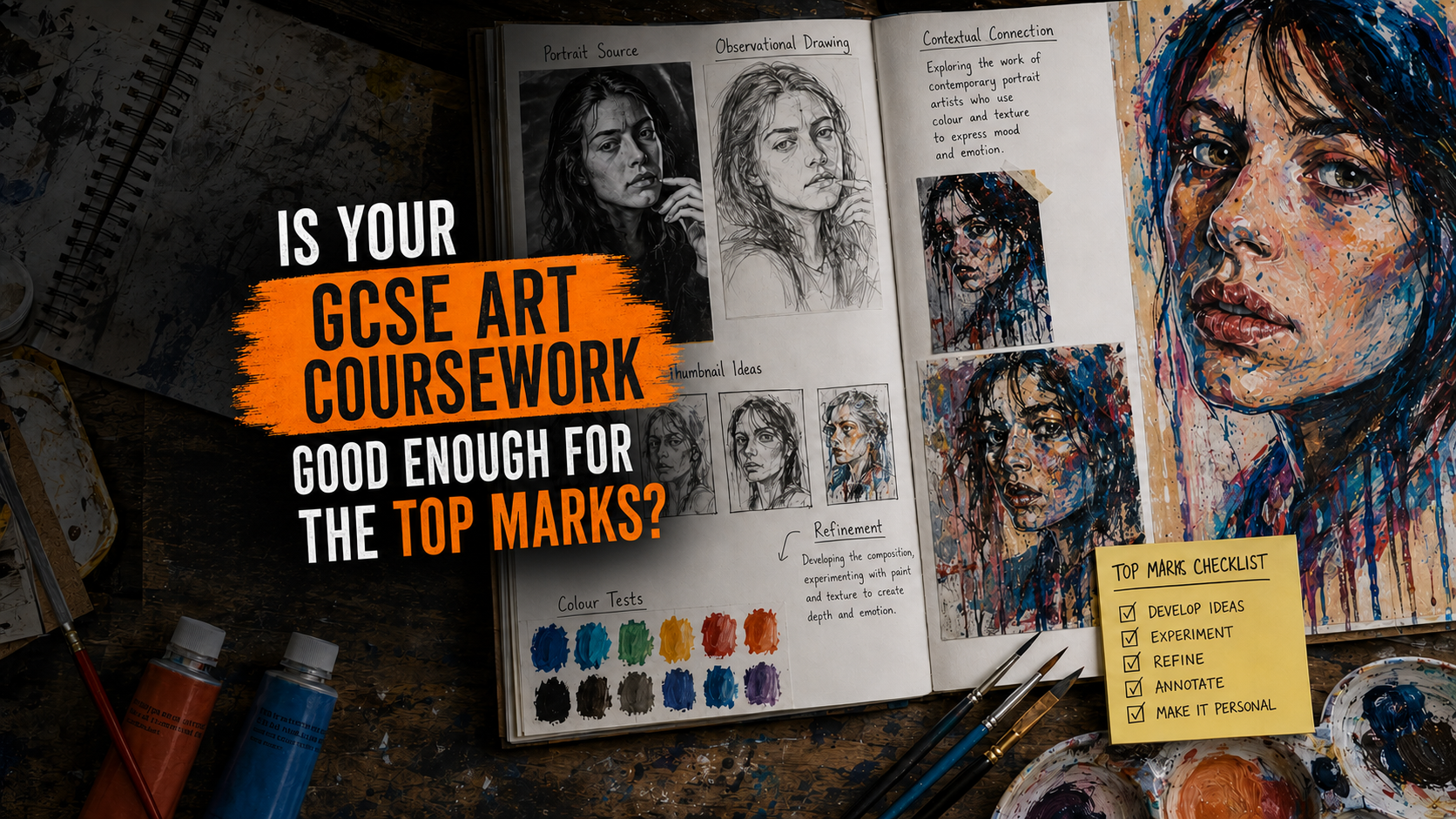
GCSE Art is not marked by asking one simple question such as “Is this drawing good?” Examiners look at the whole creative journey: how you investigate ideas, respond to artists, experiment, record observations, refine your work and present a personal response.
This guide will help you work out whether your portfolio is moving towards the highest marks. It is written in student-friendly language, so you can use it as a practical self-assessment before handing work in.
The strongest portfolios do not just contain attractive pages. They show clear thinking, purposeful decisions and a journey that becomes increasingly independent and personal.
What Are Examiners Really Looking For?
Across GCSE Art and Design, examiners are looking for evidence that you can do more than follow instructions. They want to see that you can:
- develop ideas instead of stopping at the first idea
- use artists and other sources to move your work forward
- experiment with materials for a clear reason
- record observations and ideas with care
- reflect on what is working and what needs changing
- make increasingly confident and independent decisions
- bring your ideas together in a personal final response
That means a student who can draw beautifully but copies everything may not achieve as highly as a student whose work shows curiosity, development, risk-taking and thoughtful refinement.

Level 1: Your Work Feels Mostly Teacher-Led
At the lowest level, the portfolio often feels like a collection of tasks rather than a personal investigation. Pages may be incomplete, disconnected or created mainly because the teacher asked for them.
Signs that your work may be at this stage
- You copy artists or photographs without changing them.
- Your project has no clear theme, question or intention.
- You complete only one or two experiments.
- Your written work mainly says what you did.
- You rely on your teacher to tell you every next step.
- Your final outcome does not clearly connect to the work in your sketchbook.
A page might contain a copied artist image, a short paragraph and a drawing, but there may be little evidence that you understood the artist or used the research to create something new.
How to move forward
- Choose one idea and develop it through several versions.
- Use your own photographs whenever possible.
- Write about why you made a decision, not only what you did.
- Try at least three different ways of changing the same idea.
- Make one independent choice before asking your teacher what to do next.
Try this: Take one existing drawing and create three new compositions by cropping, enlarging, rotating, layering or changing the viewpoint.
Level 2: You Are Beginning to Show Purpose
At this stage, your work begins to show that you understand what a project journey should look like. You may have relevant artist research, some experiments and a developing final idea, but the project can still feel simple or dependent on teacher direction.
Signs that you are beginning to improve
- You make basic links between an artist and your own work.
- You record observations through drawing or photography.
- You test some materials and techniques.
- You begin to explain what worked and what did not.
- Your project has a general direction.
- You show some control, but the quality is not yet consistent.
This is progress. The next step is to make the work less predictable. A simple response might copy an artist’s colour palette. A stronger response would use the artist’s ideas, composition or process to create something clearly connected to your own subject.
Level 3: Your Work Is Competent but Still Safe
Many GCSE portfolios sit in the middle because they contain all the expected parts, but the journey is short, repetitive or too safe. The student has done the work, but the project does not yet show enough depth, confidence or independence.
Common signs of a middle-level portfolio
- Your pages are sometimes strong and sometimes rushed.
- You repeat similar experiments without learning anything new.
- Your artist analysis contains general comments rather than close observation.
- Your ideas are sensible but obvious.
- You make a final piece too early without enough refinement.
- Your annotations mention success and failure but do not explain why.
- Your project still feels strongly shaped by classroom tasks.
The biggest problem here is often not lack of skill. It is lack of depth. A student might use five materials, but if every experiment produces almost the same result, the project has not really moved forward.
How to push beyond “safe” work
- Ask a clear question before every experiment.
- Compare your results instead of treating each experiment separately.
- Return to earlier work and improve it using what you have learned.
- Study fewer artists in more depth.
- Make your own photographs, objects, textures or source material.
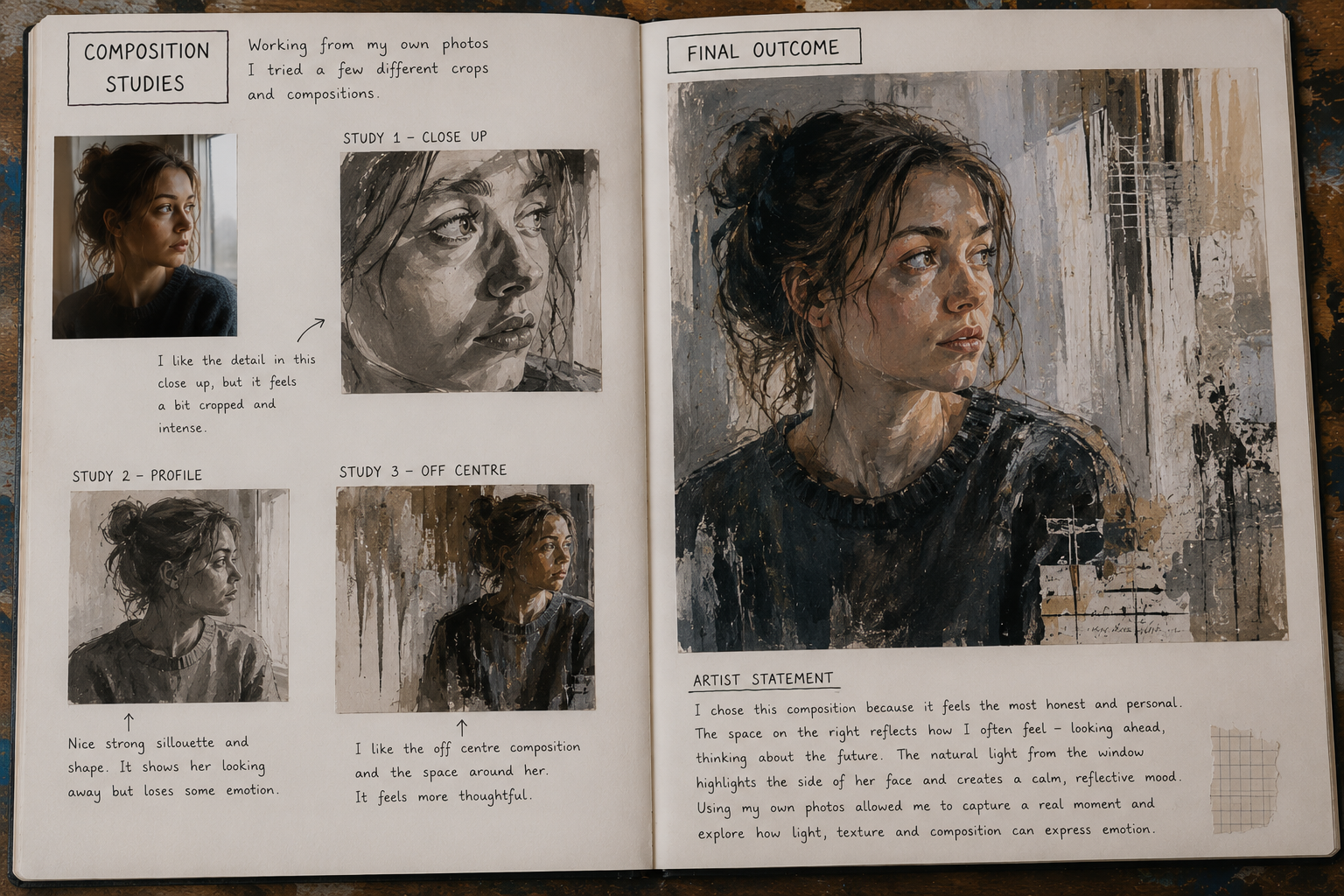
- Test alternatives before deciding on your final composition.
For example, do not simply test acrylic, pencil and collage. Ask which material best communicates age, movement, isolation, identity, decay or whatever your project is about.
Level 4: Your Portfolio Shows Consistent Ability
A strong portfolio feels connected. Research, recording, experimentation and refinement all help the project move towards a clear intention.
What consistent work looks like
- Your artist choices are relevant to your own ideas.
- You understand what you are learning from each source.
- Your experiments influence what happens next.
- You make careful choices instead of keeping everything.
- Your ideas become less derivative and more individual.
- You take some informed creative risks.
- Your refinement is thoughtful rather than decorative.
- Your intentions become clearer as the project develops.
This level is not about producing perfect work on every page. It is about showing a reliable pattern of purposeful thinking. When an experiment fails, you explain what it taught you and use that knowledge in the next stage.

Level 5: Your Work Is Highly Developed
Highly developed work has confidence, control and genuine curiosity. The student is not simply completing a process correctly. They are actively investigating possibilities and making informed choices.
Signs of highly developed work
- Your project shows a clear personal interest or line of enquiry.
- You investigate ideas independently and consistently.
- You use experimentation to improve the creative journey.
- You take risks for a clear reason.
- You select materials because they support your intention.
- Your reflections are specific, honest and useful.
- Your skills and ideas work together.
- Your final response feels personal, controlled and connected to the whole project.
At this level, you might reject a technically successful experiment because it does not communicate your idea strongly enough. That is a sign of artistic judgement: you are selecting based on meaning, not simply appearance.
High marks come from making informed decisions repeatedly, not from creating one impressive final piece at the end.
Level 6: Your Work Feels Exceptional
Exceptional portfolios show mature and independent thinking throughout. The student explores alternatives, responds intelligently to change and brings complex ideas together with confidence.
What exceptional work tends to show
- Sophisticated ideas supported by strong understanding.
- A highly personal response rather than a formulaic project.
- Confident analysis that clearly changes the student’s work.
- Careful and demanding selection of media, materials and processes.
- A willingness to reconsider, adapt and improve ideas.
- A genuine process of discovery.
- Clear intentions alongside alternative possibilities.
- Strong self-awareness and independent reflection.
- A final response that brings research, experimentation and personal meaning together.
Exceptional work often includes moments of uncertainty and change. The difference is that the student responds thoughtfully. They do not change direction randomly; they recognise when an idea needs to be challenged, refined or replaced.
The Difference Between More Work and Better Work
Filling every blank space does not automatically improve your mark. Examiners are interested in the quality of your journey, not just the quantity of pages.
More work might mean producing ten similar drawings.
Better work might mean producing four drawings, comparing them carefully, identifying the strongest features and using those discoveries to create a more successful composition.
The aim is not to make your sketchbook thinner. It is to make every section useful.
Do Your Artist Studies Actually Help Your Project?
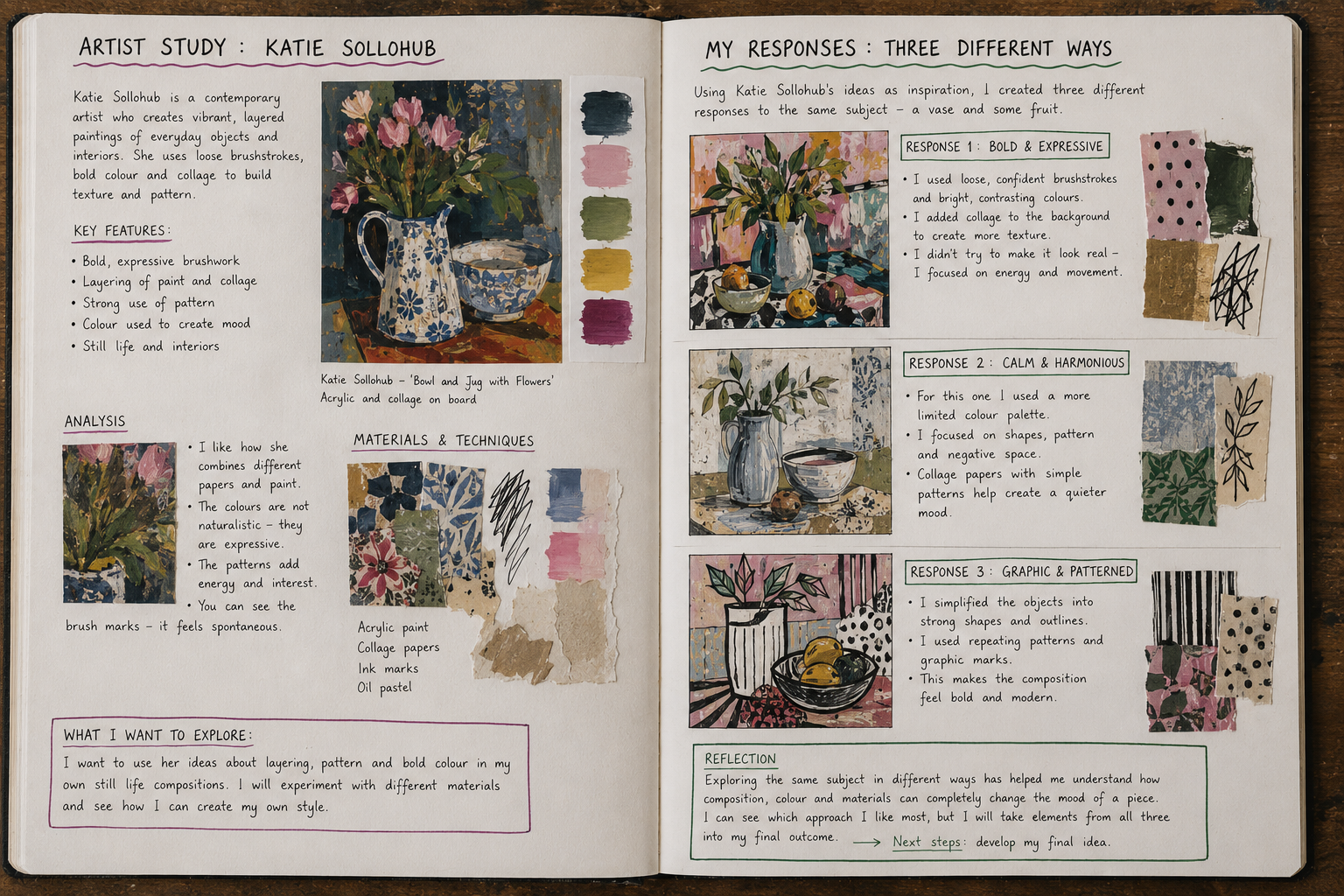
Artist research should not be a separate school exercise. It should change how you think or work.
A weak artist page might:
- copy information from the internet
- describe colours and shapes without explaining their effect
- include a copy of the artist’s work with no personal response
- have no connection to later pages
A stronger artist investigation might:
- identify a technique, idea or visual quality that supports your project
- analyse how the artist creates meaning
- test the artist’s methods using your own subject matter
- compare several responses
- use the discoveries to develop an original idea
A useful question is:
What changed in my project because I studied this artist?
If the answer is “nothing,” your research may need to become more connected and purposeful.
Does Your Experimentation Have a Purpose?
Experimentation is not a competition to use the greatest number of materials. It is a way of discovering what will communicate your ideas most successfully.
Before you begin, write a question such as:
- Which technique creates the strongest sense of movement?
- How can I make this portrait feel more fragmented?
- Which colour palette best communicates memory?
- Would a larger scale make the image more powerful?
- How can texture help show age or decay?
Afterwards, compare the results and explain what you will use next. That final step turns material testing into genuine development.
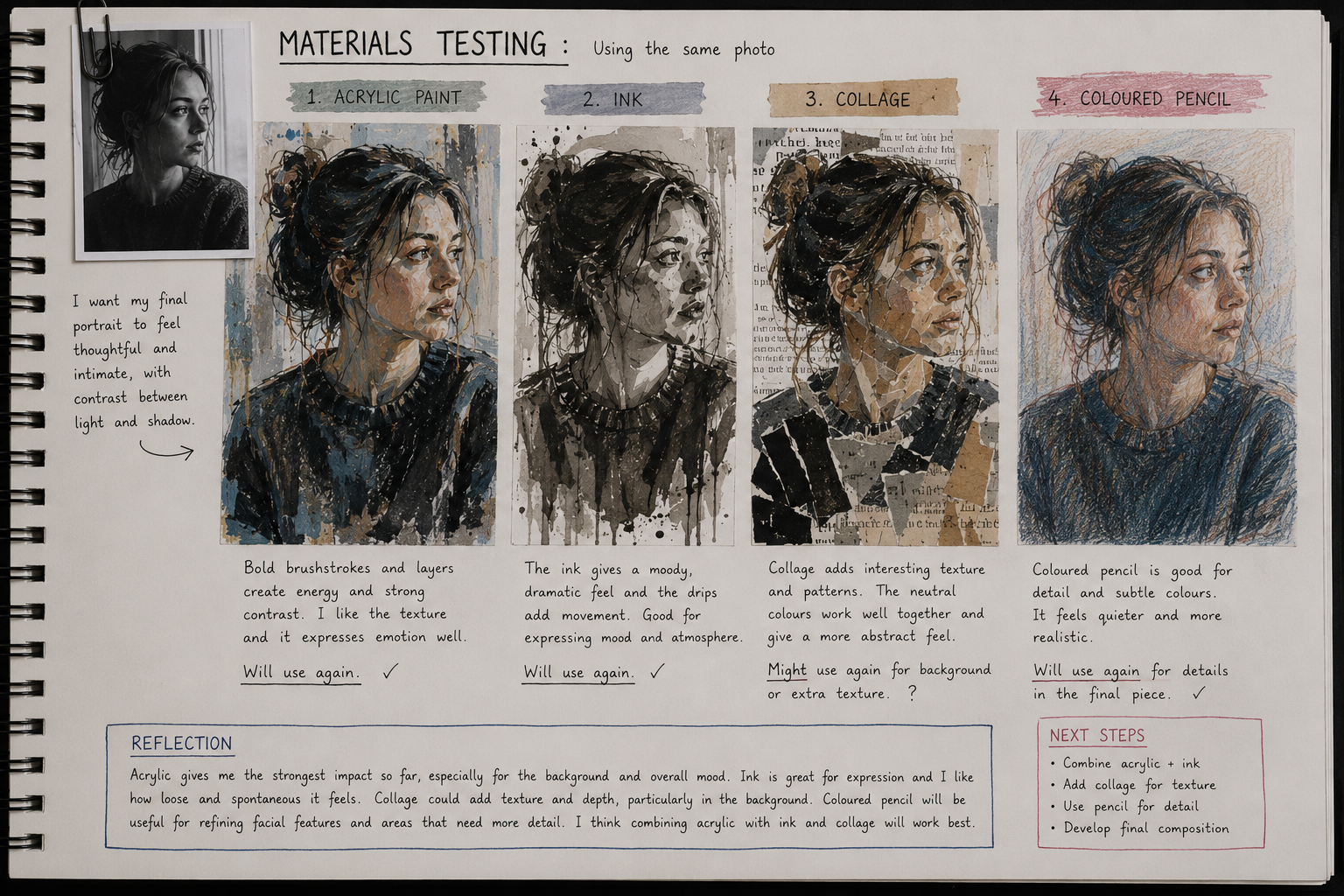
Are Your Annotations Helping You Earn Marks?
Strong annotations reveal your thinking. They do not need to be long, complicated or full of art vocabulary.
Avoid writing only:
I used acrylic paint. I like this experiment because it is colourful.
Try writing:
The thick acrylic marks create more energy than my pencil study. The cropped composition also makes the expression feel more intense. I will keep the close-up viewpoint, but test a more limited colour palette so the face remains the main focus.
The stronger version explains:
- what happened
- why it happened
- how successful it was
- what will change next
Can Someone See a Clear Journey?
Imagine that someone opens your sketchbook without you there to explain it. Can they understand:
- what your project is exploring?
- where your ideas came from?
- how your artist research influenced you?
- why you tested particular materials?
- how your compositions changed?
- why you selected your final idea?
- how the final outcome connects to earlier work?
If the journey is difficult to follow, add short reflections, comparisons and transition pages. Do not invent a false story after finishing the project. Instead, make the genuine decisions and connections easier to see.
The Top-Marks Self-Assessment Checklist
Use this checklist honestly. A strong portfolio should allow you to answer yes to most of these questions.
Ideas and independence
- □ Is there a clear idea, question or intention running through my project?
- □ Do my ideas develop rather than repeat?
- □ Have I made important decisions independently?
- □ Does my work become more personal as the project progresses?
- □ Have I explored more than one possible direction?
Artists and sources
- □ Are my chosen artists genuinely relevant?
- □ Have I explained how they communicate ideas?
- □ Have I used their work to create my own responses?
- □ Can I show exactly where artist research changed my project?
- □ Have I avoided simply copying?
Experimentation and refinement
- □ Does each experiment have a purpose?
- □ Have I compared the results?
- □ Have I selected materials for a reason?
- □ Have I improved weaker ideas instead of ignoring them?
- □ Have I taken at least some informed creative risks?
- □ Does my final choice come from testing alternatives?
Recording and reflection
- □ Have I used my own drawings, photographs or observations?
- □ Do my annotations explain decisions?
- □ Have I reflected throughout the project, not only at the end?
- □ Do I explain what I learned from unsuccessful work?
- □ Is there enough visual evidence to support my claims?
Final response
- □ Does my final outcome clearly connect to the rest of the project?
- □ Does it communicate my intention?
- □ Does it bring together my strongest ideas and discoveries?
- □ Does it feel personal rather than copied?
- □ Is it presented with care and control?
If you have several unchecked boxes, do not try to fix everything at once. Choose the three areas that would make the biggest difference and create a short action plan.
A Simple Three-Step Improvement Plan
Step 1: Find the weakest link
Look through the project and identify where the journey becomes rushed, repetitive or unclear.
Step 2: Add development, not decoration
Create work that changes the direction or quality of the project. Avoid filling gaps with borders, titles or copied images that add no new evidence.
Step 3: Explain the connection
Add a short reflection showing what you discovered and how it will affect the next stage.
A strong improvement is not just something new. It is something new that helps your project move forward.
Frequently Asked Questions
Do I need to be excellent at drawing to get a Grade 9 in GCSE Art?
No. Drawing skill can help, but high marks depend on the complete creative process. Strong development, analysis, experimentation, recording, refinement and personal decision-making are all important.
Does every sketchbook page need to look perfect?
No. A sketchbook should show exploration and change. Some experiments may be unsuccessful, but you should explain what you learned and how that influenced later work.
How much writing should I include?
Include enough writing to make your thinking clear. Short, specific annotations are usually more useful than long paragraphs that repeat information or describe obvious details.
Will more pages automatically earn more marks?
No. More evidence can help, but only when it is relevant. A smaller number of thoughtful, connected pages can be stronger than many repetitive pages.
Is the final piece the most important part?
The final response is important, but it is judged as part of the full journey. A technically impressive final piece cannot completely replace missing research, development, experimentation or reflection.
Can I still improve my mark near the deadline?
Yes, but focus on meaningful gaps. Strengthen connections, add purposeful experiments, improve weak recording and explain your decisions. Avoid rushing through random extra pages simply to increase quantity.
Final Advice
The best GCSE Art portfolios feel like a real investigation. They show a student becoming more curious, selective, skilled and independent as the project develops.
Do not ask only, “Does this page look good?” Ask:
What does this page prove about my thinking, my decisions and the development of my ideas?
That question will help you make improvements that genuinely support the highest marks.
No responses yet