
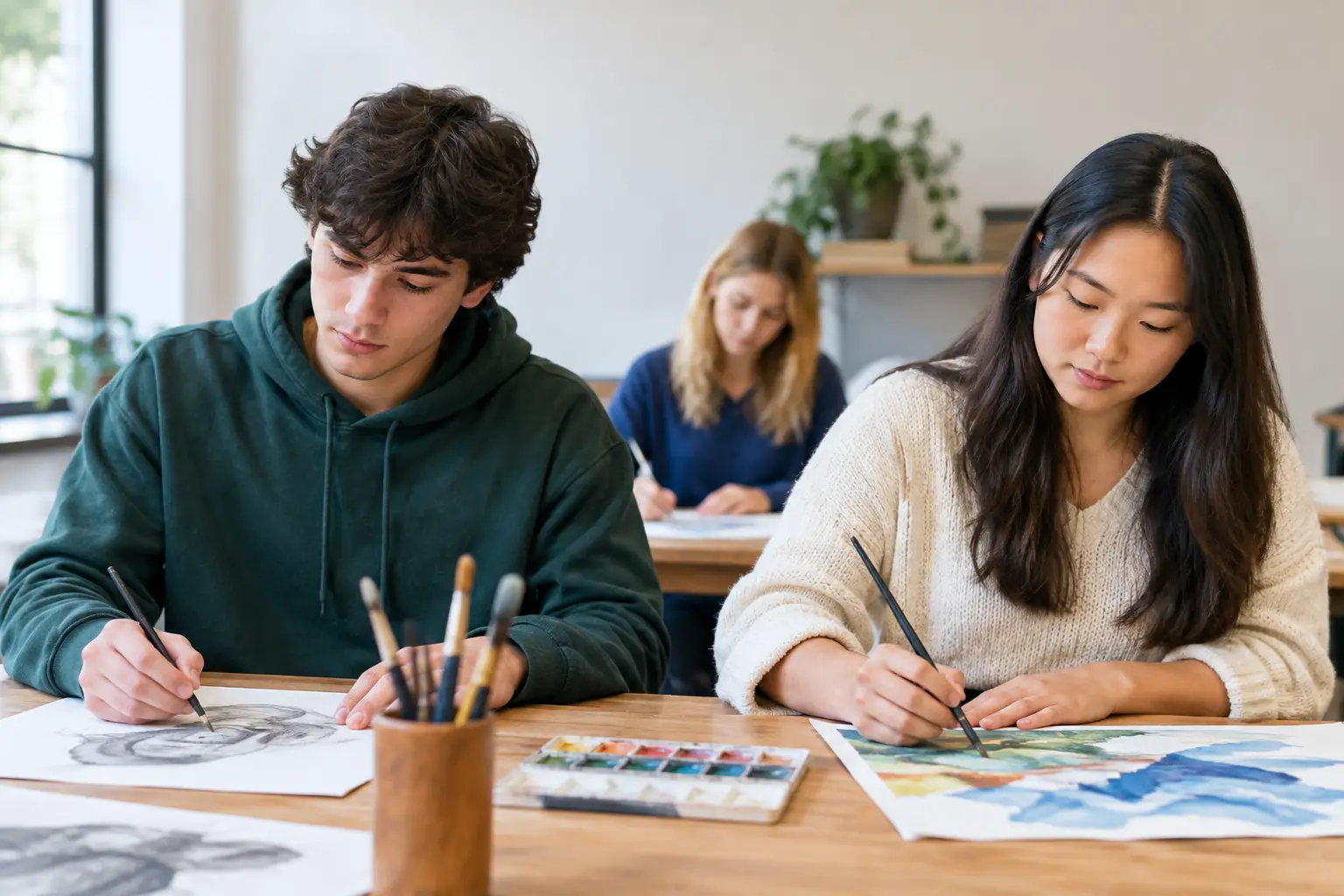
A carefully copied painting can look impressive in a sketchbook. But if the next page has no change in scale, media, composition or meaning, it can leave an examiner with one key question: where are your ideas? Understanding artist copy versus artist response helps you turn artist research from a decorative sketchbook task into convincing evidence for AO1, AO2 and AO4.
An artist copy is not automatically weak. In fact, a purposeful copy can teach you a great deal about an artist’s process. The issue is stopping there. High-grade coursework shows that you have investigated an artist, selected what is useful, experimented with it, and made informed decisions in work that becomes increasingly personal.
Artist copy versus artist response: the essential difference
An artist copy is a direct recreation of an existing artwork, image or section of an artwork. You may copy the colour palette, marks, layout, subject matter and composition as closely as possible. This can be done in pencil, paint, collage, photography or digital media.
An artist response uses an artist’s work as a starting point, but changes it through your own intentions. You might borrow a printmaking technique, a fragmented composition, an unusual viewpoint, or the way an artist uses text. Then you apply that feature to your own photographs, observations, theme and message.
The difference is not simply whether the finished page looks different. It is whether you can explain a chain of creative decisions. If you have used an artist’s layered surfaces because they communicate weathered urban spaces, then tested those surfaces with photos from your local area, that is a response. If you have reproduced their cityscape exactly because it looked good, it is mainly a copy.
Both have a place, especially at the beginning of research. However, they do different jobs in your portfolio.
What each approach proves to an examiner
A copy can provide useful evidence of technical observation and analysis. It may show that you have noticed how an artist mixes muted colours, uses thick paint, crops a figure, or builds contrast. When it is accurate and well annotated, it can support AO1 by showing that you understand an artist’s work.
Yet AO1 is not just about naming an artist and reproducing an image. You are expected to develop ideas through investigations that are relevant to your project. A strong copy needs a clear purpose: what were you trying to learn, and how will that learning affect your own work?
Artist responses often create broader evidence across the Assessment Objectives:
- AO1 is shown when you select and investigate an artist in a meaningful way.
- AO2 is shown when you experiment with materials, techniques and processes inspired by that research.
- AO3 is strengthened when your response uses your own photos, drawings, visual research and observations.
- AO4 is evident when those experiments help you create a personal, resolved final outcome.
This does not mean every page must cover all four Assessment Objectives. It means your sketchbook should connect. Artist research should lead somewhere, rather than appearing as an isolated, beautifully presented page between unrelated studies.
When an artist copy is worth doing
A direct copy is most valuable when it answers a specific practical question. Perhaps you want to understand how a photographer creates harsh shadows, how a painter simplifies facial features, or how a graphic designer overlaps type and image.
Choose a manageable detail rather than feeling you must copy a whole artwork. A section of a portrait may teach you more about brushwork than a rushed recreation of the entire painting. Label the original image clearly and state the medium you used. Then annotate what you noticed while making it.
Useful annotation is precise. Rather than writing, “I like this artist because their work is interesting,” explain what happened in your practical study: “I used dry brush over a pale wash to recreate the broken texture. This created an aged surface, but the colours became too muddy when I added too many layers.”
That final judgement matters. It shows that you are evaluating a process, not simply presenting a neat copy.
How to turn a copy into an artist response
The easiest way to develop beyond copying is to change one visual decision at a time. Start with the feature you genuinely want to borrow from the artist. Be specific. It could be their limited colour palette, repeated motif, angular line, dramatic crop, mixed-media layering or distorted proportions.
Next, bring in your own source material. For Fine Art, that might be observational drawings of objects connected to your theme or photographs you have taken yourself. For Photography, it could mean planning a shoot that uses the artist’s lighting, viewpoint or editing approach without recreating their exact image. For Graphic Communication, it may involve applying an illustrator’s visual language to a new brief, audience or message.
Then test variations. Change the composition, the materials, the scale, the colour choices or the level of abstraction. You are looking for evidence of selection and refinement. One response does not need to be perfect. A less successful experiment can be valuable if you identify why it failed and show a clear next step.
For example, imagine you are researching an artist known for fragmented portraits. First, you might make a small copy to understand how they split facial features into geometric sections. Your response could then use your own photographs of a family member, divide the face with shapes linked to your project theme, and test collage alongside paint. You could decide that collage is too flat, but that painted sections over a photographic base create a more convincing sense of identity. That sequence shows development.
Avoid the common sketchbook trap
Many students create an artist page, complete a copy, write a short biography, and never refer to that artist again. The page may be attractive, but it is difficult for an examiner to see its impact on the project.
Instead, make the connection visible. Use short annotations such as, “I will take forward the close crop in my next photo shoot,” or “The rough charcoal marks work well for my theme of decay, so I will test them on drawings of abandoned buildings.” Later pages should prove that you acted on that intention.
Be careful not to force every artist into your work either. If an experiment does not suit your project, say so. A clear evaluation such as, “Although the bright flat colours reflect the artist’s style, they weaken the sombre mood I want to communicate,” demonstrates mature judgement. Coursework is not about proving that every technique works. It is about making thoughtful choices.
A practical page sequence that creates development
A strong sequence is usually more convincing than one large, polished artist page. Begin with a short artist investigation focused on relevant visual features, followed by a small copy or technique study. Add annotation explaining what you learned.
On the next page, use your own primary source material to test one or two of those features. After that, develop the more successful experiment with further changes. You might combine the artist influence with a second artist, a different medium, or a compositional idea from your own drawings. By the time you reach a final piece, the artist’s influence should be recognisable but not dominant.
At A Level, you will normally be expected to push this further. Your responses should show sustained exploration, sharper critical judgement and more independent connections between sources. At GCSE, clear progression is still essential. Do not assume a simple copy earns high marks because it took a long time.
Questions to ask before you move on
Look at your artist research and ask yourself: What exactly have I learned from this artist? Which visual feature connects to my theme? Have I used my own photographs, observations or ideas? What changed after my first experiment? Can someone turn through my sketchbook and see how this research influenced my final direction?
If your answer is unclear, you do not necessarily need to start again. Add the missing development. Make a focused response using your own imagery, annotate the decision, and show what you will refine next.
The best artist research does not make your work look like somebody else’s. It gives you the confidence and practical evidence to make creative decisions of your own. Let the copy teach you, then let your response show where your project can go.
No responses yet