
A Level Art & Design (Fine Art) Explained: Course, Assessment and How to Succeed
The A Level Fine Art course is not assessed by counting sketchbook pages or judging one final piece in isolation. Sometimes described as Fine Art A Level, this course gives students the opportunity to develop a sustained and increasingly independent creative practice. It rewards a sustained creative investigation in which research, practical exploration, first-hand recording, critical reflection and personal outcomes develop together.
Most students study A Level Art & Design (Fine Art) over two academic years. During that time, they learn to work with increasing independence, develop a personal visual language and produce two assessed components. The precise timetable, project structure and raw marks vary between awarding organisations, but the main principles are remarkably consistent.
The course in one sentence
You investigate a personally significant idea, learn from relevant sources, record from experience, explore and refine materials, reflect on your progress and present a meaningful response—while making the whole journey visible enough to be assessed against AO1, AO2, AO3 and AO4.
A Level Fine Art Course – What is A Level Fine Art?
Fine Art is one title within A Level Art & Design. It is broader than “painting and drawing”. Depending on the facilities available and the direction of a student’s enquiry, work may involve:
- Drawing and painting
- Printmaking
- Mixed media, collage and assemblage
- Sculpture and construction
- Ceramics
- Installation and site-specific work
- Photography used within a Fine Art practice
- Moving image, animation or projection
- Digital and lens-based processes
- Combinations of traditional and contemporary media
A student does not receive extra marks simply for using more materials. The important issue is whether the selected media, processes, scale and form are appropriate to the developing intention. A small, perceptive drawing can provide stronger evidence than a large painting made without investigation or reflection.
How long does the course usually take?
The full A Level is normally taught over two years, with assessment completed at the end of the course. Awarding organisations commonly recommend approximately 360 guided learning hours, although an individual school or college decides how lessons are arranged.
In England, AS Art & Design is a separate qualification. An AS result does not contribute marks towards the final A Level grade. Some centres teach an AS-style first year or enter students for AS, while others run a continuous two-year A Level programme.
A common two-year pattern
- Early Year 12: diagnostic work, workshops, new processes, visual recording and shorter projects that build independence.
- Later Year 12: a more sustained project, wider contextual investigation and increasingly personal decision-making.
- Summer between Year 12 and Year 13: first-hand source collection, reading, gallery visits, proposal development and practical preparation.
- Autumn Year 13: concentrated development and completion of the Personal Investigation, including the required extended written element.
- From February in Year 13: preparation for the Externally Set Assignment, followed by 15 hours of supervised work.
This is a useful model rather than a national compulsory calendar. Students should follow the dates set by their own centre and awarding organisation.
The two assessed components
| Component | What it normally contains | Weighting |
|---|---|---|
| Component 1: Personal Investigation | A sustained practical investigation based on a personally significant idea, issue, concept or theme; supporting studies; one or more resolved outcomes; and a related extended written element. | 60% |
| Component 2: Externally Set Assignment | Preparatory work developed from a starting point issued by the awarding organisation, followed by a 15-hour supervised period in which the student completes or brings the response to a resolved conclusion. | 40% |
Both components are normally marked by the student’s school or college and externally moderated by the awarding organisation. The work is assessed as presented: an examiner or moderator cannot award marks for ideas, experiments or improvements that are not visible in the submission.
What is required in the Personal Investigation?
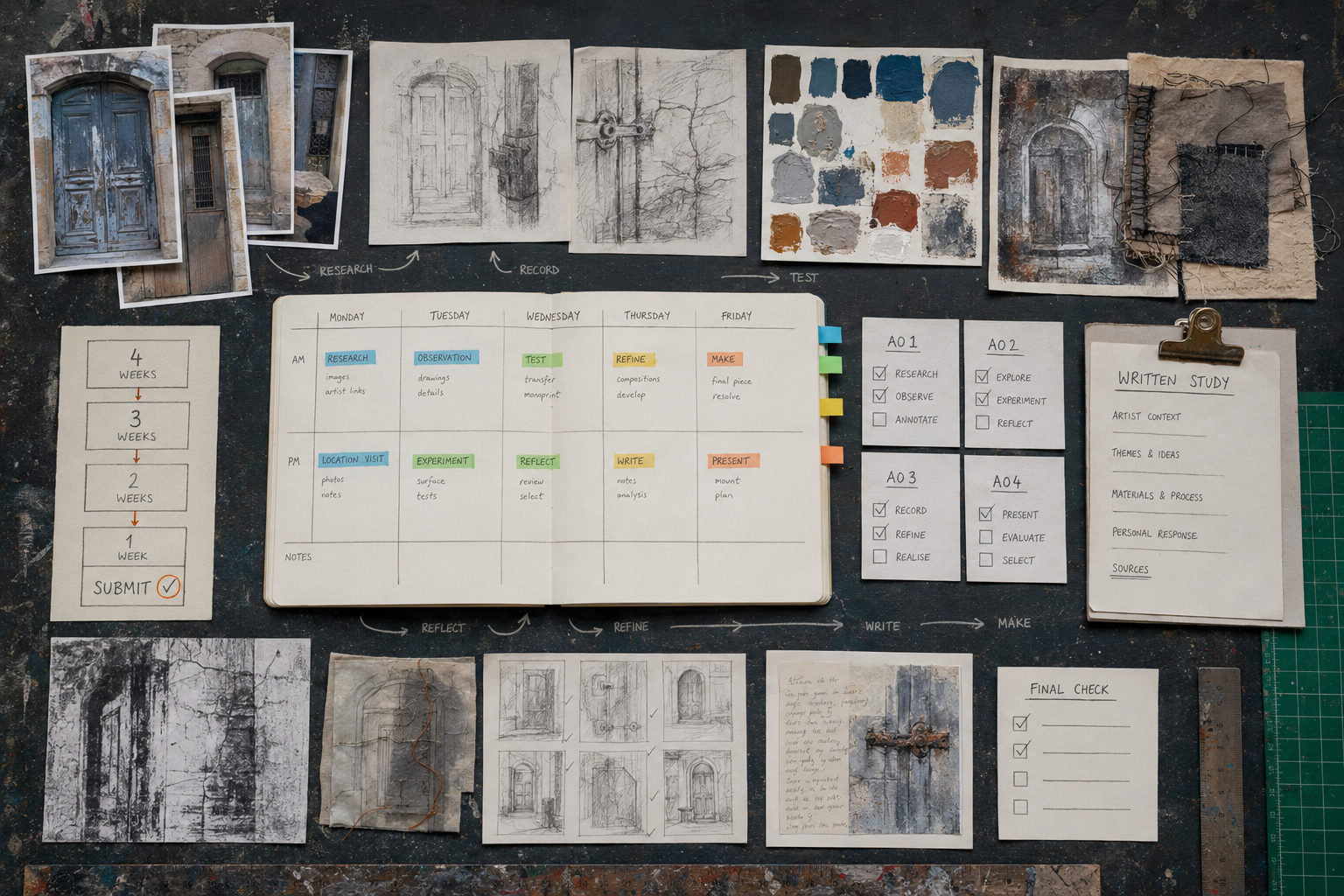
The Personal Investigation is the larger component and usually occupies much of Year 13. It should not be a collection of unrelated exercises. It is an in-depth enquiry with a clear thread connecting the starting point, contextual sources, first-hand recording, practical decisions, reflection and outcome.
- A personal focus: an idea, question, issue, concept, experience, place, theme or visual concern that can sustain investigation.
- Practical investigation: purposeful drawing, recording, making, testing, comparison and refinement.
- Contextual understanding: meaningful engagement with relevant artists, makers, movements, cultures, ideas and other sources.
- First-hand evidence: original photographs, drawings, observations, visits, objects, environments, interviews or experiences where appropriate.
- Development: visible changes in thinking rather than repetition of the first idea.
- One or more resolved outcomes: work that grows from and realises the developed intention.
- Extended writing: a related written element that demonstrates critical understanding and connects directly with the practical investigation.
- Source acknowledgement: a bibliography and clear identification of material that is not the student’s own.
The written requirement differs slightly by board. AQA specifies between 1,000 and 3,000 words of continuous prose. Pearson Edexcel, Cambridge OCR and Eduqas require a related study or extended written response of at least 1,000 words. Students must follow the precise format required by their centre.
The writing is not an unrelated art-history essay. It should help the student clarify the enquiry, analyse relevant sources, explain significant connections, question decisions and show how contextual understanding has informed practical development.
What happens in the Externally Set Assignment?
The awarding organisation issues a paper containing themes, questions, briefs or starting points. Students select one and produce preparatory work over a period determined by the centre. They then undertake 15 hours of supervised sustained focus.
The 15 hours are important, but the preparatory work is also assessed. The student should arrive at the supervised period having already investigated the starting point, collected first-hand evidence, studied relevant contexts, tested materials, compared alternatives, refined the intention and planned a realistic response.
The 15 hours are not the time to invent the response – A Level Fine Art Course
A strong student uses the supervised time to realise an informed plan while retaining enough flexibility to respond intelligently to the work as it develops. A weak plan often asks the student to solve composition, colour, scale, material behaviour and technical problems during the examination itself.
The four Assessment Objectives
Every piece of submitted work iin the A Level Fine Art Course s considered through four Assessment Objectives. Each objective contributes approximately 25% of the overall A Level. They are equally important, but they should not be treated as four separate chapters.
| Assessment Objective | What it assesses | What useful evidence might show |
|---|---|---|
| AO1: Develop | Sustained and focused investigation informed by contextual and other sources, with analytical and critical understanding. | Relevant artist research, gallery or site investigation, comparison, interpretation, developing ideas and evidence that sources change the student’s thinking. |
| AO2: Explore, select and refine | Exploration and selection of appropriate resources, media, materials, techniques and processes, with review and refinement as work develops. | Purposeful trials, comparison, technical learning, selection, rejection, combination, reshooting, remaking and increasingly controlled refinement. |
| AO3: Record and reflect | Recording ideas, observations and insights relevant to intentions, with critical reflection on work and progress. | First-hand drawing, photography, notes, diagrams, visual studies, contact sheets, plans, perceptive observations and reflection that directs a next step. |
| AO4: Present and realise | A personal and meaningful response that realises intentions and, where appropriate, connects visual and other elements. | Resolved work whose subject, visual language, materials, format, scale and presentation grow convincingly from the investigation. |
Read the detailed Portfolio to A Star guides to A Level Art AO1, A Level Art AO2, A Level Art AO3 and A Level Art AO4 for a closer explanation of each objective.
How are marks actually awarded?
Teachers do not normally award a fixed number of marks to every page or piece. They judge the evidence for each Assessment Objective across the component and use the awarding organisation’s assessment grid to decide which performance band best fits the work.
- Marks are awarded for visible evidence. Time spent, cost of materials and effort cannot be credited unless they result in assessable learning or achievement.
- Quality matters more than volume. Twenty repeated experiments may show less exploration than four well-chosen tests that are compared, evaluated and developed.
- Process and outcome both matter. A polished final piece cannot replace weak investigation; equally, extensive development does not excuse an outcome that fails to realise the intention.
- Consistency matters. High marks require convincing evidence across the project, not one excellent page surrounded by superficial work.
- Relevance matters. Evidence is stronger when it serves the enquiry. Unrelated artist pages and random material tests may add bulk without adding marks.
- Independence matters. A Level work should demonstrate the student’s own judgement, interpretation and direction.
- The objectives overlap. One purposeful activity can contribute evidence to several AOs at once.
Do all exam boards use the same number of marks?
No. The main awarding organisations use the same 60%/40% component balance and four equally weighted Assessment Objectives, but their raw mark totals differ.
| Awarding organisation | Personal Investigation | Externally Set Assignment | Important note |
|---|---|---|---|
| AQA | 96 raw marks; 60% | 96 raw marks; 40% | Each AO is marked out of 24 in each component; component marks are scaled to produce the 60/40 weighting. |
| Pearson Edexcel | 90 marks; 60% | 72 marks; 40% | The Personal Investigation includes practical/supporting work and a separately assessed personal study. |
| Cambridge OCR | 120 marks; 60% | 80 marks; 40% | Both components must be completed for the A Level award. |
| Eduqas | 120 marks; 60% | 80 marks; 40% | Each AO contributes 30 marks in Component 1 and 20 marks in Component 2. |
Raw totals should not be compared directly between boards. A mark of 70 has a different meaning when the component maximum is 96, 120 or 72. Students should use the assessment grid and grade-boundary information for their own awarding organisation.
What are the requirements to pass?
A Level grades run from A* to E. Grade E is the lowest passing grade; work below the required standard is unclassified. There is no permanent national percentage that always guarantees an E, C, A or A*. Grade boundaries can change from one examination series to another.
There is also no separate pass grade that must be achieved in every Assessment Objective. The final grade is based on the combined weighted total. However, because each AO is worth 25%, failing to provide meaningful evidence for one objective removes a large part of the available mark and makes success much more difficult.
In the A Level Fine Art Course, to be eligible for a complete result, a student should:
- Complete and submit the required assessed components.
- Address all four Assessment Objectives in both components.
- Include the required extended written element in the Personal Investigation.
- Complete the supervised element of the Externally Set Assignment under the centre’s rules.
- Present enough practical and supporting evidence for the work to be assessed.
- Identify and acknowledge secondary sources.
- Submit authentic work and follow all current awarding-organisation instructions.
- Achieve at least the grade E boundary for that examination series after component weighting.
Do not plan for a particular percentage
Past grade boundaries can provide context, but they are not promises about the next examination series. A safer strategy is to strengthen every AO, complete both components properly and work towards the highest performance descriptors available.
What might work at a bare-pass level look like?
There is no single “grade E style”, and only the awarding process can determine a grade. However, a minimally passing body of work is likely to contain enough relevant evidence to be credited while remaining limited, uneven or only partly developed.
- The theme is identifiable, but the investigation remains broad or predictable.
- Some artists or other sources are researched, but connections with the student’s work are simple or descriptive.
- Original photographs or drawings are present, although observation and selection may be inconsistent.
- A range of materials is attempted, but experiments are brief, repetitive or weakly evaluated.
- Ideas change slightly, but development may be driven by instructions rather than independent enquiry.
- Annotation describes what was done more often than explaining what was learned or what should happen next.
- Technical control is sufficient in places but unreliable across the component.
- A final response is completed, although it may resemble an enlarged experiment or only partly realise the intention.
- Presentation and organisation allow the journey to be followed, but important links or decisions may be unclear.
- Evidence for all four AOs exists, but its depth, consistency and independence are limited.
A bare pass is therefore not the same as “a poor drawing”. A student with modest technical confidence may still pass by presenting an authentic, complete and relevant investigation. Equally, a student who can paint skilfully may underachieve if the portfolio shows little research, exploration, reflection or personal development.
How does top-grade work differ?
Top-grade work is not merely the pass-level version with more pages, more artists and a larger final piece. It differs in the quality of thought, selection, connection, control and independence sustained across the component.
| Bare-pass or limited evidence | Top-grade evidence |
|---|---|
| A general theme such as “identity” is followed | The theme becomes a specific personal enquiry with a clear question, tension, context or purpose |
| Artist research reports facts and describes images | Contextual investigation analyses relevant decisions, compares viewpoints and materially changes the student’s direction |
| Experiments demonstrate different materials | Experiments test precise possibilities, expose limitations and lead to discriminating selection and repeated refinement |
| First-hand recording proves that photographs or drawings were made | Recording is perceptive, selective and used to discover visual, spatial, material or conceptual possibilities |
| Annotation states what happened | Reflection judges why it matters, identifies consequences and directs an intelligent next step |
| Development consists of variations | Development shows changed thinking, risk, comparison, rejection, synthesis and increasing coherence |
| Technique is sometimes controlled | Technical choices are assured, appropriate and sensitive to meaning; difficulty is managed rather than displayed for its own sake |
| The final piece is planned near the deadline | The response emerges through the enquiry and synthesises the strongest contextual, practical and observational discoveries |
| Influences remain easy to imitate or identify | Relevant principles are transformed into a visual language that belongs to the student |
| Strong pages alternate with rushed or decorative pages | Convincing evidence is sustained with consistency across the component |
| Presentation makes the work look tidy | Selection, sequencing, scale, spacing and display actively support meaning and assessment |
| The student completes assigned tasks | The student demonstrates curiosity, ownership, self-questioning and independent judgement |
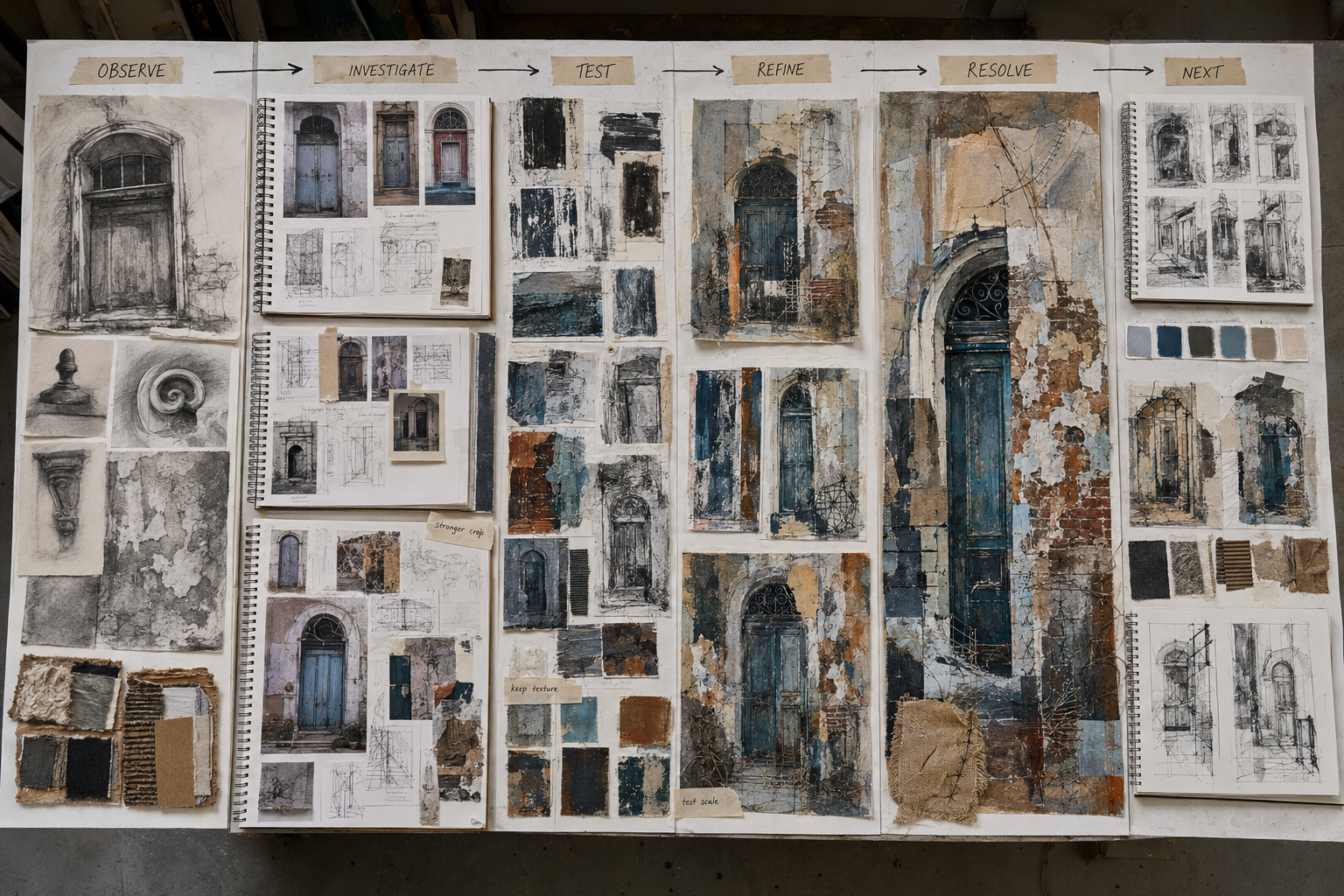
The most useful way to think about a top grade
A high-performing portfolio allows an examiner to answer four questions convincingly:
- Why did this investigation develop in this direction?
- What did the student discover through sources, observation and making?
- How did those discoveries change, refine or strengthen the work?
- Why is this response an appropriate, personal and meaningful conclusion?
If the portfolio makes those answers visible, the AOs are likely to be working together. If the answers exist only in the student’s head, they cannot be rewarded.
How much time should an A Level Fine Art student spend?
A Level Fine Art has a substantial workload. Timetabled lessons alone are rarely enough for ambitious practical work, reading, gallery research, photography, material preparation, annotation, editing and presentation. Independent studio time should be treated as part of the course rather than optional homework.
There is no universal weekly homework figure because timetables, materials and projects differ. A useful starting habit is to reserve several protected independent sessions each week and review the workload with the teacher. Two focused 90-minute sessions usually achieve more than an unfocused five-hour rush on Sunday evening.
| Type of time | Best use | Poor use |
|---|---|---|
| Lessons | Processes needing facilities, teacher feedback, technical demonstrations, critique and work that is difficult to complete at home | Spending most of the lesson choosing images, rewriting titles or deciding what to do |
| Independent studio blocks | Drawing, painting, making, editing, reshooting, testing, reading and sustained development | Switching repeatedly between small unrelated tasks |
| Short administration blocks | Printing, trimming, file naming, bibliography updates, photographing work and preparing materials | Allowing administration to consume the time reserved for creative development |
| Weekly review | Comparing evidence with intentions and AOs, choosing priorities and scheduling the next week | Producing a decorative “evaluation page” that does not affect future work |
| Holiday time | First-hand source gathering, visits, reading, photography and larger practical tasks | Leaving all written and practical work until the final days of the holiday |
Time management begins with a project map
Do not manage the course as a long list of pages. Manage it as a sequence of questions, decisions and deadlines. At the beginning of a project, create a one-page map containing:
- The current enquiry or working question
- The final submission date and interim deadlines
- Known holidays, visits, mock examinations and other subject deadlines
- First-hand sources that need to be collected
- Artists, exhibitions, texts or contexts worth investigating
- Processes requiring specialist equipment, drying time, booking or technical help
- Major practical experiments and decision points
- Written-study milestones
- Likely outcome-production time
- Time for photographing, editing, printing, mounting, sequencing and final checking
Work backwards from the submission date. Protect the final week for editing, documentation and unavoidable problems. Do not schedule the completion of the main outcome for the last available hour.

Use a weekly studio cycle
A repeatable weekly cycle prevents the project from drifting:
- Review: What changed last week? Which discovery matters most?
- Audit: Which AO is least convincingly evidenced at this point?
- Choose: Select no more than three meaningful priorities.
- Schedule: Put each task into a real time slot and prepare materials in advance.
- Make: Complete focused work without interrupting it to perfect presentation.
- Record: Photograph stages, preserve test results and note technical information immediately.
- Reflect: Compare results, identify the strongest evidence and state the consequence for the next step.
- Reset: File work, update the bibliography, back up digital material and prepare for the next session.
Turn vague tasks into finishable actions
| Vague task | Better planned action |
|---|---|
| Do artist research | Compare how two relevant artists use cropping and empty space; identify one principle to test in three original compositions |
| Work on sketchbook | Edit and print the six strongest first-hand photographs, then annotate why two will direct the next material test |
| Experiment with paint | Test glazing, scraping and opaque overpainting on the same observed detail; record drying time and compare which process best suggests erosion |
| Improve final idea | Make four thumbnail alternatives that vary scale, viewpoint and negative space; select one against three written success criteria |
| Write essay | Draft the 300-word comparison section using two cited sources and connect the conclusion to the current practical decision |
| Finish everything | Complete the AO audit, rank missing evidence by mark impact and schedule the three highest-priority actions |
Use time according to risk and value
Not every task deserves equal time. Prioritise work that either carries substantial assessment value or removes a serious risk.
- High value and urgent: missing first-hand recording, an unresolved technical problem, weak contextual connections, overdue written work or an untested final composition.
- High value but not urgent: sustained investigation, repeated refinement, gallery research, reading and building technical control. Schedule these before they become emergencies.
- Low value but urgent: routine printing, trimming and file management. Batch these tasks so that they do not consume studio time.
- Low value and not urgent: decorative headings, elaborate borders, rewriting neat copies of work already visible or making extra pages solely to increase thickness. Remove or postpone them.
When you are behind, do not start by making the sketchbook prettier
First identify which important evidence is absent or weak. A purposeful observational study, a decisive comparison, a targeted material test or a composition refinement may improve the assessment evidence far more than several hours spent on backgrounds, borders or rewritten headings.
How to organise the physical portfolio
The portfolio should make development easy to follow without forcing every project into a rigid formula. Organisation supports assessment when it reveals relationships, decisions and progress.
- Date work discreetly. Dates help the student and teacher understand sequence and identify periods of delay.
- Keep first-hand material. Preserve photographs, drawings, contact sheets, colour notes, objects, test prints and visual observations.
- Show alternatives together. Comparison is clearer when variations can be viewed side by side.
- Retain selected failures. Keep a failed test when it reveals learning and leads to a better decision; remove meaningless repetition.
- Connect annotation to evidence. Place reflection near the work it discusses rather than in a detached block several pages later.
- Use arrows and captions selectively. Make cause and effect visible without turning every spread into a diagram.
- Photograph three-dimensional or temporary work well. Include scale, detail, alternative viewpoints and context where relevant.
- Mount for clarity, not decoration. Presentation should protect, separate or relate work without overpowering it.
- Edit duplicates. Select the version that adds the clearest evidence instead of displaying every print or photograph.
- Create a contents record. Maintain a simple list of sketchbooks, sheets, canvases, objects, digital files and supporting studies.
How to organise digital work
Digital disorder wastes time and can erase valuable evidence. Use one consistent folder and filename system from the beginning.
| Folder | What it contains |
|---|---|
| 01_Project brief and planning | Starting point, working question, deadlines, project map and teacher guidance |
| 02_First-hand sources | Original photographs, scans, recordings, interview notes and location material |
| 03_Contextual sources | Research images, reading notes, source details and bibliography information |
| 04_Experiments | Scans and photographs of material tests, print stages, digital studies and process records |
| 05_Development | Compositional alternatives, edits, maquettes, studies, versions and refinements |
| 06_Outcomes | High-quality documentation of resolved work and presentation |
| 07_Written study | Plan, drafts, citations, image credits, bibliography and final version |
| 08_Submission copies | Final selected files exported in the formats required by the centre |
Use filenames that explain what the file is without opening it, for example: 2026-10-14-doorway-transfer-test-03.webp. Keep original camera files and editable working files as well as exported copies. Maintain at least one separate backup and check it regularly.
How to organise research and source information
- Record the creator, title, date, medium, location or collection and source URL when the source is first collected.
- Record the date on which an online source was accessed if required by the centre.
- Separate the student’s own photographs from downloaded reference material.
- Write brief research notes in the student’s own words.
- Use quotation marks for short direct quotations and identify the source.
- Keep a live bibliography rather than reconstructing it at the end.
- Investigate only sources that can inform the enquiry; do not collect artists simply to increase the apparent amount of research.
- Include exhibitions, artefacts, films, music, literature, architecture, social or historical contexts when they are genuinely relevant.
Manage the written study as part of the project
Writing becomes overwhelming when it is postponed until the practical work is almost complete. Build it in stages:
- Define the enquiry: write a provisional question that can connect contextual investigation with practical work.
- Gather credible sources: collect books, exhibition material, museum or gallery information and suitable online sources.
- Take analytical notes: record ideas in the student’s own words and preserve citation details immediately.
- Build a working argument: decide what the selected sources help the student understand, question or compare.
- Connect writing and making: after each major section, state how the analysis affects the practical investigation.
- Draft in sections: write manageable passages throughout the project rather than attempting the full study in one sitting.
- Review structure: remove biography or description that does not support the enquiry.
- Edit accurately: check clarity, specialist vocabulary, spelling, punctuation, citations, image credits and bibliography.
- Check board requirements: confirm word count and presentation rules before submission.
A practical system for monitoring AO1–AO4
Once each week or fortnight, use a simple red-amber-green audit. Judge the quality of evidence, not merely whether a task exists.
| Status | Meaning | Action |
|---|---|---|
| Red | Important evidence is absent, irrelevant or too superficial to support the current intention. | Schedule a focused action immediately and ask for precise teacher feedback. |
| Amber | Relevant evidence exists but needs greater depth, comparison, reflection, control or connection. | Refine or extend the strongest existing path rather than beginning another unrelated task. |
| Green | Evidence is relevant, convincing and clearly affects the development of the project. | Preserve it, connect it to later decisions and avoid repeating it without a new purpose. |
A useful audit asks:
- AO1: Which source has most changed my thinking, and can the examiner see how?
- AO2: What have I selected, rejected or refined, and what evidence justifies that decision?
- AO3: What have I discovered through first-hand recording and critical reflection?
- AO4: Is my response emerging logically from the enquiry, or am I planning a disconnected final piece?
How to use teacher feedback effectively
- Ask a precise question: “Which AO2 decision is least convincing?” is more useful than “Is this good?”
- Write the advice down during the discussion.
- Translate feedback into one or two visible actions with dates.
- Do not respond by adding text alone when the weakness is practical or visual.
- Return with evidence of how the advice was tested, not merely a statement that it was followed.
- Keep ownership of the enquiry. Feedback should sharpen the student’s judgement rather than replace it.
How to prepare for the 15-hour supervised period
- Make a realistic scale test or maquette.
- Resolve the main composition before the supervised period.
- Test the exact materials, surfaces, tools, printers, software or construction methods to be used.
- Measure drying, transfer, firing, rendering, exporting or assembly time where relevant.
- Prepare an hour-by-hour production plan with checkpoints.
- Identify which stages must happen first and which can overlap.
- Prepare permitted materials and organise them in working order.
- Plan how progress will be reviewed between sessions.
- Leave contingency time for technical problems and final presentation.
- Know the centre’s rules about preparatory material and what may be used during the supervised period.
| Before the 15 hours | During the 15 hours |
|---|---|
| Investigate, record, test, compare, decide and rehearse | Realise, monitor, adjust and complete the developed response |
| Resolve preventable technical uncertainty | Respond intelligently to the behaviour of the actual work |
| Plan scale, composition, sequence and materials | Protect the intention while making necessary refinements |
| Estimate the duration of every major stage | Use checkpoints to avoid spending too long on one area |
| Prepare a viable response rather than an overambitious fantasy | Complete enough to communicate the intention convincingly |
Common organisational mistakes
- Waiting for inspiration. Curiosity often develops through action, so schedule drawing, looking, reading and making.
- Measuring progress by pages. A full sketchbook can still contain weak evidence if the work is repetitive or disconnected.
- Researching artists after making the work. Context should inform decisions, not decorate completed pages.
- Testing too many media superficially. Breadth should lead to selection and depth.
- Keeping everything. Assessment presentation requires editing as well as production.
- Discarding every failure. A relevant failure can demonstrate insight when it causes a better decision.
- Leaving photography and documentation until the end. Temporary, large or three-dimensional work may be impossible to recreate.
- Ignoring the written element. The study is a formal course requirement, not an optional extra.
- Using lesson time for administration. Protect access to facilities and teacher expertise.
- Making an outcome too ambitious for the available hours. Unresolved scale does not earn more than a controlled, appropriate response.
- Adding annotation without acting on it. Reflection earns its value when it influences development.
- Allowing another subject’s deadline to erase Art time. Put all major deadlines on one calendar and adjust early.
- Relying on one storage location. Lost digital evidence cannot be assessed.
- Trying to repair everything in the final week. Regular AO audits prevent a last-minute reconstruction of the project.
A high-achieving student’s organisation routine
| When | Routine |
|---|---|
| At the start of each project | Create the project map, establish folders, record deadlines, identify first-hand sources and define the provisional enquiry. |
| Before each lesson | Choose the task, prepare references and materials, and decide what evidence or problem the session should address. |
| During practical work | Photograph important stages, label tests, record technical information and preserve alternatives. |
| At the end of each session | Write a short judgement: what worked, what did not, why it matters and what must happen next. |
| Each week | Review AO1–AO4, schedule independent studio blocks, update files and bibliography, and back up digital work. |
| At each project milestone | Lay out the work, remove repetition, identify gaps, compare progress with the intention and seek focused feedback. |
| Before submission | Check authenticity, citations, word count, component requirements, image quality, sequence, labels and the physical condition of work. |
A detailed self-checklist for the Personal Investigation
- My enquiry is specific enough to guide decisions but open enough to develop.
- The subject has genuine personal, visual, cultural, conceptual or material significance.
- I have collected substantial first-hand evidence.
- My contextual sources are relevant and varied rather than chosen for convenience.
- I analyse decisions and meanings instead of copying biography.
- Research has visibly affected my own work.
- I explore materials to answer questions rather than to fill pages.
- I compare results and identify limitations.
- I revisit and refine promising processes.
- My recording is purposeful, perceptive and relevant to intentions.
- Reflection changes what I do next.
- My ideas show genuine development rather than repeated variations.
- I can explain important selections and rejections.
- My technical skills are sufficiently controlled for the intention.
- My written study is directly connected to the practical enquiry.
- The writing meets my board’s length and format requirements.
- Quotations, images and secondary sources are acknowledged.
- The final response grows from the strongest discoveries in AO1–AO3.
- Scale, format, composition, materials and presentation have been tested.
- The response feels personal rather than teacher-led or imitative.
- The whole submission is edited, coherent and easy to assess.
A detailed self-checklist for the Externally Set Assignment
- I selected the starting point for its possibilities, not because the first idea seemed easy.
- I have interpreted the theme personally and specifically.
- I collected relevant first-hand sources early.
- I investigated contextual sources that genuinely inform the response.
- I tested more than one possible direction before committing.
- I explored and refined the exact materials and processes needed.
- I used critical reflection to select the strongest route.
- I rehearsed difficult technical stages.
- I tested the final scale, composition, format or sequence.
- I planned a response that can be resolved within 15 hours.
- I know the order and approximate duration of each stage.
- I included review checkpoints and contingency time.
- My preparatory work clearly supports the supervised response.
- I understand what materials may be brought into the supervised period.
- The response will remain personal, meaningful and connected to the investigation.
Frequently asked questions
Do I have to be excellent at realistic drawing to pass A Level Fine Art?
No. Drawing is important as a way of recording, investigating, thinking, planning and communicating, but Fine Art can include many approaches. Marks reward the four AOs, not one approved style of realistic drawing. Your recording and technical language must nevertheless be appropriate and sufficiently controlled for your intentions.
Is the final piece worth 25%?
Not in that simple sense. AO4 contributes 25% overall, but AO4 is not merely a beauty mark for one final piece. The personal response is judged in relation to the investigation, and resolved work may also show evidence of AO1, AO2 and AO3.
Can strong practical skill compensate for weak research?
Only to a limited extent. Technical accomplishment can strengthen evidence, but AO1 still carries 25% and the component is expected to show contextual understanding and development. A skilful but disconnected outcome is unlikely to access the highest marks.
How many artists should I research?
There is no magic number. Research enough relevant sources to challenge, deepen and develop the enquiry. Three artists studied analytically and connected meaningfully to practical work may be stronger than ten descriptive profiles.
How many sketchbook pages do I need?
No main awarding organisation awards the A Level by page count. The submission needs sufficient relevant evidence to demonstrate all four AOs convincingly. Page targets set by a centre can help pacing, but quality, depth, connection and independence determine the assessment value.
Can one activity count towards more than one AO?
Yes. A first-hand drawing informed by contextual research, tested through several processes, critically compared and developed into a response may contribute evidence to AO1, AO2, AO3 and AO4. The objectives describe aspects of a connected creative process, not separate folders.
Is an unfinished-looking artwork automatically low grade?
No. A response may deliberately use fragmentation, rawness, erasure or ambiguity. However, the decision must be purposeful and convincingly connected to the intention. Work that is simply incomplete because time ran out is different from work whose apparent incompleteness is controlled and meaningful.
What should I do first if I am falling behind?
Ask your teacher to help you identify the highest-impact weakness. Complete an AO audit, remove low-value decorative tasks, choose a small number of specific actions and schedule them. Strengthen the clearest existing direction rather than starting several new ones.
Are past grade boundaries a reliable target?
They show what happened in a previous examination series, but boundaries can change. They should not be converted into a permanent pass percentage. Use your current specification, assessment grid and teacher’s standardised judgement.
The key message
The best way to succeed in A Level Fine Art is to make the creative journey purposeful, visible and manageable.
Investigate something that can sustain your interest. Use contextual sources to change your thinking. Record first-hand with purpose. Explore materials to answer questions. Compare, select and refine. Reflect in ways that cause action. Organise evidence as you create it. Protect regular studio time. Then produce a personal response that could only have grown from your particular investigation.
Explore more A Level guidance
Visit the A Level Art Help for more help with planning, developing and presenting your portfolio.
Would detailed feedback help?
If you are unsure whether your portfolio provides convincing evidence across AO1–AO4, Portfolio to A Star can identify strengths, gaps and the most useful priorities for improvement.
Official specification sources
Course requirements and administrative guidance can be updated. Students and teachers should always check the current specification and instructions for their own awarding organisation.
- AQA A Level Art & Design (Fine Art): specification at a glance
- AQA A Level Art & Design (Fine Art): scheme of assessment
- Pearson Edexcel A Level Art & Design specification
- Cambridge OCR A Level Art & Design: specification at a glance
- Eduqas A Level Art & Design specification
- Ofqual: GCSE and A Level grading and changing grade boundaries