
Are you wondering how to get a Grade 9 or A* in GCSE or A-Level Art and Design? Many students work hard in their sketchbooks, yet feel stuck at a C or Grade 5. The key difference between an average portfolio and a top-tier project isn’t just natural drawing talent—it’s how clearly you demonstrate your thinking process across the four Assessment Objectives (AO1–AO4).
Below, we break down a real “Before and After” Portfolio Makeover so you can see exactly what examiners look for and how to fix a disconnected sketchbook.
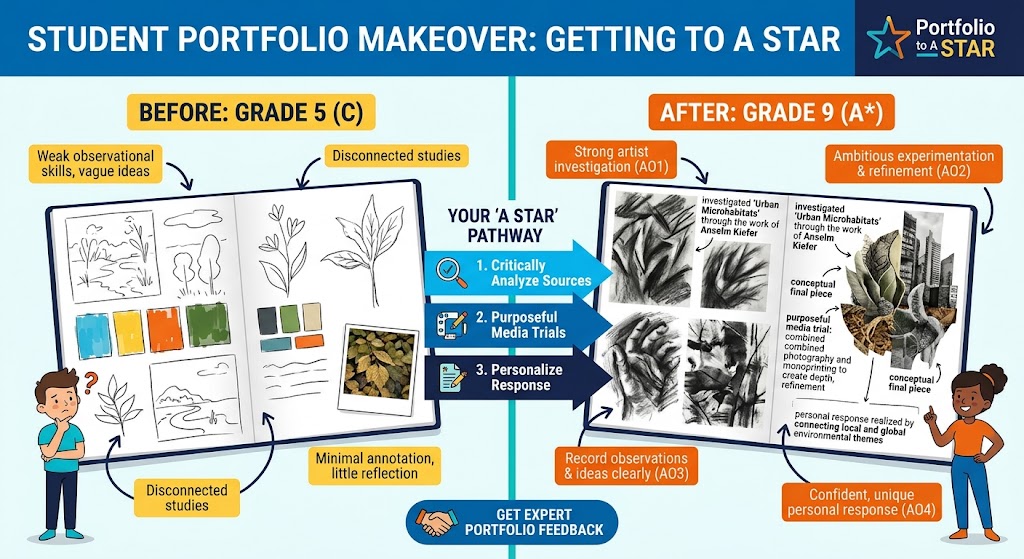
1. Stop Doing Disconnected Studies (AO1: Develop Ideas)
- The Common Mistake (Grade 5): Filling pages with random artist copies, isolated plant studies, or decorative title pages that don’t link to a central theme.
- The A* Fix: Treat your artist research as a launching pad. Don’t just copy an artist’s work—analyze their techniques and apply them directly to your own subject matter.
Top Tip: Always write 2–3 sentences explaining how an artist’s style inspired your next experiment.
2. Make Your Media Experiments Purposeful (AO2: Explore & Refine)
- The Common Mistake (Grade 5): Trying every medium in the cupboard (acrylic, watercolor, oil pastel, monoprinting) without refining any single technique or connecting them to your original idea.
- The A* Fix: Focus on purposeful media trials. Combine techniques with intent—such as overlaying monoprinting on photography to create rich textures and mood—and show clear progression from initial trials to refined samples.
3. Annotate Your Process & Reflections (AO3: Record & Reflect)
- The Common Mistake (Grade 5): Minimal annotation or purely descriptive sentences like “I painted this leaf with watercolor because I like the color.”
- The A* Fix: Record both visual observations and critical reflections. Explain why a technique worked, what failed, and how you will modify it in your next attempt. Examiners love to see problem-solving in real-time.
4. Connect Everything to a Personal Final Response (AO4: Present a Personal Response)
- The Common Mistake (Grade 5): Producing a final piece that appears completely out of nowhere and bears no visual link to the rest of your sketchbook.
- The A* Fix: Ensure your final artwork is a logical realization of all your prior research, experiments, and recordings. It should feel like the natural culmination of your entire creative journey.
Visual Summary: Portfolio Makeover Blueprint
| Assessment Objective | Grade 5 Approach | Grade 9 / A* Approach |
|---|---|---|
| AO1 (Ideas) | Unconnected studies, vague ideas | Critical analysis linked directly to theme |
| AO2 (Experimentation) | Random technique trials | Purposeful, refined media development |
| AO3 (Recording) | Minimal, descriptive annotation | Clear visual recording & reflective notes |
| AO4 (Response) | Sudden, unrelated final piece | Confident, personal, and connected response |
Want Professional Feedback on Your Art Portfolio?
If you are unsure where your sketchbook currently stands or need step-by-step guidance to reach your target grade, Portfolio to A Star is here to help. Created by an experienced Art & Design teacher with over 40 years of classroom expertise, our personalized portfolio reviews provide detailed strengths, priorities, and clear next steps tailored directly to your course.
No responses yet